- The paper introduces explicit closed-form formulas for enrichment functions, establishing a planar finite element elasticity complex with optimal approximation properties.
- It constructs C^1 potential spaces via Airy potentials, enabling direct computation and minimal local degrees for stable mixed finite element formulations.
- The approach simplifies global assembly by avoiding C^2 vertex conditions and compares favorably to conventional methods like the ADG and Arnold–Winther elements.
Explicit Finite Element Elasticity Complexes and C1 Elements on Planar Barycentric Refinements
Introduction and Context
This work addresses the constructive realization of the two-dimensional elasticity exact sequence for mixed finite element spaces tailored to plane elasticity on barycentric refinements. The paper makes explicit the sequence underpinning the Arnold--Douglas--Gupta (ADG) family of higher-order mixed elements, providing closed-form formulas for the associated enrichment functions previously only available algorithmically. By formulating explicit Airy potentials, this enables a completely concrete Hsieh--Clough--Tocher-type (C1) potential space whose image under the Airy operator exactly coincides with the ADG stress space. The main outcome is an explicit global finite element elasticity complex with optimal approximation properties, minimal local dimension, and straightforward computability, supporting quadratic and higher-order finite element constructions.
Construction of Stress and Potential Spaces
The finite element discretizations for plane elasticity require symmetric H(div)-conforming stress spaces and compatible displacement or potential spaces. The ADG construction provides Σk,hADG by enriching Pk(T;S) on barycentric refinements with three locally supported, divergence-free stresses, ensuring the polynomial character of the divergence over macro elements. The authors derive explicit symmetric enrichment functions ψi (for i=0,1,2), each supported on a macro triangle T and obtained in barycentric coordinates, satisfying divψi=0. These are shown to admit C1 potential functions C10 such that C11, with C12 the Airy (rotated Hessian) operator.
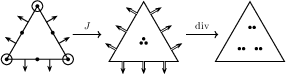
Figure 1: The lowest-order elasticity complex, C13--C14--C15, on a macrotriangle and its barycentric subdivision.
The element enrichment is verified to be direct, and unisolvence of the edge and interior moment degrees of freedom is proven. The global space C16 is assembled by enforcing continuity of normal fluxes on macro edges. These explicit basis constructions avoid the need for higher continuity in the scalar potential (such as the C17 at vertices of the Argyris element), thereby simplifying both implementation and assembly of global complexes.
Degrees of Freedom and Basis Construction
The associated C18 scalar potential spaces C19 are structured as H(div)0 plus the span of the three explicit potentials H(div)1. Degrees of freedom include function and gradient values at triangle vertices, edge moments (function and normal derivative), and select interior moments, designed to achieve precise unisolvence. A block lower triangular structure results in dof/basis systems, ensuring efficient computation and assembly.
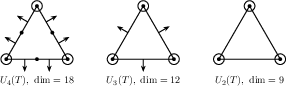
Figure 2: Degrees of freedom for the H(div)2 elements H(div)3, H(div)4, and H(div)5 (dimensions 18, 12, and 9, respectively).
The authors further offer explicit, dual local bases and clarify the hierarchical relationship between different polynomial degree elements, including H(div)6 (the cubic HCT) and its subspace H(div)7. The normal derivative conformity is obtained with the minimal additional enrichment (avoiding the extra vertex conditions present in the Argyris setup).
Geometrical Interpretation and Barycentric Refinement
The use of barycentric refinement introduces additional local structure, reflected in the geometric degrees of freedom and basis. The red lattice points of standard HCT elements cannot be assigned to two edges simultaneously; in this construction, the enrichment introduces blue lattice points that can, enabling the normal derivatives required for global H(div)8 conformity without auxiliary conditions.
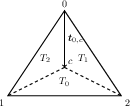
Figure 3: Barycentric refinement of a triangle used to realize explicit basis enrichment.
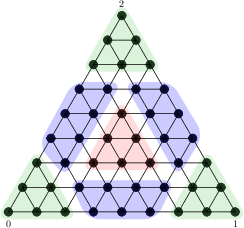
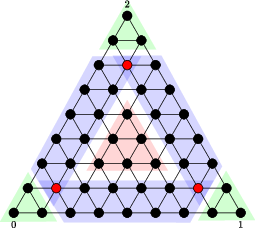
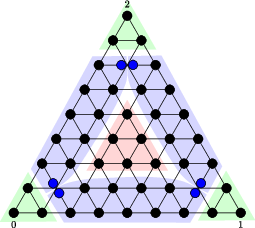
Figure 4: Duplicated lattice points (red) in refinement; their partitioning (blue) enables enough degrees of freedom for the normal derivative.
Exact Sequence and Commuting Diagram
The scalar potential, stress, and displacement spaces fit together into an exact finite element elasticity sequence:
H(div)9
with commuting interpolation operators. The lowest-order instance, Σk,hADG0--Σk,hADG1--Σk,hADG2, is fully explicit and minimal in local dimension, while the same framework scales to higher degrees.
The construction ensures that Σk,hADG3 and the associated inf-sup stability condition holds uniformly. The abstract Hilbert complex structure is mirrored discretely, and global quasi-interpolation operators are defined to respect the sequence and preserve commutativity, a crucial property for stability and convergence analysis in mixed formulations.
Comparison and Implications
This explicit realization combines the advantages of several approaches. Compared to the Arnold--Winther and Hu--Zhang elements, the new construction avoids Σk,hADG4 vertex requirements, instead only enforcing Σk,hADG5, and dispenses with global stabilization mechanisms of virtual element methods on triangles. In contrast to standard composite Σk,hADG6 elements, the enrichment is minimal: only three explicit shape functions are needed per macro element, yielding lower local dimension and considerably simplifying implementation.
The result is a family of Σk,hADG7 elements supporting direct calculation without recourse to computer algebra or stabilization, with immediate applications in conforming Σk,hADG8 and mixed Σk,hADG9-based discretizations for elasticity, biharmonic, and related PDEs.
Potential Extensions and Future Directions
The explicit recipe for constructing Pk(T;S)0 finite elements and an exact finite element elasticity complex can be extended to other mesh structures that admit similar enrichment mechanics. The authors' barycentric-mesh-specific strategy invites parallel developments for polygonal Pk(T;S)1 virtual elements, possibly leading to a serendipity family with reduced interior degrees of freedom. The general methodology—explicit enrichment for exactness, minimal unisolvence—could yield advances in hybrid-mixed, multi-physics, and high-order compatible finite elements, particularly where explicit expressions facilitate analysis and implementation.
Conclusion
The paper provides a full explicit construction of the ADG-type finite element elasticity complex on planar barycentric refinements, including closed formulas for local enrichment, explicit Pk(T;S)2 potential spaces, and practical global assembly strategies. The approach yields new, minimal-dimension, stable families of Pk(T;S)3 elements for elasticity, significantly clarifying the algebraic and geometric structure of these complexes and inviting further generalization to more involved mesh and domain types.

