- The paper presents a toolkit to detect spurious correlations by analyzing non-speech segments, thereby confirming the impact of recording artifacts on model performance.
- It employs multiple VAD systems and fixed-duration chunking to isolate non-verbal features, using a CNN classifier to reveal above-chance classification due to confounding biases.
- Empirical results on Alzheimer’s disease datasets show that audio enhancement alone cannot remove these biases, highlighting the need for rigorous VAD validation and artifact auditing.
Introduction
The detection of spurious correlations within speech datasets—particularly those curated under heterogeneous real-world conditions—remains a critical methodological challenge in computational paralinguistics and clinical speech processing. The paper "A Toolkit for Detecting Spurious Correlations in Speech Datasets" (2604.26676) provides a rigorous methodological and software framework to audit speech datasets for spurious associations between label classes and recording conditions using only the non-speech regions of waveforms. This approach is specifically intended for high-stakes voice analytics tasks, such as Alzheimer’s disease detection, where inadvertent exploitation of noise or channel artifacts by ML models undermines the validity of reported system performance.
Method
The proposed method employs a pipeline where features are extracted from VAD-delineated non-speech segments, concatenated, and chunked into fixed-duration overlapping windows. Chunks are used to train a binary classifier for the task label, and final scores for each waveform are obtained by averaging predictions across all corresponding chunks. Above-chance classification accuracy under this setup directly indicates the presence of spurious correlations between label and non-verbal acoustic signatures.
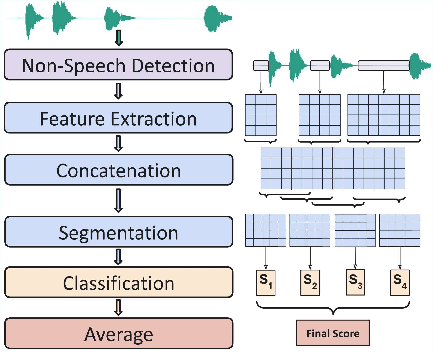
Figure 1: Schematic of the pipeline; feature extraction on non-speech regions, chunking, classification, and score aggregation.
The toolkit implements the following critical components:
- VAD Selection and Validation: Multiple state-of-the-art VADs (Silero, Pyannote, Whisper, TorchVAD, SpeechBrain) are supported, with quantitative assessment of speech leakage and missed non-speech rates. Iterative VAD and manual auditing routines minimize erroneous inclusion of speech.
- Feature Extraction: Emphasis on local features (MFCC, spectrogram) avoids encoding timing or duration information that could confound the analysis. Contextual features like W2V2 embeddings are examined but shown to be suboptimal for diagnosis.
- Chunking: Fixed-length chunking ensures no duration cues are available to the classifier, further mitigating the risk of using timing artifacts as shortcuts.
- Speech Enhancement: Integration of DeepFilterNet-based denoising and EBU R128 loudness normalization assesses whether enhancement removes class-dependent acoustic biases.
- Classification and Cross-Validation: A lightweight CNN-based classifier is trained and evaluated using robust cross-validation and bootstrapped CIs.
Empirical Evaluation
The toolkit is evaluated on two widely used Alzheimer's disease corpora: ADReSSo (English) and SpanishAD (Chilean Spanish), both collected in uncontrolled conditions and demonstrably affected by confounding factors in recording protocols. Classifier performance (AUC) is compared for (i) non-speech and (ii) speech regions, across several feature and preprocessing variants.
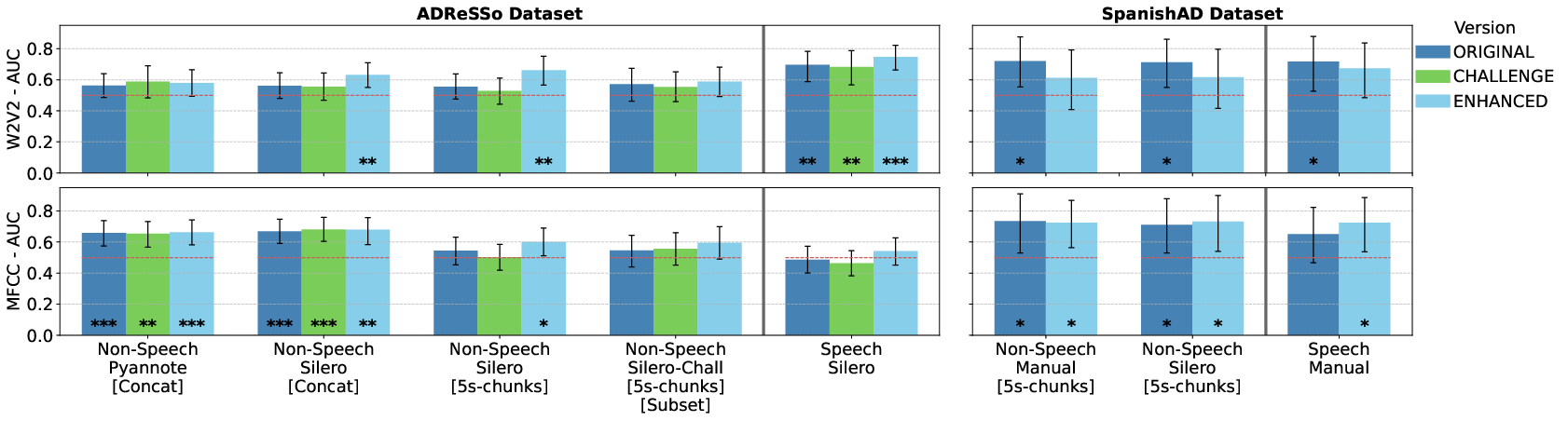
Figure 2: AUC scores on ADReSSo and SpanishAD datasets vs. baseline and enhanced audio, feature types (W2V2, MFCC), and region type (speech/non-speech).
Key findings include:
- Systems trained on raw or enhanced non-speech segments, especially using MFCC features, exhibit significantly above-chance discrimination of the target class (up to substantial AUC), even after resampling and denoising.
- AUC remains above chance for non-speech regions in SpanishAD, implicating class-conditional channel artifacts that persist post-enhancement—speech enhancement alone is insufficient to fully remove these correlations.
- Careful chunk-based processing reduces artifact-based classification to chance in some conditions, but enhanced samples suggest residual artifacts that allow limited above-chance discrimination.
- When rigorous manual VAD validation is applied (with discarding of segments with any speech leakage), classification drops to chance, confirming the necessity of precise VAD operation.
- W2V2 features do not confer a systematic advantage over MFCC for this task, likely due to their training regime and the diagnostic structure of the pipeline.
Theoretical and Practical Implications
These results validate the central assertion that strong performance on non-speech regions constitutes direct evidence of label–condition spurious correlations, especially prominent in clinical speech corpora collected under varying hardware, locales, or personnel. This diagnostic demonstrates that widely used real-world health datasets may systematically confound ML-based inferences of clinical state and that "denoising" approaches are not sufficient safeguards.
Crucially, the study identifies that system performance on internal splits of a corpus is not a reliable indicator of generalization, as shortcut cues embedded in recording artifacts may persist across both train/test partitions. The toolkit operationalizes a set of best practices—VAD auditing, feature selection, strict chunking—that must be adopted in future clinical voice studies to ensure analytic validity.
These findings urge adoption of:
- Rigorous artifact diagnosis in speech data preprocessing and reporting pipelines
- Metadata review and harmonization at data collection time
- Development of models and task definitions that explicitly ablate low-level acoustic cues unrelated to the target class
Future Directions
The toolkit lays the foundation for several methodological advances. Future research could extend artifact diagnosis to other classes of label–condition confounding (e.g., speaker ID, emotion, language ID), and develop adversarial data augmentation or robustification protocols informed by diagnosis results. Integrating this diagnostic at dataset curation time will directly mitigate risk of model failure on deployment in unseen environments. The automation of VAD selection and human-in-the-loop auditing steps may benefit from active learning or joint optimization strategies. Systematic benchmarking across broader public speech datasets will further catalogue typical sources and prevalence rates of spurious correlations in current practice.
Conclusion
This work delivers a validated, open-source toolkit and analytic protocol for diagnosing and quantifying spurious label–condition correlations in speech datasets using only non-speech segments. Empirical results show these correlations are pervasive even in state-of-the-art health datasets, are not reliably mitigated by audio enhancement, and can only be properly detected with rigorous methodological controls. Widespread toolkit adoption is necessary to raise the standard for artifact diagnosis in clinical and paralinguistic speech applications, directly informing future dataset collection, preprocessing, and trustworthy model development.

