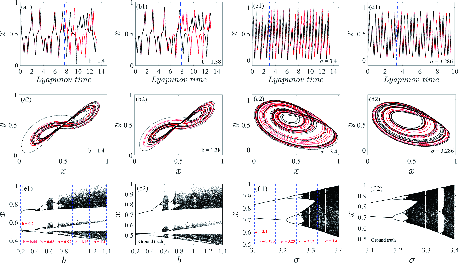
- The paper introduces a dual-channel RC model integrating system-label and parameter-control channels to infer bifurcation diagrams from sparse chaotic data.
- It accurately predicts short-term transients and reconstructs long-term attractors with deviation metrics below 0.4, outperforming earlier methods.
- Experimental validations on Lorenz, Rössler, and Chua circuits demonstrate the framework’s robustness and applicability to both simulated and physical noisy data.
Dual-Channel Reservoir Computing for Inference of Bifurcation Diagrams in Multiple Chaotic Systems
Introduction
This work presents a dual-channel reservoir computing (RC) architecture that integrates both multifunctionality and parameter-awareness, enabling a single reservoir computer to infer the dynamics and bifurcation diagrams of two distinct chaotic systems from partial observations (2604.26632). The proposed approach addresses several limitations in existing multifunctional RC (MFRC) and parameter-aware RC (PARC) frameworks, such as the inability of MFRC to reliably retrieve accurate attractors and the monofunctionality restriction in PARC. By augmenting the RC input layer with a system-label channel and a parameter-control channel, the new scheme allows state-specific control and disambiguation between fundamentally different dynamical systems.
Dual-Channel Reservoir Computing Architecture
The dual-channel RC comprises an input layer with three concatenated channels: (1) the system state vector, (2) a bifurcation parameter (specific to each dynamical regime), and (3) a binary-encoded system label to distinguish target systems. During training, time series from a small set of bifurcation parameter values for each system are concatenated and labeled accordingly. The reservoir network itself is a standard fixed recurrent architecture; only the output weights are trained via ridge regression, consistent with canonical RC methodology.
The training operates in open-loop mode, while inference and long-term generation are performed in closed-loop mode with the ability to switch target system and parameter by externally specifying the label and parameter-control channels. This fundamental separation of bifurcation parameter and system identity in the input is schematically summarized in Figure 1.
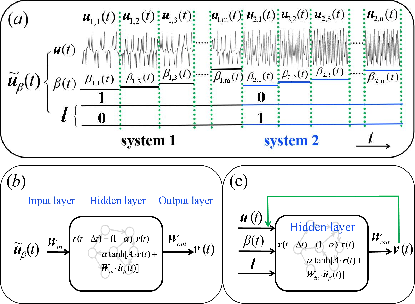
Figure 1: Dual-channel RC schematic: (a) data structure with bifurcation and label channels, (b) open-loop training, and (c) closed-loop inference/generation using externally specified parameters and labels.
Model Results: Inference of Lorenz and Rössler Systems
The model's inference capabilities were rigorously evaluated on the canonical Lorenz and Rössler systems, each parameterized by a bifurcation parameter (b for Lorenz, σ for Rössler). The RC was trained on time series from a limited set of sampled parameters for both systems and then validated on unseen parameter values.
The key results are:
This performance—reliable attractor generation and accurate bifurcation reconstruction from limited and non-overlapping training data—represents a substantial improvement over previous LAM-based MFRC schemes, which suffered from unreliable retrieval and distorted long-term dynamics.
Functional Network Analysis
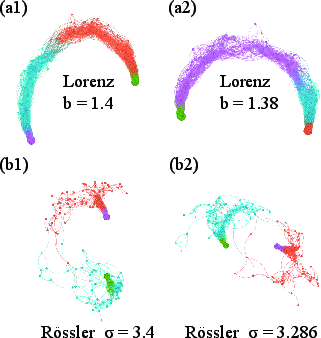
The internal mechanism of dynamical encoding in the reservoir was examined using functional network analysis, wherein correlation-based binary graphs are constructed from reservoir node activities during closed-loop inference.
Key findings include:
These results indicate that the system label acts as a primary control for reservoir attractor selection, while the bifurcation parameter fine-tunes quantitative behaviors within the selected dynamical regime.
Experimental Validation: Chua and Rössler Circuits
Experimental data from physical realizations of the Chua and Rössler circuits further confirmed the RC's applicability beyond simulated systems. The RC was trained on time series from a small subset of parameters for each circuit and tested on both seen and unseen parameter values under substantial observational noise.
Practical outcomes:
- The RC accurately predicted short-term transients and generated long-term attractors consistent with physical measurements for both sampled and unseen parameters.
- Bifurcation diagrams for both circuits were reconstructed solely from limited sampled data, exhibiting clear and artifact-free structures that reveal detailed bifurcation scenarios, often with higher clarity than direct experimental diagrams.
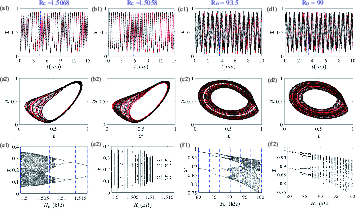
Figure 4: Dual-channel RC recovers short-term dynamics, strange attractors, and bifurcation diagrams for both Chua and Rössler circuits from noisy experimental data, for both sampled and unseen parameters.
Benchmarking versus separate, system-specific PARC machines demonstrated that the unified dual-channel RC matched the performance of specialized models while requiring only a single, jointly trained reservoir.
Implications, Limitations, and Future Directions
The demonstrated architecture combines multifunctionality (multiple system emulation via label control) with parameter awareness (continuous inference across bifurcation parameters), extending RC’s applicability to scenarios where models must adapt to heterogeneous and continuously varying dynamical regimes from limited or non-overlapping training data.
Theoretical implications include:
- The feasibility of building parameter- and system-modular RCs that generalize across bifurcation diagrams for diverse nonlinear systems.
- Functional network results suggest that RCs can self-organize high-dimensional codes that are selective to fundamental differences in attractor class, supporting modularity in physical reservoir implementations.
Practical implications span the compact deployment of RC-based digital twins for multi-regime physical systems, adaptive control across heterogeneous devices, and efficient bifurcation diagnosis using limited experimental sampling.
However, several open problems remain:
- The scheme’s scalability to more than two systems is analytically unexplored; degradation trends with increasing system diversity require quantification.
- Extension to systems with differing state-space dimensions is nontrivial and may necessitate advanced padding or embedding strategies.
- Quantitative evaluation of reconstructed bifurcation diagram fidelity and systematic analysis of functional network modulation by parameter control are open research questions.
Conclusion
The dual-channel reservoir computing framework enables reliable and accurate inference of bifurcation diagrams for multiple distinct chaotic systems using a single recurrent architecture. By integrating system-label and parameter-control channels, it fuses the strengths of MFRC and PARC, achieving both robust multifunctional retrieval and continuous parameter generalization. Theoretical and experimental validation support its potential for parsimonious yet high-capacity nonlinear dynamical inference. These results open new avenues for modular, adaptive RC-based architectures capable of supporting complex real-time inference in hybrid and uncertain dynamical environments.