- The paper introduces FunFace loss, which leverages both feature norm and certainty ratio to adapt training margins for improved face recognition.
- It integrates CR-FIQA to directly estimate biometric utility, yielding significant performance gains on low-quality face image benchmarks.
- Ablation studies confirm that optimal lambda mixing enhances robustness, outperforming static margin methods in challenging conditions.
FunFace: Feature Utility and Norm Estimation for Face Recognition
Introduction
The paper "FunFace: Feature Utility and Norm Estimation for Face Recognition" (2604.26598) proposes an adaptive margin loss function designed to improve robustness and accuracy in face recognition (FR) systems, especially under adverse conditions with low-quality imagery. The authors extend prior adaptive margin approaches by explicitly incorporating biometric utility, using FIQA techniques, into the loss function, augmenting the conventional feature norm heuristics. The main contribution centers on the FunFace loss, which synergistically combines feature norm and certainty ratio—serving as a proxy for biometric utility—to adapt the margin assigned to each training sample. Comparative evaluation with state-of-the-art methods demonstrates FunFace's superiority on low-quality benchmarks and parity on high-quality datasets.
Motivation and Background
Contemporary FR models rely increasingly on expressive loss functions to optimize for discriminative embeddings. Static margin methods such as ArcFace and CosFace, while effective, exhibit limitations in different quality domains due to their uniform treatment of samples. Adaptive margin functions (CurricularFace, MagFace, AdaFace, ElasticFace) allow for per-sample adjustment based on feature norm, which correlates loosely with image quality and recognizability. However, recent advances in FIQA emphasize biometric utility, measured by how well face images support recognition, as a more suitable metric than visual quality alone.
Empirical analysis reveals significant divergence between feature norm estimates and biometric utility, especially for low-quality face images. (Figure 1)
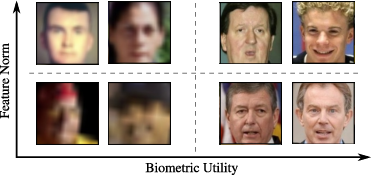
Figure 1: Feature norm and biometric utility estimates reveal a lack of one-to-one correspondence and highlight potential suboptimal guidance from feature norm alone.
Thus, there is value in directly integrating biometric utility into training objectives.
FunFace Loss Function Design
FunFace loss extends the AdaFace adaptive margin concept by combining normalized feature norm with the normalized certainty ratio (CR)—the latter computed via CR-FIQA [cr-fiqa] and tightly linked to the likelihood of correct classification. The CR is formulated as the ratio of angular similarity to the positive class to that of its nearest negative class center, stabilizing the metric for robust integration.
The adaptive margin function κ is defined as:
κ=λ⋅∥zi∥^+(1−λ)⋅∥CRi∥^
where λ is a mixing hyperparameter controlling the trade-off between visual quality (feature norm) and biometric utility (certainty ratio). The angular and additive margin terms are then functions of κ, as in AdaFace, but now explicitly incorporating utility, improving the loss's capability to focus the learning process on genuinely informative samples as opposed to merely visually appealing ones.
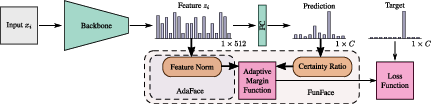
Figure 2: Overview of the FunFace loss: margin adapts via combined feature norm and certainty ratio, enriching angular separation according to utility.
Analysis of Quality Estimation Techniques
Benchmarking FIQA (e.g., CR-FIQA, eDifFIQA, CLIB-FIQA) against traditional IQA (e.g., BRISQUE) demonstrates that FIQA metrics better predict the recognition utility of face images, yielding improved error-versus-discard characteristics (EDC) and a lower false non-match rate when filtering samples. (Figure 3)
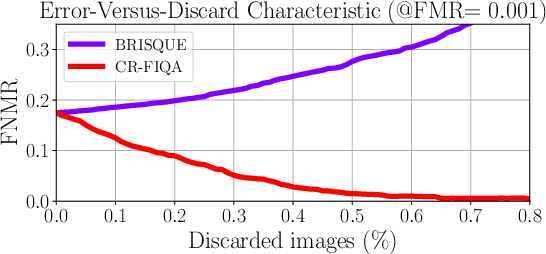
Figure 3: FIQA methods outperform IQA metrics in predicting utility for face recognition, as evidenced by superior EDC curves.
Comparative density maps between feature norm and FIQA utility scores illustrate non-linear, occasionally inverse, relationships in high-quality regimes, further underscoring the need for joint modeling in the margin adaptation process. (Figure 4)
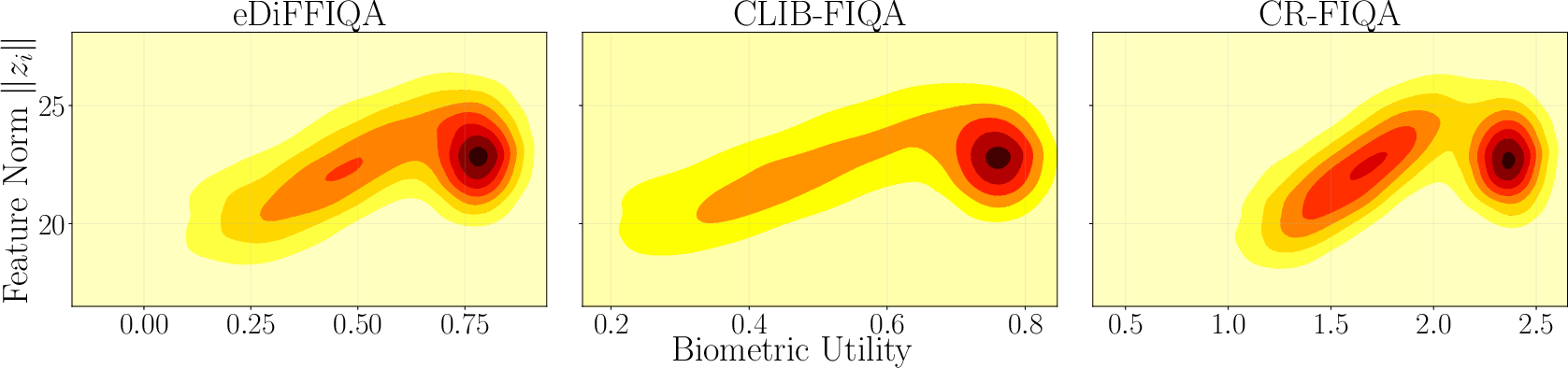
Figure 4: Non-linear relationship between feature norm and FIQA utility; high norm does not always guarantee high utility.
Gradients and Training Dynamics
The integration of CR modifies the gradient scale during training: early stages emphasize easier samples, while later stages focus on more difficult, boundary-adjacent embeddings. Detailed analysis visualizes how FunFace's margin application reconfigures the feature space, affecting the positive and negative decision boundaries dynamically over training epochs. (Figure 5)
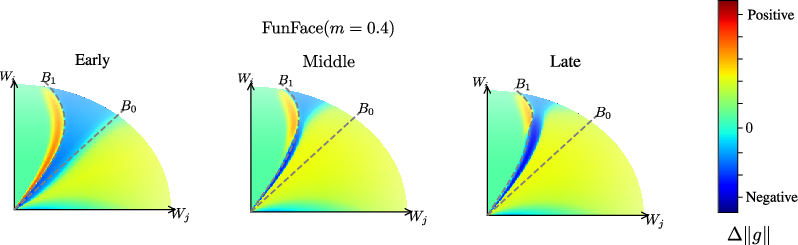
Figure 5: FunFace's gradient scaling changes the emphasis on samples throughout training, dynamically favoring boundary complexity.
Experimental Results
FunFace is robustly evaluated across a spectrum of benchmarks—ranging from easy (LFW, CFP-FP, AgeDB, etc.), medium (IJB-C), to challenging (TinyFace, DroneSURF, SurvFace). Results show:
- Comparable performance to AdaFace and other adaptive loss functions on high- and medium-quality datasets.
- Significant gains in low-quality scenarios, e.g., TinyFace, DroneSURF, SurvFace, with FunFace often achieving new state-of-the-art Rank-1, Rank-5, and TAR@FAR scores across all tested training datasets.
- The ablation study on λ confirms that optimal mixing yields performance improvements, but overemphasis on either norm or utility can diminish return, particularly in low-quality domains.
- Extended augmentations further increase FunFace's robustness to noise, occlusion, and other degradations.
Practical and Theoretical Implications
FunFace's explicit modeling of biometric utility addresses longstanding limitations of feature norm-centric adaptive loss functions. For real-world deployment in security and surveillance—where unconstrained, low-quality imagery is prevalent—this results in improved reliability and operational performance. The theoretical implication is a more nuanced understanding that discriminative embedding optimization should account for both perceptual and biometric quality metrics, not solely proxies for visual quality.
The increased computational cost of FunFace, due to CR estimation and negative neighbor search, is a practical consideration, but the benefits in performance justify potential efforts in algorithmic acceleration and parallelization.
Future Directions
- Continued optimization of time complexity and memory requirements.
- Exploration of additional biometric utility metrics beyond CR-FIQA, including unsupervised or semi-supervised variants.
- Application of FunFace in multimodal biometric systems and adaptation to transformer-based FR models.
- Deeper investigation into fairness, bias mitigation, and cross-demographic utility estimation.
Conclusion
FunFace demonstrates that margin adaptation based on both feature norm and biometric utility yields substantial improvements for face recognition in challenging, unconstrained settings. The approach advances adaptive loss function design by moving beyond solely visual quality proxies, and its quantitative effectiveness, particularly in low-quality domains, positions it as an important extension for future FR research and deployment. Limitations regarding runtime and augmentation dependencies remain fertile ground for further study.