- The paper establishes that reservoir-mediated coupling induces significant spin entanglement in the mean-force Gibbs state, revealing a non-monotonic dependence on coupling strength.
- It employs perturbative methods in both weak-coupling and narrow spectral density regimes to derive analytic corrections, quantifying entanglement via negativity.
- The findings indicate that spectral broadening and qubit detuning critically impact equilibrium coherence, providing benchmarks for quantum networks and simulation platforms.
Introduction and Motivation
This paper addresses the equilibrium entanglement between two qubits strongly coupled to a common bosonic reservoir, focusing on the consequences of such coupling within the framework of the mean-force Gibbs (MFG) state. Contrary to the conventional paradigm where coupling to a thermal reservoir leads to decoherence, the strong-coupling regime fundamentally modifies both the dynamic and equilibrium properties of the system, generating nontrivial coherences and correlations. The authors present a rigorous analytic solution for two coupled qubits, demonstrating the structure and degree of entanglement produced by reservoir-mediated correlations, and examine how this entanglement depends on parameters such as reservoir spectral density, temperature, system-reservoir coupling strength, and qubit detuning.
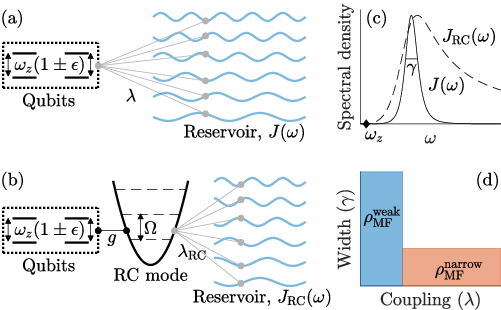
Figure 1: Schematic of the two-qubit spin-boson model, with level spacings ωz(1±ϵ), coupled to a bosonic reservoir with spectral density J(ω) and coupling strength λ; reaction coordinate mapping shown in panel (b).
Theoretical Framework and Analytic Derivation
The study relies on the spin-boson model extended to two qubits, formulating the total Hamiltonian as a sum of the system, reservoir, and coupling terms. The equilibrium state is obtained by tracing out the bosonic modes, resulting in the MFG state:
ρMF=Z1TrR[e−βH^tot]
where H^tot encodes the system Hamiltonian, reservoir Hamiltonian, and interaction.
The analytic solution proceeds via two perturbative expansions:
- Weak coupling (λ2): Derivation yields explicit corrections to the standard Gibbs state, including both single-particle and two-qubit correlation terms. The resulting density matrix contains coefficients dependent on temperature, coupling, and the reservoir spectral function.
- Narrow spectral density (γ): Exploits reaction coordinate mapping, where the qubits couple to a single bosonic mode (the reaction coordinate), which itself is coupled to a residual reservoir. The effective Hamiltonian approach leads to an MFG state valid in the limit of small spectral width, and accounts for spectral broadening corrections perturbatively.
These results generalize to N qubits in the weak-coupling limit, providing a hierarchy of corrections that recover the Gibbs state for vanishing coupling.
Numerical Results: Entanglement Behavior
The paper quantifies entanglement using the negativity, an entanglement monotone that is both necessary and sufficient for two-qubit entanglement. The analysis reveals several prominent features:
- Non-monotonic dependence on coupling strength: Entanglement, while maximal at low temperatures, exhibits a peak at finite system-reservoir coupling. Strong coupling induces both beneficial reservoir-mediated correlations and detrimental mixing with bosonic modes, leading to depurification.
- Enhancement by spectral broadening: Increasing the reservoir spectral width (γ) amplifies entanglement up to a critical point, after which further broadening suppresses correlations.
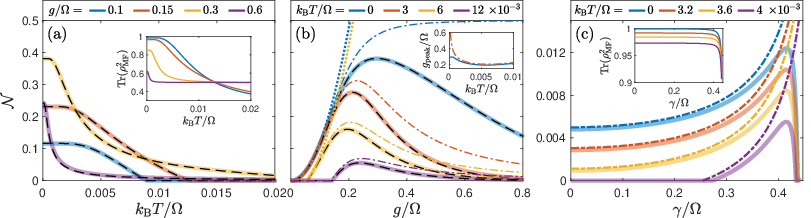
Figure 2: Entanglement versus temperature and coupling strength for single-mode and broadened reservoirs; entanglement enhancement quantified with negativity N.
- Role of qubit detuning and asymmetry: Entanglement is maximized for identical qubits (J(ω)0), especially when qubit level spacings are off-resonant from the reservoir peak. Increasing asymmetry or level spacing reduces the robustness to thermal fluctuations, ultimately suppressing entanglement.
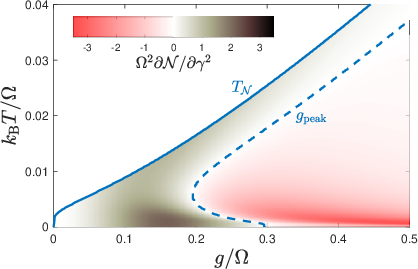
Figure 3: Perturbative effect of spectral density broadening in strong coupling regime; regions of entanglement enhancement versus suppression indicated by J(ω)1.
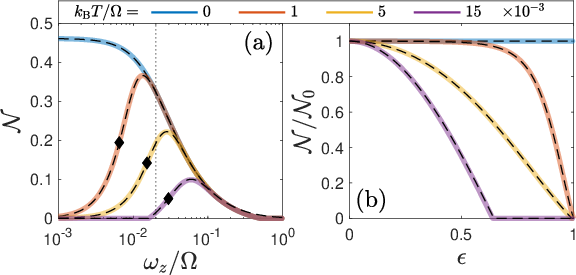
Figure 4: Negativity as a function of qubit level spacing and asymmetry; diamonds indicate the threshold where the excitation gap matches the thermal energy.
Physical Implications and Comparisons
The findings highlight that reservoir-mediated entanglement is fundamentally distinct from direct qubit-qubit interaction schemes. The purity and entanglement in the MFG state decrease at high coupling due to coherent mixing with environmental modes; this behavior departs from thermal-state entanglement in directly interacting qubits, which is strictly monotonic with interaction strength.
The spectral structure of the reservoir is crucial: broadening yields higher reorganization energies and more efficient mediation of correlations, but only up to the regime where strong coupling begins to dominate the dynamics. Beyond the perturbative regime, further enhancements could be explored numerically via reaction coordinate mapping, hierarchical equations of motion, or density-matrix renormalization group methods.
The analytic solutions here establish a precise benchmark for future numerical studies of multi-qubit open quantum systems, enabling direct comparison and model validation.
Future Directions and Challenges
The paper's analytic framework facilitates extension to larger systems and more complex spectral environments, e.g., spatially separated qubits or non-local entanglement mechanisms. Exploring the link between reservoir engineering and entanglement harvesting has implications for quantum networks, quantum information protocols, and impurity physics in many-body systems.
Experimental advances in engineered baths, quantum simulation platforms, and circuit QED provide fertile grounds for testing these predictions. Open questions concern how entanglement scales with qubit number and distance, and how non-Markovian or strong non-equilibrium effects modify the MFG state structure.
Conclusion
This work rigorously characterizes equilibrium entanglement between two qubits in the strong-coupling regime, mediated by a bosonic reservoir and quantified within the mean-force Gibbs state paradigm. Analytic expressions derived for both weak coupling and narrow reservoir spectral density allow systematic exploration of parameter dependencies, revealing non-monotonic behavior and spectral broadening-induced enhancement of entanglement. The results establish a benchmark for equilibrium open-system entanglement and constitute a foundation for further theoretical and experimental investigations in quantum thermodynamics and engineered quantum environments (2604.26562).

