The Fock-Darwin-Darboux system: eigenstates, information entropies and dispersion-like measures
Published 29 Apr 2026 in quant-ph and math-ph | (2604.26466v1)
Abstract: The Fock-Darwin (FD) quantum system describes the motion on the plane of a charged particle under the action of an isotropic oscillator potential together with a perpendicular constant magnetic field. When the isotropic oscillator is suppressed, the FD system leads to the Landau Hamiltonian with infinitely degenerate Landau levels. The Fock-Darwin-Darboux (FDD) system is the generalisation of the FD system to a particle moving on the Darboux III space, which is a conformally flat surface with non-constant negative curvature. We present a systematic study of some information-theoretic entropy and dispersion-like measures for these quantum systems. Since both systems are exactly solvable, analytical expressions for Shannon, Rényi and Tsallis entropies, among others, can be obtained. We show that for the FD system, its information-theoretic measures are formally the same as the ones for the harmonic oscillator, provided a modified effective frequency depending on the magnetic field is introduced. In the FDD case, the nonlinear nature of the underlying manifold precludes the existence of a simple closed form for the wave-function on momentum space, which is numerically analysed. We compare the numerical behaviour of the different entropy measures and we analyse the interplay arising in the FDD system between the curvature parameter and the magnetic field. In particular, it is shown that the Landau system on the Darboux III space has no infinitely degenerate Landau levels.
The paper establishes that embedding the FD oscillator in the Darboux III surface yields a tunable, exactly solvable quantum system with distinctive spectral properties.
Analytic and numerical methods provide closed-form expressions and detailed insights into information entropies and dispersion measures, highlighting inverse localization trends.
The study reveals that curvature and magnetic field effects uniquely modify degeneracy and uncertainty relations, preventing full recovery of flat-space observables.
The Fock-Darwin-Darboux Quantum System: Spectral Properties, Information Entropies, and Dispersion Measures
Introduction
The Fock-Darwin-Darboux (FDD) system generalizes the Fock-Darwin (FD) quantum oscillator by embedding it in the Darboux III surface—a two-dimensional manifold with nonconstant negative curvature. This construction incorporates a nonlinear geometric deformation (parameterized by λ) alongside the conventional harmonic confinement (frequency ω) and perpendicular magnetic field (Larmor frequency ωc), yielding a three-parameter family of exactly-solvable quantum Hamiltonians with tunable curvature, field, and trapping strength. These systems not only extend the exact solvable spectrum and superintegrable phenomenology of the standard FD and Landau problems but also serve as analytic test beds for quantum information-theoretic measures such as Shannon, Rényi, and Tsallis entropies. This essay reviews the principal technical contributions in the systematic analysis of spectral data, information entropies, and dispersion-like observables for both FD and FDD systems, emphasizing rigorous analytic and numerical findings, as well as the implications for entropic uncertainty relations and degeneracy-breaking mechanisms in curved geometries.
Fock-Darwin System: Spectral Structure and Information-Theoretic Measures
The FD system models a charged particle in a 2D plane subjected to an isotropic harmonic potential and a constant perpendicular magnetic field. Choosing natural units (m=ℏ=1), the Hamiltonian is
HFD=21(p^x2+p^y2)+21ωt2(x^2+y^2)−ωcL^z
with total frequency ωt=ω2+ωc2 and L^z the angular momentum. The eigenstates and energies are
En,mωc=ωt(2n+∣m∣+1)−mωc
with n∈N0, m∈Z. The spectrum exhibits isolated degeneracy loci determined by rational values of ω0, and infinite degeneracy in the Landau limit (ω1, ω2).
Both position-space and momentum-space wavefunctions are explicit analytic (Laguerre-Gauss form), enabling closed-form evaluation of Shannon, Rényi, and Tsallis entropies, as well as all moments and dispersion quantities, up to integrating products of Laguerre polynomials.
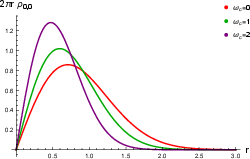
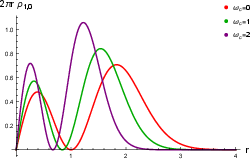
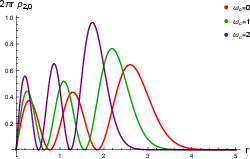
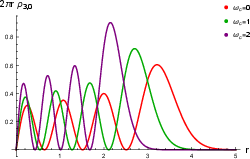
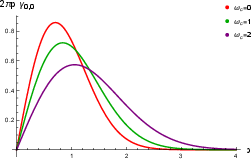
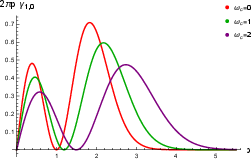
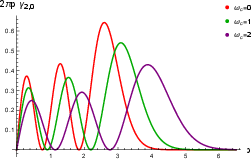
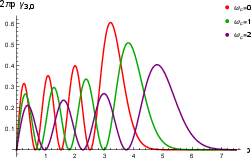
Figure 1: Probability density of the FD system in position space for ground and excited states, illustrating increased localization for higher ω3.
Figure 2: Radial momentum-space probability densities for FD; delocalization grows with increasing ω4.
A salient point is that the FD information-theoretic entropies are parametrically identical to those of the 2D harmonic oscillator, with ω5 replaced by ω6. Hence, all functional dependencies of Shannon, Rényi, and Tsallis entropies as well as uncertainty products are inherited, preserving the saturation of entropy- and dispersion-based uncertainty relations for ω7. Notably, the entropic and dispersion measures are independent of the magnetic field when considering the sum or product, underscoring the persistence of oscillator symmetry in the flat setting.
Darboux III Geometry and the Fock-Darwin-Darboux System
The Darboux III surface is characterized by the metric
ω8
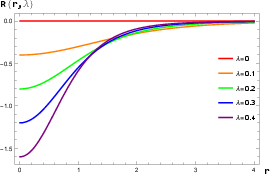
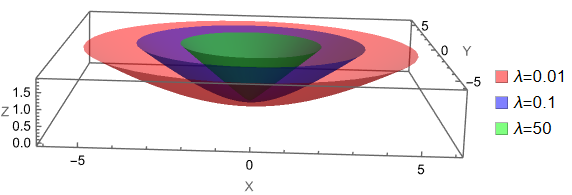
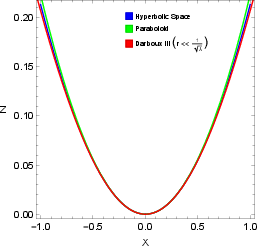
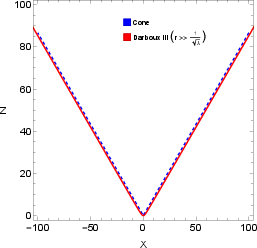
yielding a negative, spatially-varying scalar curvature ω9. This curved background interpolates between a constant-curvature hyperboloid near ωc0 and asymptotically flat geometry at large ωc1.
Figure 3: Scalar curvature ωc2 as a function of radius for several ωc3; curvature is largest at the origin and decays rapidly.
Figure 4: Embedding visualization of the Darboux III surface in ωc4; surface morphs between hyperbolic near ωc5 and conic at infinity as ωc6 varies.
The FDD Hamiltonian is then
ωc7
and is exactly solvable. The discrete spectrum is given implicit energy-dependent frequency, with eigenvalues
ωc8
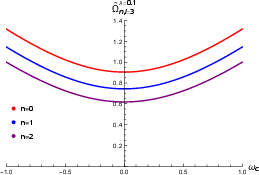
and effective frequency for the eigenmodes: ωc9
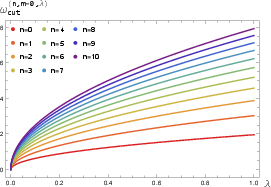
The position-space wavefunctions retain the generalized Laguerre structure with curvature-deformed measure. Degeneracy properties diverge dramatically from the FD case: except for fine-tuned values traced by parabolic curves in m=ℏ=10 or m=ℏ=11 parameter space, all levels are non-degenerate. In the Landau-Darboux (m=ℏ=12) regime, no infinite degeneracy persists for m=ℏ=13.
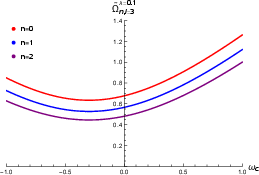
Figure 5: (A) Effective frequency m=ℏ=14 and (B) energy spectrum m=ℏ=15 as functions of m=ℏ=16 for different m=ℏ=17 and excitation numbers.
Information Entropies and their Dependencies in the FDD System
For the FDD system, position-space Shannon, Rényi, and Tsallis entropies follow from explicit integrals over the curvature-deformed probability density. Closed analytic forms are obtained for the position space, parameterized by m=ℏ=18 and m=ℏ=19, with sums over hypergeometric (Lauricella) functions tied to Laguerre polynomial integrals.
In contrast to the FD case, the momentum-space probabilities lack analytic tractability due to the nontrivial Fourier-Hankel transform over the manifold, hence all momentum-space entropy results require numerical integration.
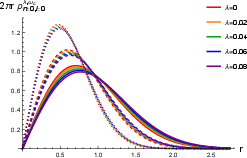
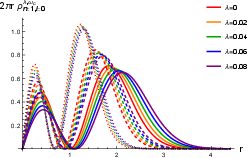
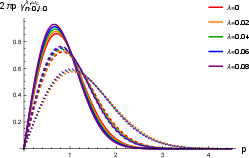
Figure 6: FDD probability densities in position space (HFD=21(p^x2+p^y2)+21ωt2(x^2+y^2)−ωcL^z0) for varying HFD=21(p^x2+p^y2)+21ωt2(x^2+y^2)−ωcL^z1 and HFD=21(p^x2+p^y2)+21ωt2(x^2+y^2)−ωcL^z2, exhibiting delocalization with curvature but localization with field.
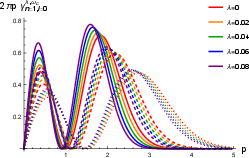
Figure 7: FDD probability densities in momentum space (HFD=21(p^x2+p^y2)+21ωt2(x^2+y^2)−ωcL^z3), showing reciprocal localization trends to the position space.
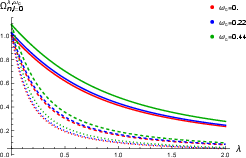
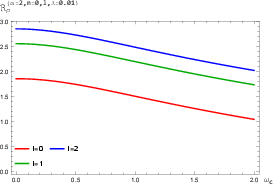
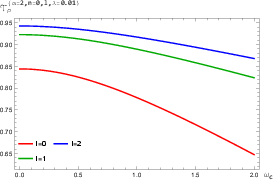
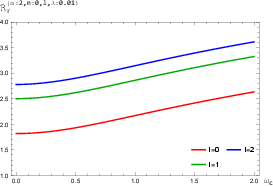
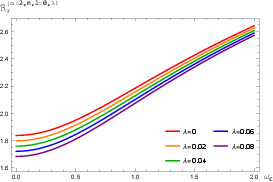
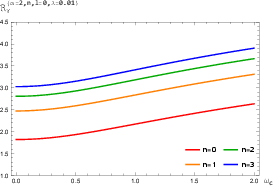
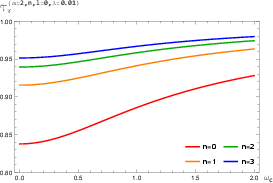
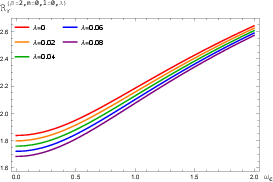
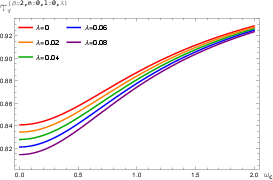
Figure 8: Rényi (A) and Tsallis (B) entropies in position space for low quantum number states, as a function of HFD=21(p^x2+p^y2)+21ωt2(x^2+y^2)−ωcL^z4 and HFD=21(p^x2+p^y2)+21ωt2(x^2+y^2)−ωcL^z5.
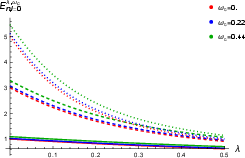
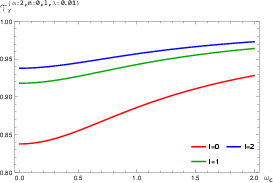
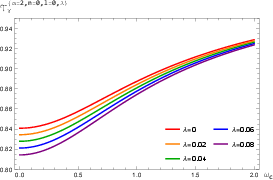
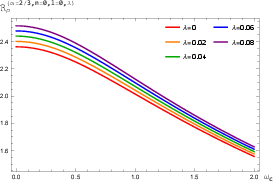
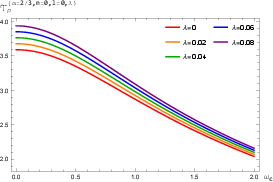
Figure 9: Equivalent entropies in momentum space, increasing with HFD=21(p^x2+p^y2)+21ωt2(x^2+y^2)−ωcL^z6 and HFD=21(p^x2+p^y2)+21ωt2(x^2+y^2)−ωcL^z7 for fixed HFD=21(p^x2+p^y2)+21ωt2(x^2+y^2)−ωcL^z8.
The analytical and numerical results reveal that:
In position space: Rényi and Tsallis entropies increase with HFD=21(p^x2+p^y2)+21ωt2(x^2+y^2)−ωcL^z9 (curvature) and decrease with ωt=ω2+ωc20 (magnetic field), consistent with curvature-induced delocalization and field-induced confinement.
In momentum space: Entropies decrease with ωt=ω2+ωc21 and increase with ωt=ω2+ωc22, inverting the position-space trend; this is a direct consequence of reciprocal uncertainty spreading in the conjugate variables.
Quantum number dependence: Both ωt=ω2+ωc23 (radial excitation) and ωt=ω2+ωc24 (angular momentum) enhance entropies in both spaces—higher states are more delocalized and complex.
Figure 10: Momentum-space Rényi and Tsallis entropies for ωt=ω2+ωc25 with varying ωt=ω2+ωc26 (A,B) and for various ωt=ω2+ωc27 at fixed ωt=ω2+ωc28 (C,D); sharp increase with ωt=ω2+ωc29, decrease with L^z0.
Generalizations of the Bialynicki-Birula entropic uncertainty relations are numerically verified; ground states never violate the inequalities, and comparison with the FD limit illustrates saturation only occurs as L^z1, i.e., when curvature is negligible.
Figure 11: Rényi/Tsallis entropies in position and momentum spaces as functions of L^z2 and L^z3, including associated uncertainty relation residuals; approach to zero with large field or vanishing curvature.
Dispersion-Like Measures and Uncertainty Products
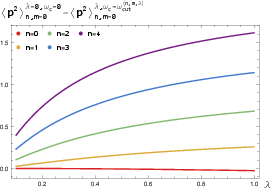
The moments L^z4 and L^z5 are derived analytically for the FDD system, with expressions involving hypergeometric sums over Laguerre mode indices. For increasing curvature (L^z6), L^z7 increases (spatial spreading), and L^z8 decreases (momentum localization). The field L^z9 exerts the opposite effect.
(Figure 12, Figure 13)
Figure 12: Expectation value En,mωc=ωt(2n+∣m∣+1)−mωc0 versus En,mωc=ωt(2n+∣m∣+1)−mωc1 for ground state and first excited state, for various En,mωc=ωt(2n+∣m∣+1)−mωc2; spatial delocalization accelerates with curvature.
Figure 13: En,mωc=ωt(2n+∣m∣+1)−mωc3 for various En,mωc=ωt(2n+∣m∣+1)−mωc4 and En,mωc=ωt(2n+∣m∣+1)−mωc5, confirming monotonic growth with both.
(Figure 14, Figure 15)
Figure 14: Expectation value En,mωc=ωt(2n+∣m∣+1)−mωc6 versus En,mωc=ωt(2n+∣m∣+1)−mωc7; higher En,mωc=ωt(2n+∣m∣+1)−mωc8 suppresses kinetic content.
Figure 15: En,mωc=ωt(2n+∣m∣+1)−mωc9 for various n∈N00 and n∈N01; confirmed monotonicity.
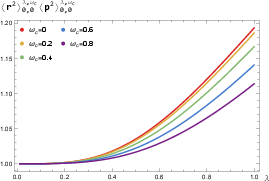
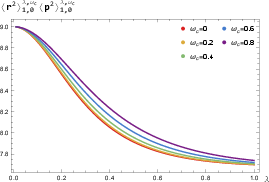
Dispersion-based uncertainty products n∈N02 are found to increase with n∈N03 for the ground state and decrease for most excited states. The FD oscillator's minimal (saturated) uncertainty is always recovered as n∈N04, independent of n∈N05.
Figure 16: Dispersion-based uncertainty product for ground and first excited state versus n∈N06, for various field strengths.
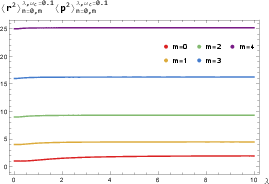
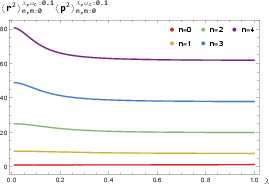
Figure 17: Dependence of the uncertainty product on n∈N07 (A) and n∈N08 (B) for n∈N09 and m∈Z0, respectively.
Interplay and Non-Cancellation Between Curvature and Magnetic Field
A central claim, supported analytically and numerically, is that curvature-induced and field-induced localizations are fundamentally non-cancelling across all observables. Specifically:
It is impossible to choose values of m∈Z1 such that all entropic or dispersion quantities match those of the oscillator (FD) for both position and momentum spaces.
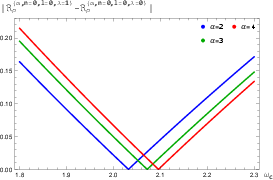
For selected observables (e.g., m∈Z2), one can identify a unique m∈Z3 for a given m∈Z4 at which that observable matches the flat-space, zero-field value, but this does not extend to, e.g., m∈Z5 or information entropies.
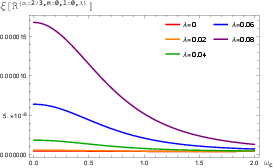
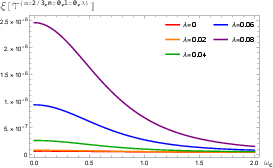
Figure 18: Entropy differences between FDD and harmonic oscillator as a function of m∈Z6 for fixed m∈Z7; zero-crossings differ with m∈Z8.
Figure 19: Difference in m∈Z9 between FDD and FD at tuned ω00 that sets ω01 equal; reveals no mutual cancellation.
Effects of Magnetic Field Orientation and Angular Momentum
Field inversion (sign change in ω02) leaves all entropies and measures invariant for ω03, but for ω04, a transport relation emerges: ω05 to restore frequencies and observables. This asymmetry is unique to nonzero angular momentum and reflects the interplay of curvature and rotation in the underlying manifold.
Figure 20: Demonstration of symmetric (ω06) and asymmetric (ω07) dependence of effective frequency on the sign of ω08.
Conclusion
The Fock-Darwin-Darboux system offers an analytically tractable quantum model in which a simultaneous tuning of curvature, magnetic field, and harmonic potential delivers a rich interplay of spectral, information-theoretic, and localization phenomena. The exhaustive analysis of entropies, dispersion measures, and degeneracy patterns highlights:
Curvature and magnetic field exert fundamentally opposed effects on wavefunction localization, information entropies, and uncertainties.
Degeneracy-breaking is absolute in the Landau-Darboux system except at isolated parameter loci; infinite Landau degeneracy is destroyed by nonzero curvature.
No pair ω09 can simultaneously recover canonical oscillator values for all observables in both position and momentum spaces.
Explicit analytic expressions and mode-by-mode numerical results articulate the dependencies for all measurable quantities, enabling quantitative predictions for any parameter regime.
From a theoretical perspective, this integrable model provides a rigorous context for quantum information measure analysis on curved backgrounds; from an applied standpoint, it serves as a reference for understanding quantum dot, nanostructure, and curved-space field-theoretic systems where geometric and gauge effects intertwine. Generalizations to higher dimensions and investigation of negative curvature (hyperbolicity) or positive curvature regimes are promising avenues for further foundational research in quantum information geometry and spectral theory.