- The paper proposes a robust multiscale finite element method that efficiently resolves time-harmonic Maxwell equations in highly heterogeneous, high-contrast media using innovative auxiliary local spectral problems.
- It demonstrates first-order convergence with errors below 2% in the energy norm and ensures exponential decay of basis functions outside oversampled regions.
- The method simplifies implementation by bypassing explicit divergence-free constraints, making it effective for large-scale simulations in metamaterials and photonic devices.
Problem Statement and Context
The time-harmonic Maxwell equations modeling electromagnetic wave propagation in high-contrast and highly heterogeneous media are central to numerous physical and engineering applications, particularly in the study of metamaterials and photonic crystals. Standard numerical approaches such as conventional FEM become inefficient in these scenarios due to the demands for extreme mesh refinement, poor conditioning, and loss of coercivity, especially at high frequencies. Furthermore, the indefinite variational structure and non-ellipticity, together with impedance (Silver-Müller-type) boundary conditions, exacerbate these computational challenges.
This work addresses these difficulties by proposing an efficient and robust multiscale finite element framework tailored for time-harmonic Maxwell equations with impedance boundaries in media featuring strong parameter heterogeneity and high contrast (2604.26449).
Multiscale Method Construction
The proposed method is based on the constraint energy minimizing generalized multiscale finite element method (CEM-GMsFEM) paradigm but introduces several critical innovations specific to the Maxwell setting and impedance boundary conditions.
Auxiliary Local Spectral Problem
A key novelty is the construction of the auxiliary space via local spectral problems that do not require explicit divergence-free constraints on the basis functions. The divergence-free property is automatically enforced in the leading eigenmodes due to the combination of a positive mass term (k2), a Silver-Müller boundary penalty, and the positive wave number. This configuration renders the local forms coercive, effectively excluding the curl-operator kernel from the low-frequency spectral space.
Multiscale Basis Synthesis
With the auxiliary space defined locally per coarse element by leading eigenfunctions, the global multiscale trial and test spaces are constructed through constrained energy-minimizing problems on mesh patches enlarged by a controlled number of oversampling layers. The multiscale basis satisfies Petrov-Galerkin-type variational problems, incorporating both the original Maxwell sesquilinear form and an additional stabilization acting only on projected components. The inf-sup stability of the ensuing discrete system is rigorously established, with constants dependent on wave number, contrast, and mesh parameters.
Theoretical Analysis
Strong convergence and stability properties are proved under moderate scale resolution assumptions. The following are critical aspects:
- Coercivity: The variational form combining the modified Maxwell sesquilinear and auxiliary stabilization is shown to be coercive in the relevant norms, uniformly in H, k, and contrast (for oversampling size above a threshold).
- Convergence: The method admits explicit O(H) convergence (in the energy norm) as the coarse mesh is refined, with the rate independent of the contrast but with explicit k-dependence reflecting the underlying Helmholtz-type nature of the equations.
- Localization: The basis functions exhibit exponential decay outside the oversampled regions, enabling accurate truncation and locality without significant loss of accuracy or stability.
Numerical Experiments
A comprehensive suite of three-dimensional experiments in homogeneous and high-contrast settings validate theoretical claims.
Benchmark tests with constant coefficients verify the method recovers the first-order convergence of classical FEM. With oversampling size m=4, the method yields errors well below those from standard FEM for a comparable mesh (see numerical results for relative a- and L2-errors).
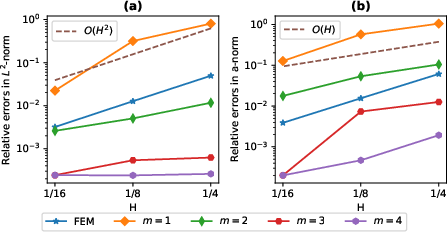
Figure 1: Relative errors for the homogeneous case (μr=1), showing the multiscale method outperforms standard FEM with increasing oversampling layers.
Photonic Band Structures and High Contrast Effects
The method is evaluated in the context of cubic inclusions and periodic structures typical of 3D photonic crystals:
- Model 1: High-contrast cubic inclusions distributed randomly (rods-in-air configuration), with contrast ratio up to 103.
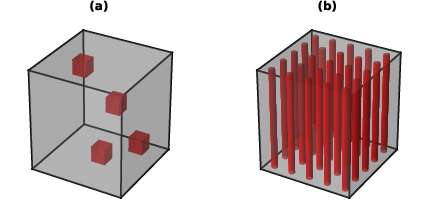
Figure 2: High-contrast computational domains: (a) randomly distributed cubic inclusion, (b) periodic array of thin cylindrical inclusions (holes-in-slab).
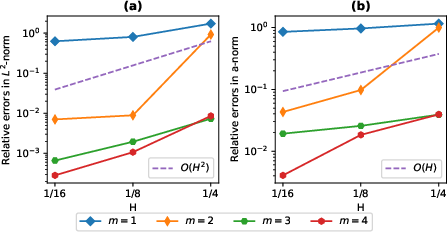
Figure 3: Relative error decay with mesh refinement and increasing oversampling layers for Model 1 (rods-in-air).
The relative H0-norm errors are reduced to 2\% or below for H1 even at high contrast, with H2 errors below 0.05\%.
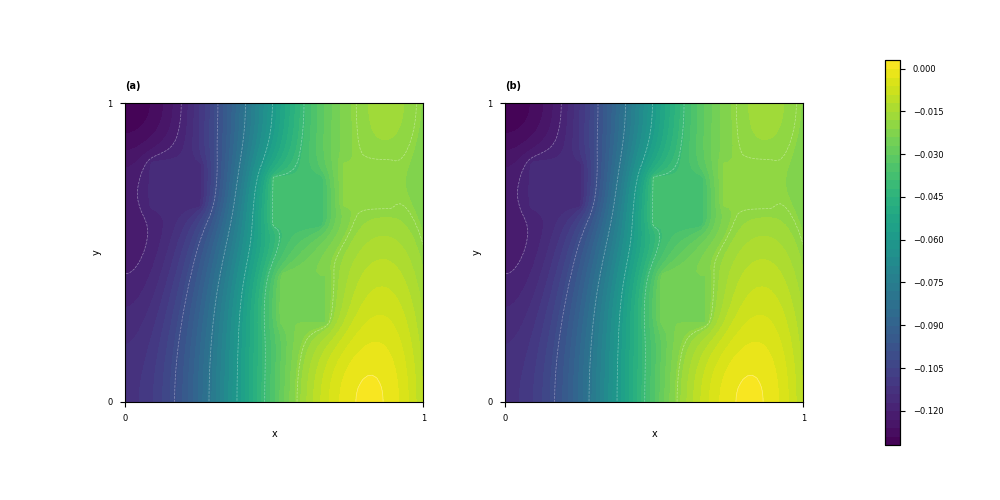
Figure 4: Top view comparison of a reference FEM solution and the multiscale method for a photonic crystal with high-contrast inclusions.
- Model 2: Periodic slab with cylindrical holes (TE-like effective response), again with high contrast (H3 up to H4).
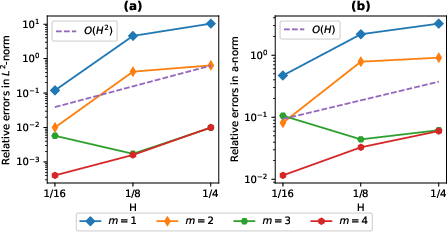
Figure 5: Errors for Model 2 illustrating the effect of oversampling and mesh size; convergence rate matches theoretical prediction.
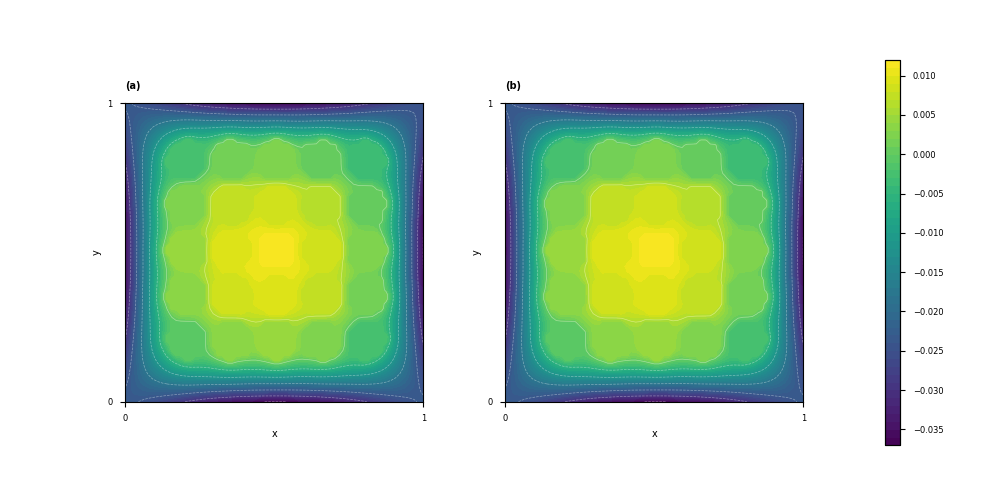
Figure 6: Cross-sectional fields for FEM and multiscale solutions in Model 2, confirming fidelity in the presence of high-contrast inclusions and edge effects.
Crucially, the error remains stable with respect to contrast for sufficient oversampling, in line with theoretical predictions. For insufficient oversampling, errors increase with contrast, as localized modes fail to be captured.
Implications and Future Directions
This framework provides a robust tool for large-scale simulation of wave phenomena in magnetically complex media with arbitrary inclusions, including photonic devices, radar-absorbing materials, and metamaterials engineering. The absence of explicit divergence-free constraints greatly simplifies implementation and removes a major barrier for adaptive and nonconforming discretization in practical 3D applications.
From a theoretical viewpoint, the method's explicit error characterization as a function of H5, H6, the spectral gap H7, and the local contrast enables rigorous control over parameter regimes relevant for high-frequency and multi-physics scenarios.
Potential future work includes:
- Higher-order basis enrichment and H8-adaptivity.
- Extension to full vector wave problems in dispersive or lossy media.
- Integration with scalable parallel solvers for handling even larger-scale high-frequency problems.
- Investigation into optimal selection of oversampling and basis enrichment for varying geometric complexity.
- Theoretical exploration of the limiting effective equations in the regime of vanishing H9 and/or increasing contrast.
Conclusion
The presented multiscale framework for time-harmonic Maxwell equations with impedance boundaries achieves provable, contrast-independent convergence, leveraging a novel auxiliary-space design that obviates explicit divergence-free constraints. Numerical experiments on canonical and challenging high-contrast 3D structures demonstrate both its stability and approximation power, with quantifiable dependence on the wave number and oversampling size. This paves the way for efficient simulation of complex electromagnetic phenomena in synthetic and engineered materials.

