- The paper introduces a two-stage tensorial ROM method that integrates mass-weighted orthonormalization and GRBF-based parametric interpolation to enhance model reduction.
- The methodology achieves rapid error decay and preserves physical invariants by adapting parameter-dependent bases for complex PDE systems.
- Numerical experiments on heat, wave, and 3D Maxwell equations demonstrate superior fidelity and efficiency compared to conventional monolithic approaches.
Structure-Aware Tensorial Model Reduction: An Expert Summary
Introduction
The paper "Structure-Aware Tensorial Model Reduction" (2604.26280) presents substantive advancements in projection-based model reduction for parametric PDEs. The core contribution is a two-stage method, building upon established tensorial approaches, that systematically incorporates both parameter-dependent basis adaptation and mass/energy-weighted inner products, and further advances interpolation techniques for parametric domains. This framework allows rapid online construction of reduced bases that are nonlinear in the parameters but preserve structure, e.g., inner-product orthonormality and, where relevant, Hamiltonian or gradient-flow structure. Two notable extensions are introduced: (1) mass-weighted orthonormalization of reduced bases based on a general discrete inner product, and (2) parametric interpolation using Gaussian radial basis functions (GRBFs), which provide significant empirical improvements in testing generalization for sparsely-sampled high-dimensional parametric domains.
Tensorial ROM Methodology and Limitations
The paper analyzes tensor-based model reduction methods, notably those utilizing the Tucker and higher-order SVD (HOSVD) decompositions of snapshot tensors extracted from parametric PDE solution trajectories. In classical approaches (e.g., monolithic SVD/POD), a global reduced basis is constructed from the entire snapshot collection. These linear bases are fundamentally constrained by the Kolmogorov n-width of the solution manifold, leading to slow error decay—often O(n−1/2)—for transport or wave problems with strong parametric dependence. The tensorial approach circumvents this by:
- Offline: Decomposing the snapshot tensor via HOSVD, capturing multi-mode interactions in a compact core tensor and factor matrices.
- Online: Generating parameter-local reduced bases through SVD of core tensor slices or interpolated latent coefficients evaluated at specific parameters.
This is depicted and characterized by the rapid singular value decay in parameter-local tensorial bases:
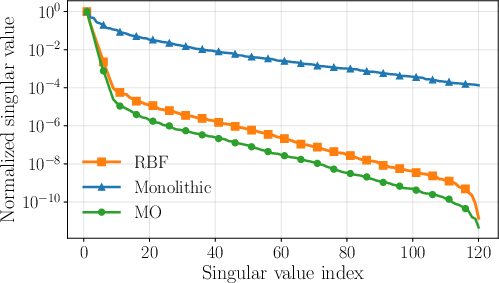
Figure 1: Normalized singular value decay for the three bases U= Uμ, illustrating the accelerated decay for tensorial (adaptive) bases compared to monolithic SVD due to local parametric adaptation.
However, the traditional tensorial strategies inherit several drawbacks: they strictly produce Euclidean-orthonormal bases, complicating use with energy-based structure-preserving ROMs; and their local basis generation often depends on interpolation schemes (e.g., barycentric, least-squares) that perform poorly in sparse, high-dimensional parametric settings.
Structure-Aware Extensions: Mass-Weighted Bases and RBF Interpolation
The authors' primary advances target these deficiencies:
1. Mass-Weighted Orthonormal Bases
The paper introduces a generalization of the tensor-based basis construction to M-orthonormality, where M is any symmetric positive-definite (SPD) inner product—commonly, the mass matrix arising from finite element discretization. The method achieves this by: (i) projecting snapshots with the Cholesky factor of M; (ii) performing HOSVD in the embedded Euclidean space; (iii) recovering the original coordinates and ensuring M-orthonormality post-processing. This generalization is critical for preserving physical invariants and energy/structure in ROMs of gradient flows or Hamiltonian systems (e.g., Maxwell, wave equations).
2. GRBF Interpolation in Parameter Space
Standard local interpolation schemes (e.g., weighted least-squares per Mamonov-Olshanskii [mamonov2022interpolatory]) can be discontinuous and highly sensitive to sparse sampling. The paper deploys a local Gaussian radial basis function (GRBF) interpolation for the latent core tensor coefficients. This scheme yields smooth piecewise responses across the parametric domain, efficiently leveraging the available data and substantially outperforming the alternatives when training samples are limited (as evidenced in the generalization error plots).
Error Analysis
A comprehensive a priori analysis is provided for both the basis representation error and the ROM solution error. The error estimates show that the total projection error at any parameter is bounded by three principal contributions:
- The HOSVD (tensor decomposition) truncation error,
- The parametric interpolation error (controlled by the interpolation scheme and snapshot smoothness),
- The local SVD truncation (basis size) error.
The analysis demonstrates that the M-weighted tensorial method achieves rigorous, monotonic error bounds on ROM error under Lipschitz assumptions on the FOM dynamics. These bounds are analogous to those for linear Galerkin ROMs, yet they hold even with strong local nonlinearity in the parameter-to-basis map, and regardless of the underlying PDE structure.
Numerical Results
The methodology is validated on three categories of PDE problems:
Heat Equation Benchmark
The 2D heat equation with parametric Gaussian forcing showcases the inefficiency of classical monolithic global bases versus tensorial adaptive ones.
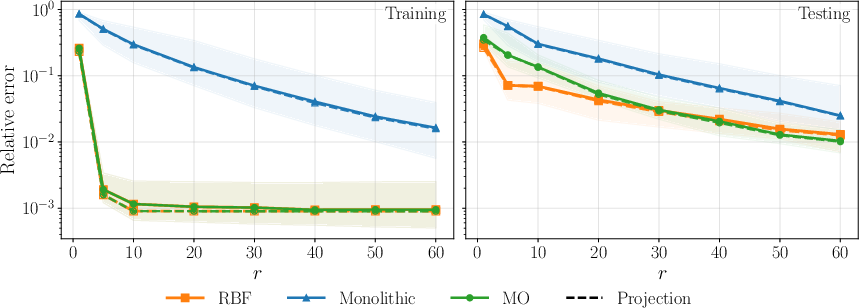
Figure 2: Relative M-weighted error in the ROM solutions to the heat system as a function of reduced basis dimension r, highlighting rapid error reduction for tensorial bases (training left, testing right).
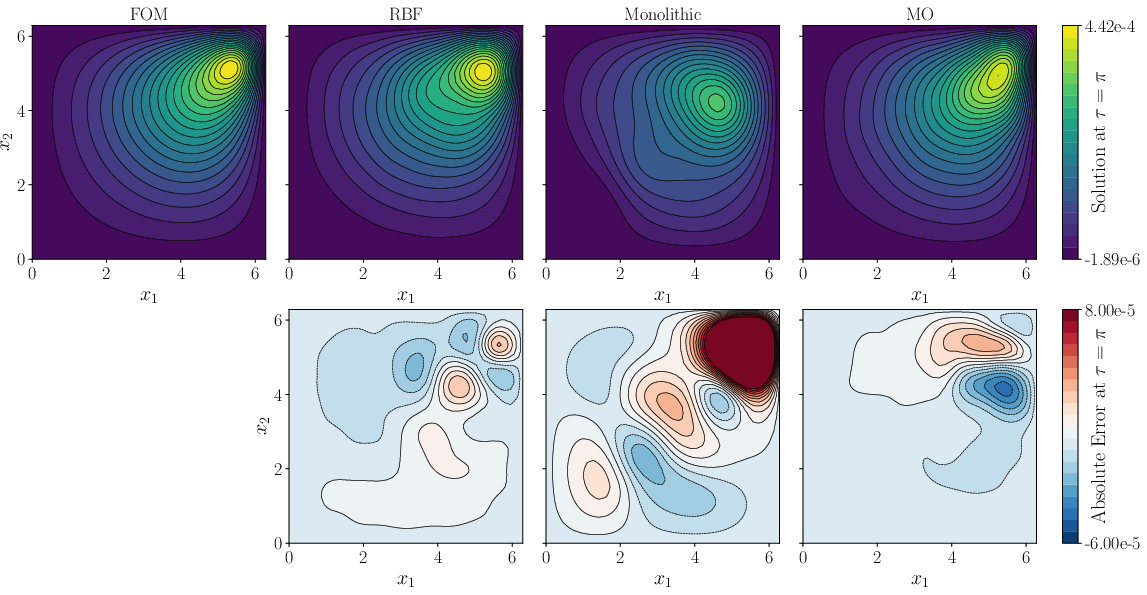
Figure 3: FOM and ROM solutions at terminal time, O(n−1/2)0: both RBF and MO tensorial ROMs yield high-fidelity approximation, whereas monolithic SVD ROMs exhibit strong underestimation and qualitative distortion.
Key finding: Tensorial bases achieve sub-1% error for O(n−1/2)1, while monolithic SVD requires O(n−1/2)2 to reach similar accuracy, confirming substantial improvements in efficiency and fidelity.
Wave Equation Benchmark
A 2D wave equation with oscillatory parametric forcing is tested under both structure-preserving (Hamiltonian) Galerkin projection and the various local interpolation strategies.
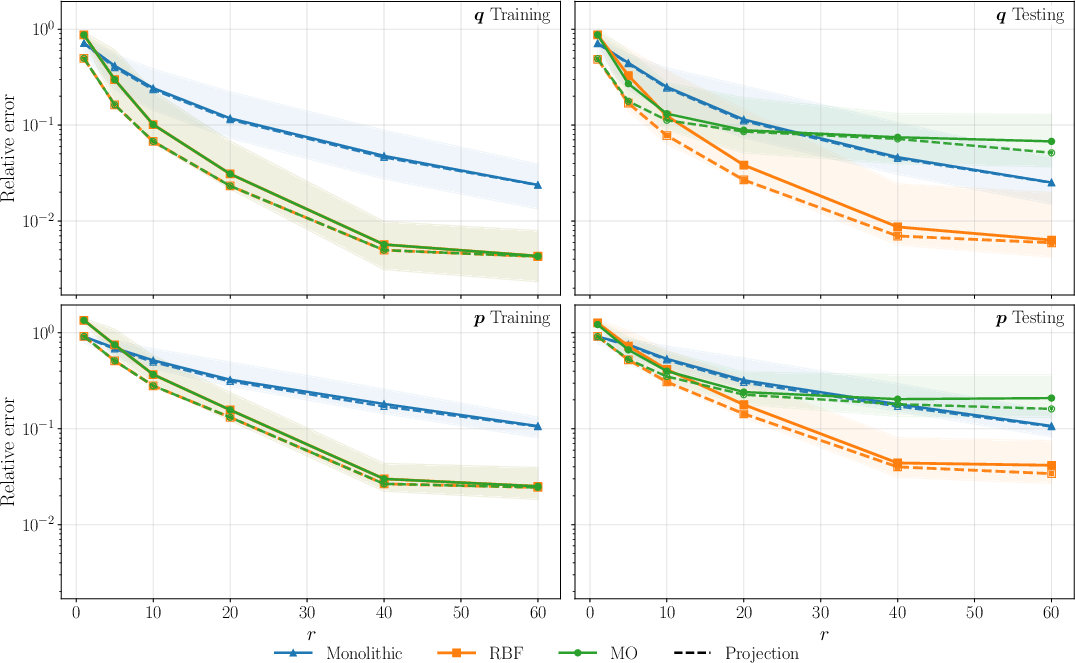
Figure 4: Relative O(n−1/2)3-weighted error in the ROM solutions to the wave system, demonstrating robust error decay for the RBF tensorial approach and stagnation for MO interpolation in the out-of-sample (testing) case.
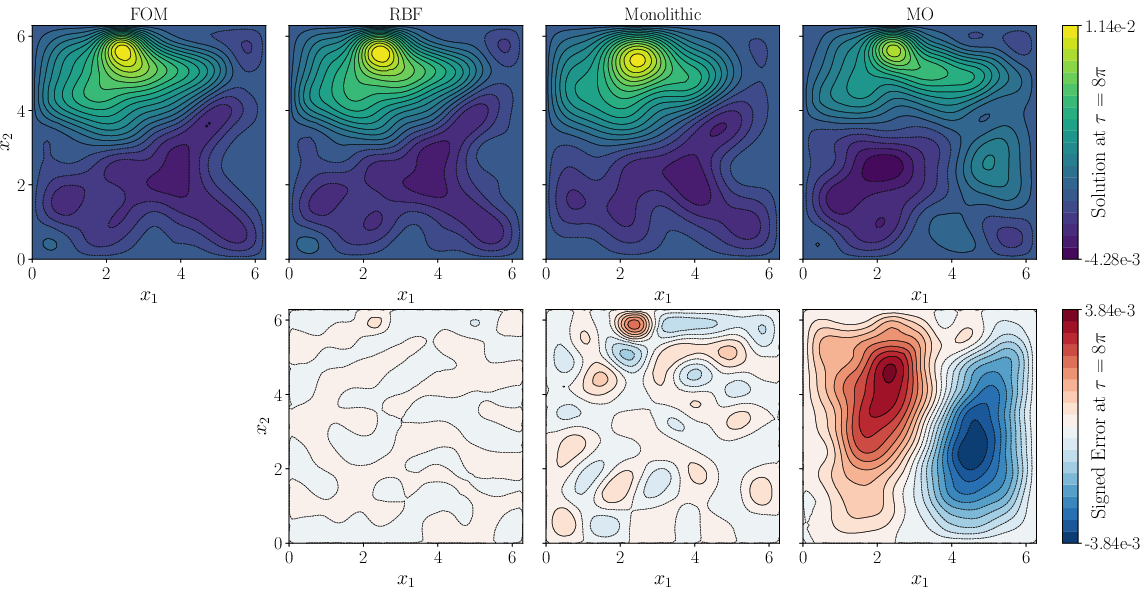
Figure 5: FOM and ROM displacement field at terminal time for O(n−1/2)4, visualizing the close correspondence between RBF-based ROM and FOM, and the inferior performance of MO and monolithic approaches.
Key result: The GRBF-based tensorial ROM maintains generalization accuracy an order of magnitude lower than both monolithic and MO-tensorial ROMs for moderate basis sizes in testing, especially under data paucity and increased parametric/temporal complexity.
3D Maxwell System
The technique is evaluated for challenging 3D electromagnetic wave propagation with parametric current injection.
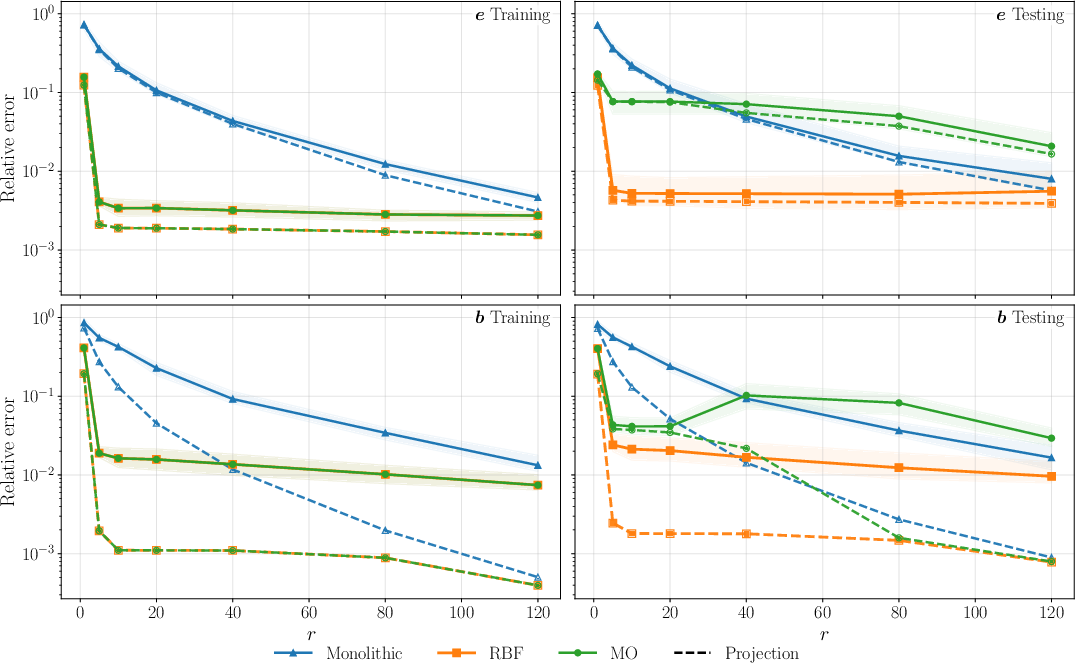
Figure 6: Relative O(n−1/2)5-weighted O(n−1/2)6 ROM error for the Maxwell system, showing superior error profiles of RBF tensorial ROMs in both electric and magnetic fields in all regimes of basis size.
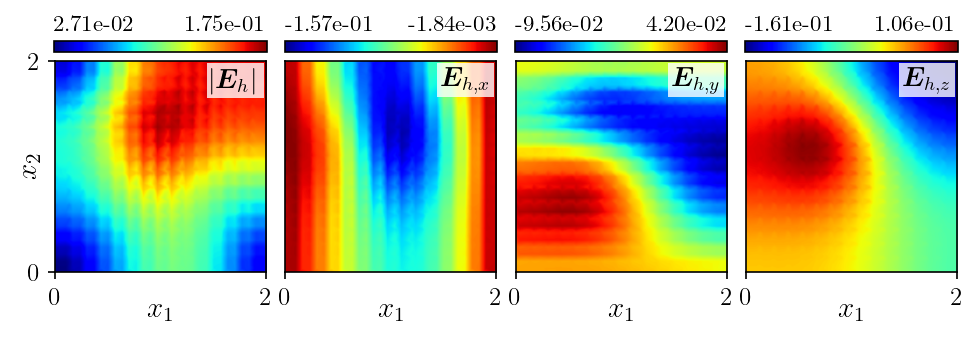
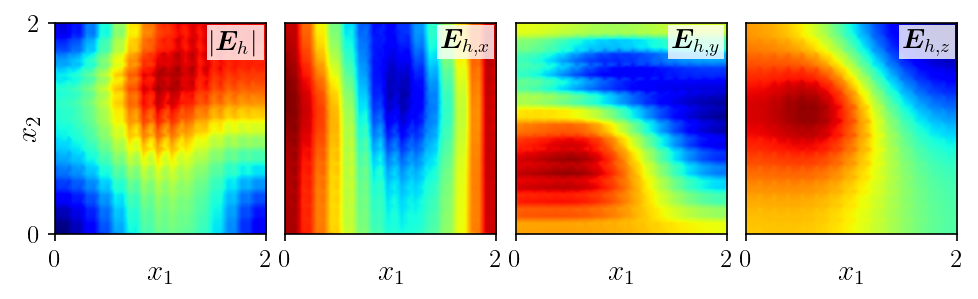
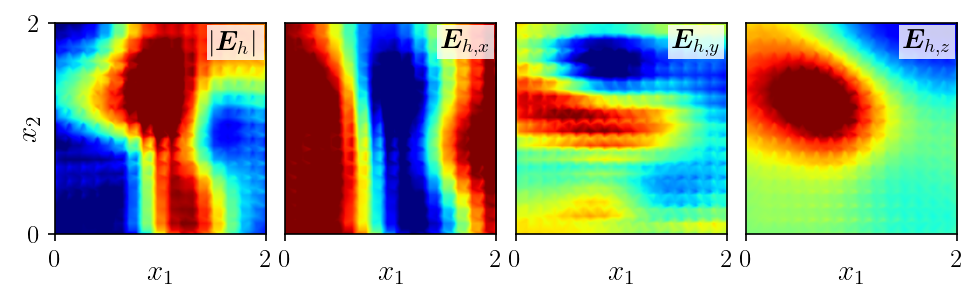
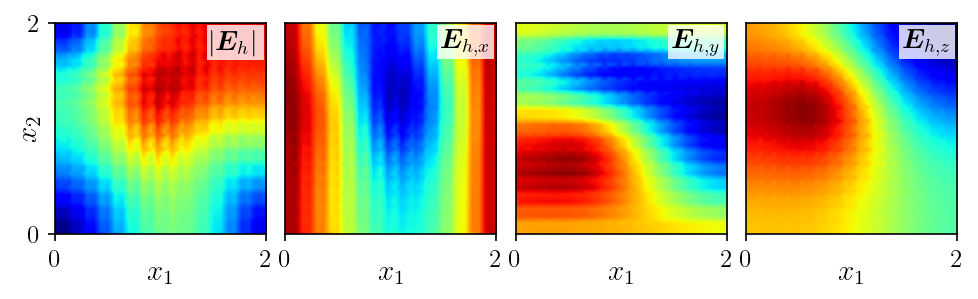
Figure 7: O(n−1/2)7 (electric field) at terminal time, slice O(n−1/2)8: RBF-MO tensorial ROM results closely match FOM, while monolithic SVD ROM incurs major qualitative and quantitative discrepancies at O(n−1/2)9.
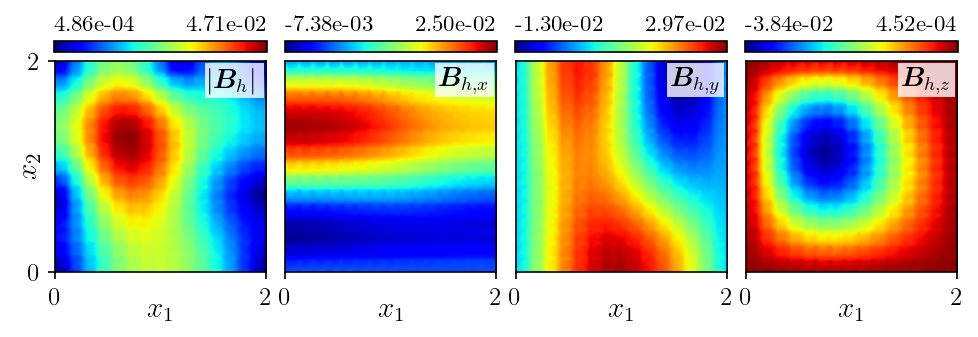
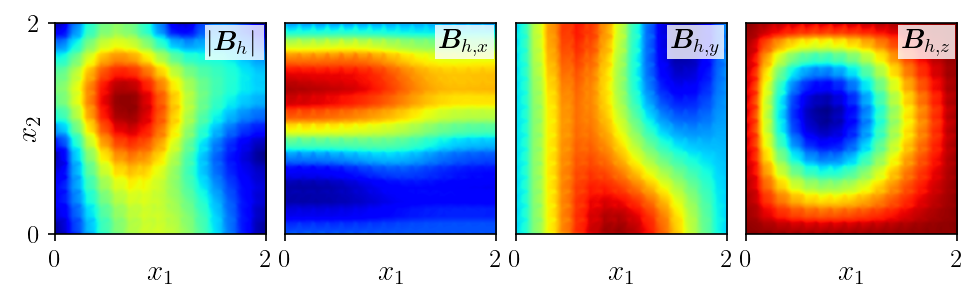
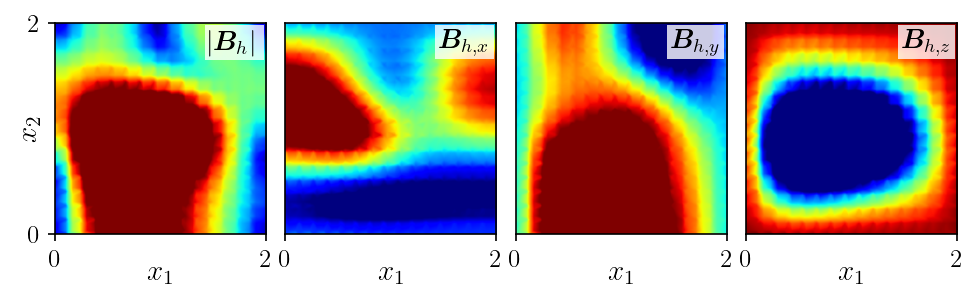
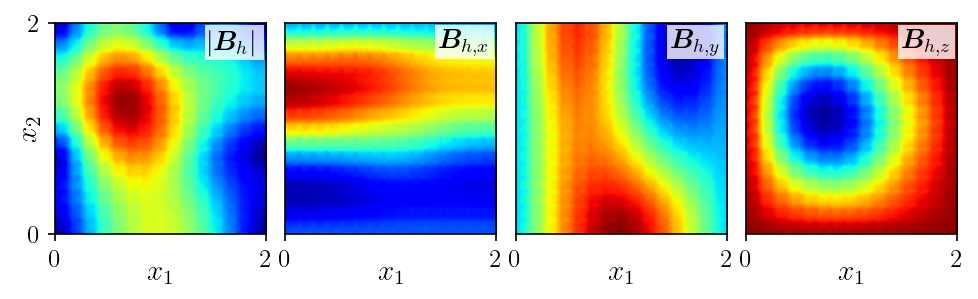
Figure 8: U= Uμ0 (magnetic field) at terminal time, same setup as Figure 7. The RBF/MO tensorial ROMs attain low error, in contrast to severe monolithic failure.
Numerical implication: The tensorial ROM approach, particularly with GRBF interpolation, enables high-fidelity, structure-preserving reduced models for highly nonlinear-in-parameter systems in three space dimensions with coarse sampling, outperforming all previously published (linear and tensor-based) methods.
Theoretical and Practical Implications
The explicit connection provided between tensorial ROM error bounds and generalized mass-weighted orthonormality extends the applicability of advanced ROMs to a broader class of PDEs, including those with conservation laws or specific energy structures. The GRBF interpolant solution directly addresses the longstanding challenge of parametric sparsity—prevailing in many real-world scenarios where simulation budget is limited—by effectively eliminating the sharp adverse effects on generalization error seen in previous work. The combined approach yields ROMs that are both resource efficient (delivering high accuracy with minimal modes) and physically trustworthy (preserving invariant structure).
Practically, computational scientists and engineers can apply this framework to enable fast, accurate, and physically consistent surrogate modeling for multi-query UQ/optimization, control, or design with expensive simulation models. The extensions to mass-orthonormality and robust interpolation readily integrate with existing data-driven or operator inference pipelines.
Theoretically, this work closes key gaps in the theory of tensorial ROMs, specifically by:
- Proving monotonic and interpretable error bounds for nonlinear parameter-dependent bases in general inner product spaces,
- Demonstrating that structure preservation (mass/energy-orthogonality, Hamiltonian/gradient flow) is compatible with efficient tensorial latent-state decomposition and online adaptation.
Future Directions
Future work may extend these methods to even more general nonlinear parameter-to-basis maps leveraging manifold learning (e.g., deep autoencoders, diffeomorphic interpolants), explore adaptive sampling to further optimize the interplay between offline workload and online accuracy, and tightly couple tensorial parametrizations with operator-inference and machine learning-based closure models for turbulent, nonlinear, multiscale, and multiphysics applications.
Conclusion
This paper develops a theoretically and computationally robust structure-aware tensorial model reduction methodology with mass-weighted basis adaptation and parametric interpolation via GRBFs. The resulting framework significantly improves fidelity, efficiency, and physical consistency of ROMs for parametric PDEs, especially in data-limited and highly nonlinear regimes. The work provides rigorous mathematical guarantees—previously unavailable for tensorial ROMs with parameter adaptation—and demonstrates clear empirical superiority across benchmark elliptic, hyperbolic, and Hamiltonian systems. This architecture is expected to become foundational for the next generation of structure- and data-aware scientific computing surrogates.