- The paper presents a robust recurrence-based framework that models nonlinear vocal dynamics to detect depression with a mean CV AUC of 0.689.
- It utilizes recurrence plots on 74-channel COVAREP features and regularized logistic regression, outperforming static acoustic metrics.
- The results validate recurrence-based biomarkers as interpretable digital signals for depression screening, confirmed by permutation tests (p = 0.004).
Recurrence-Based Nonlinear Vocal Dynamics for Depression Detection: A Technical Review
Introduction
The paper "Recurrence-Based Nonlinear Vocal Dynamics as Digital Biomarkers for Depression Detection from Conversational Speech" (2604.26242) presents a robust framework for modeling nonlinear dynamics of vocal trajectories as digital biomarkers for depression detection. Traditional speech-based biomarkers rely predominantly on static summary statistics or conventional ML representations, often neglecting nonlinear and temporal information inherent in conversational speech. The central thesis is that depression manifests as altered recurrence structure in vocal state trajectories, detectable through recurrence quantification analysis (RQA) of frame-level COVAREP features.
Methodological Overview
The study utilizes the DAIC-WOZ clinical interview corpus, focusing on a subset of 142 participants labeled via PHQ-8. Speech was parameterized as multivariate time series using 74 COVAREP feature channels, producing scalar frame-level trajectories per channel. The paper leverages recurrence plots to encode state revisitation, quantifying recurrence rate per channel as the primary biomarker.
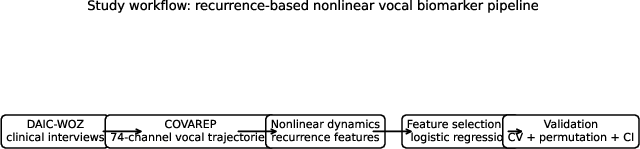
Figure 1: Study workflow for recurrence-based nonlinear vocal biomarker analysis.
Each participant's trajectory is recast as a nonlinear dynamical system. Recurrence between timepoints is defined via thresholded pairwise differences, producing a binary recurrence matrix. Recurrence rates across channels form the biomarker vector. Comparisons are made against static pooled acoustics, entropy dynamics, forecastability, Hurst exponent, Lyapunov-like instability proxies, and determinism proxies.
Recurrence Plot Construction and Characterization
Recurrence plots visualize the temporal structure of state revisitations. Depression is hypothesized to induce altered recurrence patterns, detectable via structured or fragmented recurrence distributions in the state space.
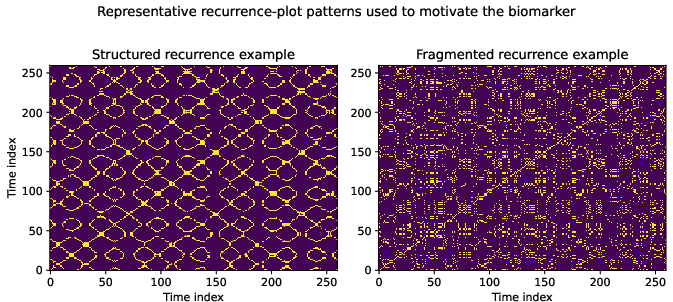
Figure 2: Representative recurrence-plot patterns illustrating structured and fragmented state-space recurrence.
RQA provides interpretable measures, such as recurrence rate, which are well-suited for clinical stratification and avoid the opacity of deep learning. Channel-wise recurrence rates are computed and used for subsequent classification.
Classification, Validation, and Statistical Significance
Feature selection and regularized logistic regression are used for classification, with stratified 5-fold CV ensuring robustness. The recurrence-based model achieves a mean CV AUC of 0.689, outperforming all tested baselines. Pooled cross-validated predictions yield AUC 0.665 (95% bootstrap CI: [0.568, 0.758]), highlighting the reliability of the nonlinear approach.
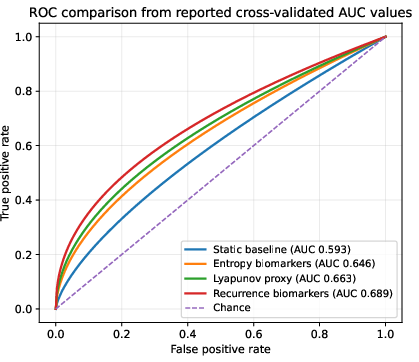
Figure 3: ROC comparison generated from reported cross-validated AUC values.
Statistical significance is confirmed via permutation testing; the observed AUC exceeds null distributions with p=0.004.
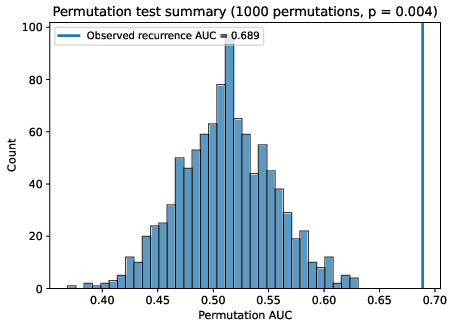
Figure 4: Permutation-test summary showing observed recurrence-model AUC relative to a null distribution.
Bootstrap resampling further affirms model robustness.
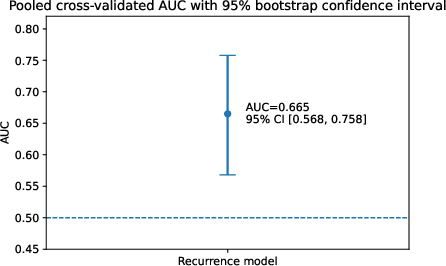
Figure 5: Pooled cross-validated AUC with 95\% bootstrap confidence interval.
Biomarker Channel Analysis
Not all COVAREP channels contribute equally to classification. ANOVA F-statistic ranking identifies the most informative recurrence channels, several of which demonstrate strong discriminatory power.
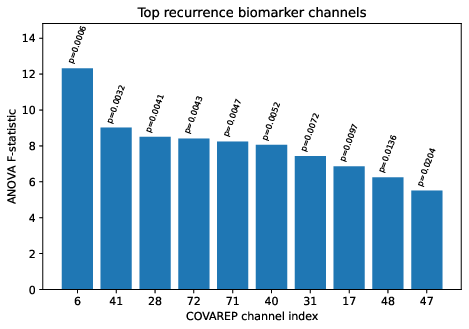
Figure 6: Top recurrence biomarker channels ranked by ANOVA F-statistic.
Such granularity enables targeted analysis of physiological underpinnings per channel, but the mapping to specific articulatory or glottal descriptors warrants further investigation.
Comparative Evaluation
The recurrence-based features significantly exceeded static acoustic metrics (AUC 0.593), Hurst exponent features (AUC 0.477), determinism proxy (AUC 0.418), and forecastability dynamics (AUC 0.590). Lyapunov-like instability features showed moderate results (AUC 0.663), but did not surpass recurrence metrics. Entropy-based approaches (AUC 0.646) also fell short. These results reinforce that nonlinear recurrence structure is a dominant signal for behavioral phenotyping in depression.
Implications and Future Directions
The findings support a methodological shift toward dynamical systems analysis in computational psychiatry. Recurrence-based markers, without relying on opaque end-to-end neural models, provide interpretable and statistically robust signals for passive monitoring and screening. Practical implications include scalability and objective risk assessment outside episodic clinical environments. Future work will extend recurrence analysis to external datasets, longitudinal trajectories, and cross-modal fusion (vocal, facial, linguistic). Subject-specific drift and noise modeling is another promising avenue for mechanistic interpretation.
Theoretically, recurrence quantification may uncover psychomotor or cognitive mechanisms underlying depression, especially in modulation of vocal flexibility and articulatory state-space organization. Broader adoption of RQA and related metrics in digital psychiatry is anticipated, alongside integration of higher-dimensional recurrence and laminarity measures.
Conclusion
Recurrence-based nonlinear vocal dynamics are validated as significant digital biomarkers for depression detection. The framework outperforms static and alternative nonlinear approaches, demonstrating that depression is characterized more by altered vocal state-space recurrence organization than by mean shifts or simple memory changes. These results advance the application of interpretable nonlinear dynamical analysis in computational psychiatry, supporting future work in operational deployment and mechanistic modeling.

