- The paper introduces a unified mechanism resolving the cosmological constant problem by linking gravitational entropy to a Higgs-like field.
- It employs holographic naturalness and pre-geometric gravity, using symmetry breaking to derive emergent spacetime metrics and suppress vacuum fluctuations.
- The study predicts testable signatures in quantum decoherence, CPT violation, and low-energy experiments, opening new avenues in quantum gravity research.
Holographic Naturalness and Pre-Geometric Gravity: A Unified Resolution of the Cosmological Constant Problem
Problem Statement and Baseline Frameworks
The cosmological constant (CC) problem remains a fundamental discrepancy between quantum field theory (QFT) predictions and cosmological observations, manifesting as a profound $120$ orders of magnitude hierarchy between expected vacuum energy densities and their measured values. The framework developed in "Holographic Naturalness and Pre-Geometric Gravity" (2604.26032) synthesizes two conceptual approaches: holographic naturalness (HN) and pre-geometric gravity (PGG). The former posits the stability of the CC as a quantum-informational phenomenon rooted in gravitational entropy, while the latter establishes the emergence of spacetime metrics through symmetry breaking in gauge-theoretic, metric-free pre-geometric systems. This combination provides both a mechanism for the origin and persistence of a minuscule CC, analytically linking the quantum informational content of de Sitter (dS) entropy and the Higgs-like vacuum expectation value (VEV) of geometric fields.
Holographic Naturalness: Entropy as a Stabilizer
The HN paradigm reframes the stability of the CC in terms of quantum information and horizon entropy. The observed de Sitter entropy, SdS∼MP2/Λ∼10120, where MP is the Planck mass and Λ is the CC, acts as an entropic barrier suppressing quantum transitions to higher-energy (lower-entropy) vacua. Specifically, the quantum tunneling amplitude from the observed dS vacuum to a Planckian vacuum is exponentially suppressed:
⟨Λ∣ΛUV⟩∝exp(−SdS/2)
This formulation invalidates conventional QFT approaches that neglect horizon entropy in loop corrections, providing a non-perturbative, thermally regulated picture of vacuum stability.
Pre-Geometric Gravity: Emergence via Symmetry Breaking
PGG replaces the metric as a fundamental object with gauge fields and a Higgs-like scalar ϕA. Geometry and the Einstein–Hilbert action arise dynamically from spontaneous symmetry breaking:
H0
This occurs via a VEV H1, mapping gauge fields onto tetrads and spin connections. In both MacDowell–Mansouri (MM) and Wilczek (W) models, the Planck mass and cosmological constant are derived quantities:
- MM: H2, H3
- W: H4, H5
A large H6 (Higgs VEV) leads to a suppressed H7 via a see-saw mechanism, tying geometric emergence to the informational capacity encoded in dS entropy.
The critical synthesis is the identification H8 (MM) or H9 (W), demonstrating that the same field responsible for geometric emergence also quantifies the quantum information content of spacetime. Stabilization of N0 is then inherently an entropic stabilization, with decay amplitudes further suppressed exponentially in N1.
New excitations, dubbed "hairons", are pseudo-Nambu–Goldstone bosons originating from orbifold gravitational instantons and pre-geometric Wilson loops, with mass N2. Hairons thermalize vacuum energy and can form a cold condensate, substantiating the quantum hair paradigm and providing a concrete mechanism for dissipating vacuum fluctuations via horizon degrees of freedom.
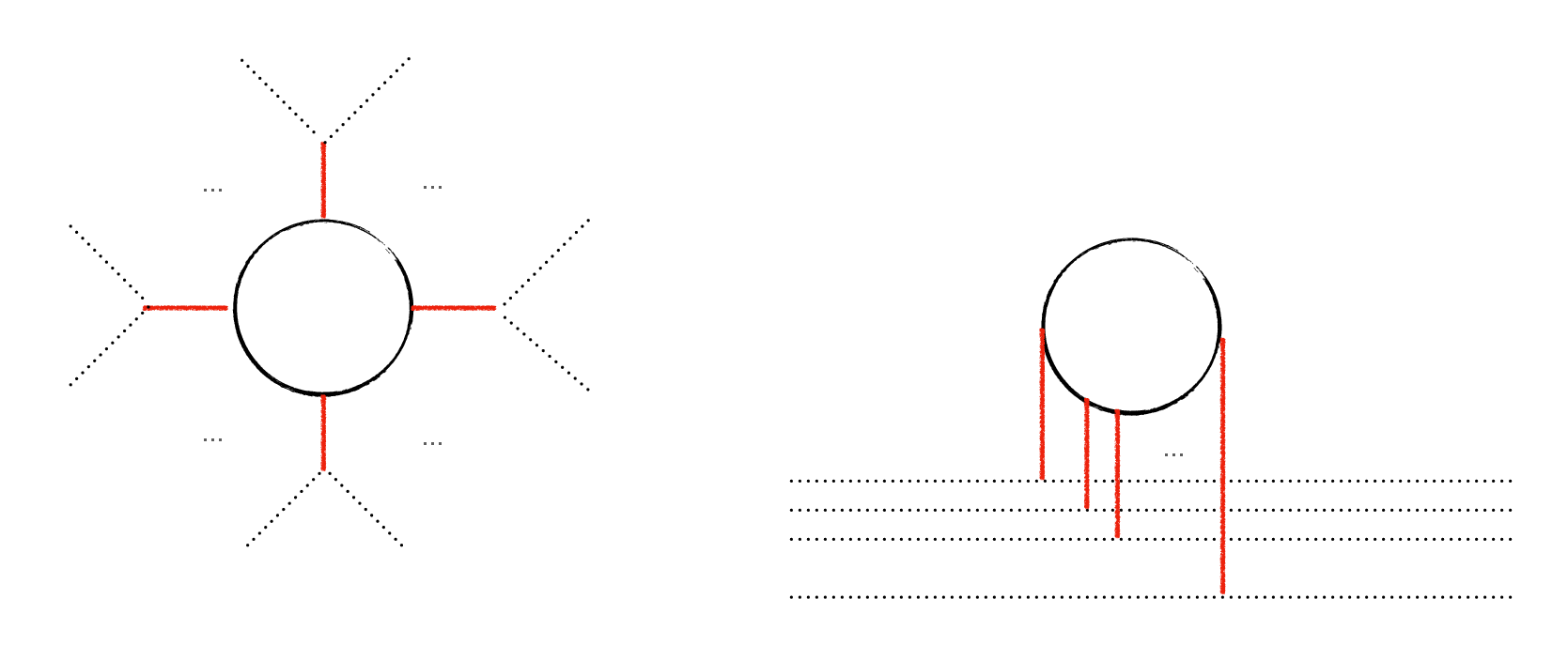
Figure 1: Left: Large graviton insertions (red) coupled to hairons (dotted), mediating quantum fluctuation dissipation by horizon modes. Right: Loop diagram with hairon condensate, showing vacuum energy absorption into horizon entropy and CC stabilization.
Consistency and Hamiltonian Structure
A rigorous Hamiltonian analysis is performed using Dirac’s algorithm for constrained systems, demonstrating that only three physical degrees of freedom persist post-SSB: two graviton polarizations and one massive scalar N3. Hairons do not represent independent degrees of freedom, but arise as collective excitations (emergent quasi-particles) analogous to phonons/magnons in condensed matter systems. Their light mass is protected by the high entropy of the dS vacuum and the condensate structure defined by N4.
Phenomenological Implications
The N5 framework predicts that hidden-sector informational degrees induce apparent quantum decoherence, CPT violation, and probability non-conservation in SM observables, measurable in high-precision, low-energy experiments (neutral meson oscillations, neutron–antineutron transitions, quantum interferometry, astroparticle anomalies). Emergent granularity is informational, not geometric, thus evading tight bounds from interferometry targeting stochastic metric fluctuations. Hairon vortices may mediate Pauli-violating transitions, opening new classes of underground quantum gravity experiments.
Theoretical and Practical Implications
Formally, the model advances the paradigm that spacetime, geometry, and the quantum information structure are emergent from a symmetry-broken, metric-free phase. The entropy–VEV correspondence underpins both CC origin and stability. Stimulated emission of soft gravitons by matter amplifies horizon entropy in cosmological time, implying a secular decrease in N6—thus dark energy is fundamentally dynamical. The model resolves the CC problem without fine-tuning or particle spectrum symmetry extensions, shifting focus to quantum informational principles.
Practically, the theory introduces testable decoherence and non-conservation signatures, suggesting new avenues for precise low-energy experiments targeting emergent informational granularity and horizon hair dynamics.
Conclusion
By unifying holographic naturalness and pre-geometric gravity, the paper establishes that the cosmological constant's smallness and stability are consequences of the quantum information content encoded by the Higgs-like field responsible for emergent geometry. Hairons mediate the dissipation and stabilization of vacuum energy at the horizon, substantiating the quantum hair paradigm and dynamically coupling geometric emergence to quantum informational entropy. The approach yields a technically natural resolution of the CC problem and motivates future investigation into informational emergence and quantum gravity phenomenology.