- The paper introduces a direct bootstrap method bypassing PSD constraints, enabling precise determination of the SYK bilinear spectrum.
- It formulates equality constraints from fractional operator families and boundary anomalies, offering efficient spectrum recovery with power-law convergence.
- Numerical results validate the method through rapid convergence to exact eigenvalues, highlighting its potential for broader bootstrap applications.
Quantum Mechanical Bootstrap without Inequalities: SYK Bilinear Spectrum
Overview
The paper "Quantum mechanical bootstrap without inequalities: SYK bilinear spectrum" (2604.26007) presents a novel method—termed the direct bootstrap—for determining the spectrum of a quantum mechanical system whose energies coincide with the bilinear operator dimensions in the Sachdev–Ye–Kitaev (SYK) model. Whereas previous quantum mechanical (QM) bootstrap approaches rely fundamentally on positive semidefinite (PSD) constraints to isolate spectral values, this work demonstrates that for systems defined with fractional Robin boundary conditions, positivity is insufficient and that spectrum determination requires equality constraints derived from the structure of operator families with fractional powers. The method efficiently recovers the exact SYK bilinear spectrum as the truncation order increases and exposes key theoretical limitations in the application of standard bootstrap techniques to systems with anomalous domain structures.
Model Definition and SYK Correspondence
The system studied is defined on the interval z∈[0,1] with Hamiltonian
H=SZ(1−Z)S+Z(1−Z)(21−Δ)2
where S=i∂z, Z=z, and 0<Δ<21 parametrizes the conformal dimension of Majorana fermions in SYK. Robin-type boundary conditions are imposed, characterized by a parameter r related to SYK as r=(1−Δ)/Δ. The spectrum is exactly solvable, and wavefunctions can be written in terms of associated Legendre functions, yielding eigenvalue equations kf(h)=1 and kb(h)=1 for fermionic and bosonic bilinears respectively. This renders the system an ideal testing ground for bootstrap techniques targeting nontrivial boundary behavior.
Traditionally, the QM bootstrap uses the PSD property of the bootstrap matrix Bij=⟨Oi†Oj⟩ combined with recursion relations on correlators such as H=SZ(1−Z)S+Z(1−Z)(21−Δ)20 to shrink the allowed parameter space and isolate energies. However, when the Hamiltonian's domain is altered by fractional boundary conditions, the requirement of self-adjointness invokes domain anomalies that manifest as boundary terms in the expectation values of commutators. For the system here, integer-powered operator families are unable to distinguish between different boundary conditions, and the allowed PSD region does not converge to isolated eigenvalues.
To overcome this, operators are generalized to fractional powers:
H=SZ(1−Z)S+Z(1−Z)(21−Δ)21
The recursion relations preserve fractional parts, resulting in distinct operator families labeled by a common fractional offset H=SZ(1−Z)S+Z(1−Z)(21−Δ)22. Within each family, the anomaly-free correlator cone closes only on three unknowns (the energy and two correlators), but the boundary conditions induce domain anomalies whose structure provides essential constraints.
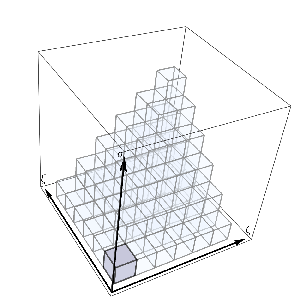
Figure 1: Anomaly-free correlator-cone for a fixed operator family labeled by fractional offset H=SZ(1−Z)S+Z(1−Z)(21−Δ)23, defined by H=SZ(1−Z)S+Z(1−Z)(21−Δ)24 in the H=SZ(1−Z)S+Z(1−Z)(21−Δ)25 limit. The gray block marks the reference point H=SZ(1−Z)S+Z(1−Z)(21−Δ)26.
Recursion Structure and Constraint Equations
The bulk and boundary anomaly structure is leveraged to construct recursion relations and explicit anomaly expressions. The anomaly-free correlator-cone for each operator family is generated via expansion recursions and specialized wall recursions that are linear combinations of the basic commutator and energy recursions. Diagrammatic representations trace these relations across the cone.
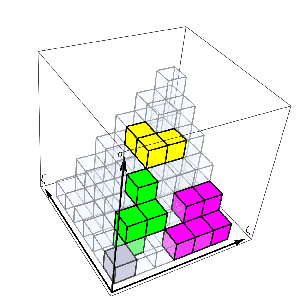
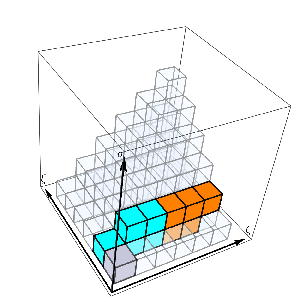
Figure 2: The basic recursion relations on the anomaly-free cone: expansion (yellow), energy (green), and commutator (purple), designed to ensure closure and efficient exploration of operator families.
The critical insight is the emergence of three exact constraint equations for three special operator families H=SZ(1−Z)S+Z(1−Z)(21−Δ)27, each probing the boundary parameter H=SZ(1−Z)S+Z(1−Z)(21−Δ)28 differently. Taylor expansions relate correlators of fractional-power operator families back to those with integer powers, breaking degeneracies introduced by domain anomalies and yielding a closed system for the energy and correlators. This procedure produces equality constraints rather than bounds, motivating the nomenclature "direct bootstrap".
Numerical Results and Convergence
The direct bootstrap is demonstrated explicitly for H=SZ(1−Z)S+Z(1−Z)(21−Δ)29 and S=i∂z0, corresponding to SYK conformal dimensions. Numerical solutions of the resulting constraint equations show rapid convergence to exact eigenvalues as truncation order S=i∂z1 grows. Strong agreement is exhibited across several excited states, with convergence error scaling bounded by S=i∂z2 where S=i∂z3 reflects the order of Taylor expansion for fractional correlators.
For general boundary parameter S=i∂z4, energies interpolate smoothly between spectra, confirming the method's sensitivity and exposing the degeneracy inherent in PSD-based approaches for this anomalous case.
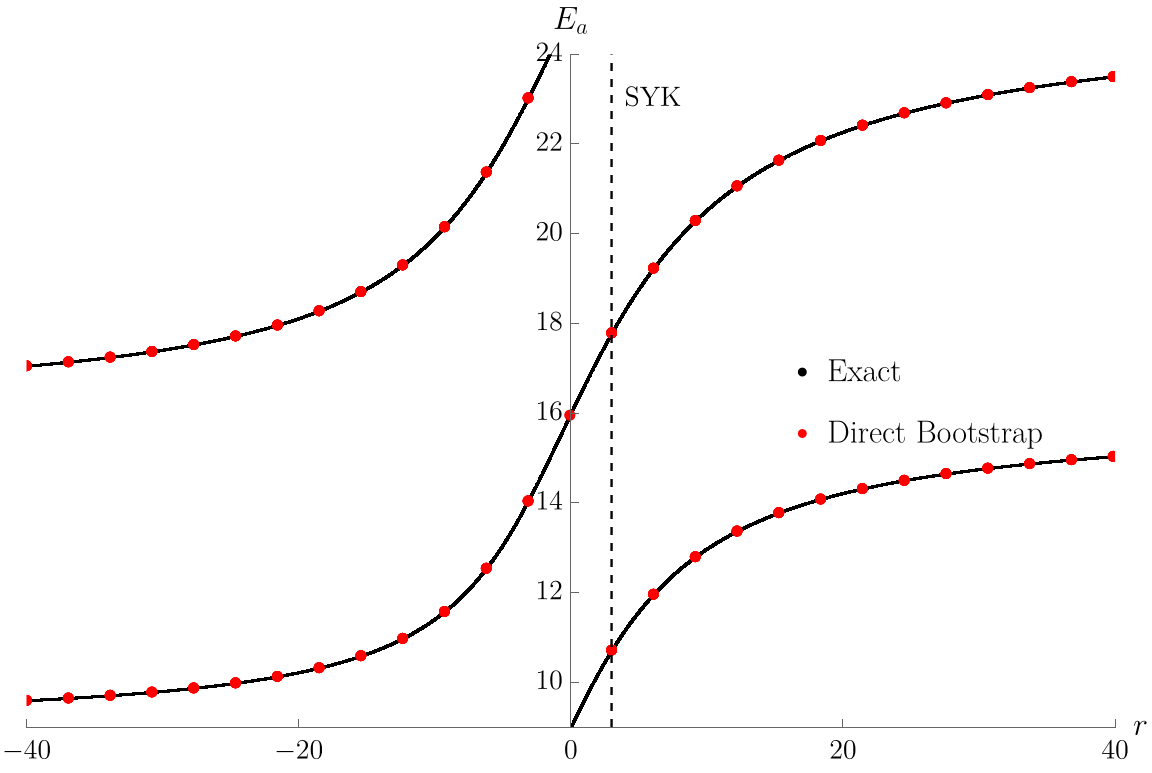
Figure 3: S=i∂z5 at S=i∂z6. Energy eigenvalues for general Robin boundary conditions parametrized by S=i∂z7. Red dots are direct-bootstrap results, black curves denote exact spectrum, and the dotted vertical line marks SYK boundary condition.
The truncation error analysis demonstrates power-law convergence rates substantially outperforming the theoretical bounds, confirming the algorithmic efficiency of the direct bootstrap.
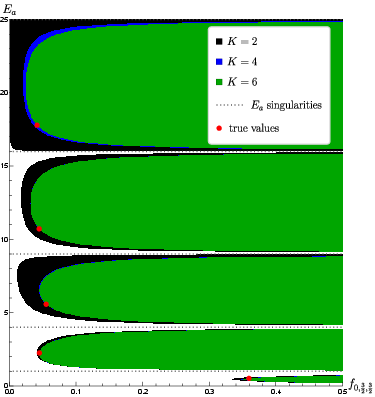
Figure 4: Bootstrap allowed regions in the S=i∂z8 plane for increasing truncation orders, illustrating persistent degenerate regions under PSD constraints and convergence to isolated eigenvalues when direct equations are imposed.
Theoretical Implications
The results establish that PSD positivity alone is structurally insufficient for spectrum determination in quantum mechanical systems with fractional boundary conditions. Domain anomalies introduce degeneracies in the constraint equations such that spectra are only isolatable when cross-family relations (Taylor expansions) are invoked. The method circumvents the necessity for inequalities, shifting the paradigm from "bounds" to "exact equations" in the bootstrap context.
This has broader implications for bootstrap methodologies applied to systems with general boundary conditions, matrix models, and other sectors—especially those exhibiting domain anomalies or nontrivial self-adjoint extensions. The theoretical limitation uncovered here suggests future hybrids of exact equations and positivity, as well as extensions to higher-dimensional and more complex models where bootstrap closure may depend on combining equality constraints from anomalous sectors with residual positivity.
Conclusion
The direct bootstrap method introduced in this work expands the toolkit of quantum mechanical bootstrap, enabling exact spectral determination for systems with anomalous boundary data where PSD constraints fail. This provides both a practical algorithm and a formal benchmark for bootstrap methodologies, delineating the limits of positivity and the necessity for equality-based closure mechanisms in anomalous quantum systems. Future directions include extending this framework to more complex Hamiltonians, analyzing convergence structures in higher-dimensional bootstraps, and exploring hybrid approaches that marry positivity with anomalous sector exactness.

