- The paper introduces a microscopic tetramer model at ν=3/4, demonstrating a gapped quantum charge liquid with minimal Z4 topological order.
- It employs resonating valence bond wavefunctions and PEPS formalism to capture local Z4 flux conservation and its effects on correlation lengths.
- Numerical analysis confirms a finite gap in the bent-tetramer regime, paving the way for electronic QCLs and extensions to other lattice geometries.
Microscopic Construction and Characterization of a Quantum Charge Liquid with Minimal Z4 Topological Order
Introduction and Motivation
Quantum charge liquids (QCLs) represent a class of strongly correlated phases expected to emerge between traditional Wigner-Mott insulators and Fermi liquids at fractional lattice filling in the presence of dominant Coulomb repulsion. The defining feature of QCLs is the combination of a charge gap and preserved translation symmetry, which, by the Lieb-Schultz-Mattis-Oshikawa-Hastings (LSMOH) theorem, implies either gapless neutral excitations or the inevitability of fractionalization and topological order. While the square lattice quantum dimer model (ν=1/2) and triangular lattice analogs have furnished minimal Z2 and Z3 topological orders for bosonic QCLs, explicit microscopic models at higher denominator filling fractions (q>3), especially with robust evidence for minimal TO, are notably absent.
The current work addresses this gap by constructing and numerically characterizing a tetramer model on the square lattice—corresponding to bosonic QCLs at ν=3/4—and demonstrates gapped phases with explicit minimal Z4 topological order. In turn, this construction paves the way for an electronic QCL model at ν=3/2, where electrons pair into bosons at ν=3/4. The primary goal is to furnish a tractable, microscopic setting realizing a gapped QCL at fractional filling, with minimal anyonic content dictated by Z4 TO.
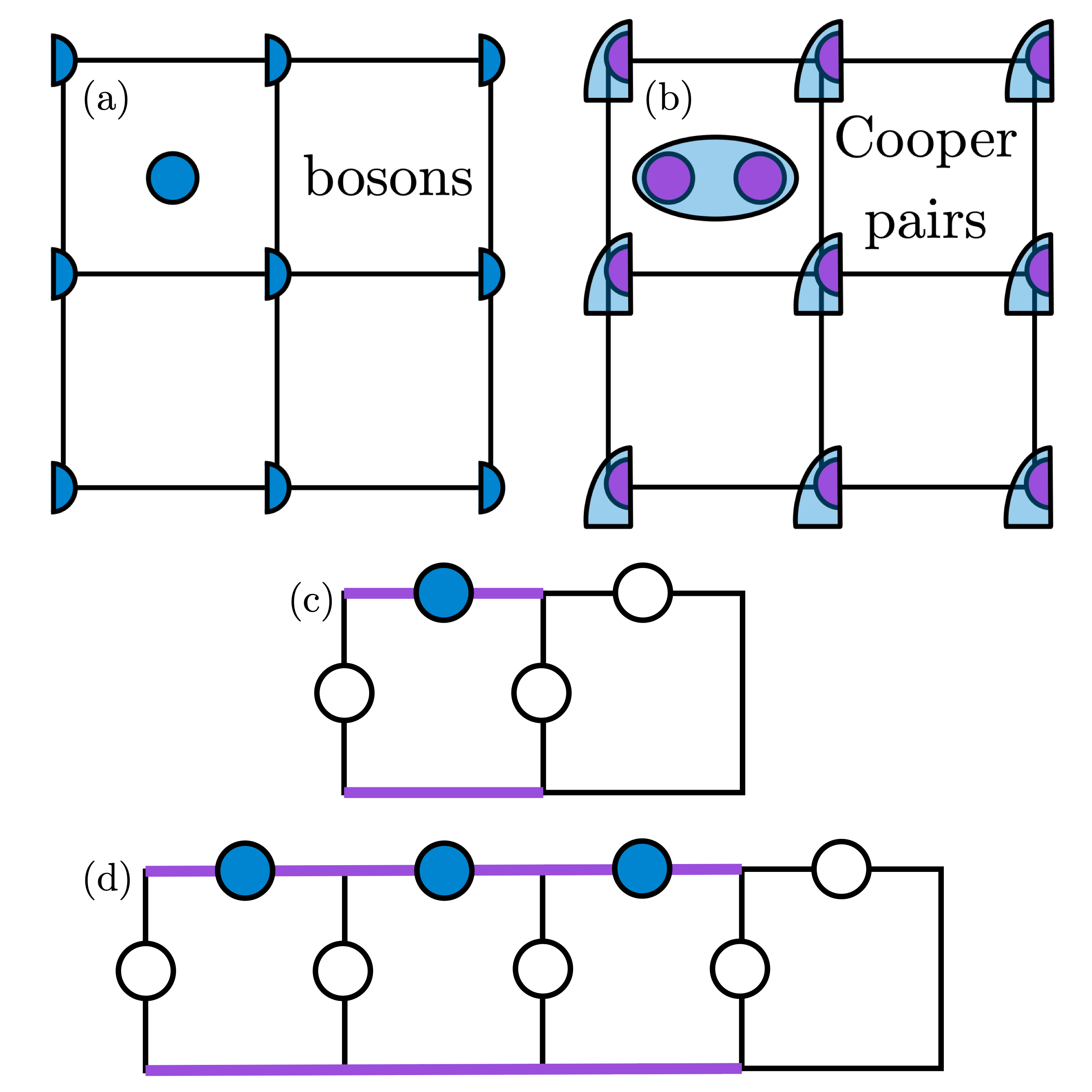
Figure 1: Schematic origin of minimal quantum charge liquids, illustrating fractionalized background anyon requirements across bosonic, fermionic, dimer, and tetramer settings.
Model Construction: Tetramers on the Square Lattice
Central to the construction is a family of resonating valence bond (RVB)-like wavefunctions for tetramers—extended objects covering four sites with varying degrees of bending—on the square lattice. Each configuration contributes to the wavefunction according to its number of bends, parameterized by an angle ν=1/20: fully straight (blue) and fully bent (red) tetramers are weighted by ν=1/21, where ν=1/22 is the number of bends. Notably, ν=1/23 interpolates between straight and bent-dominated regimes, with the equal mixture at ν=1/24.
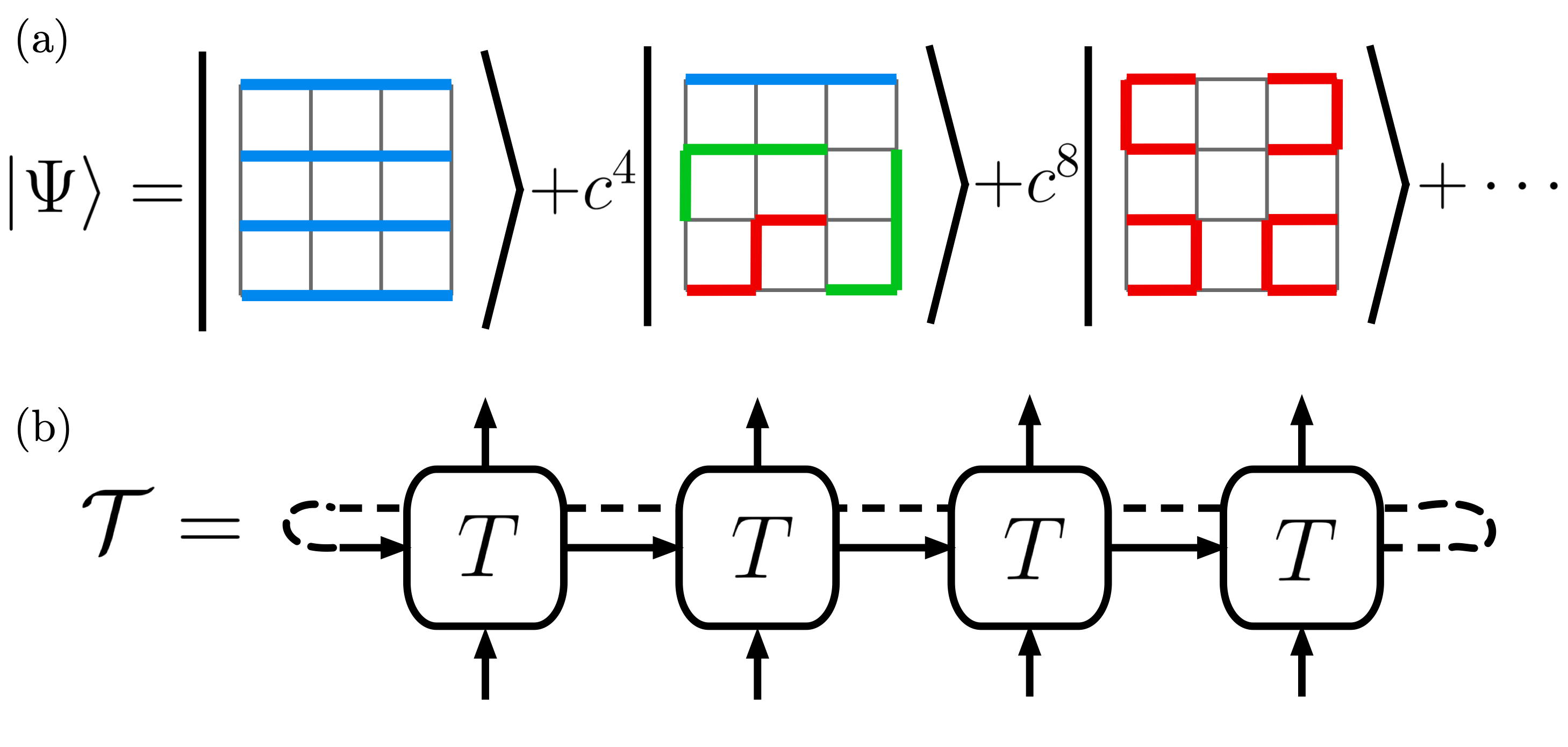
Figure 2: (Left) Depiction of RVB tetramer superpositions on the ν=1/25 lattice; (Right) Transfer matrix construction for semi-infinite cylinders utilizing site-wise rank-4 tensors ν=1/26.
The wavefunction admits representation as a projected entangled pair state (PEPS), with the transfer matrix ν=1/27 capturing correlation functions along the cylinder axis. The explicit ν=1/28 tensors, built from locality and tetramer constraints, encode a local ν=1/29 symmetry: each vertex emanates a flux of Z20, enforcing strict connectivity and constraining configurations to legitimate tetramers.
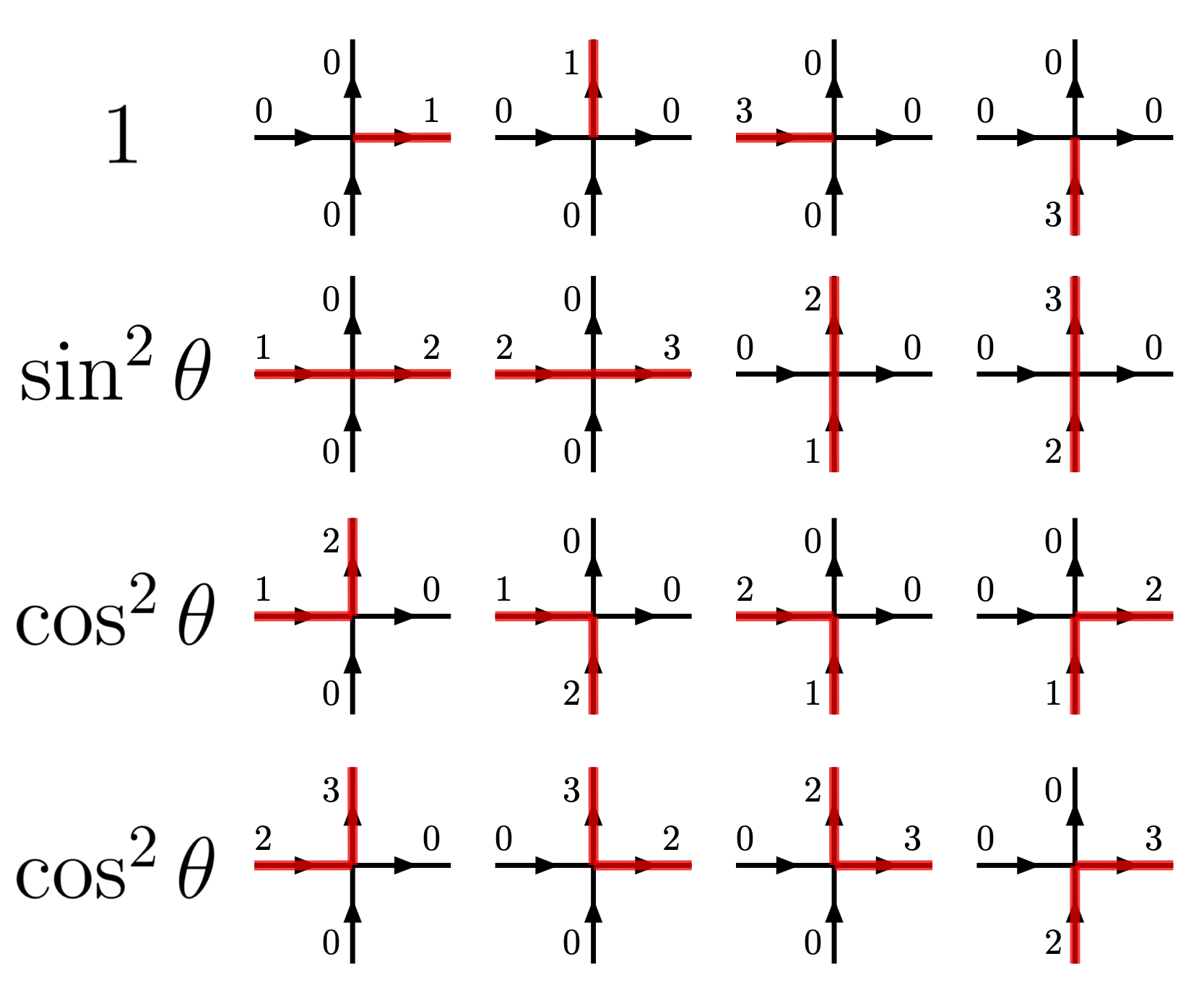
Figure 3: Tabulation of nonzero elements for the rank-4 tensor Z21 used in the transfer matrix formalism, showing vertex flux assignments modulo Z22.
Numerical Analysis: Topological Order and Gap Structure
Diagnosis of topological order and spectral gaps is performed via transfer matrix spectrum analysis. The local Z23 flux conservation manifests as a near four-fold degeneracy in the largest eigenvalues of Z24 in the thermodynamic cylinder limit. The presence of a gap is established by examining the scaling of the correlation length Z25 with cylinder circumference Z26 and PEPS bond dimensions Z27.
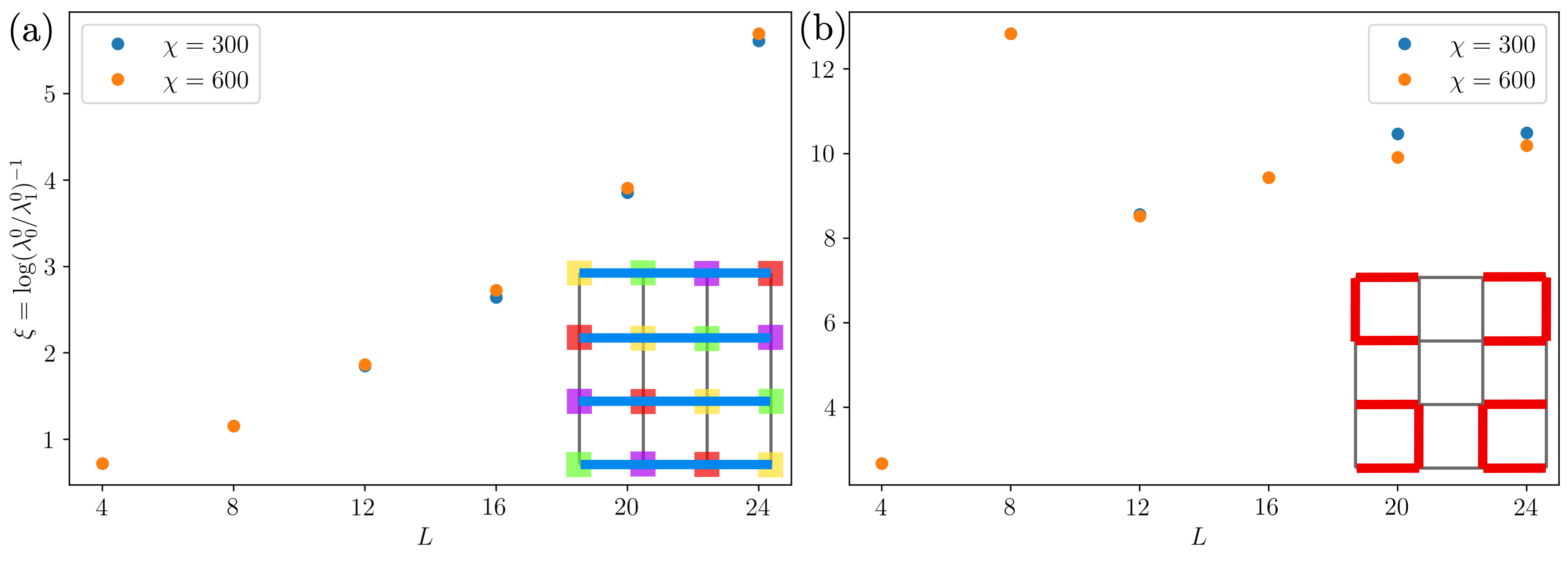
Figure 4: (a) Divergence of Z28 for fully straight tetramers (Z29), signifying gaplessness induced by Z30 conservation laws; (b) Saturation of Z31 for fully bent tetramers (Z32), demonstrating a clear finite gap.
For Z33 (fully straight), correlation length diverges, indicating emergent Z34 symmetry and associated gapless photon modes as seen in higher gauge theory settings. Conversely, for Z35 (fully bent), Z36 saturates with increasing Z37, a hallmark of a finite gap. The fourfold sector structure and locality of the Z38 tensor thus provide strong evidence for minimal Z39 TO in the gapped regime. At intermediate points (e.g., equal-weight q>30), numerical results are consistent with either a very small gap or a fine-tuned gapless point, but the minimal q>31 TO is robust near the bent-tetramer limit.
Extensions: Triangular Lattice and Scalability
To evaluate the generality of the construction, the tetramer model is also mapped to the triangular lattice, requiring adaptation to rank-6 tensors and substantial increase in bond dimension and MPO complexity.
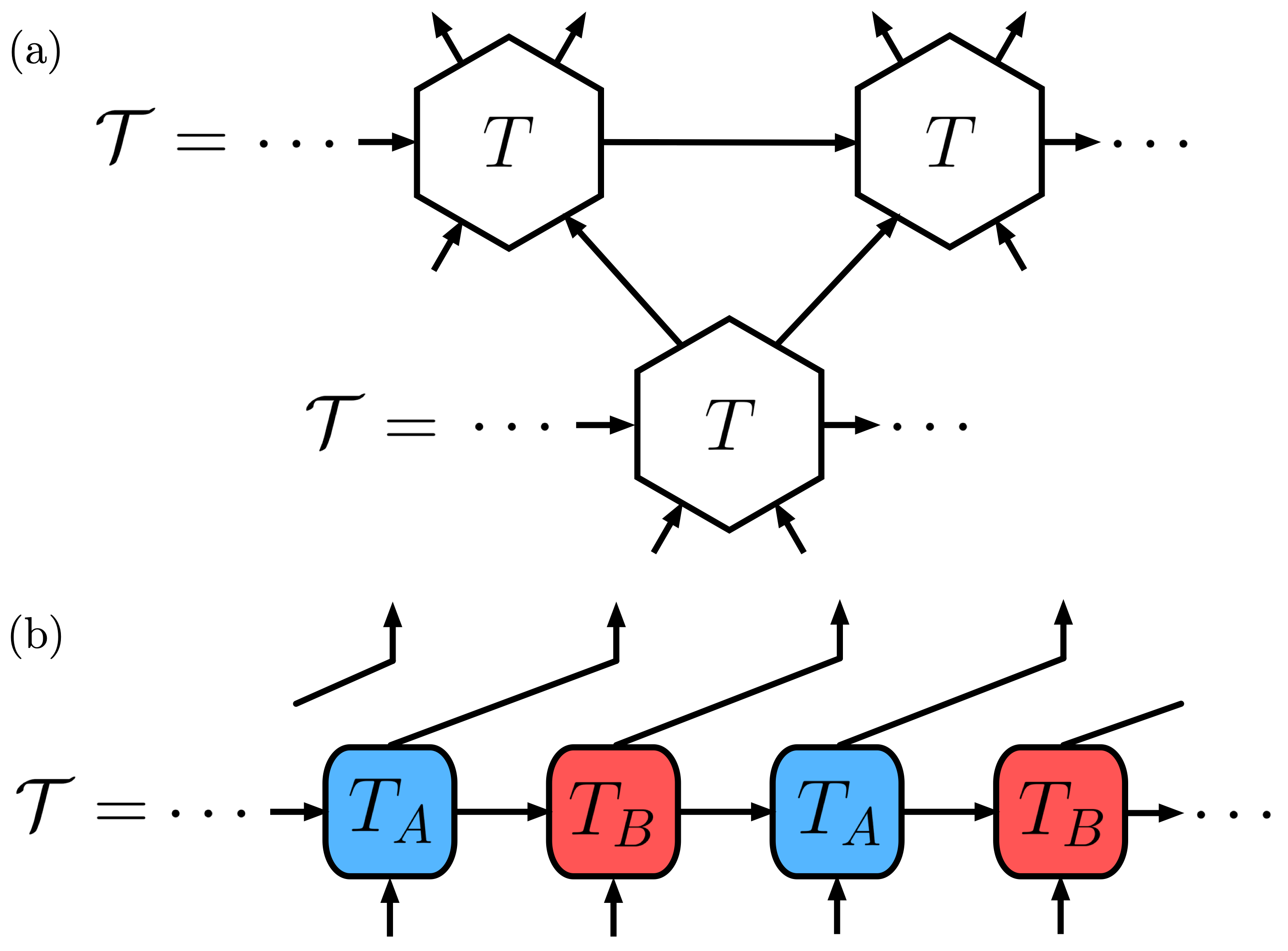
Figure 5: (a) Schematic of transfer matrix construction for tetramers on the triangular lattice using rank-6 tensors; (b) Decomposition into coupled rank-4 tensors to facilitate numerics.
Despite formidable computational costs, initial results on the triangular lattice suggest that the correlation length again saturates for equal-weight superpositions at accessible system sizes.
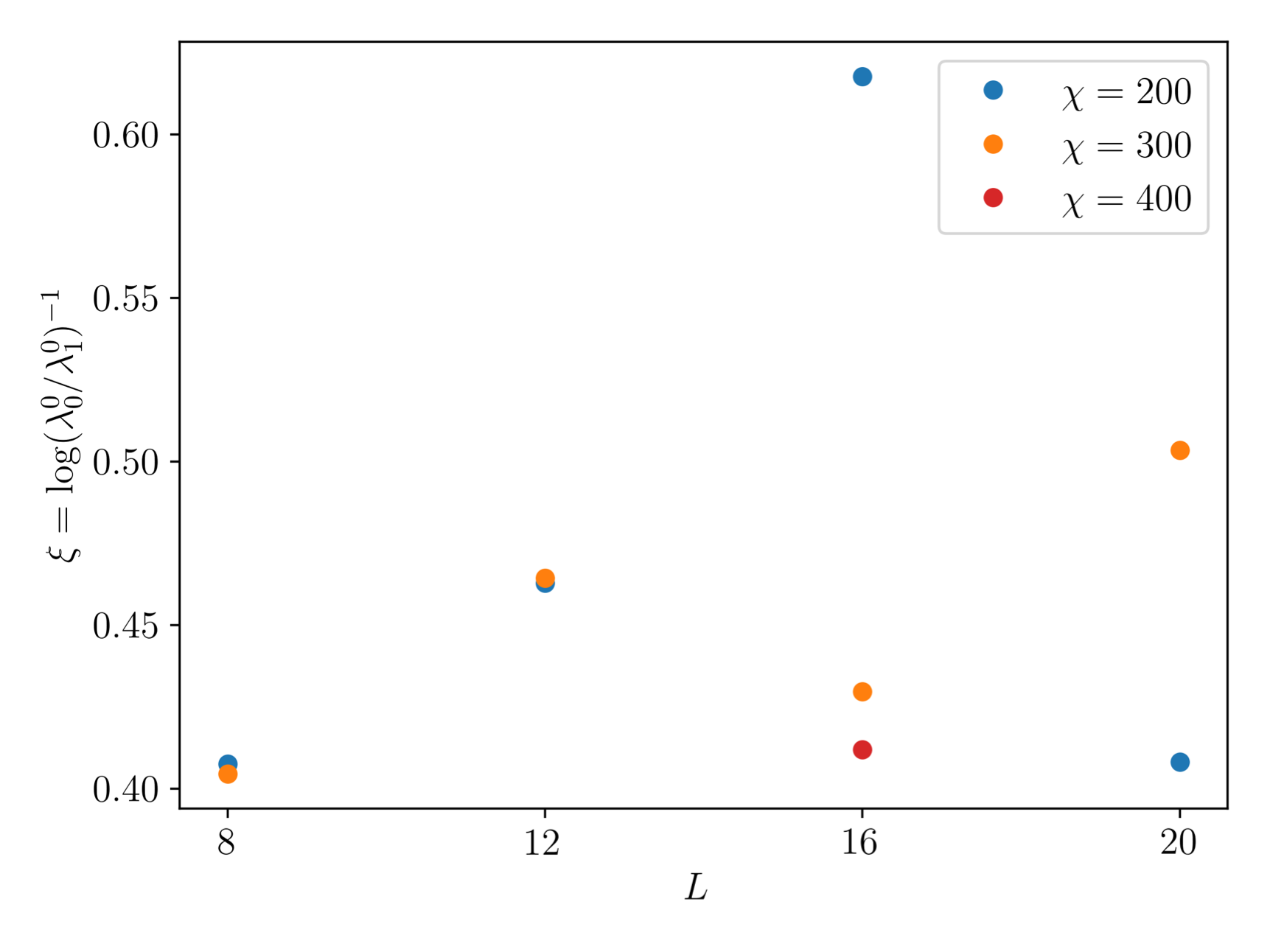
Figure 6: Correlation length q>32 vs circumference q>33 for the equal-weight tetramer wavefunction on the triangular lattice, suggesting a finite gap at large q>34.
However, reaching conclusive statements at larger q>35 or higher bond dimensions remains technically prohibitive, with further progress contingent on more advanced tensor network methods or increased computational resources.
Implications and Prospective Developments
The construction and numerical validation of a gapped bosonic QCL at q>36 with explicit q>37 TO set a precedent for similar models at even higher q>38. This has concrete implications for:
- Electronic QCLs: By mapping spinless fermions at q>39 to Cooper-paired bosons at ν=3/40, this approach enables theorists to construct explicit models for electronic fractionalized insulators with ν=3/41 TO.
- Extensions to Other Lattices and Physical Realizations: Analogs on kagome or decorated lattices may facilitate Rydberg atom implementations via constrained boson models, as previously achieved for trimer models.
- Theoretical Boundaries: The results furnish concrete realizations that saturate formal lower bounds on the number of anyons in Abelian TO at fractional filling and respect all LSMOH restrictions. Moreover, the identification of exact symmetries controlling gapless and gapped regimes enriches the taxonomy of strongly correlated insulators.
Ongoing work will necessarily address tensor network scalability, analytic understanding of effective field theories for QCLs at generic ν=3/42, and the search for physical systems—such as moiré TMDs or Rydberg array platforms—where such fractionalized insulators can be realized.
Conclusion
This study establishes a microscopic tetramer model at ν=3/43 filling as a candidate for the minimal ν=3/44 quantum charge liquid. Rigorous tensor network analysis confirms both the presence of a local ν=3/45 conservation law and a clear gapped regime with fourfold sector degeneracy and finite correlation length, in concordance with topological order expectations. The results close a longstanding gap in the catalog of QCL models at higher denominator fractional fillings and facilitate direct routes toward electronic QCLs with rich Abelian topological order. The extension of these ideas to other lattice geometries, fillings, and experimental platforms remains a compelling direction for future research in topological phases of correlated electrons and bosons.