The mixed-dimensional quantum MacWilliams identity: bounds for codes and absolutely maximally entangled states in heterogeneous systems
Published 28 Apr 2026 in quant-ph, cs.IT, and math.CO | (2604.25790v1)
Abstract: As emerging quantum architectures evolve into heterogeneous networks combining different physical substrates, such as qubits for logic and higher-dimensional qudits for robust communication, the traditional scalar metrics of quantum error correction become insufficient. To address this, we introduce a mathematical framework based on dimension multisets to characterize quantum error-correcting codes (QECC) and absolutely maximally entangled (AME) states in mixed-dimensional Hilbert spaces. By replacing scalar weights with multisets, we accurately capture the exact physical composition of error supports across these diverse systems. Our central result is the mixed-dimensional quantum MacWilliams identity, which establishes the formal algebraic relationship between Shor-Laflamme enumerators and unitary weight enumerators. From this foundation, we deduce the mixed-dimensional shadow identity and derive rigorous, generalized constraints on code parameters, explicitly formulating the mixed-dimensional quantum Hamming, Singleton and Scott bounds, and developing a linear program to systematically evaluate code viability. For the Singleton bound, a tighter bound that has no homogeneous analogue is derived for pure mixed-dimensional codes. Finally, we deploy this enumerator machinery to thoroughly analyze AME states, utilizing shadow inequalities to constrain their existence and introducing a combinatorial grid method for the explicit construction of mixed-dimensional tripartite AME states.
The paper introduces a multiset-based generalization of the quantum MacWilliams identity to address errors in heterogeneous quantum systems.
It derives generalized Hamming and Singleton bounds using linear programming tests for the existence of mixed-dimensional quantum codes.
The study applies the framework to establish constraints and construct absolutely maximally entangled states in varied quantum architectures.
Mixed-Dimensional MacWilliams Identity and Constraints on Heterogeneous Quantum Codes and AME States
Introduction and Motivation
The paper "The mixed-dimensional quantum MacWilliams identity: bounds for codes and absolutely maximally entangled states in heterogeneous systems" (2604.25790) develops a general mathematical framework for quantum error-correcting codes (QECCs) and absolutely maximally entangled (AME) states in heterogeneous quantum architectures, i.e., systems where the constituent subsystems (qudits) may have different local Hilbert space dimensions. This approach is motivated by developments in quantum architectures where distinct physical substrates for computation, memory, or communication are prevalent, e.g., combining qubits for logical operations and higher-dimensional qudits for robust communication. Traditional quantum coding theory and entanglement characterization, rooted in homogeneous (equal local dimension) systems, become inadequate for such architectures due to their reliance on scalar weights that cannot account for the physical and combinatorial structure of heterogeneous errors.
The core contribution is a multiset-based generalization of the quantum MacWilliams identity, unifying and extending the weight enumerator machinery—previously central in quantum codes and multipartite entanglement—to arbitrary mixed-dimensional Hilbert spaces. The formalism yields explicit enumerator identities, generalizes the Hamming, Singleton, and Scott bounds, and supports combinatorial algorithms for the explicit construction and non-existence certification of mixed-dimensional AME states.
Dimension Multisets, Error Structure, and Mixed-Dimensional Weight Enumerators
In mixed-dimensional systems, the support of an error is insufficiently specified by mere scalar weight (number of affected parties) or dimensional weight (product of local dimensions of the support). Instead, the full dimension multiset of the error support, which specifies the multiset of local dimensions on which the error acts, is tracked. For a system H=⨂i=1nCDi, a subset S⊂[n] has dimension multiset D(S)={Di∣i∈S}, and for an error E, D(suppE).
Using this structure, the Shor-Laflamme and unitary weight enumerators, as well as shadow enumerators, are elevated to multivariate polynomials where each distinct local dimension d∈D is associated to a pair of variables (xd,yd) and all enumerators are sums over dimension multisets, preserving the system's combinatorial details. This multiset framework reduces to the standard homogeneous case under uniform local dimension.
The key enumerator polynomial forms in terms of the multiset coefficients are:
with analogous formulations for the unitary and shadow enumerators.
The Mixed-Dimensional Quantum MacWilliams Identity
The central result is a mixed-dimensional MacWilliams identity relating the Shor-Laflamme and unitary weight enumerators via explicit transformations of the multiset variables:
This result is derived using a blend of combinatorial analysis (multiset counting on the system partition), algebraic manipulation of error bases, and the theory of polynomial invariants. This identity is foundational for transferring linear and positivity constraints between different enumerator representations (primal, dual, unitary, and shadow).
Generalized Bounds for Mixed-Dimensional Codes
Linear Programming Constraints
By expressing positivity conditions, trace-orthogonality, and the minimum distance constraints in terms of the multiset enumerator coefficients, the authors develop a linear programming (LP) test for code existence in terms of the variables {Av}. The non-existence of codes with certain parameters is established by infeasibility of the LP.
Hamming and Singleton Bounds
A mixed-dimensional quantum Hamming bound is established:
S⊂[n]0
where S⊂[n]1 is code dimension, and S⊂[n]2 is the maximum correctable error dimensional weight.
The Singleton bound is generalized: For any partition S⊂[n]3 of S⊂[n]4 with S⊂[n]5 (minimum distance), then S⊂[n]6 must hold. For pure codes, a strictly tighter bound (not reducible to the homogeneous case) is derived:
S⊂[n]7
for any submultiset S⊂[n]8 with S⊂[n]9. This illustrates that code optimality (i.e., quantum MDS) in mixed-dimensional settings does not generically imply purity, in contrast to the homogeneous case.
Absolutely Maximally Entangled States: Constraints and Construction
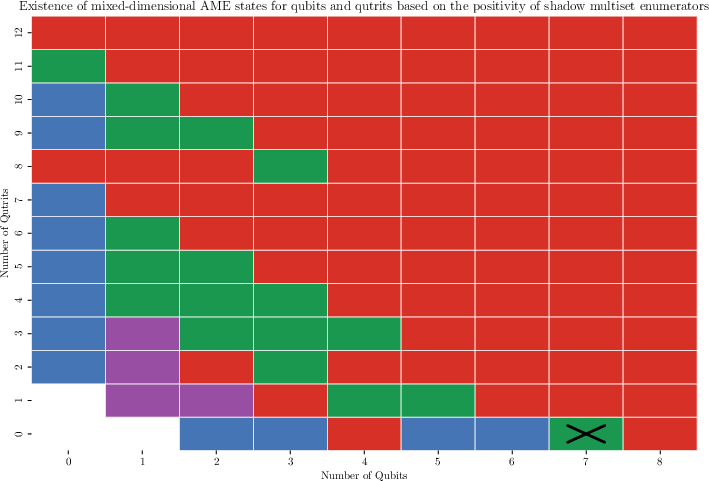
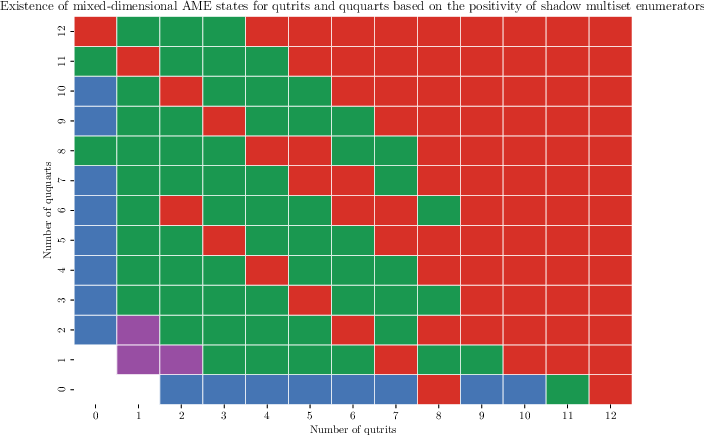
The machinery is applied to AME states, where existence and non-existence are predicted by shadow inequalities (positivity conditions on linear combinations of enumerator coefficients). Using the multiset structure, the necessary vanishing of certain coefficients for AME states is made explicit, and existence landscapes for heterogeneous AME states (e.g., qubit-qutrit) are computed.
Figure 1: Existence of mixed-dimensional AME states formed by qubits and qutrits based on the positivity of shadow multiset enumerators.
Scott-like bounds are generalized: for selected multiset pairs D(S)={Di∣i∈S}0, dimensions must satisfy
D(S)={Di∣i∈S}1
recovering known results in the homogeneous limit.
Figure 2: Existence of mixed-dimensional AME states based on the positivity of shadow multiset enumerators for qutrits and ququarts.
A combinatorial grid construction for explicit AME state generation in tripartite mixed-dimensional settings is provided, mapping the quantum-maximal mixing criteria to constraints on a grid of (real, non-negative) weights and their partitioning—providing a concrete combinatorial design procedure for heterogenous multipartite AME states.
Implications and Future Directions
The theoretical framework enables systematic existence/non-existence tests for QECCs and AME states in any mixed-dimensional setting, grounded in explicit algebraic, combinatorial, and LP conditions. The essential physical implication is that code optimality and entanglement maximality depend intricately on detailed combinatorial structure in heterogenous systems, and in particular, code purity is not in general achievable at the Singleton bound in the presence of non-uniform local dimensions.
Practically, this framework is poised to facilitate the design of codes and entanglement structures well-suited to real-world quantum hardware containing a mixture of qubit, qutrit, and higher-dimensional elements. From the perspective of quantum device architecture, the results provide precise criteria for capacity and entanglement across hybrid networks. The extension of the combinatorial construction methods to larger multipartite systems and their impact on transversal gates and fault tolerance stands as an important avenue for further study.
Conclusion
Dimension multisets and the mixed-dimensional MacWilliams identity provide a rigorous, generalizable foundation for the characterization of error correction and multipartite entanglement in heterogeneous quantum systems. The resulting bounds and criteria subsume and refine previous homogeneous theory, yield strong necessary conditions for code and AME existence, and reveal qualitative distinctions—such as the generic non-saturation of the Singleton bound by pure codes—that will inform the analysis and engineering of emerging quantum platforms.
“Emergent Mind helps me see which AI papers have caught fire online.”
Philip
Creator, AI Explained on YouTube
Sign up for free to explore the frontiers of research
Discover trending papers, chat with arXiv, and track the latest research shaping the future of science and technology.Discover trending papers, chat with arXiv, and more.