- The paper introduces GECKO, a novel post-processing routine exploiting the Jacobian kernel to optimize pulse quality without compromising fidelity.
- It demonstrates constrained optimization techniques that impose spectral filtering, pulse smoothing, and duration minimization in quantum control sequences.
- Numerical experiments show GECKO’s ability to achieve lower power, reduced noise sensitivity, and enhanced robustness in quantum gate implementations.
Pulse Quality Optimisation in Quantum Optimal Control: A Detailed Technical Review
Introduction
The paper "Pulse Quality Optimisation in Quantum Optimal Control" (2604.25768) addresses the inadequacy of quantum optimal control (QOC) methods that focus solely on fidelity maximization, neglecting secondary but crucial experimental objectives such as pulse smoothness, spectral constraints, robustness, and duration minimization. The authors introduce GECKO (geometric quantum control with kernel optimisation), a model-agnostic post-processing routine that traverses the level set of the quantum control landscape associated with a fixed unitary, seeking to optimize an arbitrary differentiable pulse-quality functional while keeping the target unitary—up to first order—unchanged.
Standard QOC frameworks—e.g., GRAPE, Krotov's method, CRAB, as well as the recently introduced GEOPE—seek to discover piecewise-constant control parameters Φ such that the system evolution closely matches a target unitary Utarget. These approaches optimize a fidelity function but often yield pulses that are experimentally suboptimal.
The key insight underpinning GECKO is rooted in the geometry of the special unitary group SU(N). For L time steps and K control channels, the parameter space is often highly redundant: multiple distinct pulse sequences can produce the same target evolution. GECKO exploits this by identifying the local tangent space (the Jacobian kernel) of the fidelity level set—a subspace of variations in Φ that leave the implemented unitary invariant to first order.
To formalize, for pulse parameters Φ, the Jacobian J(Φ) maps parameter-space variations to corresponding changes in SU(N). The kernel (nullspace), parameterized by orthonormal basis Z(Φ), comprises directions that do not change Utarget0 up to first order. GECKO performs constrained optimisation on pulse-quality objectives projected into this nullspace, enabling pulse refinement while maintaining high fidelity.
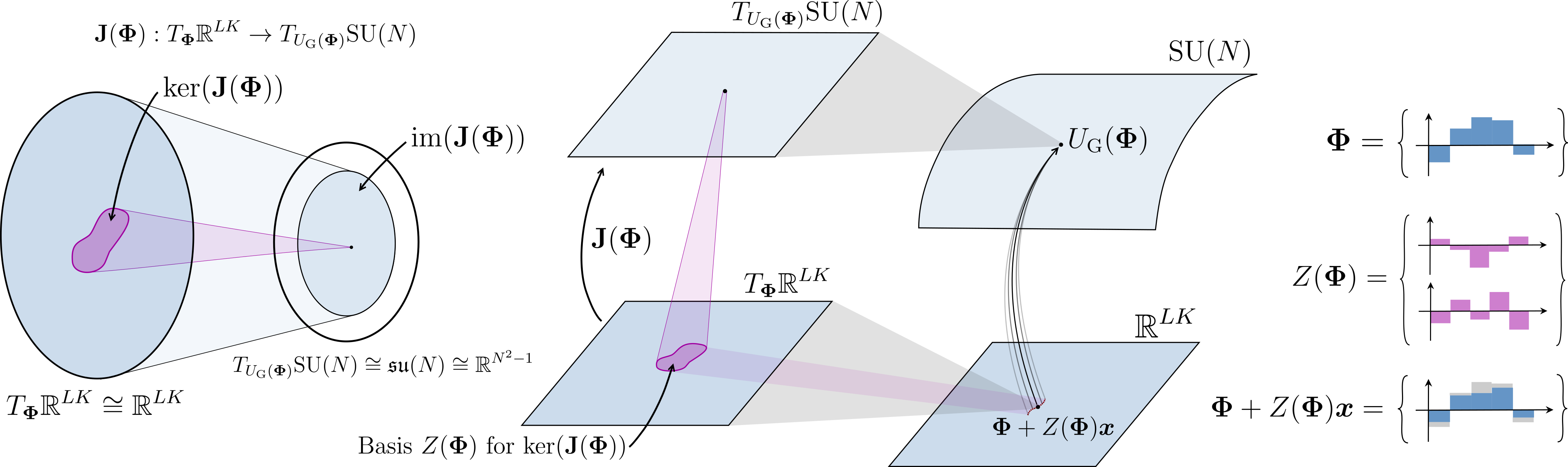
Figure 1: The structure of the mapping from pulse parameters to Utarget1, showcasing how the kernel of the Jacobian identifies fidelity-preserving directions in parameter space.
The GECKO algorithm iteratively projects the gradient of the pulse-quality functional into the kernel of the Jacobian (using either fixed-basis or gradient-projection schemes), takes a controlled step, then (if required) re-optimizes standard fidelity to remain on the desired unitary equivalence class. Computationally, this involves cost dominated by Jacobian evaluation, SVD-based kernel extraction, and pulse-quality gradient computation.
Numerical Demonstrations
Frequency-Domain Filtering
Spectral constraints are prevalent in quantum hardware due to bandwidth limitations. The authors demonstrate the ability of GECKO to impose arbitrary frequency filters (e.g., low-pass, high-pass, band-stop) on previously optimized pulses in a model two-qubit transverse-field Ising Hamiltonian. After moving into the frequency domain via DST-I, spectral filtering is expressed as a quadratic quality functional, and GECKO adaptively suppresses or enhances frequency components as specified.
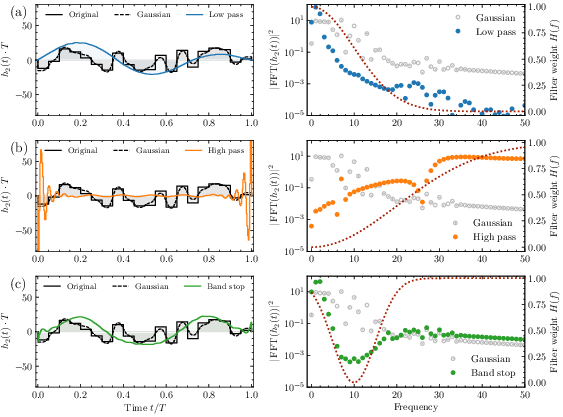
Figure 2: Application of low-pass, high-pass, and band-stop GECKO-based spectral filtering to a control pulse, illustrating preservation of fidelity while modifying the frequency content.
Pulse Smoothing
Excessive pulse roughness can introduce deleterious high-frequency components and increase noise sensitivity. GECKO enables targeted minimization of a quadratic smoothness functional—the sum of squared finite differences—in the kernel of the Jacobian. Comparison with Gaussian filtering shows that GECKO obtains pulse shapes with fewer extrema and less residual roughness, often discovering solutions where fewer control channels are necessary.
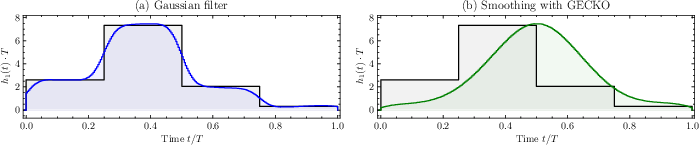
Figure 3: Comparison of Gaussian filtering and GECKO smoothing for a CZ pulse, demonstrating superior smoothness and minimal infidelity with GECKO.
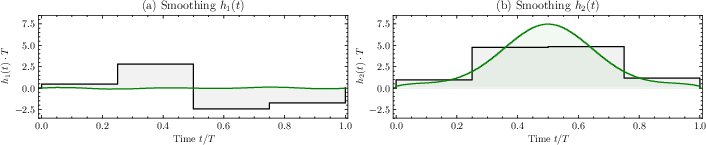
Figure 4: GECKO smoothing in a two-control scenario, frequently leading to the suppression of unnecessary controls to globally minimize roughness.
A large-scale assessment across 100 random initializations shows that GECKO consistently yields lower median power and smoother pulse shapes than Gaussian filters of varying bandwidth.
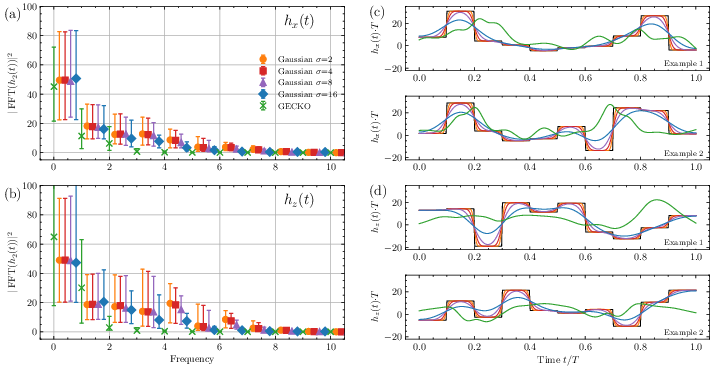
Figure 5: Statistical analysis of pulse power and smoothness over multiple initializations, demonstrating the advantage of GECKO smoothing over Gaussian filtering.
Robustness to Parameter Deviations
Robust quantum gates are essential for noisy intermediate-scale quantum (NISQ) devices. By constructing a robustness objective as the worst-case fidelity under bounded amplitude variation, GECKO directs pulse updates to regions of parameter space with increased flatness along specified directions. The method leads to pulses whose fidelity decay under parameter offsets is minimized, as empirically demonstrated on a two-qubit CZ gate.
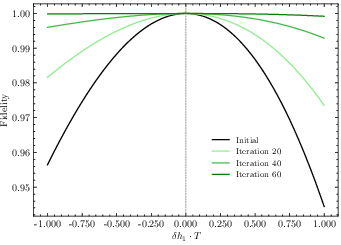
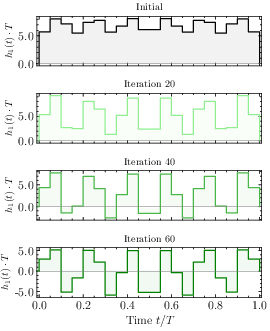
Figure 6: Evolution of fidelity and pulse parameters under GECKO robustness optimization, showing reduced fidelity sensitivity to amplitude offsets.
Pulse Duration Minimization
Minimizing gate duration mitigates both decoherence-induced errors and computation throughput penalties. GECKO applies two metrics: geometric path-length minimization (relating pulse duration to Utarget2 geodesics) and drift-constrained minimal duration (fixing entangling drift strength). In both cases, GECKO converges on pulses saturating speed limits imposed by the system Hamiltonian and constraint set.
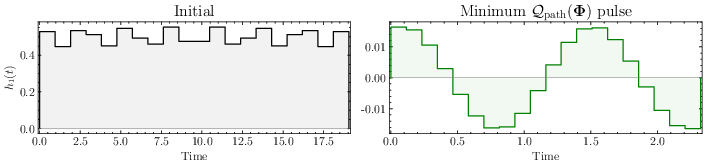
Figure 7: Initial random versus GECKO-optimized pulse for path-length minimization, demonstrating convergence to a minimal duration CZ gate.
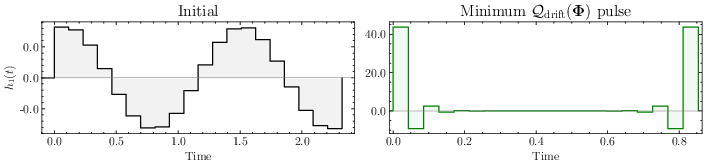
Figure 8: Minimum duration pulse under drift-strength constraint, with GECKO starting from path-minimized initialization and discovering substantially faster solutions at the cost of increased local amplitude.
Discussion, Implications, and Future Directions
The separation of fidelity maximization from experimental feature optimization, as instantiated in GECKO, allows arbitrary differentiable objectives to be incorporated post hoc—enabling flexible, platform-agnostic adaptation. In practical terms, GECKO can be sequentially or jointly applied to optimize for system bandwidth (spectral filtering), implementation feasibility (smoothness), robust error suppression, and speed, subject to hardware constraints. The ability to combine multiple objectives via weighted sum functionals further increases applicability.
A primary scalability bottleneck is the Jacobian/kernel computation, which scales exponentially with qubit number due to Hilbert space dimension. For systems up to Utarget3 qubits, this remains tractable, especially for implementation in high-fidelity noisy quantum devices and small quantum computers. For larger systems, exploiting symmetries, sparsity, or approximate kernel learning could address the scaling. Furthermore, GECKO’s geometric formulation links directly to open questions in quantum complexity geometry, subRiemannian optimization, and geodesic computation in Utarget4.
Conclusion
This work presents GECKO, a versatile, geometrically grounded framework for secondary optimisation of quantum control pulses. By leveraging the kernel of the fidelity Jacobian for any Utarget5-qubit gate, pulses are adaptively refined for arbitrary differentiable objectives with negligible fidelity loss. The authors demonstrate strong results in spectrum control, smoothness, robustness, and time optimality, with clear implications for experimental quantum technology. The geometric scope and practical efficacy of GECKO position it as an essential addition to the QOC toolbox, especially as focus shifts from pure fidelity towards implementing experimentally viable quantum controls.

