Sensitivity-Based Tube NMPC for Cooperative Aerial Structures Under Parametric Uncertainty
Published 28 Apr 2026 in cs.RO | (2604.25766v2)
Abstract: This paper presents a sensitivity-based tube Nonlinear Model Predictive Control (NMPC) framework for cooperative aerial chains under bounded parametric uncertainty. We consider a planar two-vehicle chain connected by rigid links, modeled with input-rate actuation to enforce slew-rate and magnitude limits on thrust and torque. Robustness to uncertainty in link mass, length, and inertia is achieved by propagating first-order parametric state sensitivities along the horizon and using them to compute online constraint-tightening margins. We robustify an inter-link separation constraint, implemented via a smooth cosine embedding, and thrust-magnitude bounds. The method is implemented in MATLAB and evaluated with boundary-hugging maneuvers and Monte-Carlo uncertainty sampling. Results show improved constraint margins under uncertainty with tracking performance comparable to nominal NMPC.
The paper presents a novel sensitivity-based tube NMPC that robustly manages cooperative aerial chain dynamics under parametric uncertainty.
It integrates first-order parametric sensitivities into NMPC to tighten constraints on-the-fly, improving safety margins in constraint-critical maneuvers.
Simulation studies demonstrate a 100% success rate with tube NMPC versus 58% with nominal control, while maintaining real-time computational feasibility.
Sensitivity-Based Tube NMPC for Cooperative Aerial Chains Under Parametric Uncertainty
Introduction and Problem Formulation
Cooperative aerial structures, such as chains of multi-rotor aerial vehicles interconnected by rigid links, present significant challenges for real-time control due to nonlinear, strongly coupled dynamics and the presence of stringent physical and actuation constraints. These challenges are amplified in contact-rich or boundary-hugging tasks, where even brief constraint violations may be unacceptable. Traditional Nonlinear Model Predictive Control (NMPC) frameworks frequently fail to ensure robust constraint satisfaction under parametric uncertainty, particularly when system parameters such as link mass, length, and inertia are prone to significant mismatches relative to model assumptions.
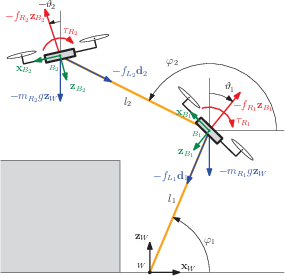
This paper addresses robust NMPC for planar cooperative aerial chains by introducing a sensitivity-based tube NMPC strategy that maintains constraint satisfaction under bounded parametric uncertainty. The primary configuration is a planar chain of two underactuated vehicles connected by links of uncertain properties and actuated via input-rate-limited thrust and torque, as represented in Figure 1.
Figure 1: Schematic of a two-vehicle cooperative aerial chain highlighting the main state variables and an example manipulation scenario.
Parametric uncertainty in the physical model is encoded by allowing relative deviations in vehicle and link mass, link lengths, and rotational inertias, thereby capturing realistic fabrication, identification, and operational variabilities. This uncertainty impacts the feasibility and safety of constraint-critical maneuvers, necessitating robust approaches to remain within geometric and actuation limits across all admissible parameter realizations.
Sensitivity Augmentation and Prediction Model
The control-oriented model augments the traditional state vector with both actuator (thrust and torque) integrators and their time derivatives as decision variables, enabling direct incorporation of actuator slew-rate constraints. The NMPC evaluation horizon propagates not only the nominal predicted trajectory but also a first-order parametric state sensitivity matrix, Π, computed via automatic differentiation and discretized in sync with the primary system integrator.
The prediction model is therefore augmented to jointly update the state and sensitivities at every stage. Parametric state sensitivities are initialized at zero under the assumption of parameter-independent state estimates and are recursively propagated horizon-wide at each sampling instant.
Sensitivity-Based Constraint Tightening
Tube-based robust NMPC traditionally "tightens" constraints to ensure constraint feasibility for all parameter instances within the uncertainty set. In nonlinear, underactuated settings with wrapped or periodic geometric constraints—as with angular separation—exact tube computation is infeasible online. The proposed method exploits on-the-fly, first-order sensitivity propagation to produce local, trajectory-dependent constraint margins for robustification.
For a generic nonlinear scalar constraint y(x,p)≤ymax, the sensitivity-based tightening adds a margin
αy=ΠyWpΠy⊤+εs,
where Πy is the first-order sensitivity of y with respect to parameters, Wp encodes the geometry and scale of the uncertainty set, and εs is a regularization constant. Tightened constraints of the form
y(xi,p0)+αy(xi,Πi)≤ymax
are enforced throughout the prediction horizon, ensuring robustness with tractable computational complexity.
The approach is particularly salient for nonlinear, periodic constraints such as inter-link angular separation—implemented using a cosine-embedded smooth inequality to sidestep the branch-cut pathologies encountered with direct angle wrapping—and for thrust magnitude bounds, where input limits are coupled to dynamic and parametric effects.
Simulation Study and Empirical Evaluation
A suite of MATLAB-based closed-loop simulations assesses the efficacy of nominal vs. sensitivity-tube NMPC for a constraint-critical, boundary-hugging maneuver. The reference trajectory is designed to drive the system near feasibility boundaries and stress both geometric and actuation limits under uniformly sampled uncertainties.
Elevation angles, internal stresses, and constraint margins are extensively compared between nominal and robust controllers. Figures below depict the output behaviors for the two controller types.
Both controllers achieve comparably low tracking error in mild uncertainty realizations. However, notable differences emerge in constraint residuals and violation rates. Signed residuals for critical constraints (cosine-based angular separation and thrust bounds) demonstrate a pronounced improvement in robust feasibility margins with tube NMPC. While the nominal controller frequently operates at or beyond the activation boundary under adversarial parameters, the robust controller systematically maintains a nonzero margin.
Monte Carlo analysis over 500 randomized trials shows a success rate of 100% for tube NMPC, versus only 58% for the nominal approach. Figure 2 demonstrates this across the distributions of tracking Root Mean Square Error (RMSE) and constraint margin statistics.
On the computational side, although the tube NMPC increases the number of decision variables over the prediction horizon by approximately sevenfold, modern solvers on desktop hardware achieve solve times and iteration budgets within real-time constraints. Projected embedded implementations are expected to maintain real-time viability based on prior work.
Theoretical and Practical Implications
This study demonstrates that sensitivity-based first-order tube tightening is an effective, computationally tractable method for robustifying NMPC in nonlinear, underactuated cooperative aerial systems. By locally adapting constraint margins according to trajectory-dependent parameter sensitivities, the approach outperforms nominal controllers in terms of constraint satisfaction without significant degradation in tracking accuracy. It circumvents the conservatism of off-line min-max robust MPC or invariant set-based tubes, and it is directly compatible with highly nonlinear, input-rate-limited, and periodically constrained dynamical systems.
Practically, the framework is directly applicable to multi-vehicle aerial manipulation and inspection tasks where robust safety is critical, including but not limited to power-line maintenance, contact-based assembly, and cooperative payload transportation. The method admits natural extension to higher-dimensional aerial skeletons and variable-topology multi-robot systems, provided local differentiability is maintained throughout the feasible set.
Future Directions
There are several avenues for further investigation:
Extension to Three-Dimensional and More Complex Chains: Incorporating additional degrees of freedom, n-link chains, or actuation redundancies, as well as accommodating closed-chain kinematics and complex workspace constraints.
Integration of Higher-Order Sensitivities or Interval Arithmetic: To further reduce conservatism in highly nonlinear or nonlocal regimes, especially when working near kinematic singularities or in regimes where first-order linearization loses fidelity.
Cable-Driven and Hybrid Structures: Addressing additional complexity stemming from unilateral tension constraints and variable link length, characteristic of practical cable-suspended cooperative systems.
Embedded and Parallelized Real-Time Solvers: Leveraging code generation and parallel architectures to enable scaling to larger aerial swarms or higher update rates.
Conclusion
This work establishes sensitivity-based tube NMPC as a robust, scalable, and computationally efficient solution for constraint-critical cooperative aerial robotic systems under realistic parametric uncertainty. Empirical analyses validate substantial improvements in safety margins and success rates with only a moderate increase in computational cost. This framework paves the way for robust, uncertainty-aware deployment of interconnected aerial vehicles in contact-rich, regulation-sensitive environments (2604.25766).