- The paper introduces a unified framework for thermo-optic reconfiguration in ENZ media, revealing that thermal effects can induce rapid, picosecond-scale nonlinear optical responses.
- It demonstrates that metal-dielectric multilayer stacks can achieve a modulation rate of 322.7±23.9 GHz/K through pronounced blueshifts driven by Ag expansion and permittivity variations.
- The study shows that ENZ metamaterials offer ultrasensitive static and transient temperature sensing, enabling real-time thermal management in photonic circuits.
The paper "Thermo-optic dynamics of effective epsilon-near-zero media" (2604.25656) introduces a unified physical framework wherein both static and dynamic thermo-optic phenomena are conceptualized as a reconfiguration of the effective medium in epsilon-near-zero (ENZ) systems. This approach transcends the traditional view of thermal effects as slow perturbations, revealing that the singular dispersion and tensorial permittivity of ENZ media amplify thermal sensitivity and enable picosecond-grade nonlinear responses. The authors experimentally demonstrate that temperature—either under equilibrium or transient optical excitation—alters both permittivity and thickness in metal-dielectric multilayers, shifting the ENZ spectral location and modifying nonlinear optical behavior.
The device platform is a five-period Ag/SiO2 metal-dielectric stack, designed for visible-range ENZ conditions targeting harmonics near 516–532 nm. The effective-medium theorem and Maxwell-Garnett equations are used to model the anisotropic permittivity. Temperature-dependent spectroscopic ellipsometry reveals a pronounced blueshift of the ENZ frequency under heating, contradictory to previous findings in ITO-based ENZ media, which demonstrated redshift or irreversible change under annealing. The blueshift reflects the dominant contribution of Ag thermal expansion and permittivity temperature dependence, which overshadow those of silica. The extracted modulation rate reaches 322.7±23.9 GHz/K, two orders of magnitude higher than previously established records in CMOS-compatible ENZ materials.
Enhancement of Thermo-Optic Coefficient and Resultant Nonlinearity
A significant finding is the unprecedentedly large effective thermo-optic coefficient (TOCeff), approaching ±10−1 K−1 in the ENZ regime. This arises from a spectral offset in neff due to the dispersion profile, resulting in simultaneous positive and negative TOCeff within the enhancement region. Away from ENZ, TOCeff drops to ordinary values comparable to conventional nanomaterials. The ENZ-enhanced TOC yields giant thermo-optic nonlinearities, with the effective nonlinear-index coefficient (n2,eff(th)) peaking three orders of magnitude above ITO ENZ devices, corroborated by pump-probe experiments.
Picosecond-Scale Thermo-Optic Nonlinearity via Dynamic Effective-Medium Reconfiguration
Ultrafast pump-probe experiments directly track the transient nonlinear response following femtosecond excitation near ENZ wavelengths.
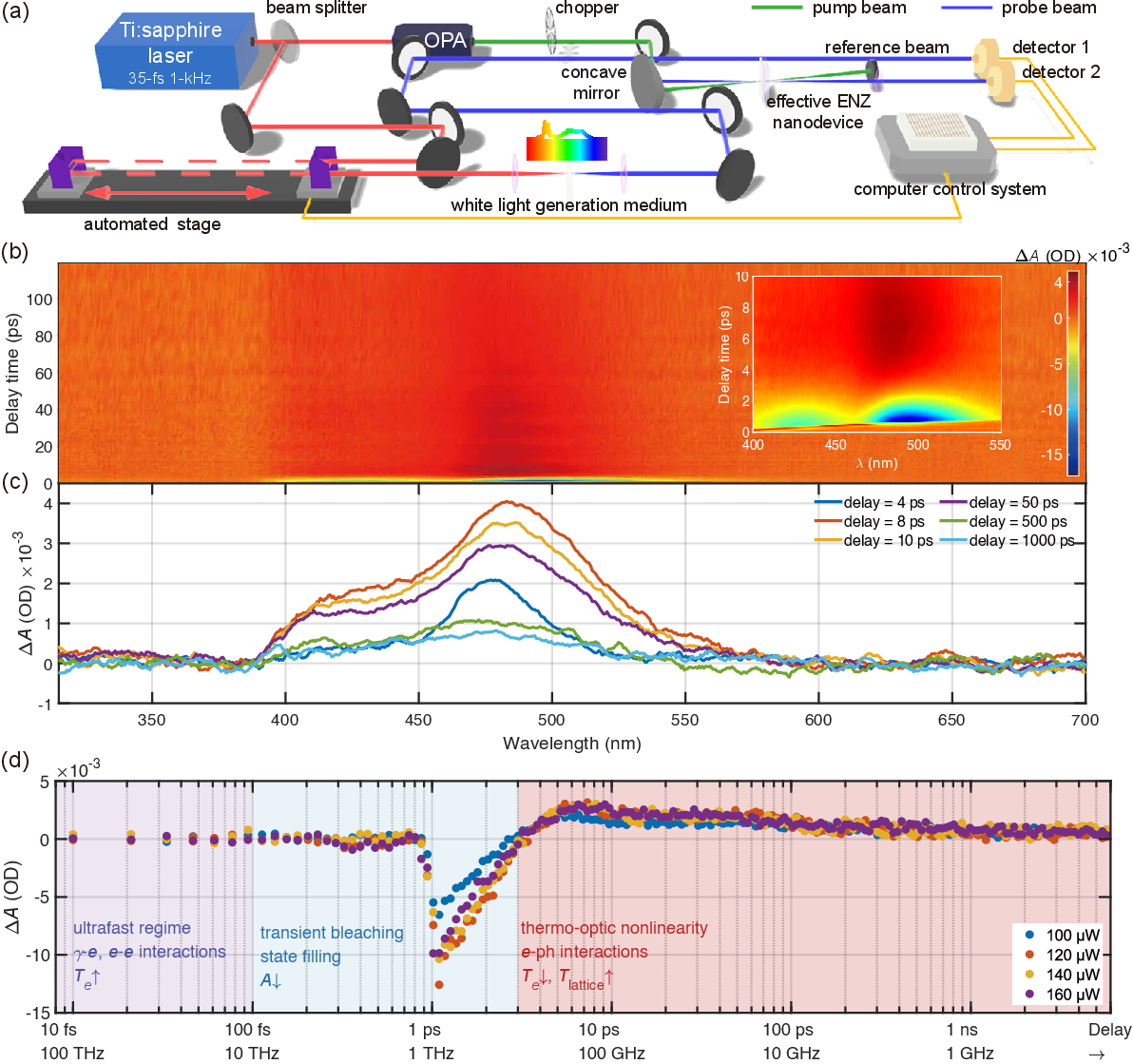
Figure 2: Ultrafast pump-probe experiments at the visible range, mapping spectral-temporal evolution and nonlinear absorption peaks.
Early-stage Kerr nonlinearity is resolved in the sub-picosecond regime, followed by a rapid thermal response as electron-phonon coupling elevates the lattice temperature, peaking at ~8.1 ps. This dynamic is interpreted using a two-temperature model (TTM), which simulates the time-dependent evolution of electron and lattice temperatures and the associated plasma frequency shifts in silver layers.
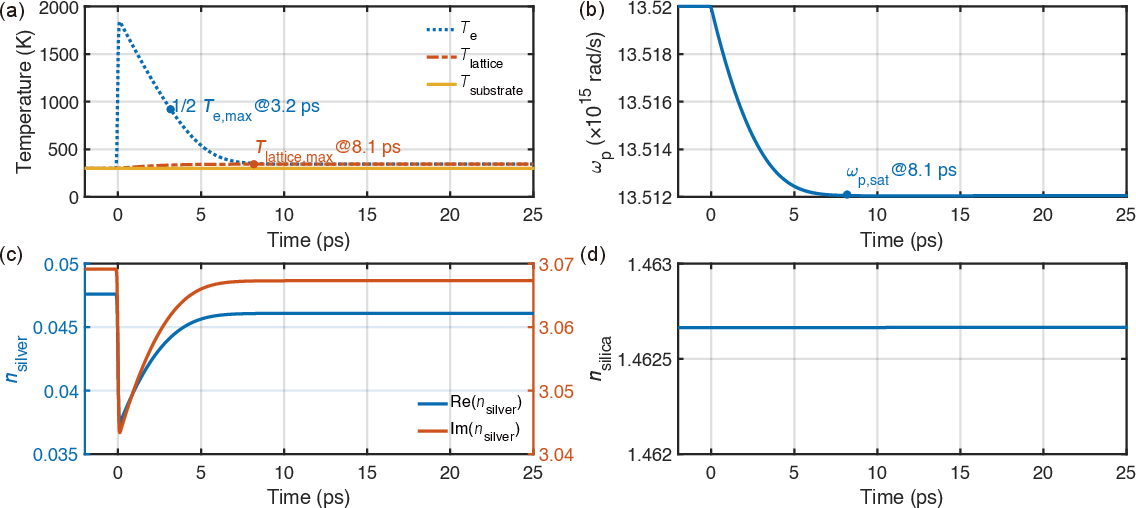
Figure 4: TTM simulation of electron/lattice/substrate temperature evolution and time-dependent plasma frequency changes, elucidating picosecond-scale nonlinear response.
The dynamic reconfiguration of the effective medium in real time—under ENZ conditions—enables transient temperature detection beyond the temporal resolution of conventional thermal sensors, thus constituting a fundamentally new regime for photonic circuit protection.
The pronounced sensitivity and speed of the ENZ metamaterial enable novel applications in temperature sensing. Without any resonant structure, the device achieves a modulation rate and TOC rivaling or surpassing state-of-the-art organic sensors, while maintaining CMOS compatibility and structural simplicity. The ENZ wavelength shift is used directly for static temperature sensing, offering a deployable unit for high-precision monitoring in photonic system-on-chip platforms.
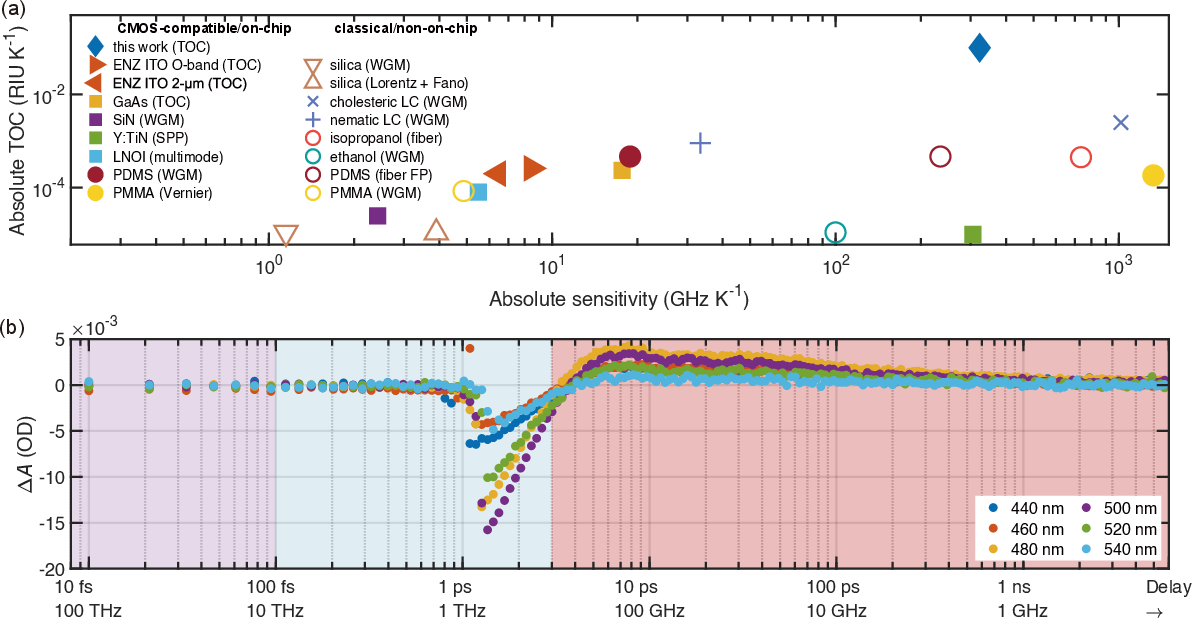
Figure 1: Comparative performance metrics in TOC and sensitivity versus organic and inorganic competitors, and ultrafast probe response for transient heat detection.
Transient detection of femtosecond optical pulse-induced heating is validated, with the ENZ metamaterial detecting ΔT as low as 0.23 K per single pulse—a capacity unattainable by conventional photonic temperature sensors.
Theoretical and Practical Implications
The theoretical reframing of thermo-optic effects as effective-medium reconfiguration establishes a new paradigm for ENZ photonics, coupling structure, composition, and optical response. Practically, such ENZ metamaterials enable new thermal risk management strategies for PICs and provide a platform for real-time heat-flow mapping and ultrafast thermal logic. The results suggest opportunities for neuromorphic photonics, time-varying interface studies, and exploitation of diverse nonlinear phenomena in visible-compatible, CMOS-ready devices.
Conclusion
This study provides a comprehensive framework for thermo-optic dynamics in ENZ media, demonstrating both static spectral shifts and picosecond-scale nonlinear responses in metal-dielectric metamaterials. The findings reveal bold enhancements in thermal sensitivity and nonlinearities, affirming that ENZ conditions facilitate extreme coupling between structural, thermal, and optical degrees of freedom. The implications span static and transient sensing, all-optical modulation, and advanced photonic circuit protection, positioning ENZ metamaterials as a universal and versatile platform for next-generation thermo-optical applications.

