- The paper introduces a machine learning regression model that predicts cost savings from replanning in robust MAPF execution.
- It leverages ADG-derived features such as total and maximum action delays to assess the benefit of dynamic replanning in uncertain environments.
- Experimental results show the model captures 94.6% of potential savings with minimal false positives, ensuring efficient intervention decisions.
Learning-Based Replanning Decisions in Robust Multi-Agent Path Finding Execution
Introduction
Robust execution of Multi-Agent Path Finding (MAPF) plans in practical deployments requires mechanisms to address asynchrony and agent delays, which are not captured in classical MAPF formulations. The Action Dependency Graph (ADG) framework enables temporally safe plan execution by enforcing action precedences and managing risk of collisions under uncertain action durations. However, delays—arising from internal disturbances or exogenous factors such as dynamic obstacles—can significantly degrade execution performance, particularly as waiting cascades propagate through temporally coupled actions. In these contexts, replanning offers a potential mitigation but incurs computational cost, and may be unhelpful if the new plan offers no better execution cost than the incumbent. The paper "Should I Replan? Learning to Spot the Right Time in Robust MAPF Execution" (2604.25567) proposes a machine learning–driven approach to predict the expected benefit of replanning online, using a regression model that ingests novel, ADG-derived features to identify execution states where replanning yields nontrivial cost recovery.
The central problem considered is the Replanning Prediction Problem (RPP): Given a current robust MAPF execution state (under ADG control and potential dynamic obstacle interference), predict the expected execution cost savings from triggering a single replanning operation at the present time. A feed-forward neural network regression model is trained to estimate savings in Sum of Costs (SOC) by leveraging features derived from runtime monitoring of the ADG, quantifying execution deviations, action delays, plan delays, slack variations, and structural properties of the instance.
The feature bank consists of 18 categories (parametrized for recency in delay metrics), spanning static instance descriptors, solution properties, and live ADG-derived statistics such as maximum observed action delay, cumulative delay, and slack increases across precedence edges. Label data is generated via large-scale simulation: For each MAPF instance, random agent initializations, random dynamic obstacle insertions (timing/location), and multiple replanning times are used to assemble a data set (N=12,000), with the regression target being the difference in execution cost between disturbed runs with/without replanning at the specified replanning time.
Experimental Setup
The core experimental platform utilizes a simulated environment with up to 25 agents per scenario and 1-robust ECBS for plan computation, across four environment topologies Figure 1.
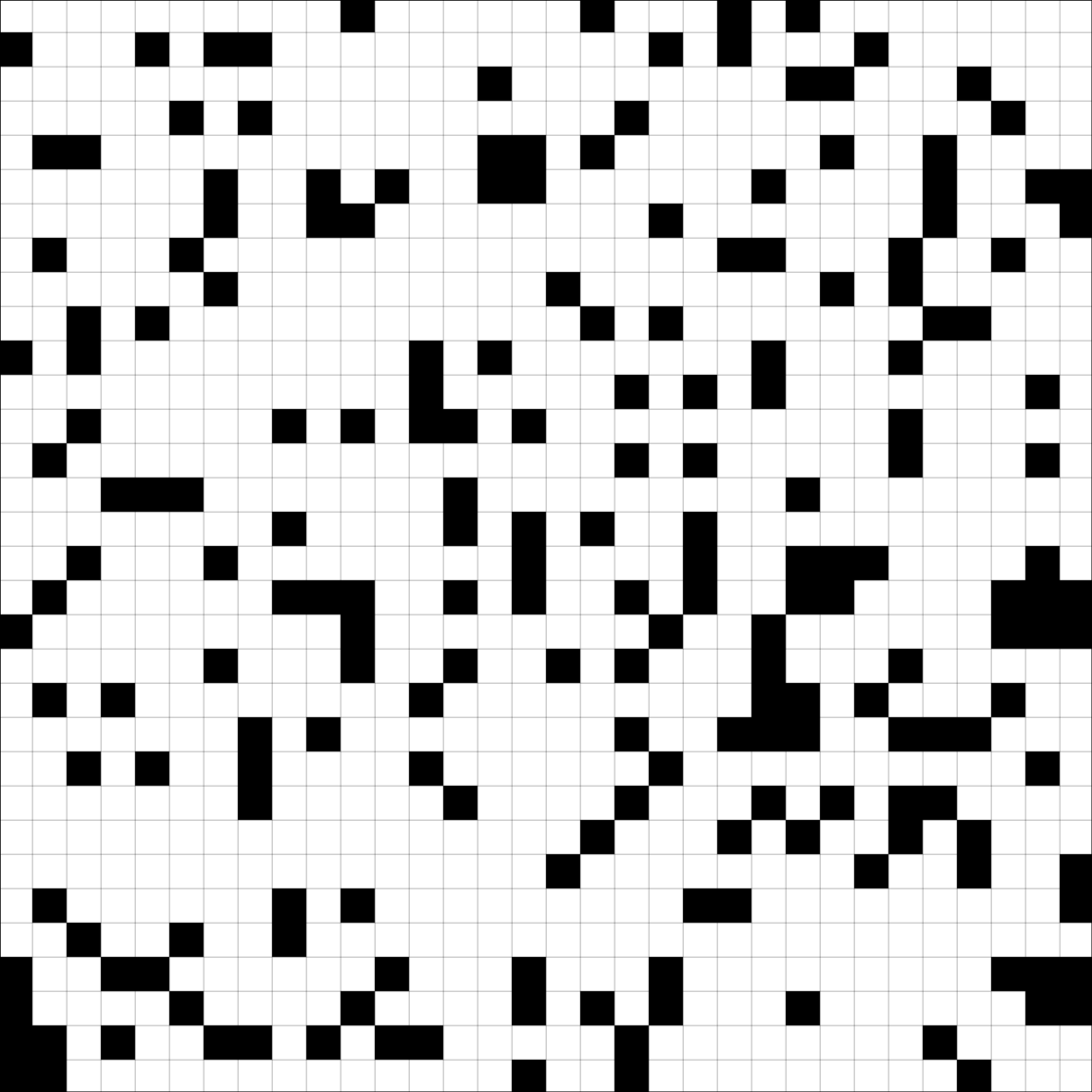



Figure 1: Diversity of evaluation environments, including random, grid with rooms, and realistic lab/arena layouts.
Dynamic obstacles are injected to induce delays, and supervised training data is compiled by executing, for each scenario, the original plan (with/without dynamic obstacle), and the replanned solution at multiple candidate triggers, recording cost outcomes. The evaluation metrics capture how often significant SOC degradation occurs, how well the model predicts interventions with benefit, and whether the method remains robust when including actual planning overhead.
Experimental Results
Quantifying Execution Degradation and Potential for Recovery
The presence of dynamic obstacles produces highly skewed distributions of SOC increase; in 5% of runs, impact exceeds 20% of baseline cost (see Figure 2 and Figure 3).
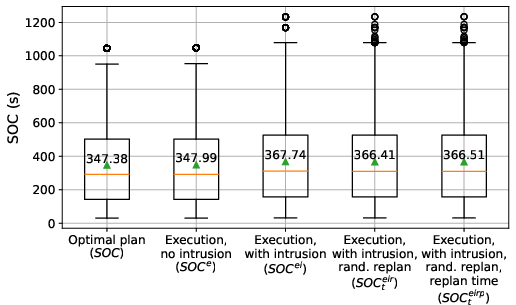
Figure 2: Distribution of SOC across all scenarios—showing the effect of dynamic obstacles and random replanning interventions.
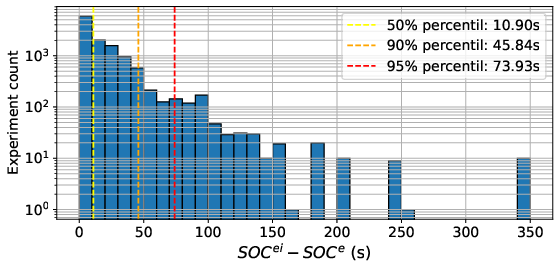
Figure 3: SOC increase histogram induced by dynamic obstacle intrusion.
Notably, indiscriminate replanning at random intervals yields negligible average benefit and may worsen performance in rare cases due to delayed switching and unmodeled obstacles. Figure 4 confirms that for most disturbed runs, random replanning does not reduce SOC, but a minority of cases offer substantial savings (up to 200 seconds).
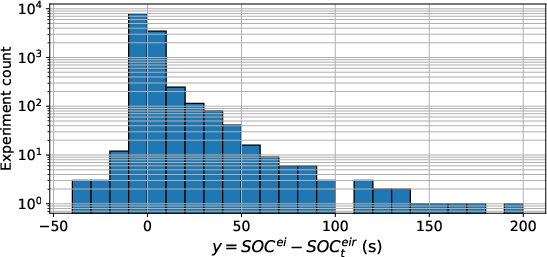
Figure 4: SOC savings achievable by random replanning, highlighting the long tail where opportunities exist.
On the held-out test set (N=3,600; 254 positive cases), the neural regressor achieves a mean absolute error of 1276 (same units as raw data, robustly scaled). Binary classification with a threshold of 1 second (to ignore insignificant fluctuation) yields high sensitivity (0.906) and specificity (0.979), with a precision of 0.764, indicating that almost all positive triggers correspond to genuinely useful replanning opportunities Figure 5.
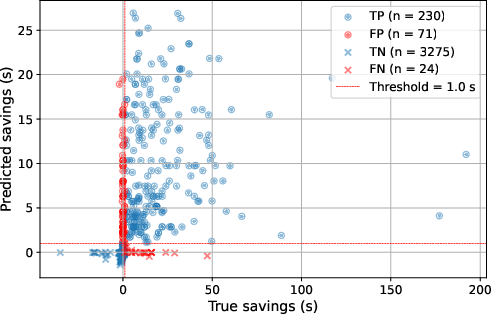
Figure 5: Comparison of true versus predicted SOC savings on the test set.
The realized performance is that 94.6% of possible cost savings (relative to optimal offline oracle triggers) are captured by the model, with negligible downside from false positives (worst-case loss of 2 seconds, average gain per intervention ~15.87 seconds—a non-trivial fraction of average plan length).
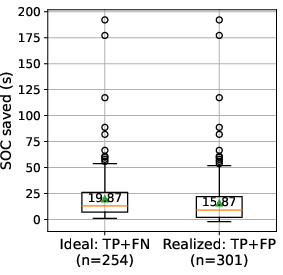
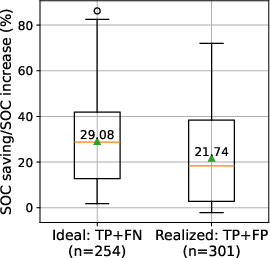
Figure 6: Histogram of absolute SOC savings per triggered replanning using the learned model.
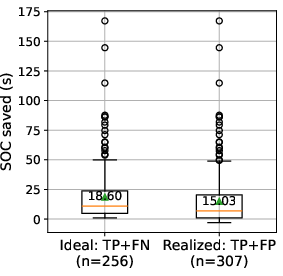
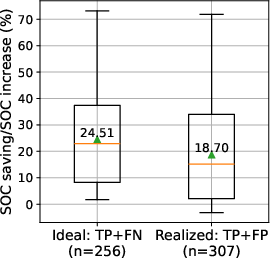
Figure 7: Histogram of relative savings, showing proportion of the SOC increase recovered per instance.
Crucially, when computational overhead for replanning is accounted for, the performance is essentially unchanged, as the model's feature set remains agnostic to these costs but the experimental domains do not incur high overheads for single replanning events.
Feature Importance and Decision Structure
Permutation importance analysis Figure 8 identifies three highly informative feature types: total action delay, highest action delay, and highest slack increase. Features linked to static instance properties or expected (predicted) plan delays are negligible in influence. This highlights that acute, realized delays and direct propagation metrics dominate the decision to trigger replanning.
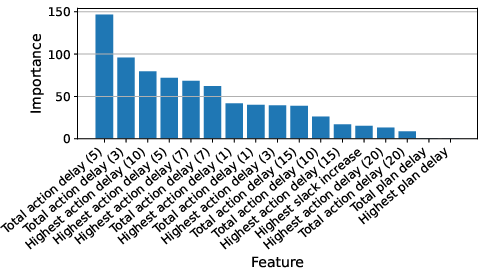
Figure 8: Permutation importance for features. Action delays and slack increase provide most predictive value.
Implications and Perspectives
The results establish that single-shot replanning decisions in robust MAPF execution can be delegated to a supervised learning model whose input is lightweight, well-structured from runtime ADG monitoring, and does not depend on explicit disturbance modeling or full observability of exogenous disruptions. In practical terms, this offers an effective and computationally controlled alternative to naive periodic replanning or hand-tuned intervention policies, showing that a model can autonomously detect critical execution deviations and minimize cumulative coordination cost.
Theoretically, the work illustrates that online reactive control of plan adaptation can be efficiently cast as a regression over carefully crafted state features in high-dimensional MAPF execution, making the framework amenable to extension towards reinforcement learning or sequential decision processes (where multi-stage, budgeted intervention is possible). The negligible utility of static features further suggests limited need for instance-driven policy parameterization.
Future Directions
Potential research avenues include extending the learning-driven intervention scheme to the sequential, multi-replan regime, where disturbances may compound over time and computational cost of planning can dominate. More complex dynamic obstacle models—multiple interacting unpredictable entities, partial observability, and obstacles with agent-like kinematics—pose further challenges. Additionally, direct integration with kinodynamic planners and incorporating computation- or communication-aware constraints into the feature space would increase real-world transferability.
Conclusion
The study presents an empirically validated, learning-based method for online replanning decision-making in robust MAPF execution. By leveraging ADG-derived live execution features and training a regression model to estimate cost savings from replanning, the approach identifies nearly all opportunities for meaningful intervention without incurring unnecessary computation or loss. Feature analysis reveals that the observed execution delay and action dependencies are paramount, outstripping static or solution prescriptors. The technique demonstrates potential for broader adoption in large-scale, asynchronous multi-robot deployments where dynamic, robust performance is essential.

