- The paper extends standard microlensing models by incorporating arbitrary velocity distributions, unveiling a speed–mass degeneracy in the lens parameter space.
- By analyzing Maxwell-Boltzmann and Dirac delta distributions, the study shows how lens velocity directly shifts the inferred mass range and alters event rate constraints.
- The findings emphasize the need for high-cadence and astrometric surveys to accurately probe non-standard compact objects and break traditional degeneracies.
Summary of "Microlensing of fast and slow compact objects" (2604.25434)
Motivation and Context
The paper addresses the gravitational microlensing constraints on non-standard compact objects, challenging the standard assumption that lens populations trace the Milky Way's dark matter halo with velocities governed by a Maxwell-Boltzmann distribution at characteristic velocities ∼10−3c. Realistic astrophysical and theoretical models often predict populations of compact objects with much more extreme velocities, ranging from ultrarelativistic primordial black holes (PBHs) arising from cosmic string collapse to free-floaters ejected from planetary systems or dark neutron stars with atypical natal kicks. For these scenarios, the conventional mapping between microlensing event duration and lens mass, assumed for virialized dark matter, fails, exposing a fundamentally richer phenomenology and opening new regions in the phase space for compact object populations.
Methodology
The authors systematically generalize microlensing event rate calculations to arbitrary velocity distributions and spatial profiles, breaking away from the standard dark matter assumptions. They consider benchmark velocity distributions: Maxwell-Boltzmann and Dirac delta, and spatial distributions: uniform and NFW—covering both tightly clustered and unvirialized populations.
Event rates are computed using survey-specific detection efficiencies, observational baselines, and source statistics for the Subaru-HSC (monitoring M31) and OGLE (monitoring LMC) surveys. The analysis quantitatively explores the speed-mass degeneracy: for a fixed Einstein crossing time, faster lenses correspond to higher mass ranges than traditional windows, while slower lenses probe lower masses.
Special attention is paid to the transverse motion of source and observer, which becomes dominant for slow lenses—imposing a microlensing "floor" for event rates originating from their bulk motion. Results are presented both as model-independent upper limits on microlensing event rates as a function of Einstein diameter crossing time and as mass-dependent constraints for lens populations with speeds spanning 10−4c to 10−1c.
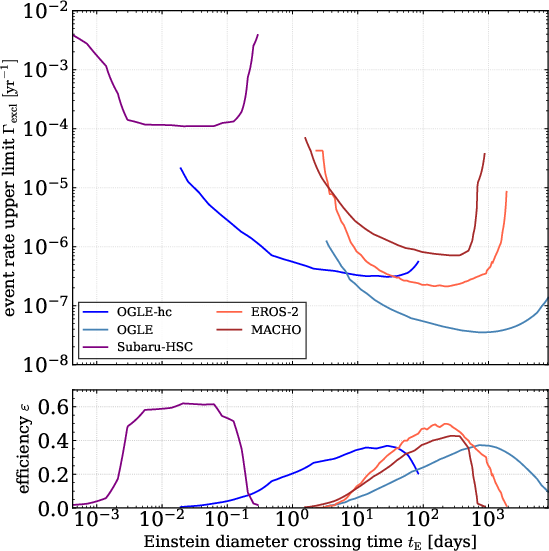
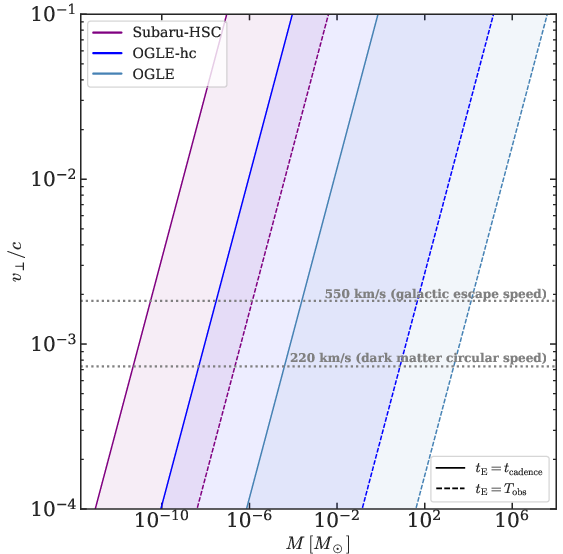
Figure 1: Survey-dependent upper limits on microlensing event rate per star; right panel illustrates the speed-mass parameter space accessible, demonstrating the degeneracy and extended reach for fast/slow lens scenarios.
Results
The analysis reveals several key findings:
- Microlensing constraints for fast/slow lenses differ from standard dark matter constraints by orders of magnitude, and for specific velocity distributions, surveys probe distinct mass ranges.
- Limits for Dirac delta and Maxwell-Boltzmann distributions are comparable, with event rates scaling primarily with mean velocity rather than the distribution's shape; minor deviations emerge due to the tails of the distributions.
- As lens speed increases, the probed mass range shifts to higher M (M∝v2 at fixed event duration), and finite-source effects become less suppressive, especially for high-cadence surveys like Subaru-HSC.
- For slow lenses (v≪10−3c), the transverse motion of source and observer dominates, and event rates essentially track those for standard dark matter-speed objects. However, if the lensing tube and lens population are co-moving (as in a dark disk or certain mirror star scenarios), constraints can be computed under different assumptions—illustrated, but not physically representative, in the paper.
- Dedicated searches for anomalously short events (high-cadence observations) can access smaller lens masses for fast populations without suppression by finite-source or wave optics effects—contrary to standard dark matter interpretations.
Implications
Theoretical implications are profound: microlensing discovery space extends well beyond the conventional dark matter paradigm by accounting for arbitrary lens kinematics and spatial distributions. The analysis shows that, for lens populations not tracing the dark matter halo, traditional mapping to mass windows is incorrect, risking both missed discovery and false exclusion in DM searches.
Practically, this work motivates a shift in survey strategy. Higher-cadence photometry and astrometry are more potent for fast-moving, non-dark-matter lens populations, enabling probes at lower masses and shorter event durations. Astrometric microlensing, capable of measuring parallax and transverse velocity directly, offers a path to break the speed-mass degeneracy. The results also highlight the necessity to incorporate finite-source and non-point-source effects into simulations and the interpretation of microlensing events.
Recent re-analyses of Subaru-HSC data show significant impact on PBH abundance constraints, driven by updated detection efficiencies and finite-source treatments. Discrepant findings on the nature of observed events (microlensing versus variable stars) underscore ongoing uncertainties and the importance of robust pipeline development.
Future Directions
Key avenues suggested include:
- Extending microlensing search strategies to exotic, high-velocity compact object populations.
- Employing astrometric surveys for direct parallax and transverse velocity measurements to break degeneracies.
- Leveraging femtolensing and picolensing techniques with cosmological sources to probe lens mass independent of velocity.
- Systematically incorporating spatial and velocity distribution uncertainties into dark matter and non-DM searches.
- Cross-correlating microlensing results with dynamical heating, radio, and X-ray constraints for super-massive compact objects.
This work also stresses the need for survey pipelines to adapt to the diversity in effective parameter space, particularly for objects with non-standard phase space distributions.
Conclusion
The paper establishes a comprehensive framework for analyzing microlensing constraints on compact objects with arbitrary velocity and spatial distributions, revealing substantial differences from standard dark matter limits and charting qualitatively new regions in the search space. The results underscore the importance of survey cadence, the necessity to account for non-standard kinematics, and the growing role of astrometric methodologies. These findings have direct impact on ongoing and future searches for PBHs, exotic dark compact objects, and free-floating astrophysical bodies, and motivate more flexible, physically motivated interpretations of microlensing data in gravitational lensing surveys.

