- The paper introduces SPA-based closed-form expressions for the SNR PDF, CDF, and outage probability in HAPS-RIS-assisted MIMO systems.
- It models practical phase-dependent amplitude responses and discrete quantization effects in realistic RIS hardware.
- Monte Carlo simulations validate that optimized RIS phase configurations yield near-ideal performance under cascaded Rician fading.
Saddle Point Analysis of HAPS-RIS-Assisted MIMO Systems with Practical RIS Hardware
Introduction
This paper introduces a comprehensive analytic framework for evaluating the statistical performance of high-altitude platform station (HAPS) reconfigurable intelligent surface (RIS)-assisted multiple-input multiple-output (MIMO) systems over cascaded Rician fading channels (2604.25331). The framework directly addresses the limitations of conventional non-central Wishart modeling, which is rendered inapplicable due to the strong statistical coupling induced by the RIS phase and amplitude hardware constraints. Notably, the approach leverages saddle point approximation (SPA) techniques to derive closed-form expressions for the probability density function (PDF), cumulative distribution function (CDF), and outage probability (OP) of the signal-to-noise ratio (SNR), uniquely accounting for phase-dependent amplitude responses and discrete phase shifts in practical RIS deployments.
System and Channel Modeling
The model consists of a downlink MIMO system where the ground-based transmitter communicates with a receiver only through a RIS on a HAPS, fully blocking any direct path. The transmitter and receiver array geometries are uniform rectangular (URA) and uniform linear arrays (ULA), respectively, while the RIS comprises a planar URA. Both T–RIS and RIS–R hops are modeled as Rician fading, separating the LoS and scattered NLoS components. The RIS is modeled via a diagonal reflection matrix Φ, which encodes both phase and amplitude responses per element, and hardware is modeled with b-bit phase quantization and phase-dependent amplitude attenuation determined by nonlinear functions of the phase.
By invoking CLT for large RIS, each entry of the cascaded channel is approximated as a complex Gaussian random variable. However, the coupling induced by the RIS configuration breaks the independence assumptions of classical Wishart theory, necessitating alternative analysis.
SNR Statistics via Saddle Point Approximation
A LoS-aligned beamforming strategy is adopted at the transmitter, reflecting practical HAPS geometries. The post-processed receive SNR under maximum ratio combining (MRC) becomes a non-central quadratic form in a structured correlated Gaussian vector.
The random effective channel vector is decomposed into a deterministic LoS term plus a zero-mean complex Gaussian random vector with structured covariance, partitioned into isotropic and rank-one LoS-aligned components. Importantly, the distribution of the SNR quadratic form is intractable in closed form due to the inherent coupling and correlated structure. SPA provides an analytically tight and computationally efficient technique to approximate the PDF and CDF, yielding explicit expressions involving the cumulant generating function (CGF) and its derivatives conditioned on the system and hardware parameters.
Analytic results are provided for the SNR PDF, CDF, and the OP as functions of system parameters, RIS phase quantization, and size, accommodating physically accurate amplitude-phase coupling models.
Impact of RIS Phase Optimization and Hardware Constraints
The work systematically analyzes both random and optimized RIS phase configurations. The optimum phase is specified for both continuous and discrete quantization, leveraging coherent constructive combining in the dominant LoS direction. Using the analytic SPA framework, the statistical SNR distributions and outage performance are contrasted for random phases, discrete optimum, and optimum eigen-beamforming benchmarks.
The numerical validation—supported by Monte Carlo results—precisely corroborates the analytic SPA approach, confirming that the framework accurately predicts outage under a range of configurations and quantization resolutions. In particular, the analytic and simulation results converge for all investigated regimes.
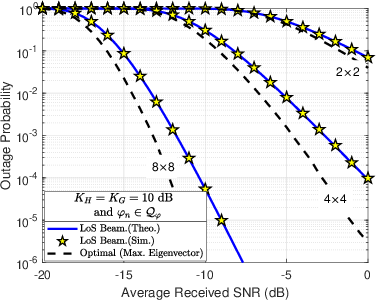
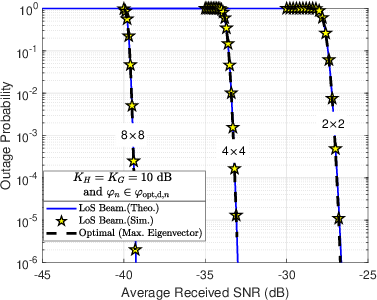
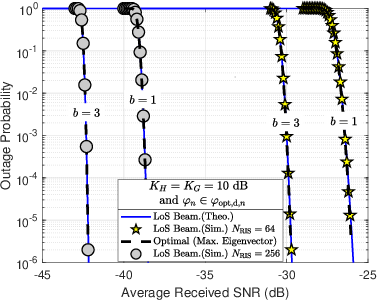
Figure 1: SPA-based analytic outage probability closely tracks Monte Carlo results for both random and optimized RIS phase scenarios.
Figure 1 shows the comparison between the outage probability obtained using SPA-derived expressions and Monte Carlo simulation. The clear improvement provided by optimized versus random RIS phase configurations is visible across diverse antenna/RIS settings. The analysis reveals that RIS phase quantization, as well as the RIS size, significantly influence the achievable SNR and outage characteristics when realistic, phase-dependent amplitude hardware constraints are imposed.
Theoretical and Practical Implications
This study fills a critical analytic gap by extending SNR-statistics-based analysis to realistic, hardware-limited RIS-assisted links in non-terrestrial (HAPS) MIMO systems under Rician fading, without recourse to unrealistic independence assumptions. It is the first to establish closed-form (SPA-based) performance characterizations incorporating both practical phase quantization and amplitude-phase coupling—two factors previously either ignored or only numerically accounted for.
The results demonstrate that LoS-aligned beamforming with discrete phase optimization approaches the ideal (eigenvector-based) performance, provided accurate geometric channel parameters and sufficient quantization resolution. The SPA-based analytic tools support design optimization in future 6G and non-terrestrial networks, quantifying trade-offs due to hardware constraints, geometry, and RIS size.
Future Directions
Potential extensions include investigating the effect of angular and distance variations, as well as hybrid analog-digital beamforming architectures at both link ends and under partial or delayed channel state information. Moreover, SPA-based tools may be adapted for the analysis of other RIS-assisted non-terrestrial communication paradigms, or for systems with more general correlated fading and more sophisticated RIS hardware nonlinearities.
Conclusion
A rigorous, tractable analytic method based on saddle point approximation is provided for the statistical characterization (PDF, CDF, and OP) of HAPS-RIS-assisted MIMO systems over structured, cascaded Rician fading with practical, phase-dependent amplitude RIS hardware. The approach yields closed-form performance characterizations, substantiated by simulation, and enables precise quantification of outage and SNR distributions for advanced RIS-aided non-terrestrial networks under realistic hardware constraints.