- The paper introduces a model where each job's processing time is a linear function of its start time, distinguishing between delay-averse and non-delay-averse jobs.
- The paper proves that pure Nash equilibria exist in delay-averse environments and can be computed efficiently using greedy or list-scheduling algorithms.
- The paper analyzes equilibrium inefficiency via Price of Anarchy and proposes coordination mechanisms (SBPT, SDR, LBDR) to mitigate cascading delays.
Job-Scheduling Games with Time-Dependent Processing Times: An Academic Analysis
Introduction and Context
This work provides a comprehensive game-theoretic investigation of decentralized job scheduling environments where processing times are linear functions of job starting times. By generalizing classical job-scheduling games—where processing times are fixed—to encompass both positively and negatively deteriorating jobs, the paper establishes critical structural and computational differences arising from these time dependencies. The authors examine both equilibrium structure and inefficiency across a variety of coordination mechanisms and job/machine classes, proposing several policies with provable efficiency guarantees.
Model Overview
The central model extends standard job-scheduling games by associating each job i with a processing time function pi(t)=bi+viait, where vi∈{+1,−1} denotes positive (increasing) or negative (decreasing) deterioration. Machines process jobs in local priority orderings; each job, controlled by a selfish agent, selects a machine to minimize its own completion time, potentially at the expense of system-wide efficiency. The analysis covers both arbitrary and structured machine policies, including global and machine-specific priority lists.
A crucial conceptual distinction introduced is delay aversion: jobs whose minimal completion time is achieved by starting as early as possible (guaranteed when vi=1, or vi=−1 with ai≤smax). The equilibrium landscape is shown to hinge on the presence or absence of delay-averse jobs, a property that demarcates cases where pure Nash equilibria (NE) exist and can be efficiently computed.
Equilibrium Existence and Computation
The paper offers a detailed landscape of equilibrium existence, showing that:
- Delay-averse environments: For important classes (e.g., all positive-deterioration, or negative-deterioration with ai≤smax), pure NE always exist and can be efficiently computed via greedy or list-scheduling algorithms. For instance, on identical machines or under a global priority list, well-structured greedy assignments always yield stable outcomes.
- Non-delay-averse environments: The presence of jobs that benefit from delaying their processing fundamentally disrupts this landscape. The authors prove that even for simple cases with a few jobs and machines, pure NE may be absent.
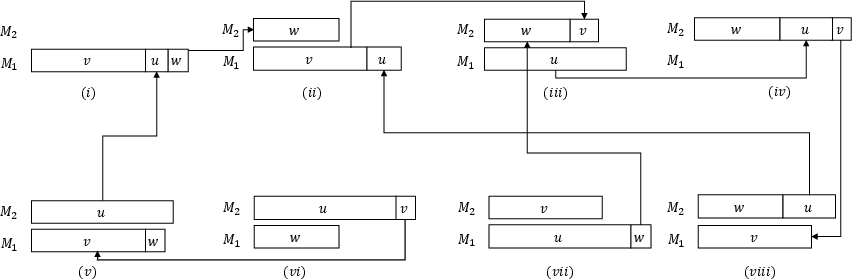
Figure 1: The possible profiles of the game GnoNE3 on two machines with three jobs; none constitute a Nash equilibrium.
This non-existence of equilibrium—demonstrated concretely in small instances—represents a stark divergence from classical games with fixed or monotonic processing times.
- Computational complexity: For settings with negative deterioration and non-delay-averse jobs, deciding NE existence is shown to be NP-complete even for identical machines. A reduction from 3-dimensional matching underpins this result, establishing a new hardness barrier not present in fixed-processing-time models.
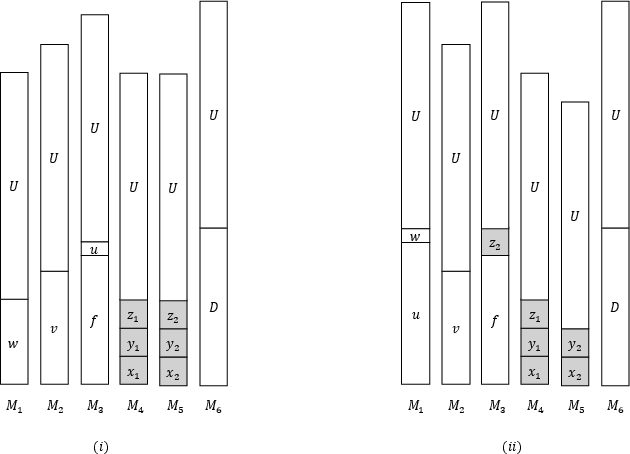
Figure 2: Reduction construction where equilibrium existence corresponds to the existence of a perfect matching in a 3D-matching instance.
Equilibrium Dynamics
The convergence of natural improvement dynamics, such as best-response dynamics (BRD), is established for all classes with guaranteed NE existence. Specifically, for symmetric jobs, delay-averse environments, and games with a global priority list, BRD always terminates at equilibrium regardless of initial profile, attesting to a robust potential-games structure in these domains.
Equilibrium Inefficiency: Price of Anarchy Analysis
The inefficiency of equilibrium (measured by Price of Anarchy, PoA) varies sharply across problem classes:
- Symmetric jobs (fixed or homogeneous time-dependent processing times): All NE are globally optimal, i.e., PoA = 1, matching the centralized optimum.
- Positive deterioration (with global priority, uniform rates): The PoA can grow exponentially in n/m, as delay effects cascade in the schedule and amplify workload multiplicatively, unlike additive growth in classical settings.
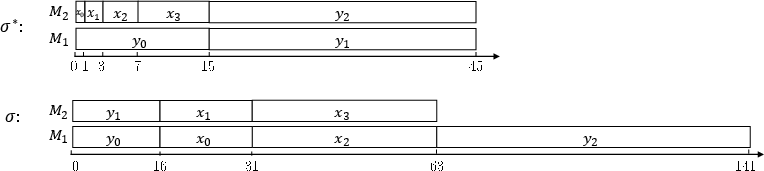
Figure 3: A game with n=7 and pi(t)=bi+viait0 where the NE schedule yields an exponential PoA due to cascading delays under positive deterioration.
- Negative deterioration / delay-averse jobs: Tight constant PoA bounds are established. For identical machines and arbitrary priority lists, PoA is at most pi(t)=bi+viait1, and for identical machines with global priority, the upper bound tightens to pi(t)=bi+viait2. These bounds are shown to be tight via explicit constructions.

Figure 4: Example with three identical machines, optimal makespan 1, NE makespan approaching pi(t)=bi+viait3—demonstrating tightness of the PoA bound for arbitrary priorities.

Figure 5: Under a global priority list, optimal makespan pi(t)=bi+viait4 and NE makespan pi(t)=bi+viait5, matching the theoretical upper bound.
Coordination Mechanisms to Mitigate Inefficiency
To restrain equilibrium inefficiency, the authors introduce and analyze three coordination mechanisms:
SBPT: Shortest Basic Processing Time Policy
For jobs with uniform positive deterioration, scheduling in non-decreasing order of basic processing time (SBPT policy) effectively partitions jobs into rounds, dampening the exponential inefficiency of unstructured priority lists. This reduces PoA to a constant pi(t)=bi+viait6 for pi(t)=bi+viait7 machines and deterioration rate pi(t)=bi+viait8.
SDR: Smallest Deterioration Rate
For negative deterioration, the SDR mechanism schedules jobs in order of increasing deterioration rate, maximizing cumulative waiting-job deterioration density. The associated PoA is tightly bounded by pi(t)=bi+viait9, independent of the number of machines.
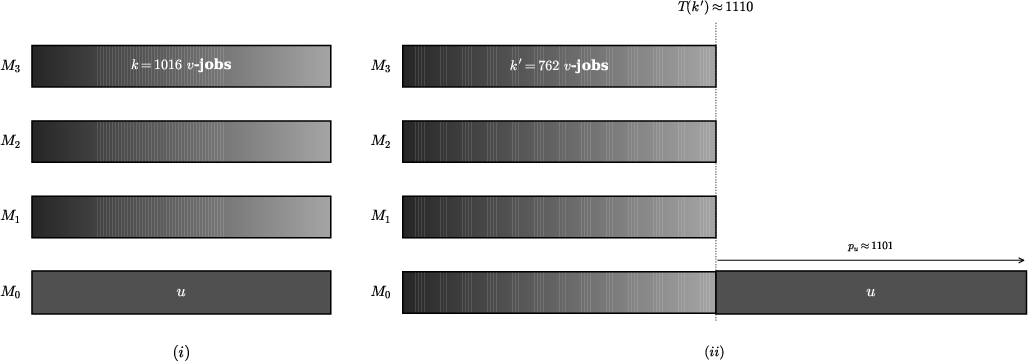
Figure 6: An optimal profile (makespan vi∈{+1,−1}0) and a NE profile under SDR (makespan vi∈{+1,−1}1) where PoA approaches 2.
LBDR: Largest Basic-Deterioration Ratio
Scheduling via Largest Basic-Deterioration Ratio (vi∈{+1,−1}2 in non-increasing order) yields PoA vi∈{+1,−1}3. The analysis leverages a product-based recursion linking completion times across the schedule to fundamental convexity and logarithmic bounds.
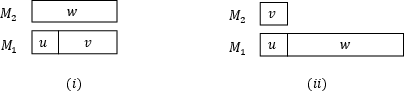
Figure 7: Optimal profile (makespan vi∈{+1,−1}4) and NE profile (makespan vi∈{+1,−1}5) under the SBPT policy—verifying the tight PoA upper bound for vi∈{+1,−1}6, vi∈{+1,−1}7.
Theoretical and Practical Implications
This work demonstrates that introducing linear time dependencies into job scheduling games radically alters both equilibrium existence and systemic inefficiency, especially in decentralized strategic environments. While delay-averse classes permit efficient algorithms and robust equilibria, the presence of non-delay-averse (e.g., rapidly decreasing processing times) jobs fundamentally destabilizes the game, rendering equilibrium reasoning in tractable domains unviable.
The proposed coordination mechanisms restore efficiency in broad classes of time-dependent scheduling games, simultaneously enabling practical decentralized policies and informing the design of incentive-compatible systems. The new analytical techniques—including work-based density analysis, product-based induction, and round-optimality reasoning—are likely to be fruitful in more general dynamic resource allocation problems.
Future Directions
This research invites further exploration in directions including:
- Beyond linear processing-time dependencies: addressing nonlinear, stochastic, or nonmonotonic functions.
- Improvements under additional realistic constraints (e.g., preemption, release dates, multi-resource settings).
- Dynamic or incomplete-information extensions, where agent strategies/parameters may evolve or be private.
- Development of online/dynamic scheduling policies with strong equilibrium efficiency guarantees.
Conclusion
By bridging centralized scheduling theory with game-theoretic analysis under time-dependent processing, the paper maps out a nuanced equilibrium landscape and provides practically relevant policy proposals with provable inefficiency bounds. The characterization of delay aversion as a fundamental dichotomy, together with the established complexity and inefficiency results, refines the understanding of decentralized temporal resource allocation and lays groundwork for robust mechanism design in time-sensitive systems.