- The paper proposes a graph-conditioned meta-optimizer that integrates objective and constraint features for tailored QAOA parameter generation.
- It employs UniHetCO embeddings to capture problem-specific nuances, leading to higher optimal hit rates and superior approximation ratios.
- The method achieves enhanced trajectory diversity and cross-problem transfer, reducing optimization steps and experimental effort in quantum circuits.
Motivation and Context
The Quantum Approximate Optimization Algorithm (QAOA) is a preeminent variational hybrid quantum-classical algorithm for combinatorial optimization, extensively studied for applications in finance, biology, and scientific computing. Efficient parameter search for QAOA circuits becomes increasingly challenging as the number of qubits, circuit depth, and diversity of problem classes increase, due to flat optimization landscapes and hardware noise. Conventional parameter initialization and optimization strategies—ranging from linear ramp schedules to multistart heuristics and nearest-neighbor transfer—suffer from limited cross-instance adaptability and do not scale gracefully to heterogeneous or unseen problem classes.
Prior work on learned meta-optimizers leverages recurrent neural networks (RNNs), particularly LSTMs, to mimic classical parameter update trajectories and generate QAOA angles for strong initialization. However, empirical evidence reveals a critical mode collapse: the meta-optimizer tends to produce nearly identical parameter trajectories, thus failing to adapt to individual instance features and limiting transfer efficiency across distinct problem formulations.
Problem-Aware Graph Conditioning
This paper proposes an instance-conditioned meta-optimizer framework for QAOA parameter generation. The optimizer embeds problem-specific features by projecting each graph instance into a fixed-dimensional vector using a graph encoder, which is then injected into the hidden state of a recurrent parameter generator at every rollout step.
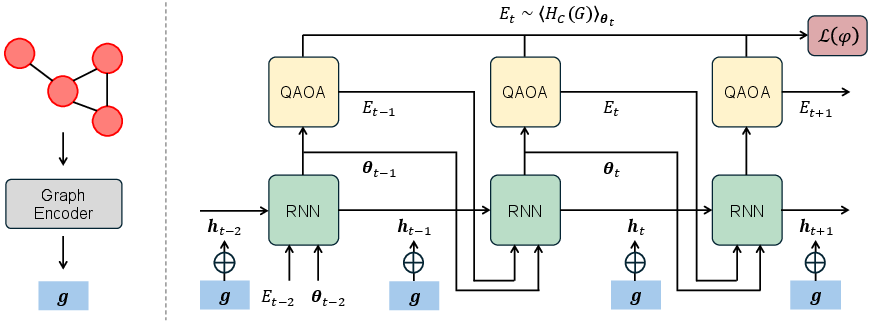
Figure 1: The end-to-end training pipeline projects problem instances into embeddings, which condition the RNN-based meta-optimizer for trajectory generation.
This conditioning mechanism contrasts starkly with unconditioned LSTM approaches and those employing purely structural graph embeddings (e.g., Graph2Vec). The graph embedding is obtained via UniHetCO, a universal heterogeneous graph encoder rooted in quadratic programming (QP) formulations. UniHetCO augments the original graph structure with objective-coupling relations and explicit constraint nodes, producing embeddings that are simultaneously structure-aware and problem-aware.
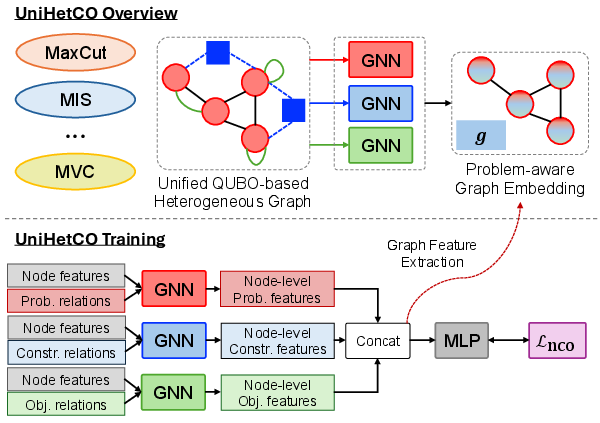
Figure 2: UniHetCO encodes structure, objective, and constraints into heterogeneous embeddings, facilitating transfer across problem classes.
UniHetCO leverages unsupervised neural combinatorial optimization (NCO), training the embedding GNN to minimize a loss comprising both the objective value and constraint violation penalties. The pool of node embeddings is aggregated to yield a graph-level representation, which conditions the meta-optimizer for trajectory generation.
Optimization and Expressivity
For trajectory generation, the conditioned LSTM is trained to minimize a decay-weighted sum of normalized QAOA energies over a fixed horizon. Adjoint differentiation is used for efficient computation of gradients through quantum circuits, circumventing the need for ground-truth angles. The conditioning signal, via instance-specific embeddings, is injected into the hidden state at every step, ensuring that rich instance information informs every parameter proposal.
In empirical tests spanning four optimization problem types (MaxCut, MIS, MaxClique, MVC) and multiple circuit depths, Uni-Meta-LSTM demonstrates superior expressivity: significantly higher variance in generated parameter trajectories across test instances, reflecting adaptability and diversity.
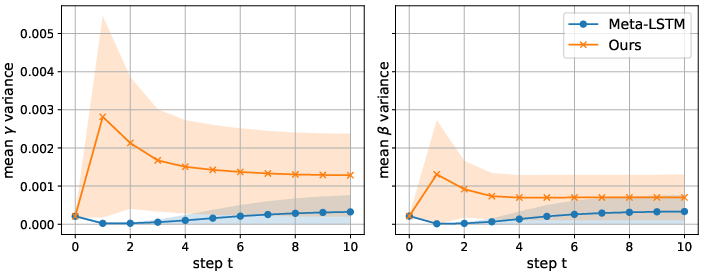
Figure 3: Uni-Meta-LSTM yields greater diversity in parameter trajectories over QAOA circuits than unconditioned Meta-LSTM.
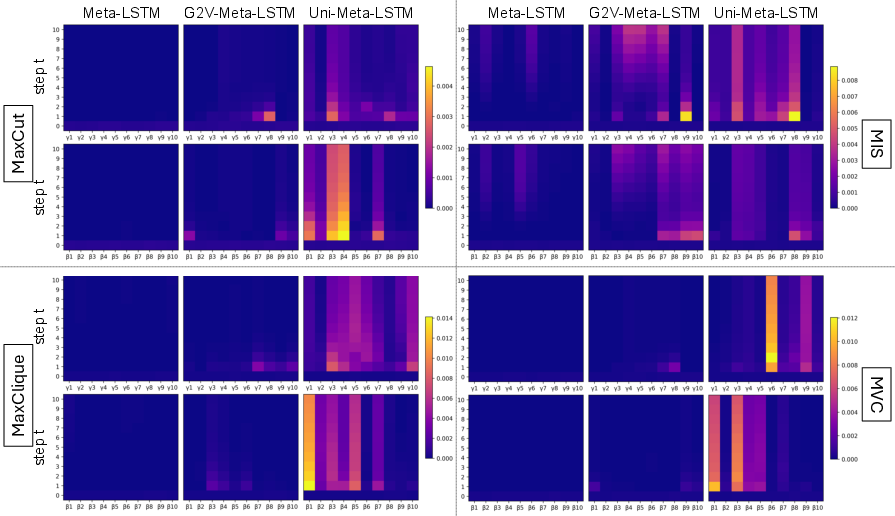
Figure 4: Diversity visualization across problem classes confirms enhanced expressivity and instance adaptation with Uni-Meta-LSTM.
Numerical Results and Claims
A comprehensive evaluation over 64 settings (single-problem and cross-problem transfer, four classes, four depths) reveals several key outcomes:
- Single-problem setting: Uni-Meta-LSTM consistently yields the highest optimal hit rates (p(x∗)) and best approximation ratios in most settings, frequently outperforming vanilla QAOA in both unconstrained and constrained formulations, despite drastically fewer optimization steps.
- Cross-problem transfer: Uni-Meta-LSTM surpasses traditional and structure-embeddings-based meta-optimizers in 34 of 48 transfer scenarios, with marked gains when transferring to MaxCut and MaxClique.
- Instance trajectory variance: Uni-Meta-LSTM produces significantly higher trajectory variance, indicating its capacity for nuanced adaptation. Purely structure-based conditioning (e.g., Graph2Vec) fails to capture problem-specific nuances, confirmed by the lack of separation in embedding spaces.
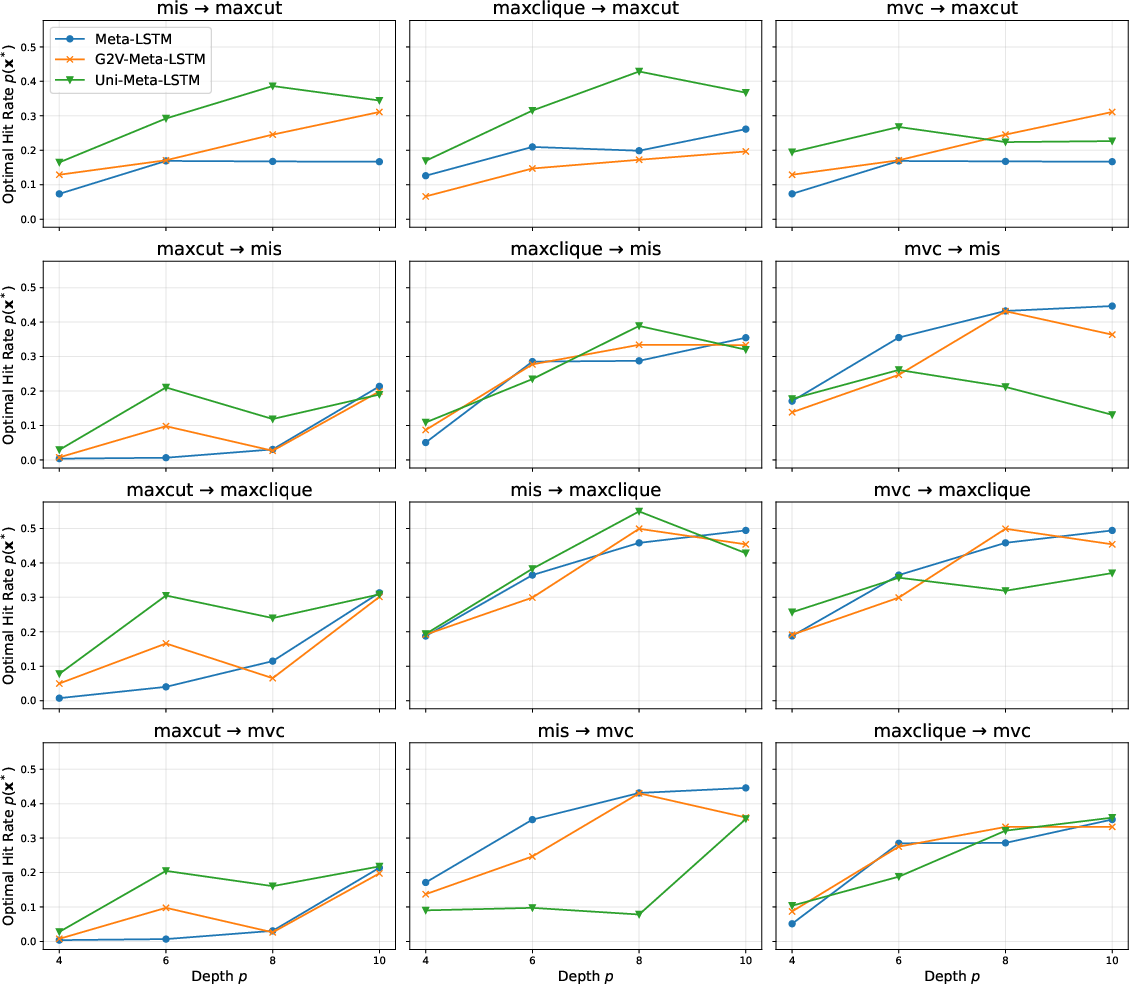
Figure 5: Uni-Meta-LSTM maintains higher optimal hit rates in cross-problem transfer settings, especially among heterogeneous formulations.
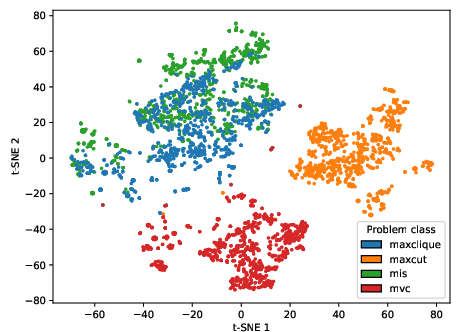
Figure 6: t-SNE visualization of UniHetCO embeddings shows well-separated clusters by problem class, with nuanced proximity (MIS/MaxClique), confirming embedding space informativeness.
Practical and Theoretical Implications
Conditioning QAOA meta-optimizers on problem-aware embeddings advances parameter-generation toward robust, instance-adaptive, and transferable initialization. This reduces optimization effort and measurement budget, enabling effective deployment in heterogeneous and time-constrained settings. The enhanced expressivity facilitates rapid adaptation to new instances and formulations, offering practical gains in near-term quantum computing environments with hardware constraints.
Theoretically, the integration of objective and constraint information into embeddings enables a framework where meta-optimization dynamics transcend mere structural similarity, aligning with problem landscape geometry. This broadens transferability, suggesting the feasibility of universal parameter-generation architectures that amortize search over families of related combinatorial formulations.
Prospects for Future Research
The observed performance degradation at increased circuit depths underlines the need for stronger conditioning and alignment of intermediate trajectory updates. Open directions include:
- Structuring conditioning for long-horizon parameter generation.
- Developing general models spanning multiple problem classes and circuit depths.
- Extending embedding strategies to capture dynamic constraints and evolving objectives.
- Exploring joint optimization of embedding and meta-optimizer in an end-to-end manner.
Conclusion
By conditioning a neural QAOA meta-optimizer on problem-aware graph embeddings, this work achieves greater trajectory diversity, improved solution quality, and superior cross-problem transferability compared to conventional and structure-only conditioned baselines. The results substantiate the claim that objective- and constraint-enriched embeddings are essential for robust meta-learning in variational quantum algorithms. Future developments will focus on strengthening conditioning mechanisms, expanding universality, and optimizing trajectory generation for heterogeneous combinatorial tasks.

