- The paper proposes a novel DS-FAS architecture that enhances spatial degrees-of-freedom by equipping both transmitters and receivers with fluid antennas.
- An alternating optimization framework integrating SDR, MM, and gradient ascent efficiently addresses the joint FA positioning and beamforming problem.
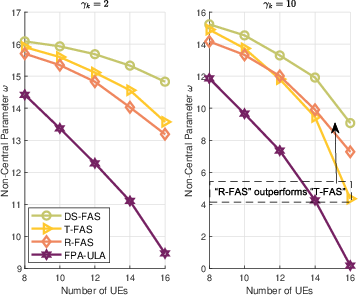
- Simulation results demonstrate up to 31.4% and 64.9% detection gains over baselines in noise-limited and interference-limited regimes, respectively.
Introduction and Motivation
The integration of sensing and communication (ISAC) in wireless networks, particularly for emerging 6G systems, necessitates frameworks that thoroughly exploit physical resources including space, time, and power. While mono-static and bi-static ISAC architectures have shown the potential of joint resource usage, their efficacy is restricted by limited spatial degrees-of-freedom (DoFs). The extension to multi-static architectures—with multiple distributed access points (APs) fulfilling both transmission and reception—addresses this limitation by providing macro-diversity and improved sensing capability.
Parallelly, the development of fluid antenna systems (FAS), which allow spatial reconfiguration of antenna positions, further exposes latent DoFs and enables adaptive array geometries. Extant ISAC research either equips transmitters or receivers with FAs but rarely both. This paper fills a critical gap by analyzing and optimizing a multi-static ISAC network where both ISAC transmitters and sensing/receiving APs, as well as user equipments (UEs), are equipped with position-flexible FAs—establishing a double-side FAS (DS-FAS) architecture.
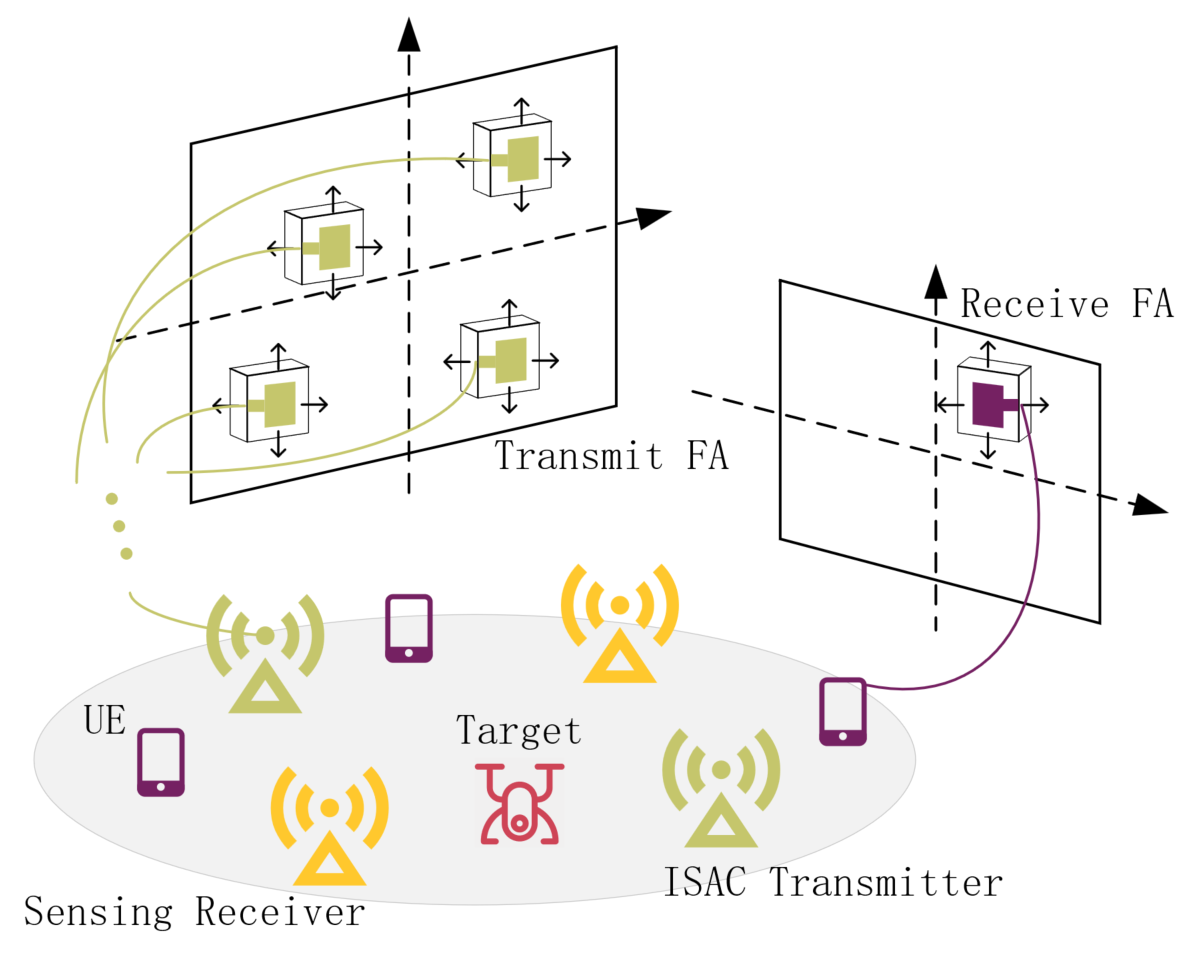
Figure 1: Schematic of a DS-FAS-assisted multi-static ISAC system illustrating distributed APs with reconfigurable FAs for joint transmission, reception, and target sensing.
System Model Overview
The considered system comprises Mt ISAC transmitters, Mr sensing receivers, and K UEs, spatially distributed within a coverage area. Each ISAC transmitter and receiver is equipped with N FAs capable of continuous movement within a given 2D region. Each UE possesses a single FA, similarly position-flexible.
The channel model reflects path-based amplitude-phase structures determined by FA positioning, with separate field response matrices for communication and sensing links. The sensing link model assumes a LoS-dominated response with negligible influence from NLoS multipath at the receiver-side FAs, a property that is later leveraged for optimization tractability.
A GLRT-based target detection process is implemented across distributed sensing receivers, yielding closed-form detection probabilities as a function of the full vector of design parameters, including all FA positions and transmit-side digital beamformers. The main system-level optimization is formulated as maximizing the detection probability (equivalently, the non-centrality parameter ω of the detection statistic), subject to:
- User SINR constraints,
- Per-transmitter power constraints,
- Position bounds for all relevant FAs,
- Minimum element spacing,
- Feasibility with respect to arbitrary initial FA layouts.
The critical innovation is a penalty-based treatment of UE SINR constraints, circumventing non-convex feasibility-seeking at initialization and enabling robust convergence without heuristic FA placements.
Optimization Algorithm: Alternating Approach and Surrogate Construction
The highly-coupled and non-convex nature of joint FA location and beamforming renders the direct solution intractable. The authors therefore develop an alternating optimization (AO) framework decomposing the variable space into:
- Joint digital beamforming and sensing signal covariances (using SDR):
- The transmit-side subproblem is relaxed to a convex SDP by discarding rank constraints, with guaranteed recoverability of rank-1 solutions via SVD post-processing.
- Transmit-side FA positioning (using majorization-minimization):
- Individual FA positions are iteratively updated by optimizing lower-bound surrogate functions constructed via second-order Taylor expansion, efficiently handled as QCQP/SOCPs.
- UE-side FA positioning (using gradient ascent):
- Rather than a mere feasibility problem, the UE FA location update is cast as SINR maximization, solvable independently and in parallel, with explicit gradient derivations facilitating fast convergence.
The penalty term is dynamically driven to zero as feasibility is approached. The convergence is monotonic and empirical results show rapid improvement per iteration.
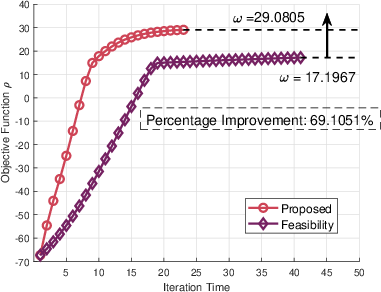
Figure 3: Objective function evolution with iteration, contrasting convergence rates under different UE FA optimization schemes.
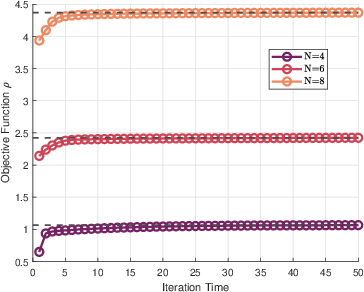
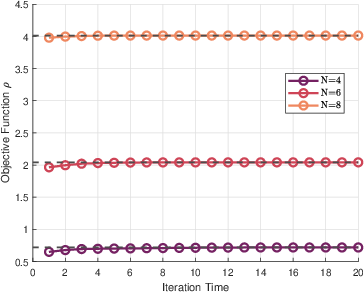
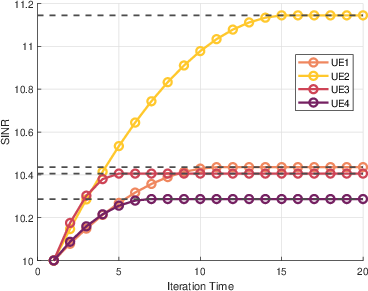
Figure 5: Detailed convergence plots for the overall AO algorithm (left), transmit FA location MM subproblem (middle), and per-UE FA SINR maximization (right), across various system sizes.
Noise-Limited Regime
Simulation studies under elevated noise variance conditions demonstrate:
- The DS-FAS framework achieves substantial ω enhancements and higher detection probabilities at ambitious SINR thresholds compared to single-side FAS and static array baselines.
- Notably, as communication SINR requirements tighten, systems without flexible antennas quickly become infeasible, while DS-FAS supports much higher SINR targets.
- Quantitatively, DS-FAS delivers up to 31.4% (ω gain over FPA-CP) and 64.9% (ω gain over FPA-ULA) when γk=20.
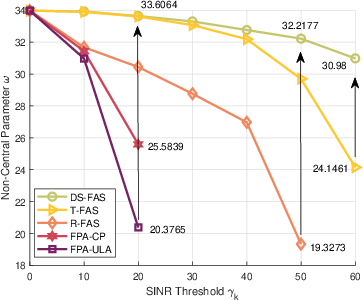
Figure 2: Non-centrality parameter ω versus SINR threshold Mr0 in a challenging noise-limited scenario for several baseline architectures.
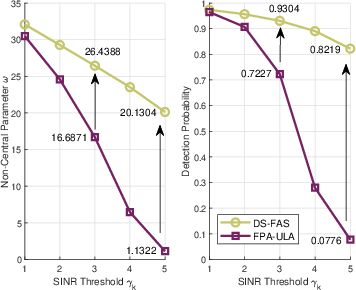
Figure 4: Average Mr1 and detection probability improvement as a function of Mr2, demonstrating robustness over random channel realizations.
Interference-Limited Regime
In heavily-loaded interference-limited cases (where Mr3):
FA Position Geometry and Resource Analysis
Visualizations of the optimized FA spatial layouts reveal:
- As SINR thresholds increase, the spatial exploration regions (i.e., practical movement domains for FAs) must enlarge to sustain feasibility and take advantage of the system's spatial flexibility.
- Both transmit and receive FAs are forced towards region boundaries as constraints tighten, underscoring the value of large movement areas.
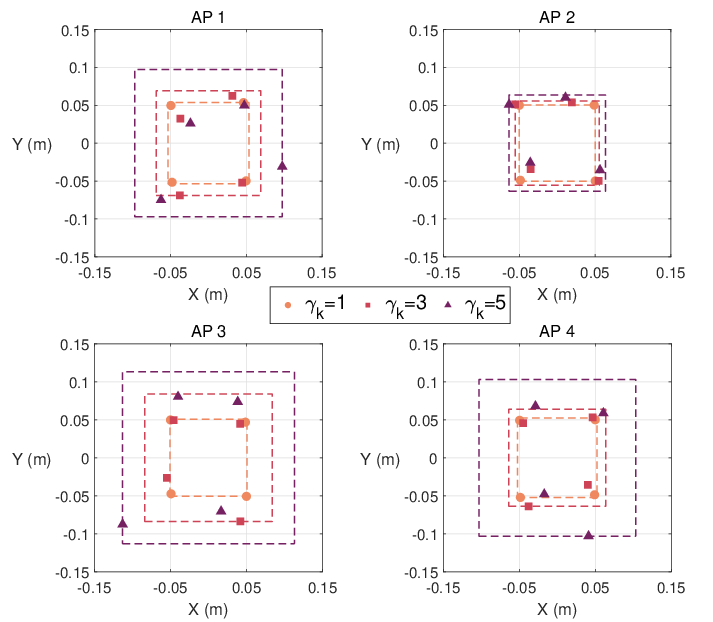
Figure 7: Optimized transmit FA positions across various SINR constraints, showing edge-expansion in response to resource tightening.
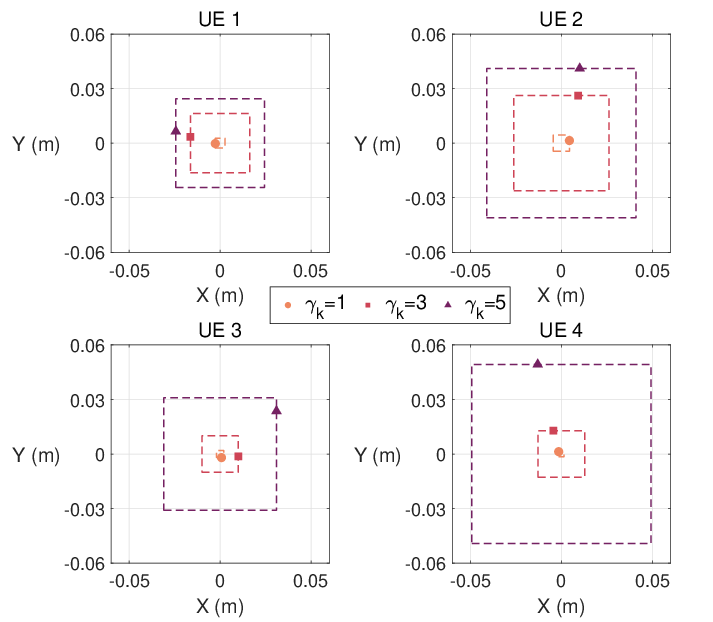
Figure 8: Corresponding optimized receive FA positions, again illustrating the boundary-seeking behavior for high SINR.
Practical Implications and Theoretical Insights
The results provide clear guidance for future ISAC system deployment:
- For noise-limited scenarios with an abundance of antennas, maximizing flexibility on the transmit side delivers the largest gains, but receiver FA deployment remains advantageous, especially as SINR constraints reach operational limits.
- In interference-limited environments, focusing on receive FAs can realize most of the achievable gains with lower computational burden due to decoupled optimizations.
- The proposed robust, penalty-based AO framework reliably navigates challenging initializations, enabling scalable, feasible solutions even for large, heterogeneous network topologies.
- Importantly, the analysis rigorously demonstrates that in sensing-only operation, transmit FA position has no direct effect, but for joint ISAC with stringent communication requirements, indirect effects through constraint feasibility become dominant.
Conclusion
This work provides a comprehensive system design and analysis for DS-FAS-assisted multi-static ISAC, incorporating closed-form GLRT-based detection, robust joint optimization of transmit and receive FA locations, and an efficient AO-based solver architecture. Substantial and quantifiable gains are validated across operational regimes, offering a blueprint for leveraging position-flexible hardware in future integrated wireless networks, with significant implications for 6G ISAC deployments. Theoretical perspectives and algorithmic strategies paved here could be directly extended to more complex multi-target sensing or near-field models, a promising avenue for further research.
Reference: "Multi-Static ISAC Assisted by Double-Side Fluid Antenna System" (2604.25234)