- The paper finds that integrating real-world problems modestly but significantly increases students' perceived relevance of core CS theory.
- It employs a quasi-experimental crossover design with over 1200 students using pre- and post-course surveys and chi-square tests to validate the intervention.
- Over 90% of students recommended continuing the intervention, highlighting enhanced engagement and ethical reflection compared to traditional curricula.
Real World Relevance and Ethics Integration in Foundational Theory Courses
Introduction
The paper "Does This Even Matter in the Real World? Real World Problems in Foundational Theory Courses" (2604.25082) presents an extensive mixed-method analysis on embedding real-world motivated problems into foundational theory coursework—specifically, discrete mathematics and probability theory—in a large R1 CS program. Contrary to entrenched faculty expectations and recurrent anecdotes in the CS education literature, a critical quantitative finding is that only a marginal fraction of students (<7%) initially view the material as irrelevant either to real life or their professional trajectory, both at course entry and completion. Moreover, the research demonstrates that integrating 'Real World Problems' (RWPs) modestly but significantly reinforces students' perceived relevance of the content—most notably with respect to real-life applicability—while also providing ethical contexts rarely treated in early theory curricula.
Design and Structure of the Real World Problem Intervention
The intervention distributes a set of seven RWPs—three in Discrete Math (DM) and four in Probability & Statistics (PS)—across the curriculum, replacing a subset of traditional exercise problems. The problems are structurally tripartite: (1) a technical exercise, (2) an open-ended application to a real or hypothetical scenario (often with a list of options or scope for student selection), and (3) a short, structured reflection connecting course content to the scenario. Notably, ethical ramifications are intentionally embedded in several RWPs, exemplified by cases involving legal reasoning, ML fairness definitions, and scrutinizing the limitations of statistical/ML modeling in high-stakes domains.
Methodology and Analytical Framework
The study employs a quasi-experimental crossover design, comparing intervention and control offerings (the latter lacking RWPs but otherwise parallel in content/assessment) with a sample size exceeding 1200 students across several terms. Data sources include pre- and post-course Likert-scale surveys on relevance perception, granular problem-specific feedback, and inductively coded qualitative responses. Statistical analysis hinges on χ2 testing for shifts in perceived relevance between groups and over time, with robustness checks for social desirability bias and cohort confounds.
Empirical Results
Student Perceptions of Relevance
A key quantitative result is that the vast majority of students agree, both pre and post, that theoretical CS is relevant to both real life and their future careers, even in the absence of explicit RWP intervention (>93% of students in all groups are at or above neutral on relevance). However, embedding RWPs statistically increases the fraction who agree strongly that theory is relevant to real life—a shift seen in both full-course-sequence and per-term analyses (notably, e.g., Q1 post-intervention: 59 'strongly agree' versus 32 pre-intervention, p<0.01 via χ2).
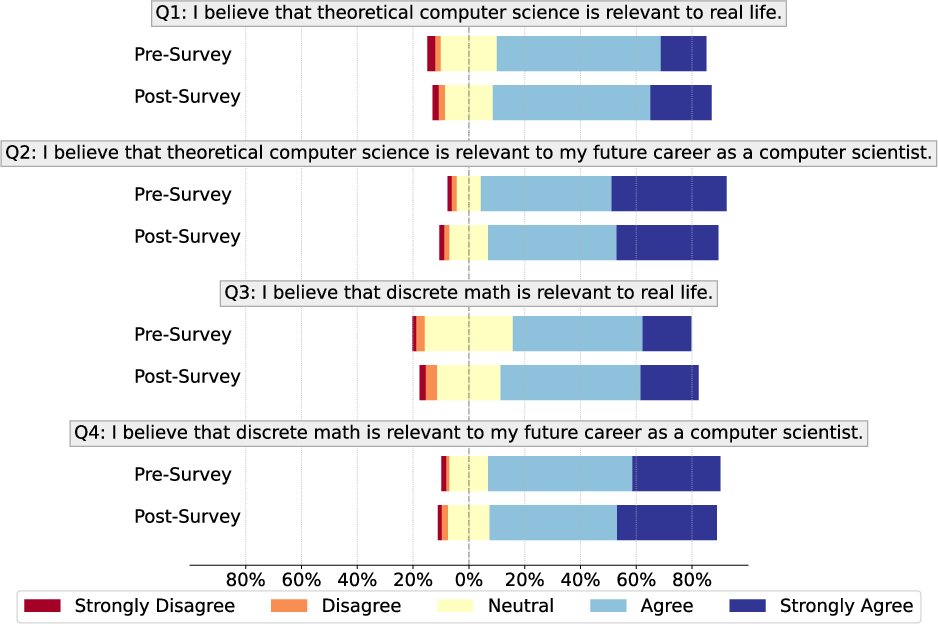
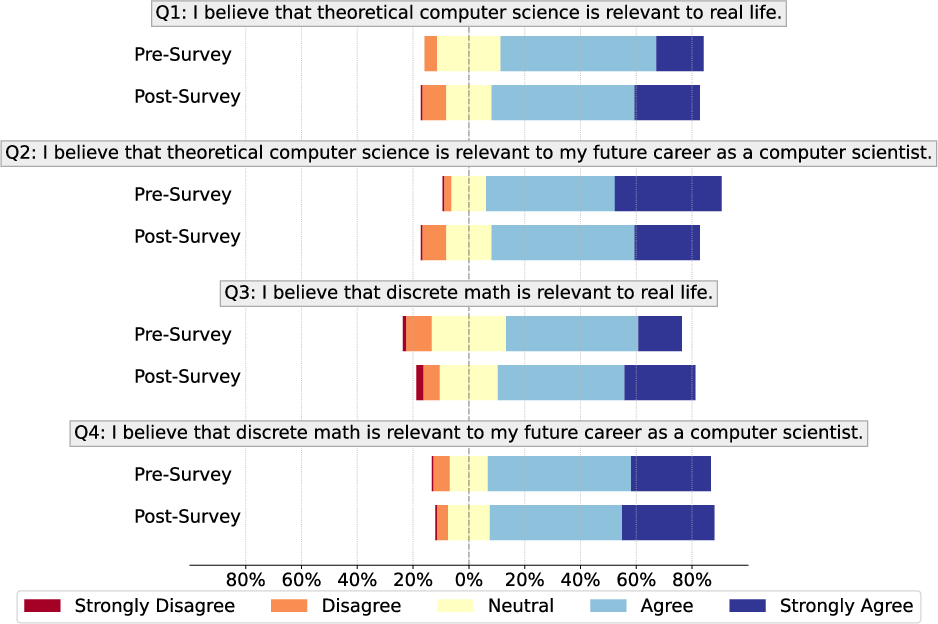
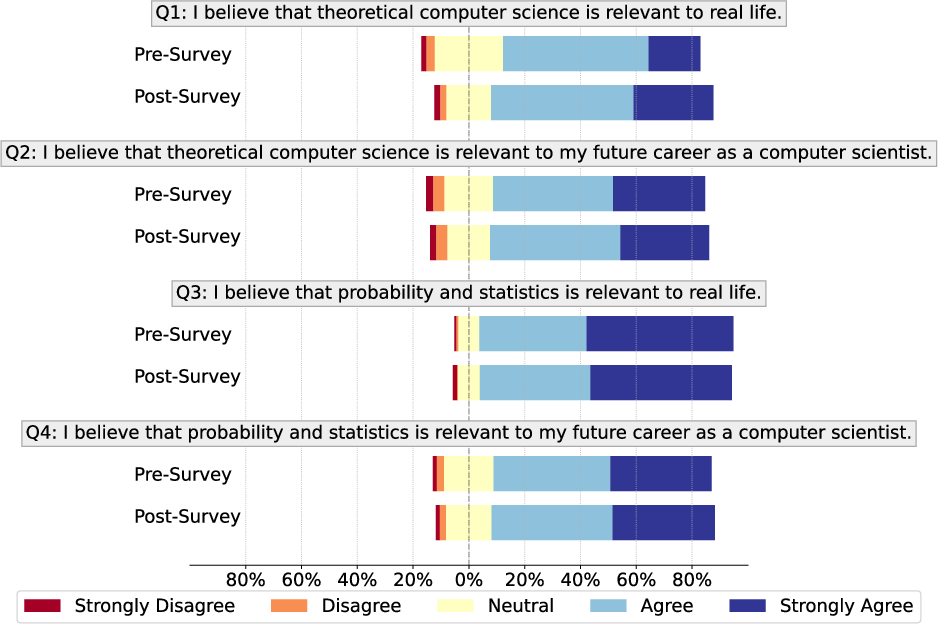
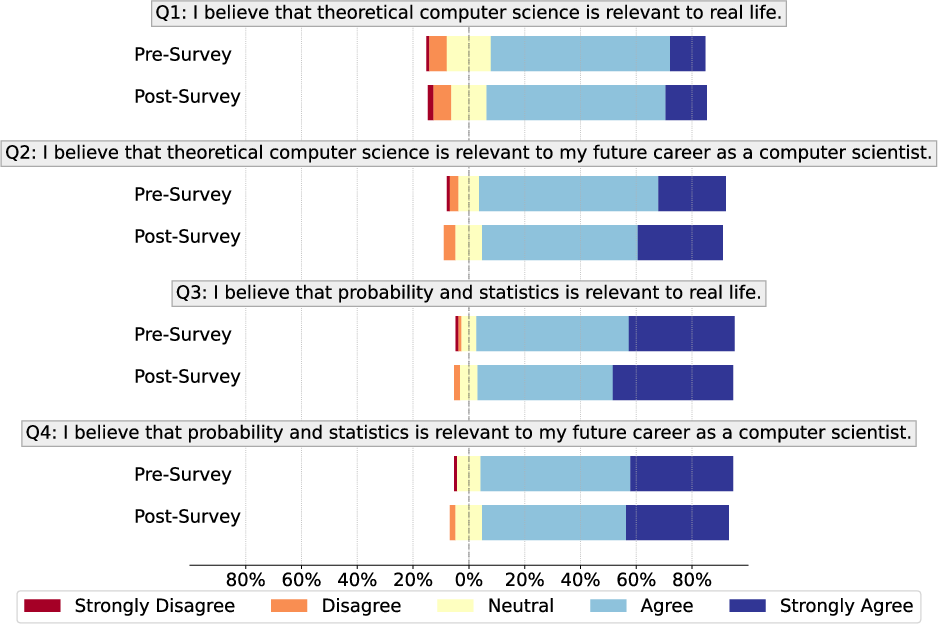
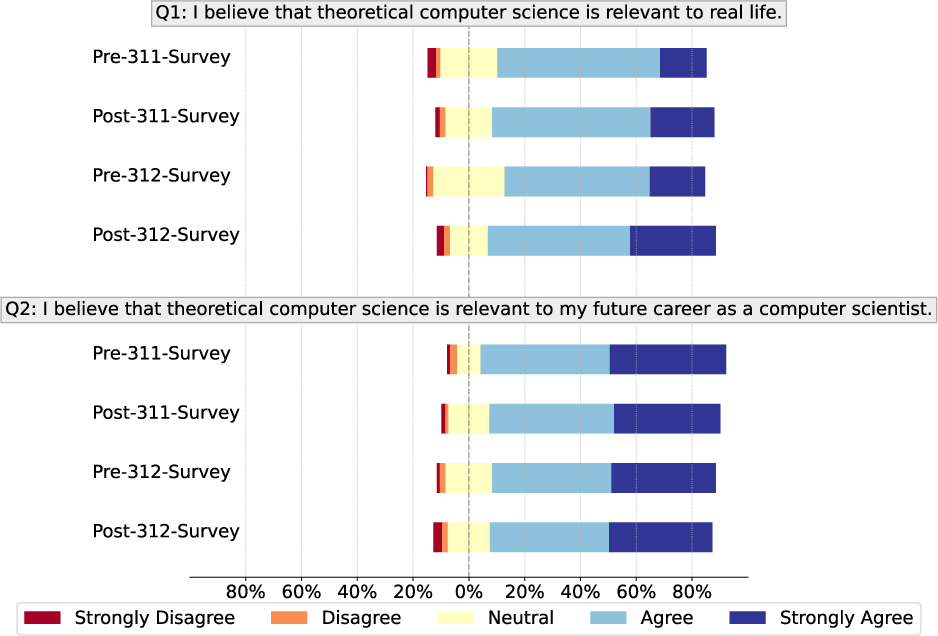
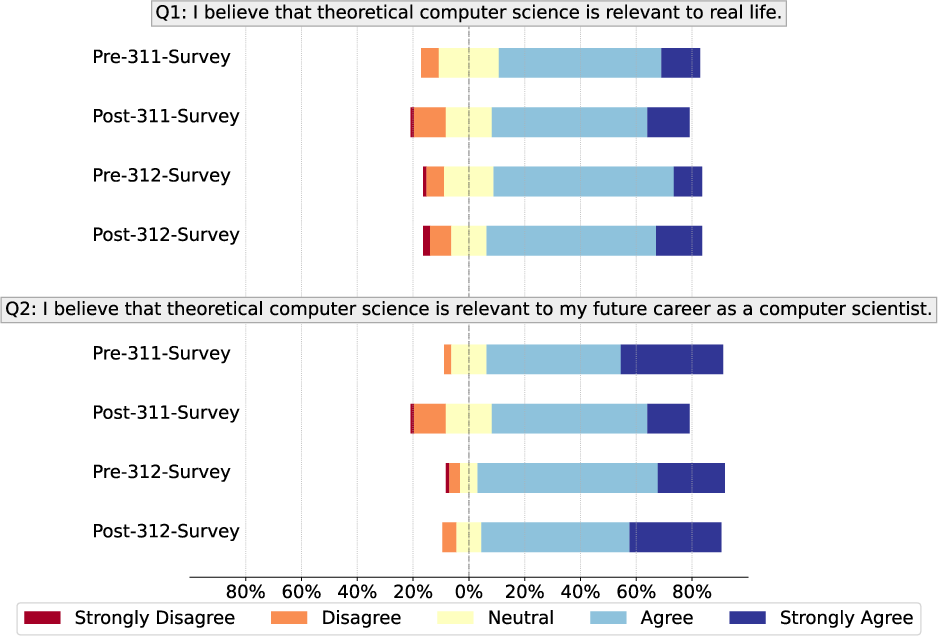
Figure 1: DM Intervention Term — student Likert responses indicate a pronounced rightward-shift (increase in perceived relevance) post-RWP intervention.
Student Reception and Pedagogical Impact
Over 90% of RWP-exposed students recommended continuing their use, with sentiment analysis of long-form feedback showing that positive affective responses far outweigh negative or neutral ones (e.g., 308:41:17 positive:negative:neutral in DM). Students report increased engagement, deeper conceptualization, and a reinforced ability to connect abstract formalisms to their lived experience and professional goals. While a subset noted confusion (mainly around open-endedness or finding applicable scenarios), very few students indicated any negative impact on learning.
Integration of Ethics
RWPs uniquely provide context for ethical reflection on foundational material. Students were able to articulate, sometimes with sophistication, the ways in which logic, statistical reasoning, and fairness criteria play out in contentious applications such as legal adjudication, algorithmic bias, and misuse of statistical evidence in public discourse. Several responses demonstrate significant metacognitive engagement with the problem of translating between ambiguous natural language and precise formalisms—an important professional and ethical skill.
Quantitative Summary
| Outcome |
Intervention Effect |
Comment |
| Initial perceived irrelevance |
<7% (both arms) |
Contradicts prevailing faculty view |
| Increase in "strongly agree" (Q1) |
Yes (stat. signif) |
Effect size ≈ 27 post-course |
| Course enjoyment / RWP affinity |
>90% recommend |
Weak negative outlier |
| Ethics commentary in feedback |
Present |
Absent in control, strong in RWP |
| Detrimental effect on learning |
~0% |
Minimal, rare instances observed |
Implications for Theory Curriculum and Future Research
The results contest common instructor assumptions regarding student disengagement due to abstraction in theory courses. Instead, they suggest that while the median student already sees substantial value, targeted RWPs further solidify perceived relevance and open space for new connections—with notable impact on the upper tail of strong engagement. Moreover, the research provides evidence for the tractability and desirability of integrating ethics into lower-division theory, thereby addressing a gap both in the curriculum and the literature.
Practically, the study offers a replicable blueprint: RWPs need not be elaborate, and can focus on a short technical core coupled with guided exploration and structured reflection. They also provide an accessible entry-point for the inclusion of otherwise challenging topics such as algorithmic fairness, legal reasoning, and the interpretive hazards of probability.
On a theoretical level, the research invites a re-examination of curricular assumptions about abstraction and motivation in foundational courses. It raises new questions about the impact of such interventions on long-term retention, professional trajectory, and the potential for more robust assessment of ethical reasoning skills early in CS education. The observed tension between high pre-survey relevance (possibly augmented by social desirability) and substantial qualitative engagement warrants further study, potentially with blinded or indirect measurement instruments.
Conclusion
The study demonstrates that embedding real-world and ethically-inflected problems in foundational theory courses modestly but robustly increases the perceived relevance of these subjects to students' lives, with overwhelming student support. It counters enduring misconceptions about the disconnect between theory and application, and provides a validated, easily-implemented mechanism for improving curriculum, engagement, and ethical competence in pre-advanced CS training. This intervention constitutes a pragmatic, evidence-based step toward aligning early theory pedagogy with both disciplinary and societal imperatives.