- The paper introduces a principal matroid determinant that generalizes GKZ theory to matroid combinatorics through a novel framework of discriminants and resultants.
- It establishes factorization properties and explicit degree formulas for uniform matroids, linking combinatorial structures with geometric invariants.
- The work connects matroid hypergeometric systems and tropical geometry, offering computational tools for singularity and topological analyses.
Principal Matroid Determinants: A Theory Bridging GKZ and Matroid Combinatorics
Introduction and Motivation
"Principal Matroid Determinants" (2604.24667), authored by Saiei-Jaeyeong Matsubara-Heo and Simon Telen, proposes a comprehensive analog of GKZ (Gel'fand-Kapranov-Zelevinsky) theory within the context of realizable matroids, fundamentally expanding the reach of discriminants, resultants, and determinants beyond toric varieties into the structural domain of matroids. This framework replaces the geometric role of polytopes and their faces with matroid combinatorics, specifically leveraging the language of flats and reciprocal linear spaces.
The central object, the principal matroid determinant EL, is defined as a specialization of a matroid resultant, paralleling the principal A-determinant in GKZ theory. This determinant encodes the combinatorial and geometric complexity of a matroid arising from a linear space's intersection with projective coordinate hyperplanes. The authors systematically develop properties—factorization, degree formulas, Newton polytope structure, and links to singular loci of hypergeometric systems—establishing tight analogies with toric GKZ constructions.
Analogies and Departures from GKZ Theory
The manuscript rigorously establishes a relational map between GKZ's toric discriminant theory and the matroid setting. Key substitutions include replacing:
- The toric variety with reciprocal linear spaces L−1;
- The principal A-determinant EA with EL;
- The GKZ hypergeometric system with the matroid hypergeometric system, a holonomic D-module.
The matroid determinant EL exhibits factorization properties linked to matroid discriminants Δ(LF−1) indexed by flats F of the matroid. The Newton polytope of A0 is shown to be a generalized permutohedron, reflecting the structure of matroid flats analogous to the secondary polytope in GKZ theory.
Strong numerical results are reported for uniform matroids, such as explicit degrees of matroid discriminants and determinant polynomials. For instance, the degree of the principal matroid determinant for a uniform matroid is given by A1, where A2 denotes the number of connected components and A3 is the M\"obius invariant (see Theorem~\ref{thm:mainintro}).
Factorization and Combinatorial Structure
The principal matroid determinant A4 is demonstrably reducible, factoring over matroid discriminants associated with flats of varying rank. The zero locus of A5 decomposes as a union over all flats:
A6
For uniform matroids, the explicit factorization includes rank-one flat contributions as powers of coordinate variables and higher-rank discriminant factors.
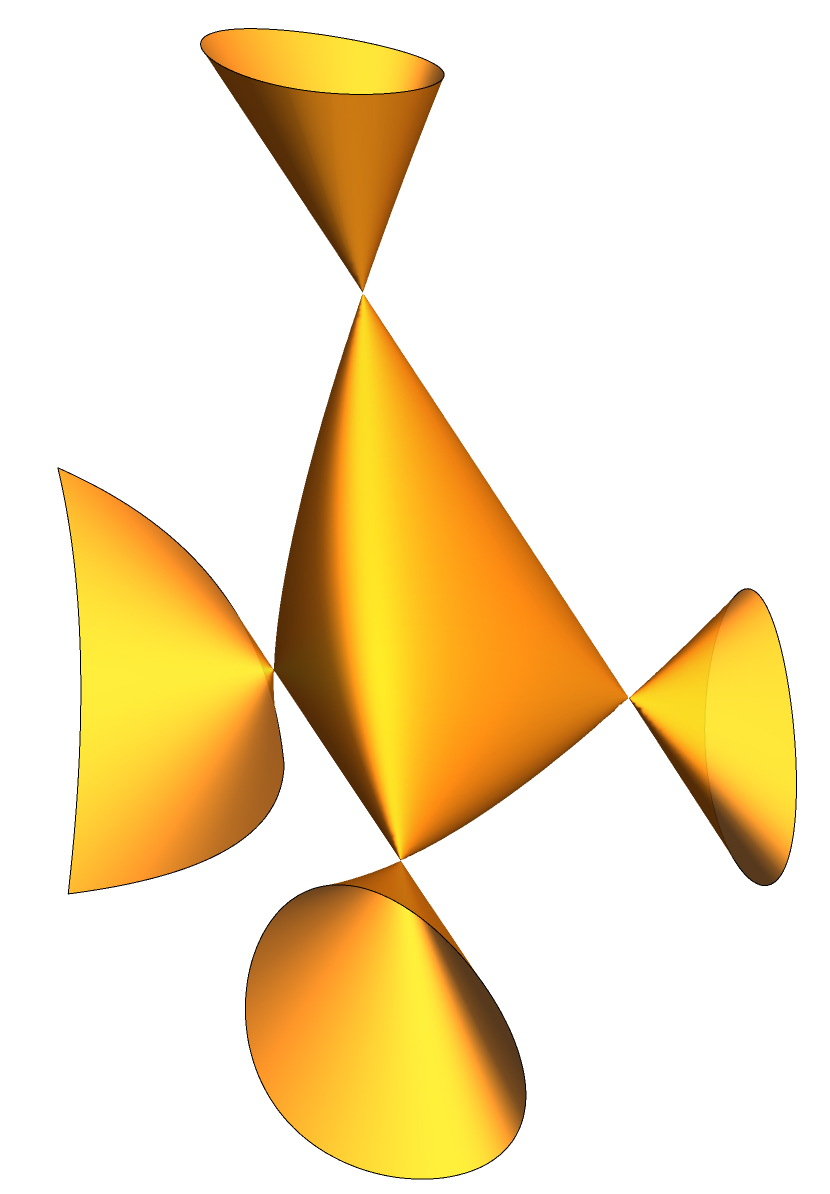
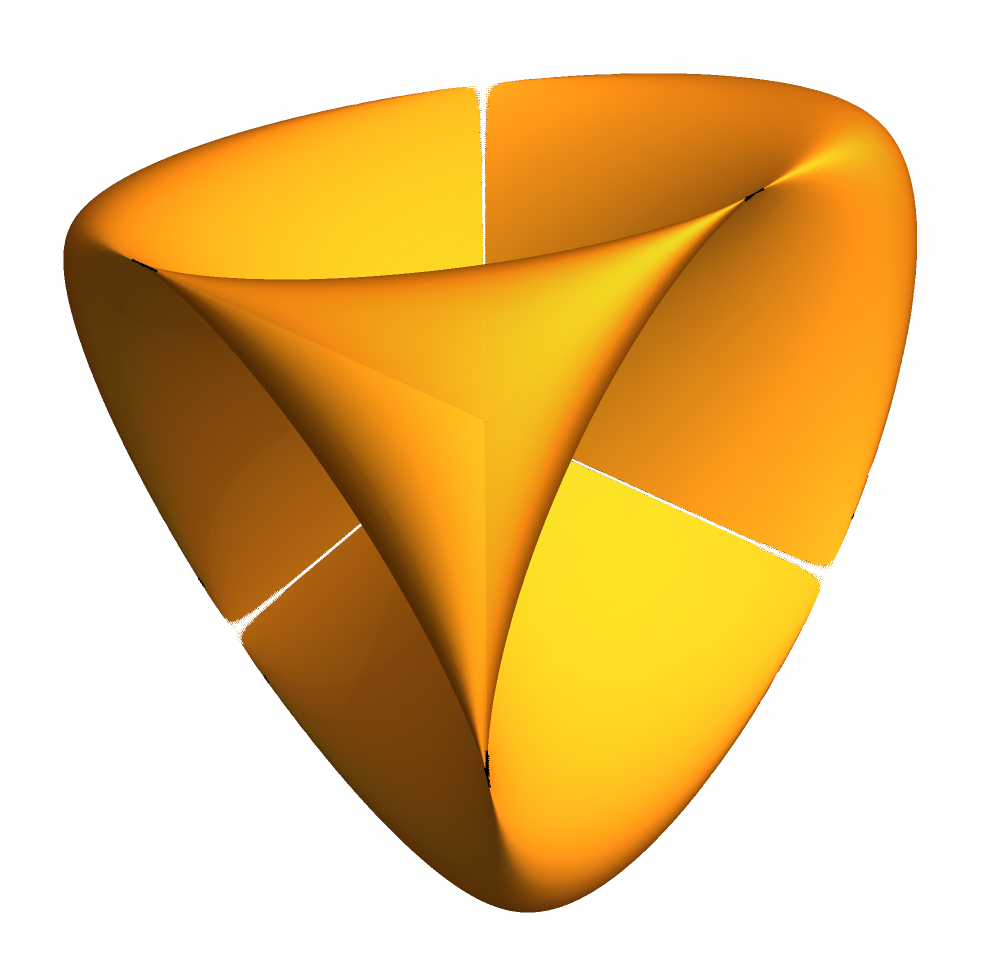
Figure 1: The Cayley surface (left) and the Steiner surface (right) are reciprocal duals; these encode the matroid discriminant and its dual in the setting A7.
The factorization theorem generalizes classical GKZ results, situating matroid discriminant varieties as fundamental building blocks of the determinant. The Newton polytope emerges as a sum of simplices indexed by flats—a generalized permutohedron.
Euler Discriminant Interpretation and Topological Implications
A pivotal result relates the vanishing locus of A8 to points where the topological Euler characteristic of a family of hyperplane sections deviates from generic values:
A9
with L−10 parameterizing cubic or elliptic curves intersecting line arrangements structured by L−11. This result consolidates the role of L−12 as an Euler discriminant, directly generalizing Esterov's theorem for toric varieties to matroid configurations.
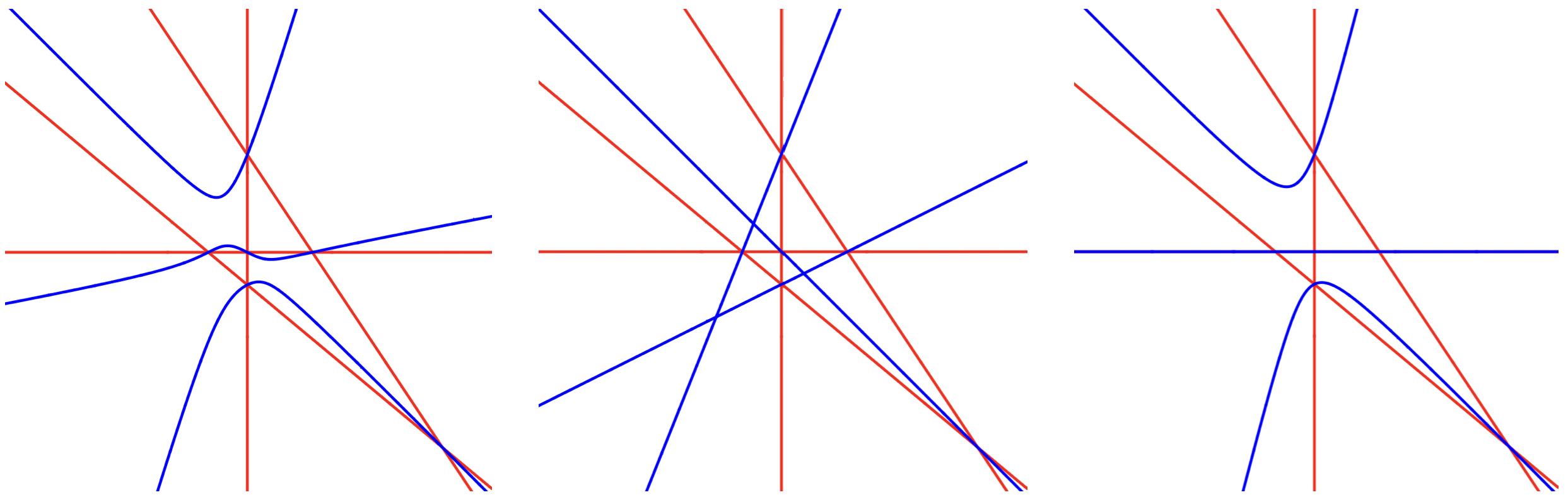
Figure 2: The cubic curve L−13 (blue) and associated line arrangement of L−14 (red) illustrating non-generic Euler characteristics for specific L−15.
The authors present explicit computations demonstrating loci where the genus and singularities of the curve L−16 correspond to components in the discriminant. The geometric stratification aligns with matroid combinatorics, where flats dictate the topology of intersections.
Matroid Hypergeometric Systems and D-Module Theory
The proposed matroid hypergeometric system L−17 generalizes the GKZ holonomic system, defining a Weyl algebra ideal using matroid data:
L−18
for L−19 in the ideal of the reciprocal linear space, with appropriate parameter constraints.
Key theoretical results:
- A0 is holonomic for all parameter choices, with singular locus contained in A1.
- For generic A2, the inclusion is conjectured to be equality: the vanishing locus of A3 precisely characterizes singularities (see Conjecture~\ref{conj:bigconjecture}).
The integral representation of solutions via Euler integrals,
A4
recovers classical hypergeometric functions (Lauricella A5, etc.) and, notably, computes Feynman integrals of banana diagrams in quantum field theory. The characteristic cycle of A6 is explicitly tied to the structure of matroid discriminants, including Landau singularities.
Tropical and Parametric Geometry
Combinatorial algorithms for computing the degree and structure of matroid discriminant varieties leverage tropical geometry: tropicalizations of A7 and A8 yield Minkowski sums representing the discriminant variety. For uniform matroids, the degree formula A9 is obtained by detailed counting arguments through Bergman fans and their weights.
The Hadamard product parametrization, EA0, situates matroid discriminants within explicit geometric transformations, elucidating defectivity conditions and generalizations of classical projective duality.
Implications and Future Directions
The theoretical implications are multifaceted:
- Combinatorial Algebraic Geometry: This work establishes a new landscape where matroid structure governs discriminants and resultants, inviting further investigation into matroid Chow forms, intersection theory, and singularity stratification.
- D-Module and Hypergeometric Theory: The matroid hypergeometric system offers a template for generalizing GKZ models, with direct application to algebraic statistics, combinatorial probability, and analytic constructions on spaces structured by arrangements.
- Quantum Field Theory: Explicit identification of Euler discriminants with Landau singularities in Feynman integral computations suggests practical computational advances for singularity analysis in particle physics.
- Tropical Geometry and Algorithmics: The combinatorial algorithmic framework yields effective methods for degree computations and defectivity analysis in high-dimensional settings, especially for uniform and non-uniform matroid cases.
Practically, the results offer computational tools for determining singular loci, factoring high-degree determinants, and understanding topological invariants of parameterized families.
Theoretically, the paper conjectures several deep combinatorial characterizations (e.g., defectivity and multiplicity in terms of matroid invariants), opening directions for matroid-based stratification, resonance phenomena in EA1-modules, and explicit series solution construction.
Conclusion
This manuscript introduces and develops a principal determinant theory for realizable matroids, structurally paralleling and extending GKZ theory. The principal matroid determinant, matroid discriminants, and associated hypergeometric systems are shown to be intricately governed by matroid combinatorics, both algebraically and topologically. The implications pervade algebraic geometry, combinatorics, analytic D-module theory, and mathematical physics, making this contribution a foundation for future research in matroid-based algebraic structures, stratified topology, and constructive algorithms for discriminant computation.