- The paper proposes a PEPS construction that restores translational covariance for physical observables by encoding magnetic flux virtually as a continuous variational parameter.
- It implements Peierls phases through local U(1) actions on the auxiliary bonds, allowing standard translation-invariant contraction and optimization without large magnetic unit cells.
- Numerical benchmarks on the Harper-Hofstadter-Hubbard model validate the ansatz’s ability to capture ground state correlations, paving the route for studying topological phases.
Gauge-Covariant PEPS for Interacting Lattice Systems in Magnetic Fields
Introduction
The simulation of interacting quantum lattice systems under uniform magnetic fields introduces formidable challenges for tensor network methods due to the explicit breaking of ordinary lattice translation symmetry by Peierls phases. Standard approaches rely on introducing large magnetic unit cells, which restrict the accessible parameter regimes and dramatically increase computational complexity. The paper "Gauge-covariant projected entangled paired states for interacting systems in a magnetic field" (2604.24574) proposes a PEPS construction that restores translational covariance on the physical observable level by encoding magnetic flux at the virtual layer. This enables explicit gauge invariance and physical translation symmetry for local observables, eliminates the need for large unit cells, and allows the flux per plaquette to enter as a continuous variational parameter.
Gauge Structure and PEPS Ansatz Construction
The introduction of a uniform magnetic field on a lattice via Peierls substitution gives rise to Peierls phases in the hopping terms, where the phase is determined by a line integral of the vector potential. Although this choice of vector potential (gauge) explicitly breaks lattice translation symmetry, physical observables are expected to be invariant under the magnetic translation group, which combines translation and appropriate gauge transformations. The authors exploit this by developing a PEPS ansatz with virtual flux tensors: the Peierls phases are implemented through local U(1) group actions on the PEPS auxiliary bonds, forming a virtual flux network that exactly mirrors the Hamiltonian’s phase structure.
The ansatz is not translation invariant at the wavefunction level because of the explicit flux pattern. However, by construction, it is covariant under the magnetic translation group; translation combined with the relevant gauge operation leaves all physical local observables strictly invariant. The construction allows for unit cell choices that reflect only the intrinsic symmetry breaking in the phase under investigation rather than any artificial breaking due to magnetic field implementation.
Variational Optimization, Contraction, and Gauge Independence
One crucial technical advance is that contraction and energy optimization for the constructed PEPS ansatz can proceed using standard algorithms designed for translation-invariant PEPS, without having to handle large, flux-dependent magnetic unit cells. The flux per plaquette, ϕ, appears only as a parameter in the contraction, not structurally in the network, disentangling flux handling from gauge. The contraction of the network and evaluation of expectation values become efficient via a single-site boundary MPS approach, because the action of the flux network on the boundary MPS is absorbed by the U(1) symmetry structure of the tensors.
Perturbative analysis from the infinite-U Mott insulator provides further justification for the ansatz, demonstrating that the inclusion of the appropriate virtual flux structure naturally emerges in the expansion of the ground-state wavefunction, consistent with expected gauge covariance properties.
Numerical Benchmarks and Physical Results
The approach is benchmarked on the bosonic Harper-Hofstadter-Hubbard model at unit filling in the strongly interacting Mott regime, with continuous variation of the flux per plaquette. Variational optimization with the gauge-covariant PEPS yields ground state energies that closely reproduce MPS results on infinite cylinders. Importantly, this agreement is obtained without the need to restrict to discrete commensurate fluxes or large unit cells.
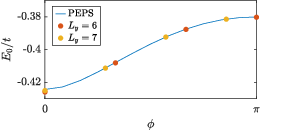
Figure 1: Ground state energy per site of the bosonic Harper-Hofstadter-Hubbard model as a function of magnetic flux per plaquette, demonstrating convergence of the PEPS ansatz with results from infinite-cylinder MPS simulations.
These results provide strong numerical evidence that the gauge-covariant PEPS ansatz is capable of capturing the necessary ground state correlations and physical observables of strongly interacting bosonic systems in a magnetic field, without suffering from gauge-related restrictions.
Theoretical Implications
The explicit construction of a tensor network state which is covariant under the magnetic translation group reconciles physical symmetry with numerical efficiency, a significant step forward in tensor network simulations of gauge field-coupled systems. This construction also clarifies that large magnetic unit cells are not intrinsic requirements but rather artifacts of particular gauge choices and naive tensor product implementations. On the theoretical front, the work points toward the classification and generation of families of tensor network states that are manifestly invariant under combined internal and spatial symmetries.
Additionally, the formalism provides a route to constructing tensor network representations for states in rational flux as well as potential generalizations to irrational flux, with implications for the study of topological phases such as fractional Chern insulators. The authors discuss the necessary modification of the auxiliary legs to support fractional charge and projective symmetry, opening a pathway toward PEPS constructions for fractionalized and chiral topological orders.
Prospects and Future Directions
The authors propose that the approach readily generalizes to fermionic systems by appropriate modification of the bond and tensor structure (via fermionic PEPS). They anticipate that future work will focus on non-integer fillings where fractional Chern insulating phases and their associated $\mathds{Z}_q$ projective symmetries play a central role. One technical obstacle is the scaling of bond dimension necessary for accurate contraction and the computation of local observables in such chiral topological states; surmounting this will likely lead to significant advances in the simulation of strongly correlated topological matter.
Furthermore, the work sets the stage for a broader class of gauge-invariant variational tensor network states tailored to lattice gauge theories and lattice models with dynamical gauge fields, extending beyond static background fluxes.
Conclusion
This work formulates a gauge-covariant PEPS ansatz for interacting quantum lattice systems in a uniform magnetic field that maintains translation symmetry at the level of physical observables, avoids artificial symmetry breaking, and treats the flux per plaquette as a continuous variational parameter. Numerical simulations confirm the efficacy of this approach, and the theoretical framework paves the way for the study of correlated phases in magnetic fields—including fractional and chiral topological states—using efficient tensor networks. The versatility and mathematical clarity of the construction suggest its potential to become a standard tool for studies of interacting quantum matter under background gauge fields.

