- The paper's main contribution is using multi-messenger observations from GW170817 to improve constraints on scalar polarizations via Bayesian parameter estimation.
- It integrates electromagnetic-derived constraints, notably on the polarization angle, to break degeneracies in non-GR waveform parameters.
- Results reveal a mild ~2σ deviation for the scalar amplitude (αB) while overall findings remain consistent with General Relativity.
Probing Scalar Polarizations in Gravitational Waves Using Multi-Messenger Events
Introduction
The detection of gravitational waves (GWs) by ground-based interferometers has enabled stringent and theory-agnostic tests of General Relativity (GR) in the strong-field regime. While GR admits only the + and × tensor polarizations, more general metric theories of gravity—such as scalar-tensor, vector-tensor, and bimetric theories—predict up to six possible GW polarization modes, including vector and scalar (breathing and longitudinal) modes. Unambiguous identification of non-tensorial polarization would provide direct evidence for physics beyond GR.
Binary neutron star (BNS) mergers are particularly informative for polarization studies due to their robust electromagnetic (EM) counterparts. Multi-messenger observations constrain the binary orientation—specifically, the inclination and polarization angles—breaking degeneracies that cannot be resolved from GW data alone, especially with current GW detector networks lacking the required diversity and number of detectors to fully resolve all modes. The GW170817 event, detected by LIGO/Virgo with extensive EM follow-up, is unique in providing sky location, distance, inclination, and polarization angle constraints.
This work performs Bayesian parameter estimation of possible non-GR GW polarizations from GW170817 using the parameterized post-Einsteinian (PPE) framework. The study focuses on the inclusion of a non-GR scalar breathing mode in addition to amplitude and phase corrections to the tensor modes, and—crucially—incorporates for the first time tight EM constraints on the polarization angle. The aim is to assess whether current data show evidence for scalar polarization and to elucidate the impact of EM information on bounding non-GR waveform parameters.
General metric theories admit up to six polarization states: +,×,x,y,b,ℓ. For GW170817, only the +,× (tensor) and b (scalar breathing) modes are considered, consistent with theoretical expectations for scalar-tensor theories and technical limitations of the detector network in disentangling the degenerate scalar modes.
The detector response is constructed as a sum over polarization modes, weighted by antenna pattern functions Fp(θ,ϕ,ψ) and the intrinsic gravitational waveform for each mode. The tensor (dominant) and scalar harmonics, as functions of binary orientation and coalescence phase, are explicitly included, particularly for the (ℓ,∣m∣)=(2,2) quadrupole and (1,1) dipole.
The PPE framework parameterizes generic leading-PN amplitude and phase corrections to each mode, introducing free parameters: (α,aT) for tensor amplitude, (β,b) for tensor phase, (αB,aS) for scalar amplitude, and shared exponents motivated by typical corrections in modified gravity (e.g., Horndeski, Einstein-Aether, Lightman-Lee). This modeling is applied exclusively to the inspiral regime to avoid unquantified uncertainties in modified gravity during merger and ringdown.
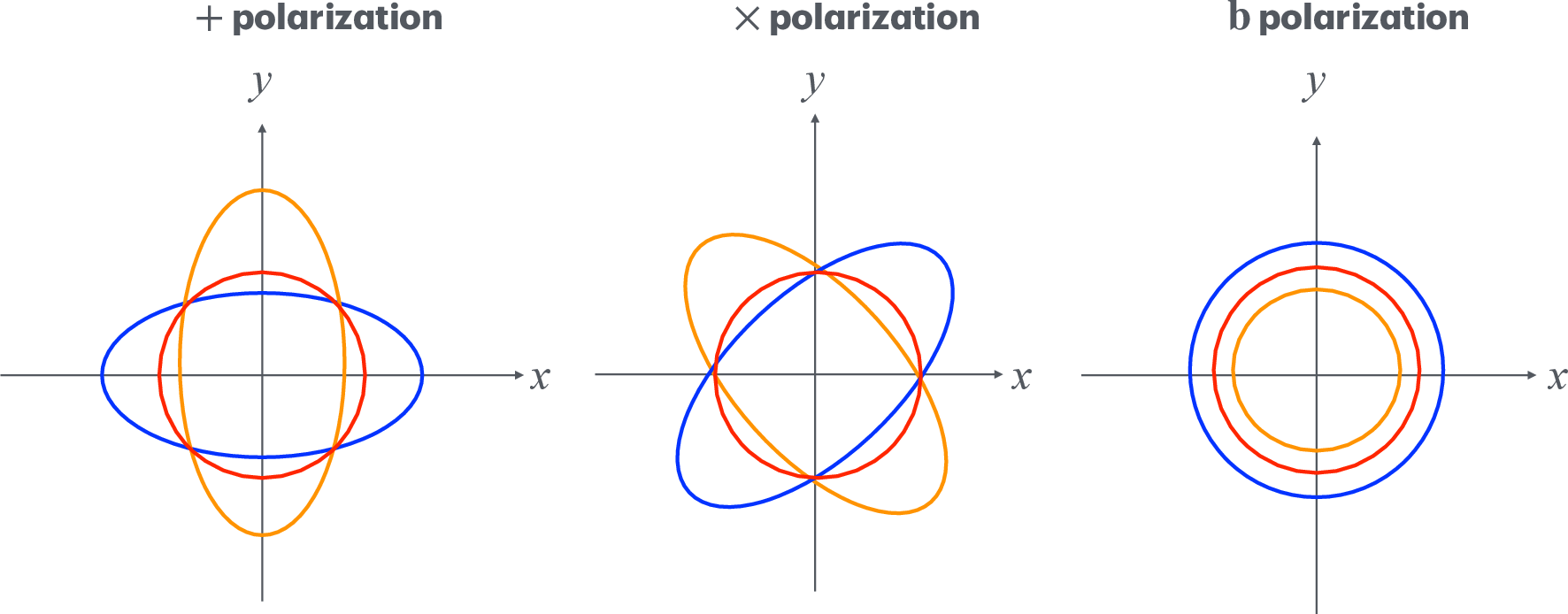
Figure 1: Schematic representation of the +, +,×,x,y,b,ℓ0, and breathing (+,×,x,y,b,ℓ1) polarization modes propagating along +,×,x,y,b,ℓ2, visualizing their distinct action on a ring of test particles.
Multi-Messenger Constraints and Parameter Estimation
GW170817's sky position, luminosity distance, inclination (+,×,x,y,b,ℓ3), and polarization angle (+,×,x,y,b,ℓ4) were fixed using EM counterparts: host galaxy identification, kilonova emission, and long-baseline VLBI radio follow-up of the GRB afterglow, which tightly constrains the jet's orientation and polarization angle. These constraints enable a sequence of analyses using progressively stricter priors—first on sky position, then adding +,×,x,y,b,ℓ5, +,×,x,y,b,ℓ6, and finally +,×,x,y,b,ℓ7—culminating with "All" EM constraints.
Bayesian inference is performed on GW170817 with a PPE-augmented IMRPhenomD waveform, focusing on the dominant +,×,x,y,b,ℓ8 mode and subdominant +,×,x,y,b,ℓ9 mode for the tensor and scalar polarizations, respectively. Priors for the PPE amplitude and phase deviations are informed by both theoretical considerations and perturbativity, and the impact of the EM constraints on parameter posteriors is systematically examined.
Results
Constraints on PPE Parameters
The main result is that the inclusion of EM constraints, particularly the polarization angle, leads to substantial tightening of bounds on non-GR parameters, most notably on the scalar amplitude parameter +,×0 and the tensor amplitude correction +,×1. For the quadrupole case +,×2 with +,×3, the uncertainties on +,×4 and +,×5 improve by approximately 61% and 29%, respectively, when all EM information is used compared to GW-only priors.
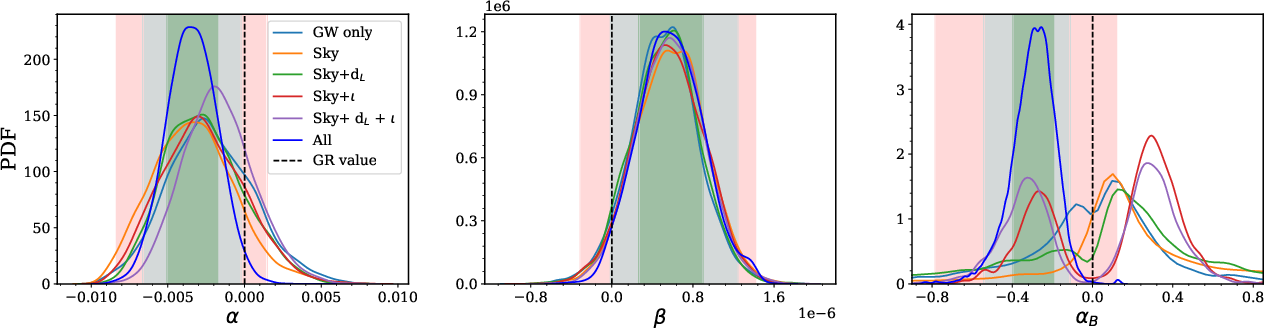
Figure 2: Posterior PDFs for PPE parameters +,×6, +,×7, +,×8 for +,×9 under successive EM prior inclusion, showing progressively tighter credible intervals; the GR value is marked.
The scalar amplitude b0 exhibits a mild b1 deviation from zero when all EM constraints are included: b2 (95% credible interval), with GR lying at the 99.75th percentile. For b3, a similar mild deviation is found, while the phase correction b4 is entirely consistent with GR.
A double-peaked posterior in b5 is observed when the polarization angle is unconstrained, an artifact of the b6 symmetry in b7 and the detector's response. This degeneracy is broken by the EM prior on b8.
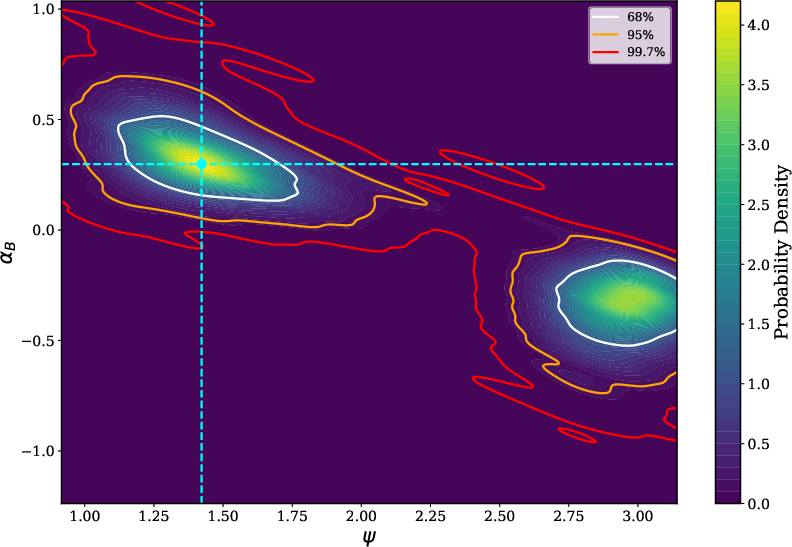
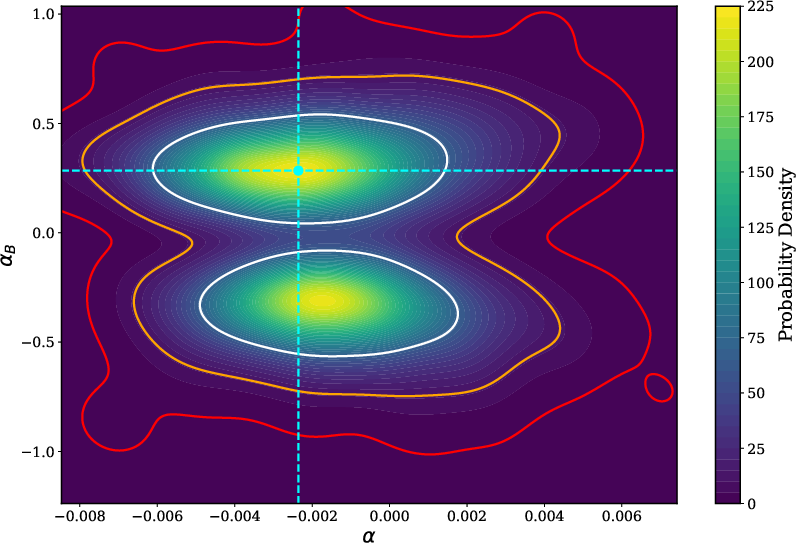
Figure 3: Joint posterior distributions illustrating the correlation between b9 and Fp(θ,ϕ,ψ)0 (left), and between Fp(θ,ϕ,ψ)1 and Fp(θ,ϕ,ψ)2 (right), highlighting how EM priors on Fp(θ,ϕ,ψ)3 break the degeneracy.
For the dipole case Fp(θ,ϕ,ψ)4, all non-GR parameters are fully consistent with GR for all choices of exponents.
Robustness to Model Assumptions
Changing the frequency exponent Fp(θ,ϕ,ψ)5 for the scalar mode (Fp(θ,ϕ,ψ)6 vs.\ Fp(θ,ϕ,ψ)7) does not qualitatively affect the constraints; the preference for nonzero Fp(θ,ϕ,ψ)8 remains mild and statistically consistent. The results are not sensitive to the cutoff frequency used to terminate the waveform.
Analysis in which only a single PPE parameter is free (pure tests) shows weaker or null deviations, whereas simultaneous variation of Fp(θ,ϕ,ψ)9 and (ℓ,∣m∣)=(2,2)0 (mixed polarization test) produces the (ℓ,∣m∣)=(2,2)1 effect. Thus, the mild preference for nonzero (ℓ,∣m∣)=(2,2)2 is not a generic consequence of the method but emerges under the joint hypothesis of multiple non-GR amplitude corrections.
Interpretation and Theoretical Implications
No statistically significant evidence for non-tensorial (non-GR) GW polarization is observed when accounting for model selection penalties. The improvement in maximum likelihood for the PPE model is marginal and is offset by the increased number of free parameters, evidenced by the negative difference in the Akaike Information Criterion.
The (ℓ,∣m∣)=(2,2)3 deviation of (ℓ,∣m∣)=(2,2)4 must be interpreted with caution: such effects can be produced by non-Gaussian noise fluctuations. Notably, population studies in GWTC-4 report similar mild outliers without significant cumulative evidence for non-GR physics. Importantly, the underlying assumption of source-independence in new physics may not hold: scalar-tensor theories can produce strong scalarization for neutron stars while leaving black holes unaffected. Thus, stacking across BBH and BNS events could obscure effects present only in BNS mergers.
The improved constraints—driven by the polarization angle prior—demonstrate that long-term radio follow-up and precise jet modeling in future multi-messenger events will play a decisive role in closing parameter space for modified gravity models.
Prospective Outlook
This analysis demonstrates the critical impact of including orientation and polarization information from EM counterparts in GW tests of fundamental gravity. The generic PPE framework, augmented for non-tensor modes, is applicable to forthcoming events from advanced and next-generation GW detectors which will sample even more diverse polarizations and improve parameter identifiability due to expanded detector networks.
As future BNS mergers with high-fidelity EM and radio afterglow observations are detected, and as the detector network evolves, the methodology outlined here will enable more stringent and nuanced theory-agnostic constraints on GW polarization content and the possible breakdown of GR.
Conclusion
A comprehensive, theory-agnostic test of GW polarizations in GW170817 leveraging full EM counterpart constraints, including for the first time the polarization angle, yields the strongest model-independent bounds to date on extra scalar (breathing) polarization. Particularly, the polarization angle prior tightens bounds on both tensor and scalar amplitude corrections by over 30%. The analysis finds no statistically significant evidence for deviation from GR, but identifies a mild (ℓ,∣m∣)=(2,2)5 effect in the scalar channel that warrants further investigation with future multi-messenger events. The results highlight both the necessity of multi-messenger data and the limitations of GW-only observations for polarization tests, and set the stage for next-generation precision tests of the gravitational interaction.