Geometric Analysis of Self-Supervised Vision Representations for Semantic Image Retrieval
Abstract: Content-based image retrieval (CBIR) systems enable users to search images based on visual content instead of relying on metadata. The text domain has benefited from vector search of representations created with unsupervised methods such as BERT. However, modern self-supervised learning methods for vision are mostly not reported in CBIR-related literature, instead relying on supervised models or multi-modal methods that align text and vision. We evaluate how the representations learned by modern self-supervised learning methods for vision perform under typical retrieval stacks that leverage vector databases and nearest neighbor search. Our evaluation reveals that the latent space geometry impacts approximate nearest neighbor (ANN) indexing. Specifically, highly anisotropic representations with high skewness produced by several modern SSL methods degrade the performance of partition-based and hashing-based search, even if their own linear probe or K-NN accuracy is not affected. In contrast, representations with higher isotropy and local purity better satisfy the distance-based assumptions of ANN indexes, leading to improved semantic retrieval performance.
Paper Prompts
Sign up for free to create and run prompts on this paper using GPT-5.
Top Community Prompts
Explain it Like I'm 14
Overview
This paper studies how well “self-supervised” vision models help you find images that mean the same thing (like “dogs” or “pasta”), not just the exact same picture. The authors look at how these models turn images into vectors (lists of numbers) and how the “shape” of those vectors affects fast search systems that find similar images.
What the researchers wanted to know
They set out to answer three simple questions:
- Do popular self-supervised vision models make good vectors for image search when you want “same kind of thing” (semantic) matches?
- Why do some models work better than others with common vector databases that use nearest-neighbor search?
- Which hidden properties of the vector space help or hurt image retrieval, and what should practitioners look for?
How they tested it (in everyday terms)
First, a few plain-language translations:
- Embedding/vector: a picture turned into a list of numbers so that similar pictures end up as nearby points.
- Latent space: the invisible “map” where those number-lists live.
- Nearest neighbor search: finding the closest points on that map.
- Index: a data structure that makes searching fast.
They used two datasets:
- ImageNet-1k (lots of everyday objects)
- Food-101 (different types of food)
They compared several training methods that create image embeddings:
- Self-supervised methods (SimCLR, BYOL, SwAV, Barlow Twins, VICReg, DINO, ReSA, Hypersolid)
- A standard supervised baseline (trained with labels)
They stored all image embeddings in three popular search indexes:
- IVF (partition-based): Think of dividing a city into districts and only searching the nearest district.
- HNSW (graph-based): Think of a network of shortcuts and bridges to quickly jump toward the right neighborhood.
- LSH (hashing): Think of assigning each image to a mailbox (a “bucket”) by a short code, so you only check that mailbox.
They measured how good the search results were using common metrics like Precision@10 (how many of the top 10 are the right kind) and MRR (how soon the first correct match appears).
Then they studied the “geometry” of the embedding space—the way points are spread out—because that shape changes how well indexes work. Key ideas:
- Anisotropy vs. isotropy: If points are squeezed into a cone (anisotropic), it’s like everyone crowding into one corner of a room—hard to search. If points are evenly spread (isotropic), searching is easier.
- Skewness/hubs: If a few images pop up as “nearest neighbors” for tons of queries (like celebrities), they create “hubs” that can mislead search.
- LSH bucket balance (entropy): If too many items fall in just a few mailboxes, you still end up sifting through big piles—slow and noisy.
- DBSCAN clustering: A way to see if the space naturally forms dense, separated groups (like well-defined neighborhoods).
- Local purity: For each image, what fraction of its closest neighbors are from the same class? Higher and slower-decaying purity means cleaner neighborhoods.
What they found and why it matters
Big picture:
- High accuracy in typical self-supervised checks (like “linear probe” or plain K-NN) does not guarantee good search results in real vector indexes.
- The geometry of the embedding space is the hidden deal-breaker.
More specifically:
- Many modern self-supervised models produced highly anisotropic, skewed spaces. In plain terms: points crowd into narrow regions, and a few “hub” images show up everywhere. This harms IVF and LSH (and can also hurt HNSW), even when those models look good on classic benchmarks.
- Embeddings that were more isotropic (evenly spread) and had higher local purity worked much better for semantic retrieval. They fit the assumptions that indexes rely on—distances mean something, districts are balanced, and buckets aren’t overloaded.
- LSH was especially sensitive: when embeddings clump, only a few buckets get flooded, and performance drops. Adding more bits (more buckets) helps a little, but not enough if the geometry is poor.
- DBSCAN showed that some methods form clearer, denser regions that better reflect semantic classes; those tended to retrieve more relevant images.
- One method (Hypersolid) consistently produced more balanced spaces, better LSH behavior, and higher local purity, which led to stronger search. Another (ReSA) did well in several retrieval metrics even with different clustering behavior—showing there’s more than one way for geometry to help.
Why this matters:
- Vector indexes assume “nearby means similar.” If your embedding space doesn’t behave that way, the index wastes time and returns noisy results.
- A model can be excellent at classification benchmarks but still be a poor fit for fast, precise image search.
What this means going forward
For people building image search:
- Don’t rely only on standard self-supervised scores. Test your embeddings with your actual index (IVF, HNSW, or LSH).
- Check simple geometry signals:
- Isotropy (are points evenly spread?)
- Hubness/skewness (do a few items appear in too many neighbor lists?)
- Local purity (do nearest neighbors stay “on topic” as you look farther out?)
- If geometry is poor, expect higher costs (bigger buckets, slower scans), more complex re-ranking steps, or weak results. Consider fine-tuning for your domain or choosing models that produce cleaner geometry for retrieval.
For researchers:
- There’s a gap between general-purpose self-supervised objectives and what retrieval systems need. Designing methods that favor isotropy, stable local neighborhoods, and balanced hash buckets could noticeably improve semantic image retrieval.
- Reporting retrieval metrics and geometry diagnostics (not just classification) will help the community build better systems.
In short: To make image search that finds “things of the same kind,” you don’t just need smart models—you need the right shape of the vector space. Spreading points evenly and keeping neighborhoods clean can matter more than headline accuracy numbers.
Knowledge Gaps
Knowledge gaps, limitations, and open questions
Below is a concise, actionable list of what remains missing, uncertain, or unexplored in the paper, aimed to guide future research.
- Limited datasets and scale: evaluation is restricted to ImageNet-1k and Food-101 (tens of thousands of images) with in-dataset queries; it is unclear how findings transfer to larger-scale (millions), long-tailed, multi-label, or domain-shifted retrieval settings.
- Backbone and architecture coverage: experiments focus on ResNet-50/18; modern backbones (e.g., ViT/DeiT, ConvNeXt, Swin, EVA-CLIP backbones) are not assessed, leaving unknown whether geometric findings (anisotropy/skewness effects) generalize across architectures.
- Method coverage: several prominent SSL approaches (e.g., MoCo-v2/v3, MAE, iBOT, MSN, LeJEPA) and retrieval-optimized SSL (e.g., InsCLR) are not included; the robustness of conclusions across a broader set of methods remains untested.
- Training budget and protocol mismatch: models come from mixed sources (pretrained vs. trained in-house), with different epochs, batch sizes, and augmentations; this confounds geometry and retrieval comparisons and calls for controlled, equal-budget training to validate conclusions.
- Index hyperparameter under-exploration: IVF is run with nprobe=1 and HNSW with a small efSearch (candidate list=16); no recall-speed trade-off curves are reported, making it unclear whether “geometry effects” persist under tuned ANN settings.
- ANN method breadth: only IVF, HNSW, and basic LSH are evaluated; modern indexes (e.g., IVFPQ/OPQ, IMI, ScaNN, DiskANN, SSD-based graph indexes) and their sensitivity to embedding geometry are unexplored.
- Distance metric sensitivity: IVF is evaluated with L2, HNSW with inner product on L2-normalized vectors; the impact of alternative metrics (cosine vs. L2) and metric learning on geometry–retrieval alignment is not systematically studied.
- Post-hoc embedding processing: effects of centering, whitening, PCA, dimensionality reduction, spectral reweighting, isotropy regularization, or de-hubbing techniques on retrieval quality and indexability are not evaluated.
- Retrieval stack realism: no re-ranking, query expansion, or relevance feedback is incorporated; it remains unclear how much geometry-driven gaps persist once standard re-ranking pipelines are applied.
- Speed/latency and memory: the paper argues about index load and efficiency but reports no wall-clock latency, throughput, memory, or cost measurements; the practical impact of geometry on system performance is unquantified.
- LSH analysis realism: bucket entropy analysis uses a 16-bit stress test and single-table setup; realistic configurations (multi-table LSH, longer hashes, learned or data-dependent hashing) and their interaction with anisotropy are not explored.
- Local purity and clustering scope: local purity decay and DBSCAN analysis are primarily presented for ImageNet-1k; reproducibility across datasets, sensitivity to DBSCAN parameters (eps/minPts), and alternative clustering methods (HDBSCAN, spectral, GMM) are not examined.
- Correlation vs. causation: correlations between anisotropy/skewness and retrieval metrics are computed with a small sample (n≈9 methods) and often non-significant p-values; causal links between geometry and ANN failures remain unproven.
- Theoretical grounding: beyond empirical correlations, there is no theory or formal analysis connecting global anisotropy/hubness to specific ANN failure modes (e.g., partition imbalance, search layer routing errors) to establish general conditions.
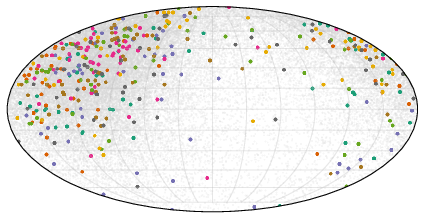
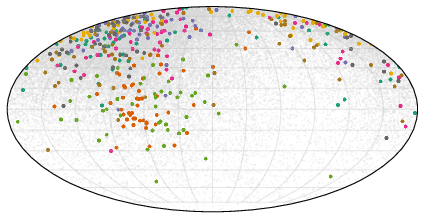
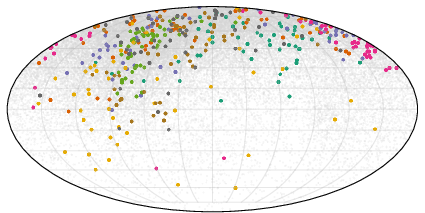
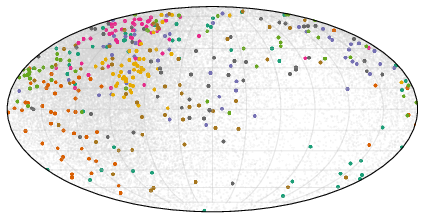
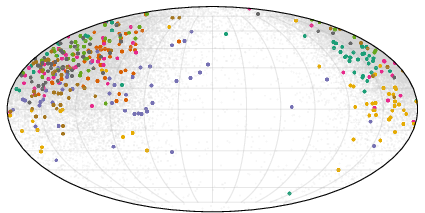
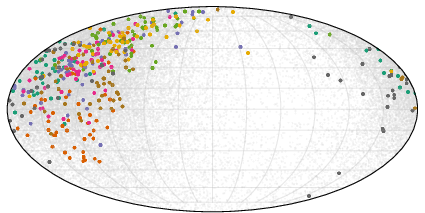
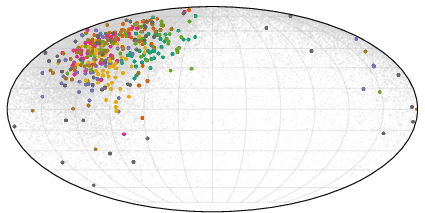
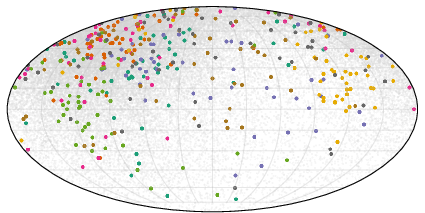
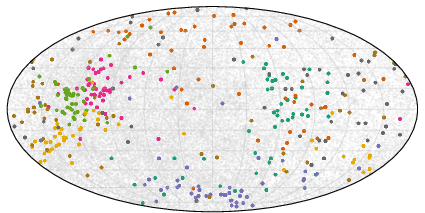
- Robustness of geometry visualizations: JL + Mollweide projections can distort neighborhood structure; invariance of observed patterns across random seeds and projection choices is not validated.
- Generalization to other retrieval tasks: only category-level and fine-grained retrieval are studied; behavior on instance-level retrieval, cross-view/place recognition, and open-world retrieval remains unknown.
- Out-of-distribution and cross-dataset retrieval: embeddings are evaluated on the same dataset they were trained on; cross-dataset retrieval performance and geometry stability under distribution shift are not assessed.
- Multimodal baselines: strong multimodal models (e.g., CLIP, ALIGN, SigLIP) are not included; it is unclear how pure-vision SSL geometries compare to widely used text–image embeddings for semantic retrieval under identical indexing conditions.
- Training-time geometry control: the paper recommends low anisotropy and low skewness but does not test training-time regularizers/objectives that explicitly control these (e.g., stronger uniformity terms, whitening losses, contrastive debiasing) or their trade-offs with general transfer.
- Dimensionality effects: embedding dimensionality and its interaction with anisotropy, hubness, and ANN performance are not varied or analyzed.
- Normalization choices: the impact of normalization (e.g., per-sample L2 normalization for IVF, mean subtraction, temperature scaling) on indexability and retrieval accuracy remains unexplored.
- Evaluation metrics breadth: only P@10, R@10, MAP@10, and MRR are used; ranking-sensitive metrics such as NDCG, precision–recall curves, or recall@K vs. latency curves would better capture practical performance.
- Query protocol realism: each indexed item is used as its own query; scenarios with separate query sets, cross-view/cross-condition queries, or noisy/cropped queries are not evaluated.
- Fairness and bias: the effect of geometry on class imbalance, minority-class retrieval, and hubness-induced bias is not examined.
- Reproducibility details: full hyperparameters for all methods (especially ReSA and Hypersolid), random seeds, and code for geometry measurements are not fully documented, limiting independent validation.
- Practical guidance scope: while recommending “evaluate embeddings before deployment,” the paper stops short of providing concrete procedures (e.g., thresholds for acceptable anisotropy/hubness, tuning recipes for nprobe/efSearch, or post-hoc isotropy fixes).
Practical Applications
Practical Applications Derived from the Paper’s Findings
Below, we distill actionable use cases and map them to sectors, tools, and workflows. Each item notes key assumptions or dependencies that may affect feasibility.
Immediate Applications
- Industry (Retail/e-Commerce): Geometry-aware product image search (CBIR)
- Application: Build or improve visual product search by auditing and selecting image embeddings with low anisotropy, low skewness, and high local purity; choose ANN indexes accordingly (e.g., HNSW over LSH when embeddings are anisotropic).
- Tools/products/workflows: FAISS (
IndexHNSWFlat,IndexIVF), geometry metrics (anisotropy, skewness/hubness, LSH bucket entropy), “embedding QA” dashboards, lightweight re-ranking. - Assumptions/dependencies: Product photos representative of catalog; availability of candidate SSL/supervised encoders; results in the paper were based on ImageNet-1k/Food-101 and minimal index tuning—your dataset and index tuning will affect outcomes.
- Industry (Media/DAM): Semantic asset retrieval in large image libraries
- Application: Improve newsroom and creative asset search using embeddings with higher isotropy and slower local purity decay to reduce false positives in top-k.
- Tools/products/workflows: FAISS/HNSW for coarse retrieval + metadata or tag-based re-ranking; periodic audits of LSH bucket balance if LSH is used at scale.
- Assumptions/dependencies: Domain shift must be evaluated; lack of paired text may favor pure-vision SSL; expected to add re-ranking for editorial criteria.
- Industry (Food apps/Delivery): Fine-grained food image retrieval
- Application: Enhance dish recognition and “find similar dishes” features leveraging fine-grained retrieval insights (Food-101 experiments); select embeddings with higher local purity for top-k results.
- Tools/products/workflows: ResNet-based encoders, HNSW/IVF indexes, purity-by-k monitoring; optional lightweight supervised fine-tuning on domain.
- Assumptions/dependencies: Menu classes and presentation variability; model/domain alignment affects transfer performance.
- Industry (Catalog QA/Dedup/Moderation): Visual near-duplicate and semantic clustering
- Application: Use DBSCAN density signals and hubness monitoring to detect duplicates, spam clusters, and catalog anomalies; reduce moderation workload by improving coarse routing with more isotropic embeddings.
- Tools/products/workflows: DBSCAN over embeddings (cosine/Euclidean), hubness and skewness reports; FAISS indexing; rule-based triage.
- Assumptions/dependencies: DBSCAN parameters and scaling impact sensitivity; coarse clustering won’t replace human review in sensitive scenarios.
- Industry (Manufacturing/MRO): Parts retrieval and semantic lookup
- Application: Speed up visual lookup of parts or assemblies by selecting embeddings with better LSH entropy (if hashing is used) or defaulting to HNSW when geometry is anisotropic.
- Tools/products/workflows: Visual search UI; FAISS-based vector DB; geometry audit reports to set LSH nbits and IVF probes.
- Assumptions/dependencies: Photographic variation (lighting, angle) and category granularity; potential benefit from supervised fine-tuning.
- Software/Platform Vendors (Vector DBs and MLOps): Embedding geometry QA and auto-tuning
- Application: Ship “embedding preflight checks” that compute anisotropy, skewness, max hub, local purity decay, and LSH bucket entropy; auto-suggest index types/parameters (e.g., HNSW vs IVF vs LSH, probes, nbits).
- Tools/products/workflows: Integrate metric computation into ingestion pipelines; auto-tuner heuristics; CI for embedding changes.
- Assumptions/dependencies: Compute cost of audits on large corpora; need for periodic sampling strategies.
- Academia (Evaluation and Benchmarking): Retrieval-centric evaluation protocols
- Application: Add retrieval metrics (P@10, MAP@10, MRR) and geometry diagnostics to standard SSL evaluations; report LSH entropy and purity-by-k alongside linear-probe/KNN.
- Tools/products/workflows: Open-source evaluation suites built on FAISS; standardized datasets with retrieval splits.
- Assumptions/dependencies: Community adoption; dataset coverage beyond ImageNet-like domains.
- Healthcare (Research/Prototyping): CBIR for radiology/pathology archives
- Application: Use geometry-audited embeddings (favoring isotropy and higher local purity) to prototype similar-case retrieval; choose HNSW when LSH buckets collapse.
- Tools/products/workflows: On-prem vector DB; clinician-in-the-loop re-ranking; stringent audit logs.
- Assumptions/dependencies: Regulatory approvals; domain shift and clinical validation required; sensitive data governance.
- Robotics/Autonomy (Mapping/Perception back-ends): Geometry-aware nearest-neighbor search
- Application: For visual retrieval components in mapping/localization, prefer index types robust to anisotropy (e.g., HNSW) and use geometry audits to prevent route failures caused by hubs.
- Tools/products/workflows: FAISS/HNSW; on-device approximations; periodic hubness checks.
- Assumptions/dependencies: Many robotics tasks are instance-level (not semantic), but geometry lessons still reduce latency/failure modes.
- Policy/Governance (Public-sector procurement and audits): Minimum evaluation criteria for vector search systems
- Application: Require vendors to report embedding geometry metrics and retrieval performance under the intended ANN index; disallow “linear probe only” claims; include hubness bias checks.
- Tools/products/workflows: Procurement templates; audit procedures referencing anisotropy/skewness and bucket balance.
- Assumptions/dependencies: Capacity to evaluate proprietary models; evolving standards.
- Daily Life (Consumer Photo Apps): Better on-device photo search (“find similar,” “group by concept”)
- Application: Use embeddings with higher isotropy and local purity to improve top-k relevance and enable smaller, more efficient LSH hashes or switch to compact HNSW.
- Tools/products/workflows: Mobile-friendly embeddings; geometry-driven choice of index (HNSW-lite or compressed LSH).
- Assumptions/dependencies: Battery and memory constraints; privacy preferences for on-device indexing.
Long-Term Applications
- Retrieval-optimized SSL objectives
- Application: Design SSL losses/regularizers that explicitly encourage isotropy, reduce skewness/hubness, and preserve high local purity aligned to semantic classes.
- Tools/products/workflows: New training recipes (e.g., covariance/whitening penalties, uniformity terms) and post-hoc geometric normalization pipelines.
- Assumptions/dependencies: Must maintain transferability without collapsing fine-grained discriminative power.
- Geometry-aware ANN indexes
- Application: Adaptive IVF/LSH/HNSW variants that detect global anisotropy and rebalance buckets/partitions or reweight directions at build/search time.
- Tools/products/workflows: Learned hash functions; pre-processing transforms (PCA/whitening/normalizing flows) embedded in index; dynamic bucket sizing.
- Assumptions/dependencies: Additional index build complexity; need to avoid latency regressions.
- Automated “index/embedding co-design”
- Application: Systems that jointly select embeddings and index hyperparameters to hit target SLAs (latency, memory, accuracy), driven by geometry metrics and local purity decay curves.
- Tools/products/workflows: AutoML for vector search; cost-quality knobs (nbits, nprobe, efSearch) guided by audits.
- Assumptions/dependencies: Requires representative holdout data and continuous monitoring to avoid drift.
- Standards and benchmarks for semantic retrieval geometry
- Application: Community benchmarks that include P@k/MAP/MRR plus geometry metrics (anisotropy, skewness, hubness, LSH entropy, purity-by-k); sector-specific testbeds (e.g., retail, cultural heritage, medical).
- Tools/products/workflows: Public leaderboards; reproducible FAISS configs; reference embeddings.
- Assumptions/dependencies: Cross-organization collaboration; licensing of datasets.
- Fairness, bias, and safety frameworks for vector search
- Application: Detect and mitigate hubness-driven bias (overexposure of certain items), ensure bucket balance does not degrade subpopulation recall, and avoid privacy leakage in “similar content” retrieval.
- Tools/products/workflows: Bias dashboards for hub detection; governance policies for re-ranking and opt-out.
- Assumptions/dependencies: Requires labeled or proxy attributes; policy clarity on acceptable trade-offs.
- Hybrid multi-stage semantic retrieval pipelines
- Application: Use isotropy-optimized embeddings for fast coarse retrieval and feed a task-specific or multimodal (e.g., CLIP) reranker for semantic alignment, reducing re-ranking load.
- Tools/products/workflows: Two-tower architecture; distillation to compress rerankers; query-time normalization.
- Assumptions/dependencies: Engineering complexity; maintaining consistency across stages.
- On-device and edge CBIR with geometry-informed compression
- Application: Leverage embeddings that maintain discrimination with fewer bits (thanks to better bucket balance/local purity), enabling compact LSH/HNSW for mobile or embedded devices.
- Tools/products/workflows: Quantization/pruning co-designed with geometry; binary/ternary embeddings.
- Assumptions/dependencies: Potential accuracy drop; hardware-specific optimizations.
- Domain-specific training programs for regulated sectors
- Application: Curate sector datasets (e.g., radiology, satellite imagery) and train retrieval-optimized SSL models with geometry constraints and robust evaluation.
- Tools/products/workflows: Federated or privacy-preserving training; clinical/operational validation loops.
- Assumptions/dependencies: Data access and compliance; strong need for human oversight.
- Multimodal geometry alignment
- Application: Align text-vision space while preserving isotropy and local purity properties beneficial for ANN, enabling semantic retrieval where paired data exists.
- Tools/products/workflows: Multimodal pretraining objectives with geometry regularizers; modality-specific normalization layers.
- Assumptions/dependencies: Availability of high-quality text-image pairs; risk of overfitting to captions.
- Hardware–software co-optimization
- Application: Co-design vector instruction paths, cache layouts, and memory budgets for geometry-aware indexes (e.g., variable-bit LSH keyed to entropy) to meet strict SLAs.
- Tools/products/workflows: SIMD/ASIC-friendly index kernels; autotuning based on geometry telemetry.
- Assumptions/dependencies: Requires collaboration with hardware vendors; cost–benefit justification.
Notes on feasibility and limitations:
- The paper’s findings are based on ImageNet-1k and Food-101 with minimal index tuning and FAISS (IVF/HNSW/LSH). Generalization to other domains requires geometry audits and controlled A/B tests.
- Correlations between geometry metrics and retrieval performance are indicative but sample sizes are limited; use as guidance, not guarantees.
- In sensitive domains (e.g., healthcare, finance), regulatory review and domain validation are prerequisites for deployment.
- Models mentioned (e.g., specific SSL variants) may vary in availability and licensing; choose embeddings based on measured geometry and target index behavior rather than reported linear-probe/KNN alone.
Glossary
- Adjusted Rand Index (ARI): A clustering similarity metric that measures agreement between two partitions while adjusting for chance. "ARI is generally low for all methods"
- Alignment (in representation learning): The property that semantically or augmentationally matched examples map to nearby points in the embedding space. "alignment and uniformity"
- Anisotropy: Non-uniform variance across directions in an embedding space, often causing embeddings to crowd a narrow cone. "Anisotropy is the property of non-uniformity in different directions."
- Approximate Nearest Neighbor (ANN) indexing: Algorithms and data structures that return near neighbors efficiently with controlled approximation. "approximate nearest neighbor (ANN) indexing"
- bfloat16 precision: A 16-bit floating-point format with an 8-bit exponent used for mixed-precision training to reduce memory and compute. "mixed bfloat16 precision"
- Content-based image retrieval (CBIR): Retrieving images by comparing visual content rather than metadata or text. "Content-based image retrieval (CBIR) systems enable users to search images based on visual content"
- DBSCAN (Density-Based Spatial Clustering of Applications with Noise): A density-based clustering method that discovers clusters of arbitrary shape without predefining the number of clusters. "we used the DBSCAN clustering algorithm"
- FAISS: A library for efficient similarity search and clustering of dense vectors. "using the FAISS library"
- Hierarchical Navigable Small World (HNSW): A graph-based ANN index that uses navigable small-world graphs to enable fast approximate search. "HNSW, implemented using IndexHNSWFlat"
- Inner product metric: A similarity measure based on the dot product between vectors. "using an inner product metric"
- Inverted File (IVF) index: A partition-based ANN index that assigns vectors to coarse centroids and searches within selected partitions. "Inverted File index (IVF)"
- Isotropy: Near-uniform spread of variance in all directions in an embedding space; the opposite of anisotropy. "uniformity (in this sense equivalent to high isotropy)"
- Johnson–Lindenstrauss lemma: A result stating that high-dimensional points can be projected to a lower dimension while approximately preserving pairwise distances. "Johnson-Lindenstrauss lemma"
- Latent space: The learned embedding space where images are represented as vectors for downstream tasks. "latent space geometry"
- Local purity: The proportion of a point’s nearest neighbors that share its class label. "Local purity as a function of neighborhood size "
- Local purity decay: The decrease in local purity as the neighborhood size grows. "local purity decay"
- Locality Sensitive Hashing (LSH): A hashing scheme that increases collision probability for similar items to enable sublinear search. "Locality Sensitive Hashing (LSH)"
- Mean Average Precision at 10 (MAP@10): The average of precision values computed at ranks of relevant items, truncated at 10 results. "Mean Average Precision at 10 (MAP@10)"
- Mean Reciprocal Rank (MRR): The average reciprocal rank of the first relevant result across queries. "Mean Reciprocal Rank (MRR)"
- Mollweide projection: An equal-area map projection used here to visualize a spherical embedding on 2D. "Mollweide projection"
- Normalized Mutual Information (NMI): A clustering quality measure that quantifies shared information between clusters and labels, normalized to [0,1]. "normalized mutual information (NMI)"
- Precision@10 (P@10): The fraction of the top-10 retrieved items that are relevant. "Precision@10 (P@10)"
- Re-ranking: A post-processing step that reorders initially retrieved results using additional signals or models. "re-ranking of results"
- Recall@10 (R@10): The fraction of all relevant items that appear within the top-10 retrieved results. "Recall@10 (R@10)"
- Shannon entropy: An information-theoretic measure of uncertainty; here used to assess hash bucket balance. "Shannon entropy of the resulting distribution"
- Skewness: A measure of asymmetry; here of how often items appear as neighbors, indicating hub dominance. "Skewness measures whether nearest-neighbor retrieval is evenly distributed across items"
- Spearman correlation: A rank-based correlation coefficient assessing monotonic relationships. "Spearman correlation"
- Uniformity (on the hypersphere): The property that embeddings are spread evenly on a unit sphere, aiding separation and index balance. "alignment and uniformity on the hypersphere"
- Voronoi cells: Regions partitioning space by nearest centroid; used conceptually to describe IVF partitioning. "balanced Voronoi cells"
- Worst-case hubness: The maximum number of times any single item appears in all top-k neighbor lists. "worst-case hubness is defined as:"
Collections
Sign up for free to add this paper to one or more collections.