- The paper demonstrates that reviewer bot feedback quality, particularly comment relevance and conciseness, significantly correlates with pull request acceptance and resolution times.
- It employs a rigorous annotation framework and statistical tests to analyze 7,416 bot comments across 4,532 agentic PRs, ensuring robust measurement of feedback characteristics.
- The study highlights a dilution effect where increased comment volume decreases average relevance, suggesting that adaptive bot designs could optimize CI/CD workflows.
Empirical Analysis of Reviewer Bot Feedback in Agentic Pull Requests
Introduction and Motivation
The paper "On the Footprints of Reviewer Bots Feedback on Agentic Pull Requests in OSS GitHub Repositories" (2604.24450) presents an empirical investigation into the role and influence of reviewer bots in agent-driven pull requests (PRs) within open-source software (OSS) repositories hosted on GitHub. Agentic PRs entail contributions produced autonomously by AI-enabled coding agents, which are increasingly integrated into modern CI/CD pipelines. Parallel to this trend, reviewer bots—automated systems that assess code changes—have become central actors in automated code review workflows. Despite their widespread deployment, quantitative evidence regarding the impact of reviewer bot feedback characteristics and activity volume on PR resolution and acceptance has been limited.
This study leverages the AI_Dev dataset, comprising 7,416 reviewer-bot comments across 4,532 agentic PRs, to systematically analyze: (1) the qualitative and quantitative aspects of bot-generated reviews; (2) the correlations of bot feedback quality and activity volume with workflow outcomes, specifically PR acceptance and resolution time.
Methodology
A rigorous annotation process was employed, utilizing GPT-5.1 as an automated annotator calibrated against human-labeled validations. An established framework [sghaier2025harnessing] used for categorizing comment Type, Nature, Civility, and scoring Relevance, Clarity, Conciseness (1-10 scale) facilitated consistent, high-throughput assessment of review quality. Manual validation confirmed strong inter-rater reliability for both categorical and ordinal metrics, ensuring robust annotation performance.
For correlational analysis, PR resolution time and acceptance rate were statistically analyzed against average feedback metrics and comment counts through Spearman's rank correlation and Mann–Whitney U tests, with Holm-Bonferroni correction applied to mitigate family-wise error rates.
Qualitative Characterization of Reviewer Bots
Reviewer bots demonstrate distinct behavioral patterns when interacting with agentic PRs. Comments predominantly target bug fixes (14.0%), testing (11.8%), and documentation (11.6%). Prescriptive feedback dominates the nature of bot communication (32.5%), with a negligible share of clarifications or descriptive remarks. Civility is nearly universal at 99.8%, confirming the bots' compliance with constructive discourse norms. Notably, 55.5% of comments fall within the 'Other' category, largely relating to configuration or functional status notifications.
Scoring analysis reveals high conciseness ($8.69$ overall), but only moderate relevance ($6.91$) and clarity ($6.96$). The conciseness bias is particularly pronounced in 'Other' type comments ($9.25$), but these often trade off relevance. Clarification comments score lowest in clarity ($5.94$) and conciseness ($5.22$), indicating diminished utility in facilitating actionable review.
Correlations of Feedback Quality and Activity Volume with PR Outcomes
Spearman's correlation and Mann–Whitney U test results establish nuanced relationships between feedback characteristics and workflow outcomes:
- Feedback Quality and Acceptance Rate: Mean relevance of bot comments exhibits a statistically significant negative correlation with PR acceptance (ρ=−0.09, adjusted p=0.0006), implying that higher relevance does not straightforwardly enhance merge likelihood. In contrast, mean conciseness shows a positive correlation (ρ=0.06, adjusted p=0.01), suggesting concise feedback improves merging outcomes.
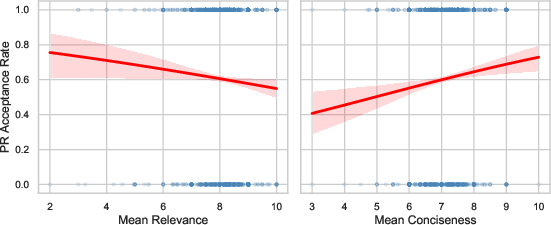
Figure 1: Correlations of mean relevance and mean conciseness of bot comments against PR Acceptance Rate.
- Feedback Quality and Resolution Time: Feedback quality metrics (relevance, clarity, conciseness) show negligible association with reduction in PR resolution time. Instead, reviewer bot activity volume—comment count per PR—emerges as a dominant factor, exhibiting robust positive correlation ($6.91$0, adjusted $6.91$1) with prolonged resolution time.
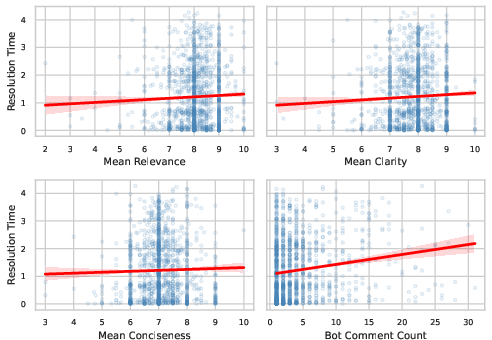
Figure 2: Correlations of Bot Feedback Quality metrics and Bot Activity Volume against PR resolution time.
- Volume-Quality Tradeoff: High comment volume is negatively correlated with average relevance ($6.91$2, adjusted $6.91$3) and clarity ($6.91$4, adjusted $6.91$5). This indicates a dilution effect: as bots generate more comments, the average pertinence of those comments declines, increasing review noise.
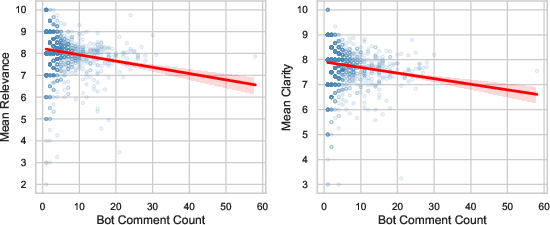
Figure 3: Correlation between Bot Comment Count and mean relevance of bot comments, revealing the dilution effect.
Implications and Applications
The findings suggest that reviewer bots currently excel in producing civil and concise feedback, but may lack targeted relevance for complex agentic workflows. The dilution effect experienced at high comment volumes signals inefficiencies: reviewing large numbers of low-relevance comments can lead to workflow bottlenecks and degrade the review signal. The practical implication is clear: bot developers should prioritize enhanced semantic relevance and implement volume thresholds to minimize redundant, low-value comments. This would enhance both developer experience and CI/CD pipeline reliability.
On a theoretical level, the study exposes the fundamental tension between feedback quality and activity volume in automated review systems. Future efforts could focus on adaptive comment generation, integrating semantic metrics that dynamically calibrate feedback volume based on PR complexity. Longitudinal studies might evaluate how evolving bot architectures impact broader OSS ecosystem productivity and maintainability.
Threats to Validity
Construct validity is constrained by the categorization framework, with a substantial fraction of comments labeled as 'Other' potentially masking more granular subtypes of feedback. The internal validity excludes analysis of bot internal logic and external developer exchanges. Generalizability is limited by focus on the AI_Dev dataset within a rapidly evolving agentic coding landscape.
Conclusion
This paper provides an authoritative characterization of reviewer bot feedback in agentic PR workflows, demonstrating that bots produce uniformly civil and concise comments but achieve only moderate relevance. As bot activity volume increases, average feedback quality—particularly relevance and clarity—systematically declines, leading to longer resolution times. The results call for re-engineering reviewer bots to emphasize high-relevance, context-aware feedback while curbing comment volume to mitigate review noise and optimize workflow efficiency.