- The paper introduces a modular GNN architecture that decomposes gene interactions into 354 KEGG-based pathway modules, enhancing interpretability and reducing noise.
- It employs hierarchical omics modulation to align gene expression with mutation, CNV, and clinical features, generating semantically informed node embeddings.
- Benchmarking across 10 TCGA cancer types shows a +10.1% C-index improvement over monolithic models, validating its clinical relevance and robust performance.
PathMoG: A Pathway-Centric Modular Graph Neural Network for Multi-Omics Survival Prediction
Motivation and Framework Architecture
Survival prediction in cancer genomics is characterized by heterogeneous, high-dimensional prognostic signals distributed across expression, mutation, and CNV profiles. PathMoG reframes this challenge by introducing modular graph neural network architecture informed by curated KEGG pathway priors, fundamentally diverging from monolithic, genome-scale graph representations commonly utilized in prior graph-based survival models. Instead of a global gene graph susceptible to noise amplification and explanatory dilution in the typical p≫n regime, PathMoG decomposes the interactome into 354 fixed pathway modules, each instantiating typed regulatory graphs (e.g., activation, inhibition, phosphorylation). This modularity enforces biologically meaningful constraints, improving tractability, interpretability, and generalizability.

Figure 1: Workflow overview of PathMoG. PathMoG integrates pathway-centric graph instantiation, HOM-based omics modulation, intra- and inter-pathway attention, and Cox-based survival prediction with clinical fusion.
Central to PathMoG’s integrative data pipeline is the Hierarchical Omics Modulation (HOM) mechanism, which explicitly conditions gene expression on mutation status, CNV, pathway embedding, and clinical covariates via FiLM-style modulation. Unlike feature concatenation approaches, HOM aligns upstream genomic alterations and clinical context with downstream transcriptional readouts, generating semantically informed initial node embeddings. Heterogeneous message passing via Heterogeneous Graph Transformer (HGT) layers operates within each pathway module, while patient-level representations are constructed through dual-level attention: intra-pathway (gene-to-pathway) and inter-pathway (pathway-to-patient), culminating in a Cox-based risk score fused with clinical features.
PathMoG was comprehensively evaluated on 5,650 patients across 10 TCGA cancer types against eight baselines, including classical (Cox-PH, RSF), deep multimodal (CAMR, HFBSurv, PCLSurv), and graph-based models (PathGNN, GraphSurv, FGCNSurv). All models were benchmarked under identical protocols (stratified five-fold cross-validation, harmonized preprocessing, C-index, and time-dependent AUC). PathMoG demonstrated dominant performance, achieving the highest C-index across all cohorts (sample-weighted mean: 0.708) and leading in AUC for 8 of 10 types.
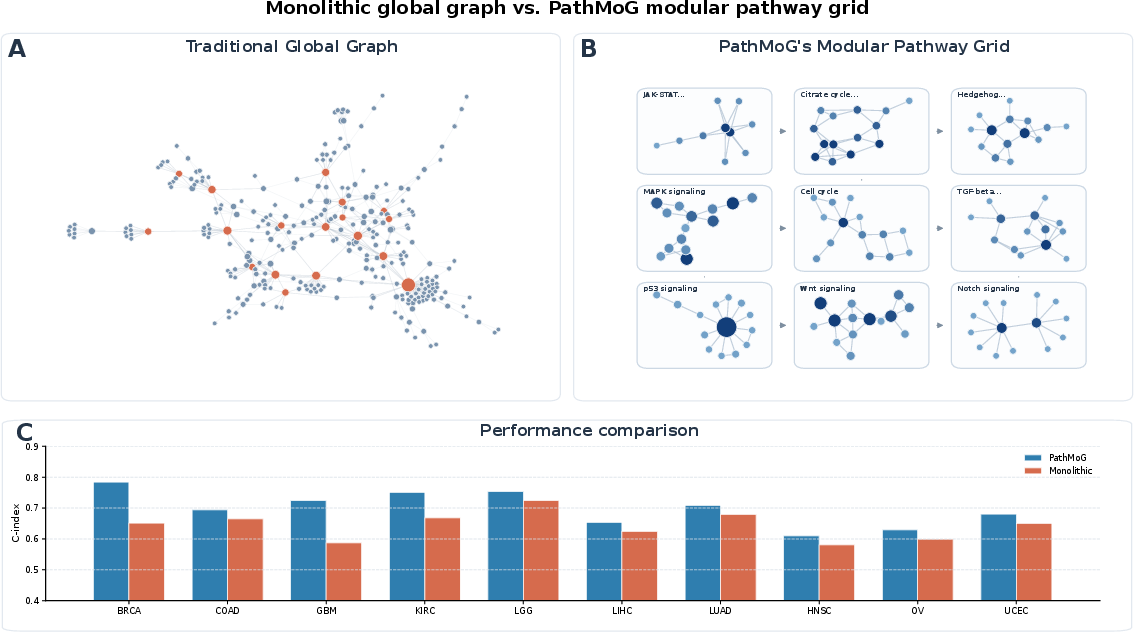
Figure 2: Comparison of monolithic and modular graph architectures and performance. PathMoG’s modular pathway grid consistently outperforms the monolithic genome-scale baseline across all 10 TCGA cancer types.
Empirical evidence supports that PathMoG’s modular structure leads to +10.1% C-index gain over the monolithic baseline (0.708 vs 0.643, p<0.001), particularly in noisy, heterogeneous cancer types (GBM, BRCA). External validation on METABRIC (without finetuning) and significant high-low risk separation in Kaplan–Meier analyses attests to the generalizability of learned representations.
Architectural Validation and Ablation Studies
Ablation experiments dissected the contributions of HOM, intra- and inter-pathway attentions, demonstrating that component removal consistently reduces performance. Intra-pathway attention emerged as a critical driver: mean pooling in place of attention dropped weighted C-index by −7.5%, with pronounced loss in BRCA and GBM. Cohort-specific dependencies revealed mechanistic heterogeneity: KIRC and LIHC were most sensitive to inter-pathway attention, LGG to HOM, confirming that PathMoG adapts to distinct cancer-specific molecular structures.
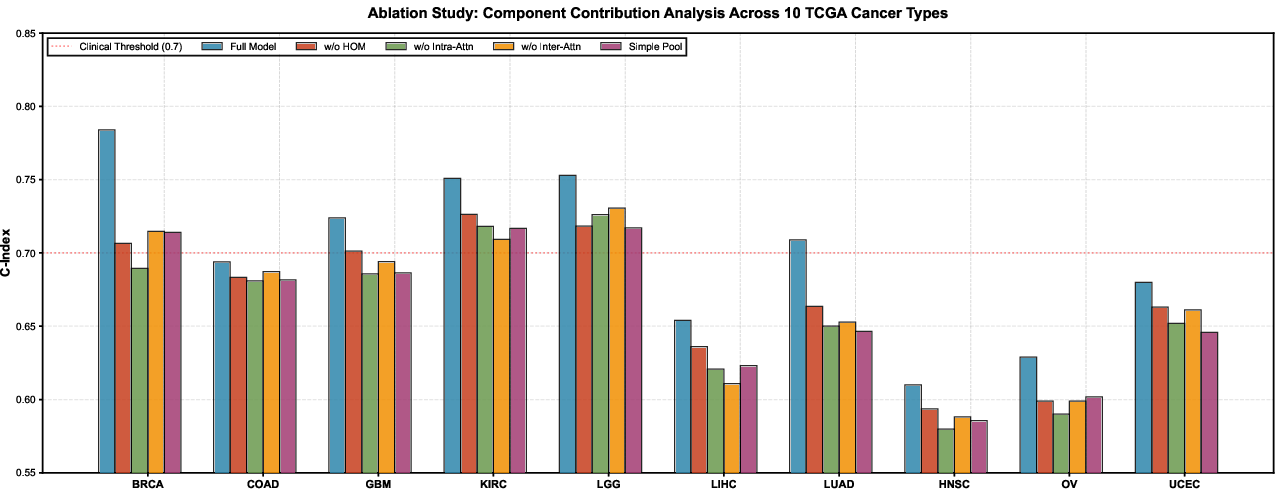
Figure 3: Ablation study of PathMoG components. Removing core modules and attention mechanisms reduces prediction performance across nearly all cohorts.
Clinical Relevance and Prognostic Utility
PathMoG’s risk score was evaluated in multivariate Cox analyses incorporating age, grade, TNM staging. Notably, the molecular risk score remained independently prognostic in BRCA after clinical adjustment, suppressing the statistical significance of anatomical staging variables. This substantiates that PathMoG captures molecular prognostic variance orthogonal to routine clinicopathological metrics.
Treatment stratification analysis in BRCA stratified patients by PathMoG risk scores, revealing that medium- and high-risk groups derive significant benefit from systemic therapy, while the low-risk group exhibits only marginal benefit. Despite retrospective confounding and non-causal inference, this pattern aligns model predictions with clinically actionable subgroup structure, suggesting potential for risk-adaptive therapeutic strategies.
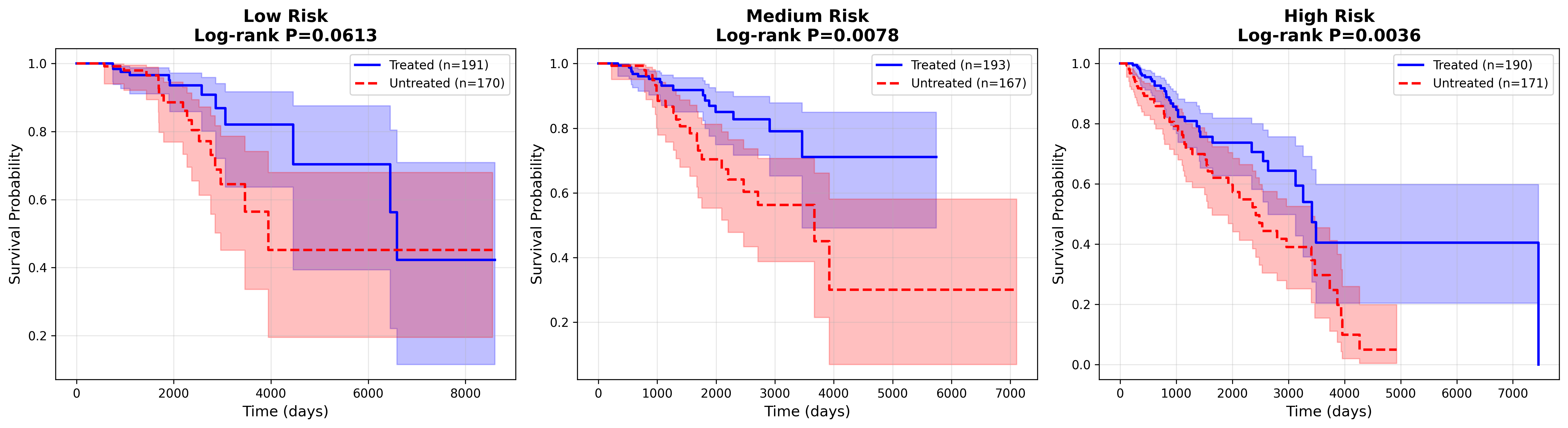
Figure 4: Treatment response across PathMoG risk strata in BRCA. Treatment benefit is most pronounced in medium- and high-risk groups, validating clinical subgroup relevance.
Interpretability: Gene, Pathway, and Patient-Level Insights
PathMoG’s dual-level attention mechanism enables interpretable evidence at gene, pathway, and patient scales. Gene-level attention weights identified BAX, APAF1, TP53 as key drivers in p53 signaling, and E2F3, CCNE1, CDK4 in cell cycle, recapitulating canonical cancer biology. Cross-cancer comparisons illustrated signatures such as differential EGFR and AKT1 importance between BRCA and KIRC. Statistical validation confirmed alignment between high-attention genes and differential expression.
Pathway-level attention revealed universal oncogenic circuits (Cell Cycle, p53) and cancer-specific dependencies (HIF-1, MAPK, mTOR in BRCA). Patient-level diagnostic reports consolidated dominant genes, active pathways, and individualized survival context based on molecular signature, supporting precision stratification.
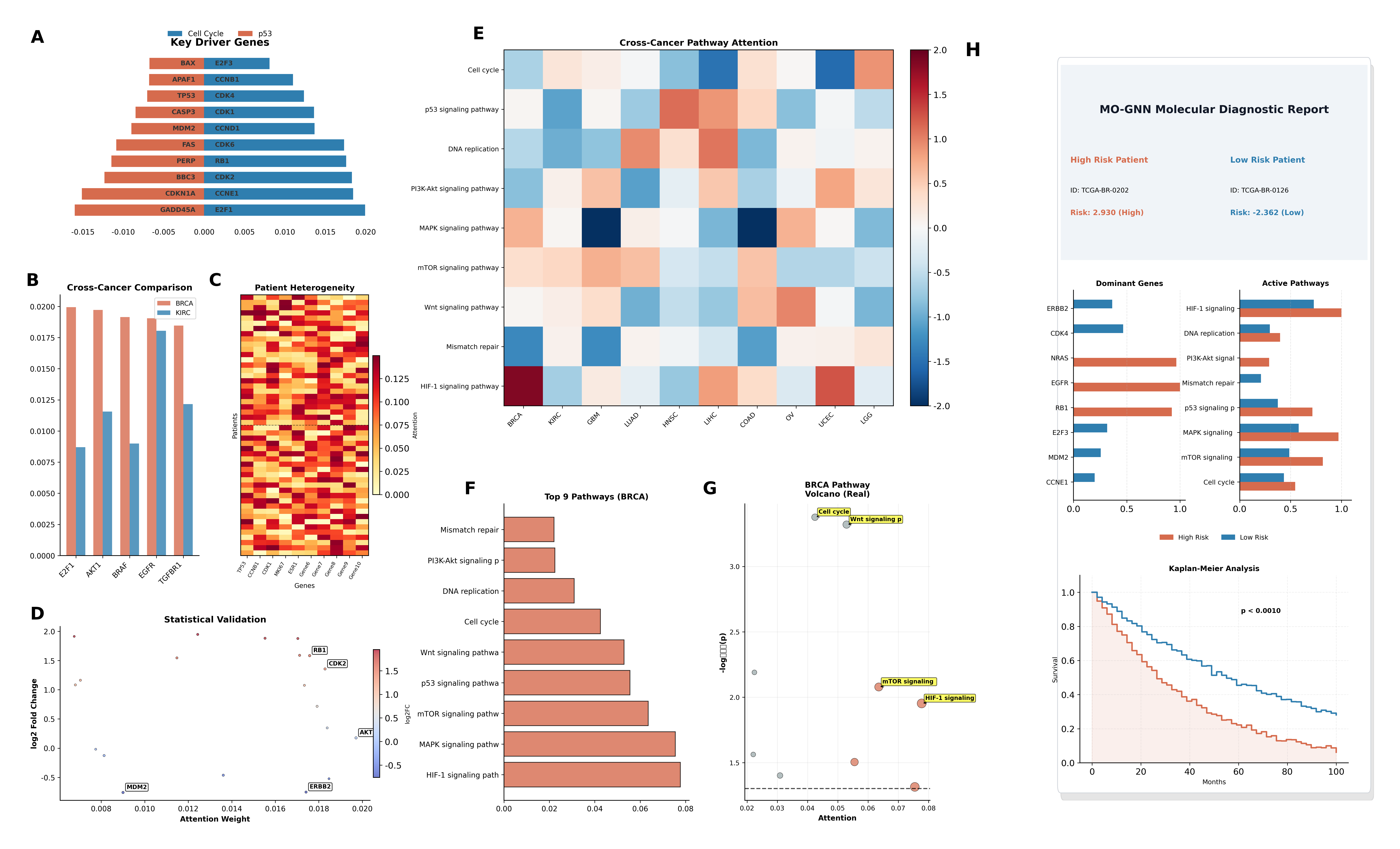
Figure 5: Multi-level interpretability analyses with gene importance ranking, cross-cancer pathway heatmaps, patient heterogeneity visualizations, and individualized molecular diagnostic reports.
Implications and Future Directions
PathMoG redefines multi-omics survival modeling as a modular, pathway-centric problem, imposing structure-driven priors to regularize hypothesis complexity and mitigate overfitting risk. The explicit HOM conditioning and interpretability via hierarchical attention facilitate actionable prognostic insights and align molecular risk stratification with clinical decision-making. Practically, PathMoG establishes a template for biologically grounded GNN architectures in high-dimensional, low-sample settings.
Further work should extend PathMoG’s framework to alternate pathway resources beyond KEGG, incorporate additional omics layers (epigenomics, proteomics), enlarge external cohort validation, and prospectively evaluate clinical integration. The modular batching and interpretability design also provide a basis for translational applications, including biomarker discovery and therapeutic subgroup identification.
Conclusion
PathMoG integrates modular pathway-centric graph construction, hierarchical omics modulation, and dual-level attention for robust, interpretable multi-omics survival prediction. It consistently outperforms monolithic genome-wide and prior deep learning baselines, yielding independently prognostic molecular risk scores and individualized diagnostic reports. PathMoG’s principled structural regularization and interpretability support clinical translational utility and plausible extension to broader multi-modal biomedical modeling (2604.24371).

