- The paper introduces a novel PEPS framework that restructures positional encoding into geometrically meaningful sampling points to improve high-frequency signal reconstruction.
- It leverages the rotational behavior of APE and Lissajous curves along with spectral priors to align feature aggregation with signal statistics, boosting PSNR and SSIM metrics.
- Experiments across image, texture, and SDF tasks demonstrate that PEPS reduces model parameters by over 25% while enhancing reconstruction fidelity and computational efficiency.
Positional Encoding Projected Sampling: Framework, Implementation, and Empirical Analysis
Motivation and Theoretical Framework
Implicit neural representations (INRs) have become a central paradigm for modeling continuous signals in domains such as image representation, texture compression, and 3D shape modeling via signed distance functions (SDF). Classical approaches leveraging multi-layer perceptrons (MLPs) are limited by spectral bias, limiting their ability to encode high-frequency components from low-dimensional input coordinates. Absolute positional encoding (APE), realized through sinusoidal projections of coordinates at various frequencies, is a widely adopted remedy—especially in applications like NeRF and neural texture compression. However, simple positional encodings often inadequately capture the multi-dimensional spatial and geometric relations necessary for high-quality reconstruction, while grid-based learned encodings require significant resolution to achieve competitive performance.
The Positional Encoding Projected Sampling (PEPS) method reframes positional encoding as a sequence of geometrically meaningful points—each projection at a frequency becomes a locus for sampling from a learned encoder. This decomposition enables PEPS to leverage the unique motion on Lissajous curves induced by APE, yielding pointwise latent features aggregated for downstream modeling. By treating the result of positional encoding not merely as a high-dimensional vector but as a structured pointwise sampler, PEPS provides a generic wrapper for existing encoding architectures and improves learning efficiency for high-frequency signals.


Figure 1: Grid-PEPS method: coordinates are projected at multiple frequencies, grid-sampled at each, concatenated, and processed by a neural network for texture compression.
Geometric and Spectral Analysis
APE induces axis-wise rotations in coordinate space, resulting in closed motion patterns on the frequency domain. For multidimensional signals, this generates Lissajous curves, providing unique geometric trajectories per input point. The uniqueness is formalized: two points have the same Lissajous curve if and only if their coordinates are identical, indicating that PEPS-based sampling preserves localized encoding and avoids ambiguity, supporting accurate spatial reconstruction.
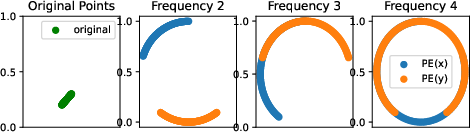
Figure 2: Rotational behavior of coordinates under APE at distinct frequencies; each projected encoding becomes a sampler locus on the frequency plane.
Beyond geometric uniqueness, PEPS leverages domain-specific spectral priors. Natural images and texture data exhibit power spectra following an approximate 1/fα inverse law, commonly termed pink noise (α=1). The Pink-PEPS variant allocates latent dimensional resources inversely proportional to frequency, aligning feature aggregation with empirical signal statistics for improved accuracy and reduced model size.
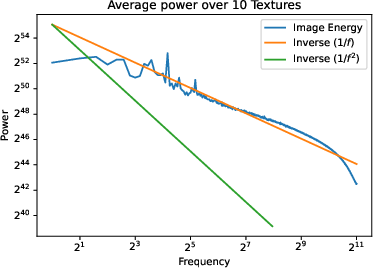
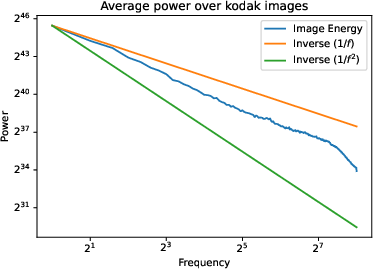
Figure 3: Empirical power spectra for (left) textures and (right) Kodak dataset images, demonstrating inverse-frequency (1/fα) decay.
Experimental Results
Image Representation
PEPS was tested for implicit image encoding on the Kodak suite and high-resolution texture datasets. Baseline MLPs with APE, Local Positional Encoding (LPE), and grid-based encoders were compared. PEPS formulations (Grid-PEPS and Pink-PEPS) consistently achieved superior PSNR and SSIM, sometimes with 25% fewer parameters for equivalent or superior reconstruction quality. Notably, Grid-PEPS demonstrates linear scaling in learning capability with increased feature dimensionality—a property absent in classic grid or LPE methods, which plateau regardless of parameter increase.
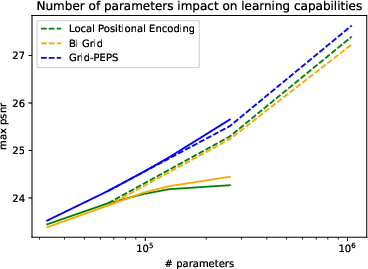
Figure 4: PSNR scaling as function of grid resolution and feature dimension; Grid-PEPS leverages additional parameters efficiently, contrasting with baseline saturation.
Comparative metrics (PSNR, FLIP, LPIPS, LSD, SSIM) reveal that PEPS and Pink-PEPS outperform grid baselines across all quality measures, including spectral fidelity (LSD) and perceptual similarity (FLIP, LPIPS). This demonstrates that PEPS preserves signal statistics and high-frequency structure, crucial for image fidelity.
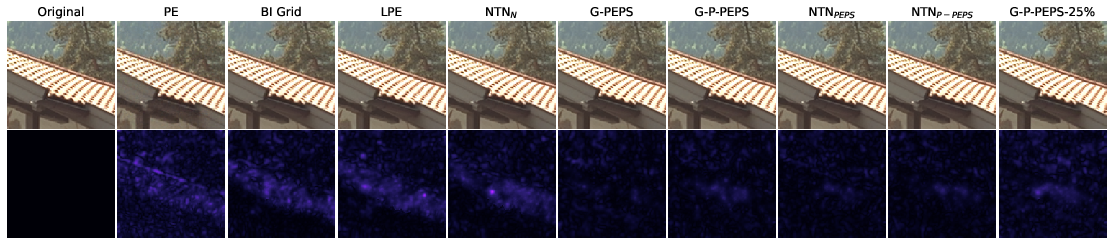
Figure 5: Visual samples from re-encoded Kodak images; bottom shows spatial error via FLIP metric.

Figure 6: Dual scatterplots for PSNR comparison between PEPS variants and baseline methods; PEPS points dominate across test instances.
Neural Texture Compression
In texture set compression, PEPS methods (Grid-PEPS, Pink-PEPS, NTC-PEPS) strictly dominate baseline implementations across all texture types and quality metrics, including PSNR and SSIM. Pink-PEPS reduces input dimensionality and inference overhead, achieving near-optimal results with reduced computational footprint. Model size reduction of over 25% is achieved without significant quality loss.

Figure 7: Texture set samples, demonstrating reduced error and color fidelity for PEPS-enhanced methods.
Signed Distance Function Representation
For SDF modeling, PEPS wrappers for TI grids, hash grids, and multi-resolution grids yield improved IoU and rendering quality over standard encoders. PEPS is particularly effective on challenging instances, such as the Pitted Stonefish, where low-resolution grids fail but PEPS maintains superior accuracy. Performance gains scale with parameter budget, with PEPS achieving high IoU levels comparable to grid methods using significantly larger encoders.

Figure 8: Armadillo SDF sample reconstructions, showcasing spatial fidelity and reduced FLIP error.
Theoretical and Practical Implications
The PEPS framework generalizes positional encoding, enabling learned sampling on geometrically meaningful loci across frequencies. It is architecturally agnostic—acting as a wrapper for grid, hash, or multi-resolution techniques—and consistently yields improvements in spectral and spatial fidelity. By exploiting both geometric uniqueness (via Lissajous curves) and spectral allocation (via Pink-PEPS), PEPS enhances learning efficacy, reduces parameter counts, and aligns feature extraction with signal priors.
On the practical side, PEPS methods are compatible with real-time constraints. Grid-PinkPEPS, with reduced input dimensionality via spectral allocation, incurs limited computational overhead and is suitable for accelerated hardware inference, including fused kernel MLPs.
Future Directions
Further exploration into adaptive aggregation strategies beyond Pink-PEPS, potentially optimizing for arbitrary α in power spectra or learned spectral allocation, may yield improved alignment with diverse signal domains. Architectural integration with quantization, block compression, and cooperative vector schemes remains an avenue for increased efficiency. Applications extend to volumetric rendering, temporal signal modeling, and inverse problem formulations, where PEPS’s locality and frequency-based sampling can elicit improvements in accuracy and compactness.
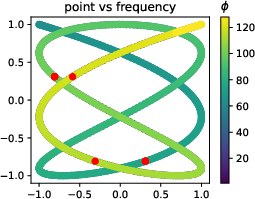
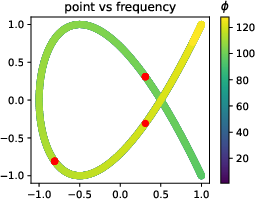
Figure 9: Normalized positional encoding across frequency spectrum for distinct spatial coordinates.
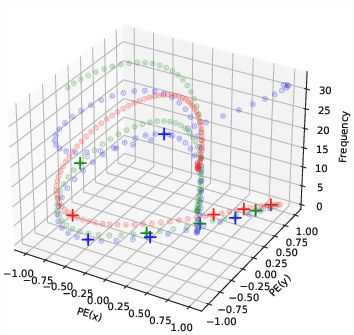
Figure 10: Distinct Lissajous trajectories for points with identical ratios, confirming geometric uniqueness in PEPS.
Conclusion
PEPS presents a rigorous, general framework for frequency-aware, geometrically-structured learned sampling in implicit neural representation. It leverages the rotational and closed-curve properties of APE, aligns feature aggregation with natural signal power spectra, and consistently improves qualitative and quantitative performance across image, texture, and SDF domains. Real-time applicability and parameter efficiency position PEPS as a robust encoding scheme for high-fidelity coordinate-to-signal modeling, with broad implications for future neural representation methods.
(2604.24167)

