- The paper introduces PSLP, a novel presolver for GPU-accelerated LP solvers that achieves 90–94% of Gurobi’s reduction with significant speedups.
- The paper details a reduction-based abstraction that decomposes presolve operations into atomic transformations leveraging both primal and dual exploration strategies.
- The paper demonstrates that PSLP’s efficient design reduces presolve time by up to 7-fold and improves overall solve times for large-scale LPs in GPU-first workflows.
Presolving for GPU-Accelerated First-Order LP Solvers: An Expert Analysis
Motivation and Context
Advances in hardware have made GPU-accelerated first-order methods a practical alternative for large-scale LPs, significantly increasing the potential throughput of core solver operations. In contrast, the presolve phase remains inherently sequential and CPU-bound, raising concerns about its relative cost in an end-to-end pipeline. Traditional presolvers, optimized primarily for CPU-based simplex and interior-point solvers, often prioritize aggressive reduction in problem size at the expense of computational complexity. The paper "Presolving for GPU-Accelerated First-Order LP Solvers" (2604.23951) interrogates the continued efficacy of these classical approaches in the context of modern GPU-first LP solvers and proposes PSLP—an open-source, lightweight presolver—as a pragmatic solution.
Presolve Paradigm and Reduction Abstraction
The paper formalizes a reduction-based abstraction for presolving, defining each reduction as a combination of a presolve transformation (problem simplification) and a postsolve transformation (reconstruction of optimal solutions for the original problem). Five atomic reduction types are central: variable fixing, constraint removal, adding multiples of equality constraints, variable substitution in single equality constraints, and variable bounds modification.
Presolving, as outlined, relies on two exploration strategies:
- Primal exploration: Identifies reductions by analyzing primal feasibility and redundancy—e.g., singleton/doubleton rows, redundant constraints, and substitutions driven by variable bounds.
- Dual exploration: Leverages dual feasibility and complementary slackness—e.g., variable lock rules—to uncover reductions informed by the dual structure.
PSLP decomposes complex transformations (as in traditional presolvers) into sequences of these atomic reductions, enabling simplified code and reliable postsolve logic for dual variable recovery.
Design and Engineering Tradeoffs
Presolver design in PSLP is guided by a categorization of explorers based on computational cost:
- Fast explorers: Simple scans leveraging internal statistics and minimal computation (e.g., singleton/doubleton rows, redundant constraints).
- Medium explorers: Require additional computations, such as hashing for parallel row and column detection or primal/dual propagation.
- Slow explorers: Significantly more expensive, involving linear dependency checks, variable symmetry detection, and opportunities for sparsification.
The implementation eschews slow explorers, focusing on the fast and medium spectrum, which empirical evidence shows delivers the bulk of practical reductions. PSLP employs dual CSR/CSC representations to facilitate efficient row and column access and leverages incremental updates to internal statistics for performance.
Empirical Evaluation
The paper rigorously benchmarks PSLP against Gurobi's commercial presolver on Mittelmann's LP collection and root-node LP relaxations from MIPLIB 2017, comparing the reduction in the number of nonzeros and presolve times.
On Mittelmann's collection, PSLP attains 90% of Gurobi's reduction while being an order of magnitude faster. For MIPLIB relaxations, PSLP achieves 94% of Gurobi's reduction with a nearly seven-fold speedup in presolve time. These results are visualized in reductions and timings per instance.
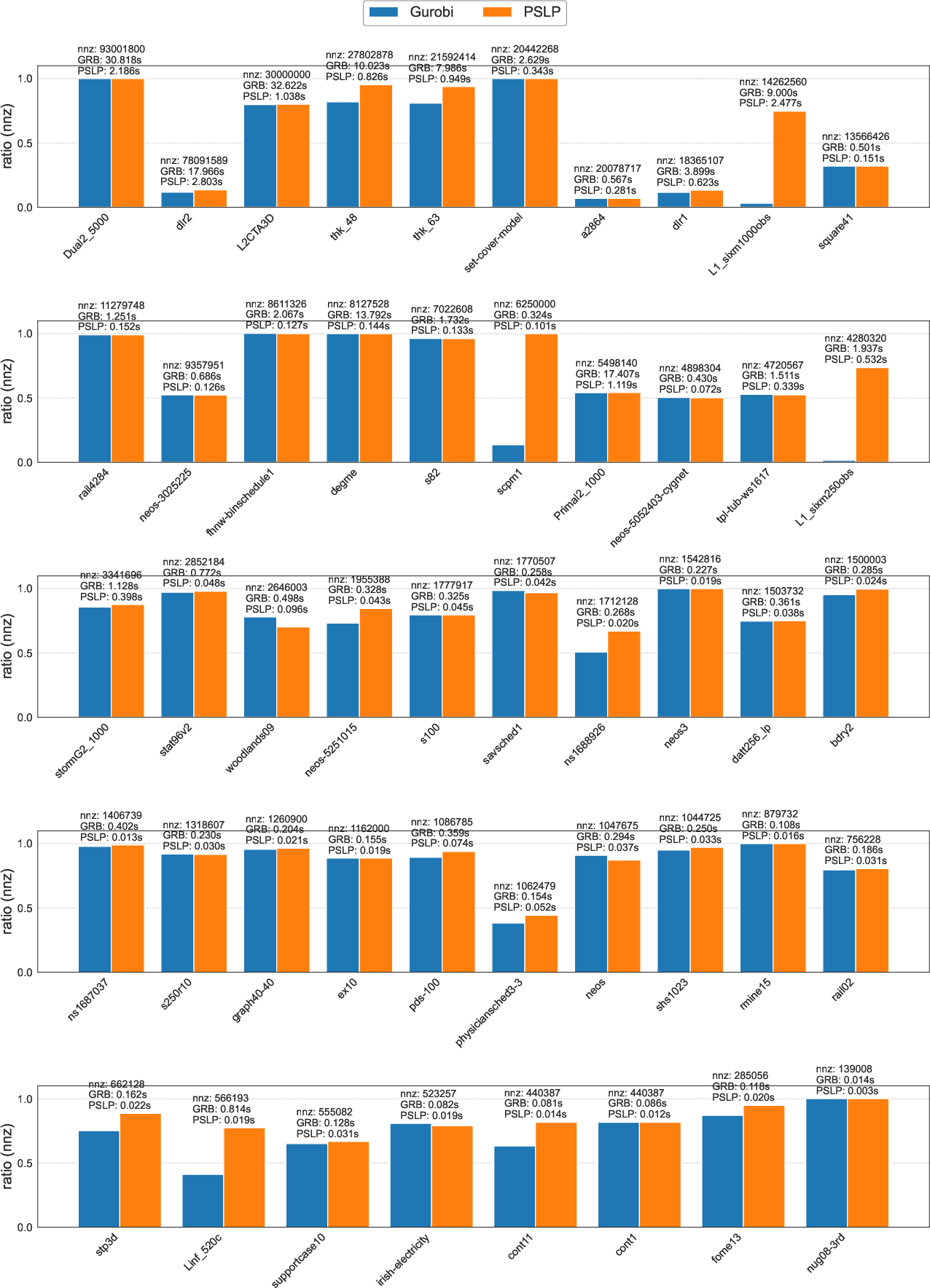
Figure 1: Comparison of PSLP and Gurobi's presolver on Mittelmann's LP collection, highlighting comparable reductions and substantial speedup for PSLP.
Performance is also evaluated for the 50 largest MIPLIB relaxations, confirming PSLP’s robustness and demonstrating that most practical reductions arise from cheap rules.
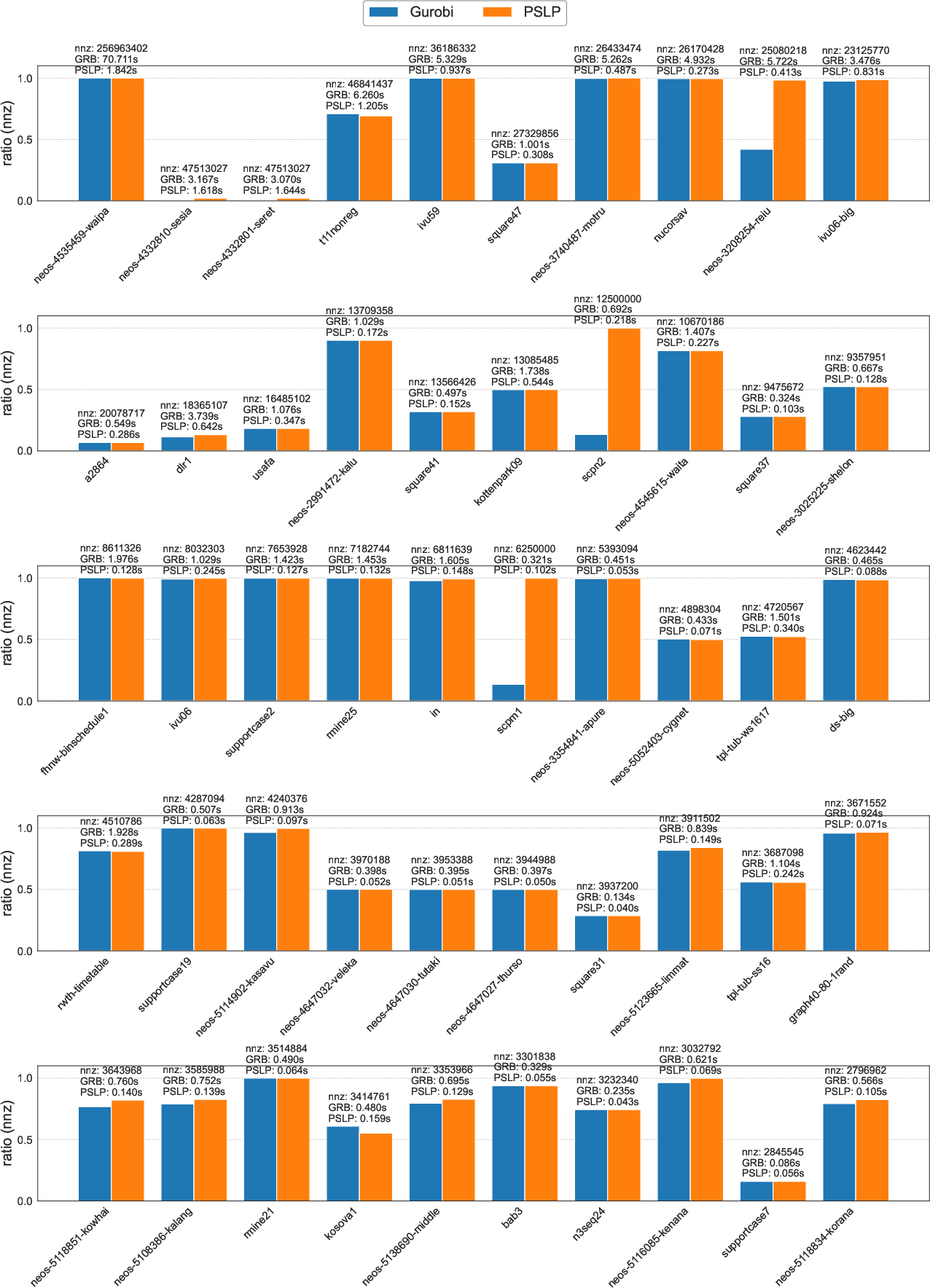
Figure 2: Comparison of PSLP and Gurobi's presolver on the 50 largest MIPLIB relaxations, confirming consistent efficiency.
End-to-End Solver Impact
Integration of PSLP with cuPDLPx yields strong practical improvements. For large instances, PSLP reduces the shifted geometric mean of solve time by factors of 2.5 (Mittelmann) and 9 (MIPLIB), maintaining near-parity with Gurobi's presolver regarding reductions and solution times. Analysis further shows that the presolve phase, formerly negligible in classical CPU settings, now constitutes a nontrivial fraction of the total runtime—sometimes as much as 20% for large-scale problems with PSLP and far more with Gurobi.
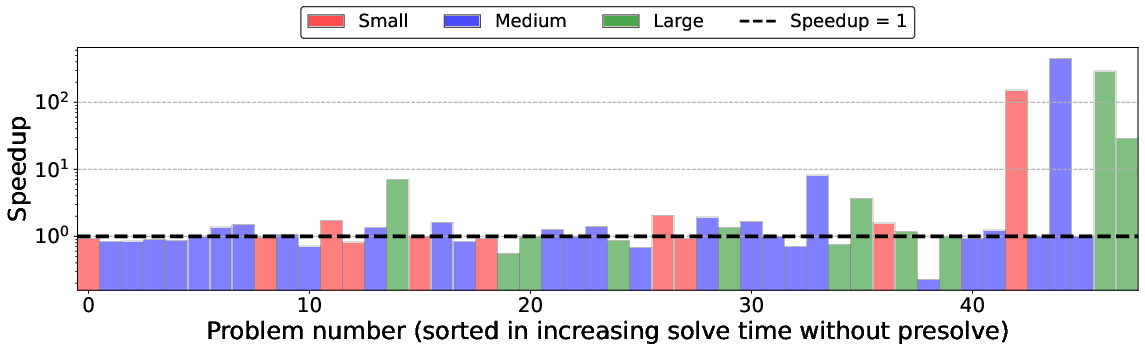
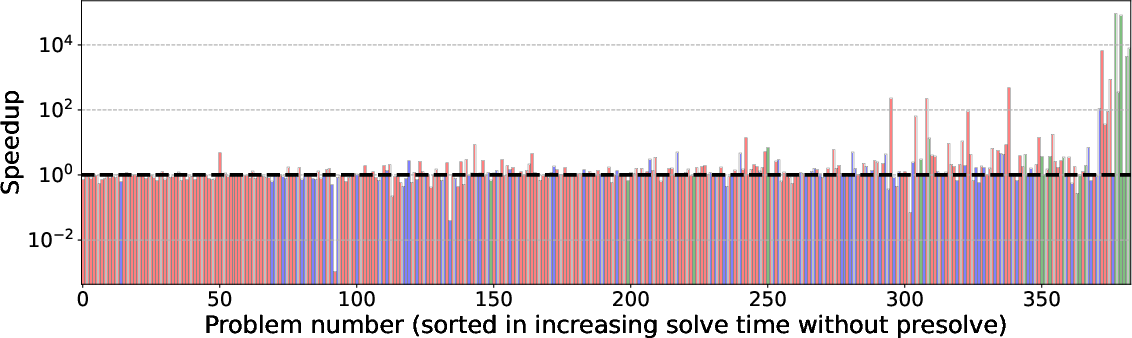
Figure 3: Mittelmann's LP collection, providing context for benchmark scale and diversity.
The win rate (instances where presolve enables faster solves) is significant but not universal, reflecting cases where presolving can be counterproductive for rapidly-converging instances.
Practical and Theoretical Implications
The findings directly challenge the classical assumption that presolve cost is always negligible. As core solver routines accelerate with hardware, presolving can become the bottleneck, motivating the refinement or omission of high-cost reductions. PSLP demonstrates that a well-engineered suite of lightweight reductions suffice for most real-world LPs targeted by GPU-first solvers, supporting sustained scalability.
The paper's reduction-centric abstraction clarifies postsolve logic, facilitating reliable integration with a wider range of solvers and potentially generalizing to quadratic and conic programs, as outlined for future extensions. Additionally, the open-source nature of PSLP lowers the barrier for widespread adoption and collaborative enhancement.
Future Directions
Given PSLP’s performance, future research should explore:
- Asynchronous or parallel CPU presolving to further reduce overhead.
- Selective offloading of propagations or bound tightening to GPUs where beneficial.
- Automated tuning of exploration aggressiveness based on problem instance characteristics.
- Extension of PSLP principles to quadratic, conic, and mixed-integer optimization domains.
As GPU solvers evolve, presolve strategies will require ongoing reevaluation to prevent stagnation of overall pipeline speedup.
Conclusion
"Presolving for GPU-Accelerated First-Order LP Solvers" (2604.23951) provides a thorough investigation into the balance of presolve efficacy and computational cost in modern LP solver pipelines. Through reduction-based abstraction and empirical benchmarking, PSLP is shown to deliver near-commercial reductions at a fraction of the presolve time, making it well-suited for GPU-first workflows. The results underscore the necessity of rethinking presolve strategy in the era of hardware acceleration and offer practical tools and theoretical insights for future optimization research.