- The paper presents a novel variational-topological framework (photography method) linking manifold topology with solution multiplicity in phase-field models.
- It rigorously analyzes Γ‐convergence and isoperimetric clustering to establish explicit lower bounds on solutions for both scalar and vectorial cases.
- The study distinguishes between double-bubble and multi-bubble regimes, highlighting the impact of curvature and boundary conditions on interface dynamics.
Topological Methods for Allen–Cahn Equations and Systems: A Survey
Introduction and Historical Context
The Allen–Cahn equation is a prototypical phase-field PDE modeling interface dynamics and phase transitions in materials. Its variational structure, particularly in the singular perturbation regime (ε→0), links solutions with geometric measure theory, minimal surfaces, and isoperimetric problems. Originally derived from the diffuse-interface approaches dating back to Van der Waals and later formalized by Cahn–Hilliard and Allen–Cahn, the equation has since become deeply integrated into geometric analysis, PDE theory, and physical modeling.
The authors present a comprehensive survey emphasizing multiplicity results for Allen–Cahn equations and systems, exploring their geometric interpretation through Γ-convergence and isoperimetric clustering. The central methodological innovation discussed is the photography method—a variational-topological framework leveraging Lusternik–Schnirelmann and Morse theory to encode manifold topology into solution multiplicity.
Physical Motivation and Model Variants
The scalar Allen–Cahn equation (m=1) models binary phase separation, typically with a double-well potential. The classical logarithmic double-well potential, derived from energetic considerations, is depicted below.
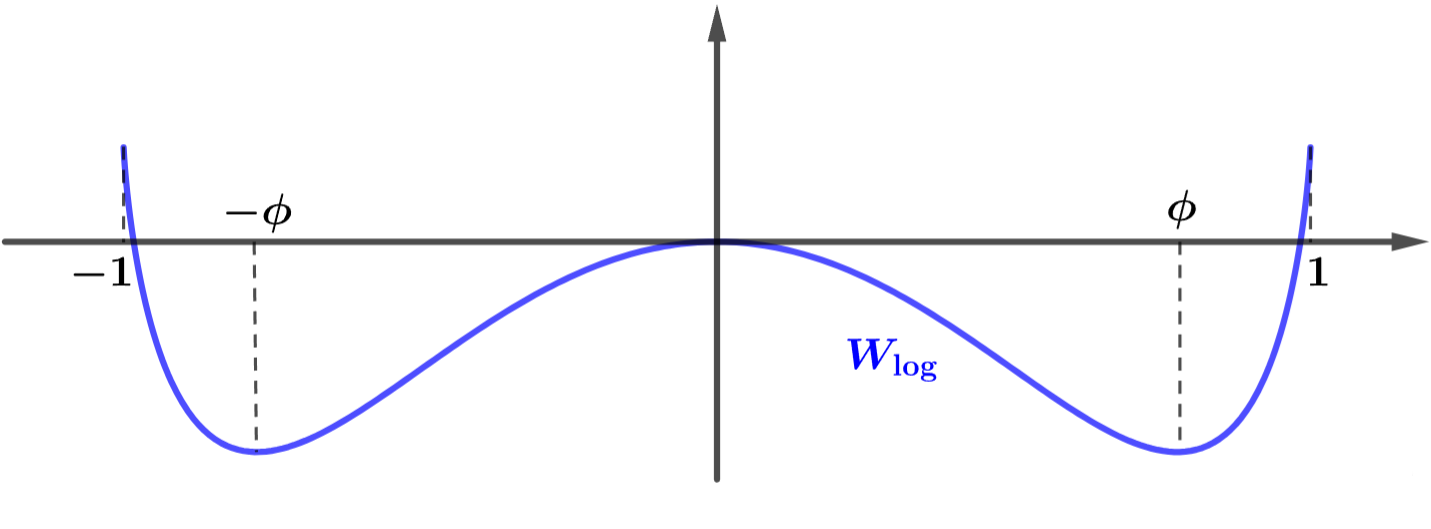
Figure 2: Graphic representation of Wlog with T=3 and Tc=4, demonstrating the two minima corresponding to pure phases.
Analytically, the regularized quartic double-well potential is more tractable and widely adopted:
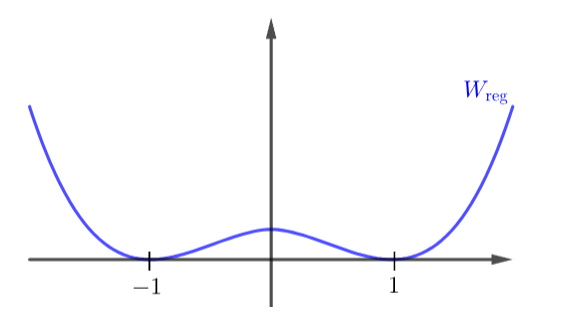
Figure 1: Graphic representation of Wreg=41(1−s2)2, showing symmetric minima at s=±1.
Attempts at scalar multi-well potentials fail to generate genuine multiphase interfaces due to imposed ordering; instead, vector-valued systems (m>1) with noncollinear minima in Rm realize true multiphase partitioning, as illustrated below.
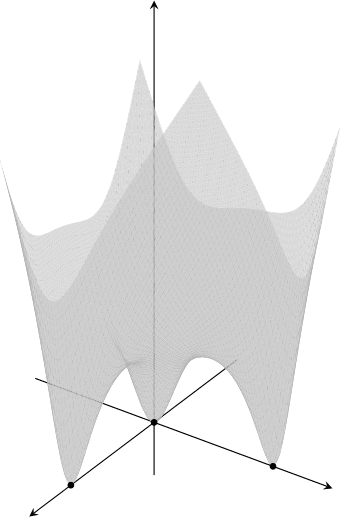
Figure 3: Schematic of a triple-well potential in the vectorial case, exhibiting three distinct pure states.
Variational Structure and Γ0-Convergence
The Allen–Cahn energy functional Γ1, for small Γ2, concentrates energy on sharp interfaces, converging to a perimeter-type functional via Γ3-convergence. Scalar variants converge to classical isoperimetric problems; vectorial systems converge to multi-isoperimetric clustering problems. Beside technical regularity and coercivity requirements for the potential, a strict triangle inequality condition ensures genuine multiphase interface formation.
The analysis further extends to Riemannian manifolds, introducing geometric effects due to curvature and boundary. Dirichlet conditions enforce fixed-phase boundaries, while Neumann induce free-boundary minimizers meeting Γ4 orthogonally.
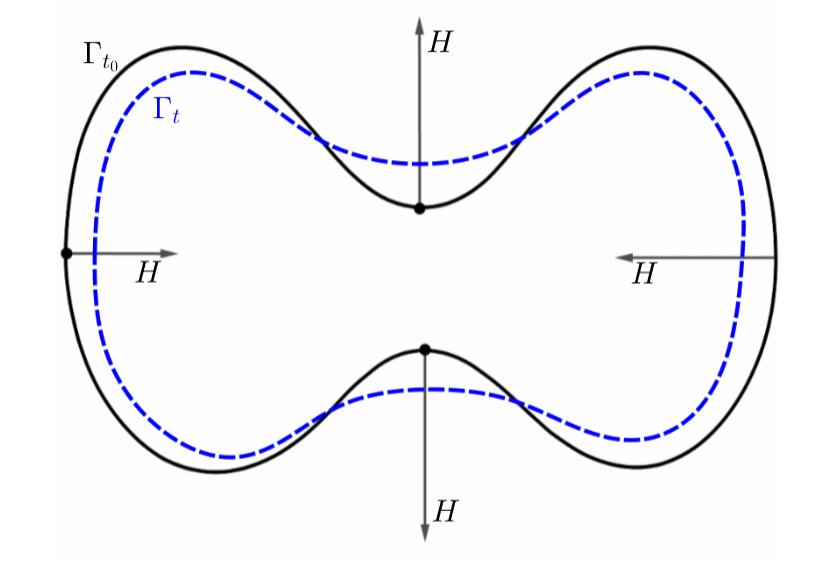
Figure 4: Evolution of an interface under mean curvature flow, capturing the geometric dynamics emergent from Allen–Cahn PDEs.
Topological Framework: Lusternik–Schnirelmann–Morse and Photography Method
Multiplicity results rely on relating the topology of the ambient manifold or boundary to the critical points of the Allen–Cahn energy under volume constraints. Lusternik–Schnirelmann category and Morse theory provide quantitative lower bounds for solution counts, with Morse theory revealing the structure of indices.
The photography method constructs localized approximate solutions (bubbles) at every point in the manifold and employs barycenter maps to encode the homotopy type of sublevels of the energy functional. This correspondence ensures that solution multiplicity reflects manifold topology.
Scalar Regime: Closed Manifolds vs. Boundary Effects
In the scalar case, Γ5-convergence ensures sharp concentration of low-energy configurations, permitting continuous embeddings of the manifold into sublevels. For closed manifolds, the number of solutions is at least Γ6, and generically Γ7, where Γ8 is the Lusternik–Schnirelmann category and Γ9 the first Poincaré polynomial coefficient.
Dirichlet boundary conditions retain interior minimizers, preserving the detection of m=10. Neumann boundary conditions, however, induce half-bubble minimizers attached to the boundary, shifting multiplicity detection to m=11.
Vectorial Systems: Double-Bubble and Multi-Bubble Dichotomy
Vectorial Allen–Cahn systems approximate multi-phase clusters in the singular limit. For m=12 (double-bubble), isoperimetric minimizers are classified, and the photography method adapts seamlessly, yielding the same multiplicity lower bounds as in the scalar case.
For m=13, minimizer classification fails, undermining uniform diameter bounds and continuous selections. The authors circumvent this by imposing fixed volume ratios and employing scaling invariance to maintain control over cluster distortion from curvature effects. The result is a local, continuous selection of almost minimizers sufficient to execute the photography method for prescribed ratios, thus extending multiplicity results to the multi-bubble regime under these constraints.
Analytical and Geometric Implications
The survey provides rigorous lower bounds on solution multiplicity for Allen–Cahn equations/systems posed on closed manifolds and, conditionally, for vectorial systems with three or more phases under geometric constraints. The dichotomy between double and multi-bubble cases highlights fundamental analytic challenges intrinsic to cluster classification. The results apply directly to pattern formation, interface dynamics, and geometric PDEs, reinforcing the variational-topological interplay in phase-field models.
The delineated open problems include:
- Extending multiplicity results for vectorial systems to manifolds with boundary, where cluster classification and geometric interaction are largely unresolved.
- Understanding nonlocal and fractional Allen–Cahn models, where long-range interaction may disrupt phase localization and the photography method's applicability.
- Developing theory for noncompact manifolds and connections to concentration-compactness principles.
- Generalizing the framework to higher-codimensional defects (e.g., Ginzburg–Landau vortices), with preliminary results indicating adaptability of topological approaches.
Conclusion
This survey provides a systematic, technical exposition of topological methods for the analysis of Allen–Cahn equations and systems. By leveraging geometric measure theory, m=14-convergence, and variational-topological constructions, particularly the photography method, the authors establish explicit, topologically grounded lower bounds on solution multiplicity for scalar and vectorial variants across diverse geometric settings. The highlighted dichotomy between scalar/double-bubble and genuine multi-bubble regimes pinpoints the subtle interplay between topological encoding and geometric rigidity. These results deepen the mathematical foundation for phase-field modeling and suggest rich avenues for further research in analytical, geometric, and computational aspects of interface dynamics (2604.23920).