- The paper introduces GW-based multi-view methods that enable consensus embedding and clustering by aligning intrinsic relational structures across views.
- The Bary-GWMDS framework aggregates geodesic distances into a barycenter, preserving global manifold geometry and mitigating distortions from Euclidean measures.
- The Mean-GWMDS-C approach achieves robust clustering via reduced-support embedding and optimal transport, yielding competitive NMI and ARI metrics.
Gromov-Wasserstein Methods for Multi-View Relational Embedding and Clustering
Introduction and Motivation
Multi-view representation learning often encounters substantial methodological challenges when the geometric structures underlying individual data views are heterogeneous, nonlinear, or misaligned. Standard multi-view fusion techniques, especially those relying on direct Euclidean averaging or linear alignment of feature spaces, lack robustness under such geometric variability and frequently distort the intrinsic relationships encoded within views. The utilization of Gromov-Wasserstein (GW) distances, which provide an intrinsic metric for comparing distributions over arbitrary metric spaces, offers a principled alternative for the fusion and analysis of relational data. This paper, "Gromov-Wasserstein Methods for Multi-View Relational Embedding and Clustering" (2604.23912), introduces two novel frameworks exploiting the GW paradigm: Bary-GWMDS for consensus embedding, and Mean-GWMDS-C for clustering from multi-view relational structures.
The setting assumes S relational views over a common sample set, each expressed as a distance matrix D(s). The core objective is the extraction of a geometrically consistent embedding or clustering over the sample set, which reflects the consensus geometry across views.
The GW distance, GW2(μ^,ν^), directly compares relational structures by aligning their pairwise distance distributions, bypassing the need for a common ambient space. This property facilitates fusion and embedding across highly nonlinear or even topologically inconsistent views. Embedding is constructed by seeking a Y∈Rn×d whose induced metric DY is optimally aligned to a consensus relational structure, as measured by the GW objective. The consensus structure is modeled either as a barycenter (with GW barycentric aggregation), or by direct distance averaging as in the clustering formulation.
Bary-GWMDS: Barycentric Embedding for Multi-View Data
Bary-GWMDS operationalizes multi-view embedding through a two-stage process: (1) aggregation of the input view distances into a consensus barycenter using the GW barycenter formulation, and (2) embedding by GW-MDS, optimizing over Y to minimize GW(Dˉ,DY). This approach is distinguished from classical methods, such as Multi-ISOMAP, by its intrinsic operation on geodesic distances and the use of GW alignment rather than linear or pointwise averaging.
Empirical investigations highlight that the use of geodesic distances, rather than Euclidean metrics, is essential for robust barycenter computation and embedding stability. Euclidean measures tend to exaggerate local structures and induce unstable consensus embeddings, while geodesic-based approaches successfully recover global manifold organization.
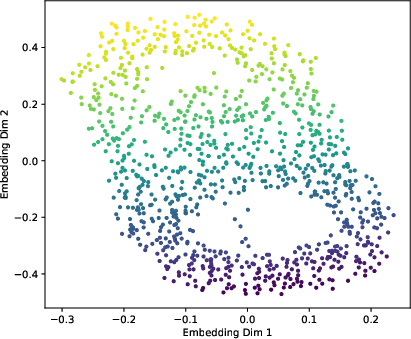
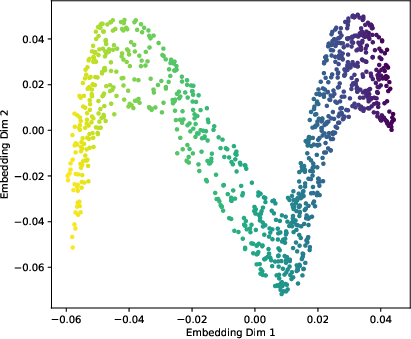
Figure 1: Swiss roll embeddings—left: Bary-GWMDS embedding; right: Multi-ISOMAP embedding—exhibit superior preservation of intrinsic geometry for Bary-GWMDS.
Quantitative analysis using synthetic manifold data (S-curve, Swiss Roll, Möbius) shows that while Bary-GWMDS may yield highly unbalanced view-wise Pearson correlation between embedding and geodesic ground truth across views, it excels at preserving the global manifold structure, even when some views are heavily distorted. These results indicate that direct distance correlation is not always indicative of geometric fidelity when barycentric optimal transport is applied.
Mean-GWMDS-C: Clustering via Reduced-Support GW Alignment
For clustering-oriented analysis, Mean-GWMDS-C introduces a reduced-support GW-MDS framework, in which embeddings are learned as prototypes (k≪n), and samples are associated with prototypes via optimal GW transport. This approach aggregates input view distances by direct averaging, then learns prototypes and their positions to minimize GW divergence against the barycentric geometry. One key advantage is that clustering emerges naturally through transported mass assignments, and both hard and soft clusterings are derived from the transport plan T, dispensing with explicit centroid or boundary constructions.
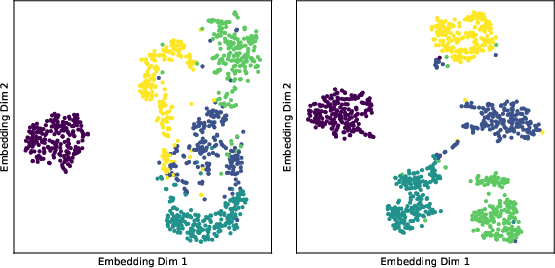
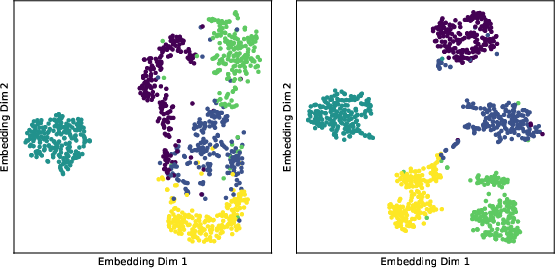
Figure 2: Visualization of the Multiple Features dataset, showing two feature views and the cluster structure recovered by Mean-GWMDS-C.
Empirical results on four benchmark datasets—MultiFeature, Caltech101-7, Handwritten, MSRC—demonstrate that Mean-GWMDS-C achieves NMI/ARI performances competitive with, or superior to, prominent multi-view clustering alternatives. In cases where view geometries are strongly compatible (Multiple Features), Mean-GWMDS-C delivers dominant performance (NMI $0.942$, ARI D(s)0); in more heterogeneous settings, multi-view spectral clustering has a marginal advantage, but Mean-GWMDS-C remains robust.
Further analyses show that the approach is highly insensitive to the embedding dimensionality, consistently maintaining strong clustering metrics even for minimal latent dimensions. It also exhibits robustness to the neighborhood parameter D(s)1 used in geodesic graph construction, with only moderate performance degradation at extreme values.
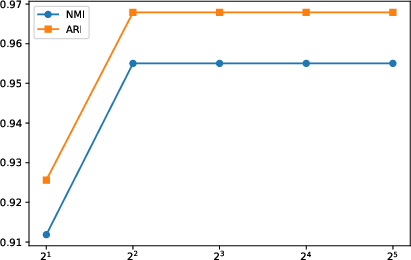
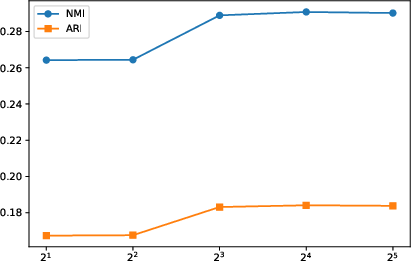
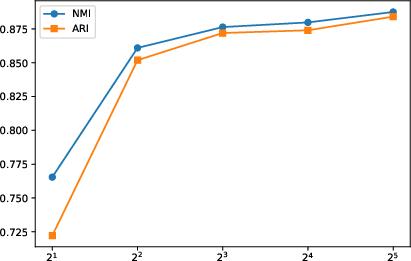
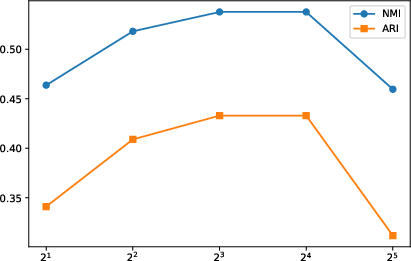
Figure 3: Clustering performance of Mean-GWMDS-C as a function of the embedding dimensionality on different multi-view datasets, evaluated using NMI and ARI.
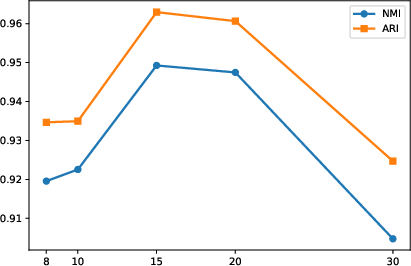
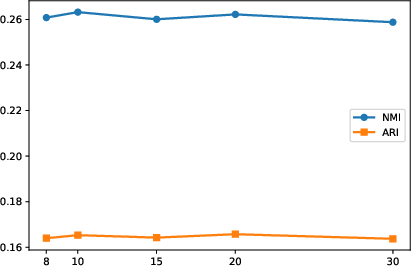
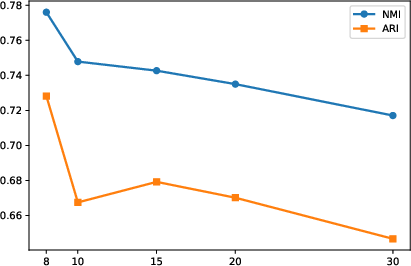
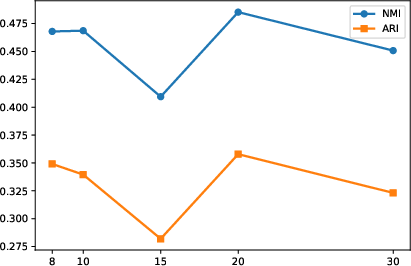
Figure 4: Comparison of NMI and ARI as a function of the number of neighbors on different multi-view datasets.
Implications, Extensions, and Future Directions
The practical implications of GW-based multi-view embedding and clustering are far-reaching, especially for scenarios involving heterogeneous, nonlinear, or noisy relational views, such as sensor fusion, functional connectivity, or bioinformatics. The theoretical appeal arises from the strong invariance properties of GW distances with respect to the underlying metric space, making these techniques robust to nonlinear distortions and misalignments.
There exists substantial potential for extension in several areas:
- Scalability: Optimization over GW objectives is computationally demanding due to the non-convexity and complexity of optimal transport. Future research could pursue large-scale stochastic or approximate solvers, particularly for high-throughput multi-view data scenarios.
- Semi-supervised and regularized formulations: Incorporation of supervision, side information, or geometric regularization may enhance the downstream discriminative utility and interpretability of the embeddings.
- Generalized relational input: Extension to multi-relational, directed, or weighted graphs would expand applicability to broad classes of networked and structured data.
Conclusion
This paper rigorously establishes Gromov-Wasserstein-based methods as powerful tools for multi-view relational embedding and clustering. Bary-GWMDS and Mean-GWMDS-C respectively enable geometry-aware fusion and compact clustering, explicitly preserving intrinsic structures across heterogeneous or nonlinear views. Empirical and theoretical findings underscore the necessity of intrinsic, optimal transport-based alignment in modern multi-view learning pipelines and open avenues for further research in scalable, geometry-preserving representation learning.

