- The paper introduces measurement constructs that distinguish appropriate reliance from trust by evaluating objective behavioral metrics.
- It reviews 22 empirical studies using the PRISMA framework, emphasizing discriminative judgment in correct versus incorrect AI advice scenarios.
- The study highlights the need for standardized, context-sensitive metrics to optimize human-AI decision-making in high-stakes environments.
Measurement Constructs of Appropriate Reliance in Human-AI Decision-Making
Introduction and Problematization
Appropriate reliance on AI systems in human-AI decision-making contexts is conceptually and operationally distinct from trust or mere reliance. While most prior research has evaluated adoption and practical use of AI systems through trust measurements—using subjective or behavioral indicators—there is growing recognition that these metrics inadequately capture the appropriateness of reliance, especially in settings where errors, over-reliance, or under-reliance have substantive consequences [schemmer2023appropriate], [cabitza2023ai]. This paper systematically analyzes empirical studies up to 2025, isolating the constructs and metrics targeting "appropriate reliance" and dissecting their theoretical and practical distinctions from traditional trust and reliance metrics.
Methodological Approach
A systematic literature review was conducted using the PRISMA framework to identify empirical human-AI decision-making studies specifically evaluating appropriate reliance with objective, behavior-driven metrics. The search targeted top venues and databases, narrowed to human-in-the-loop studies with a quantitative assessment of reliance or appropriateness thereof. The resulting corpus comprises 22 studies spanning 2018–2025, emphasizing high methodological rigor, with explicit exclusion of theoretical, non-peer-reviewed, and review-only literature.

Figure 1: Flowchart summarizing the PRISMA-based systematic identification and screening process for empirical studies measuring appropriate human-AI reliance.
Conceptualizing Appropriate Reliance: Competing Views
Three theoretically-motivated perspectives on appropriate reliance are delineated: Traditional, Appropriateness, and Dominance.
- Traditional View: Predominant in early literature, this approach classifies over-reliance as acceptance of incorrect AI advice and under-reliance as rejection of correct AI advice, measured via observable behavior but without detailed discrimination of underlying cognitive processes. It obscures whether correct user action aligns with AI due to actual discrimination or coincidental agreement.
- Appropriateness View: Recent work introduces finer-grained constructs—namely Relative AI Reliance (RAIR) and Relative Self-Reliance (RSR)—measuring the user's ability to discern and adaptively respond to correct versus incorrect AI advice on a case-by-case basis [schemmer2023appropriate], [eckhardt2024survey]. These metrics directly quantify users' discriminative judgment rather than aggregate agreement or compliance.
- Dominance View: Focusing on AI agency and user agency, this model characterizes technology's exerted dominance as either beneficial (mitigating human error) or detrimental (inducing subservience or automation bias). This view is particularly relevant in high-stakes or highly consequential domains [cabitza2023ai].
Conceptual clarity on these constructs is crucial, as lack of standardization hampers comparative evaluations and generalizability across domains.
Objective and Subjective Metrics for Appropriate Reliance
The surveyed literature exhibits a diverse range of both objective and subjective assessment metrics, with a pronounced shift towards behavioral and performance-based indicators in recent empirical work.
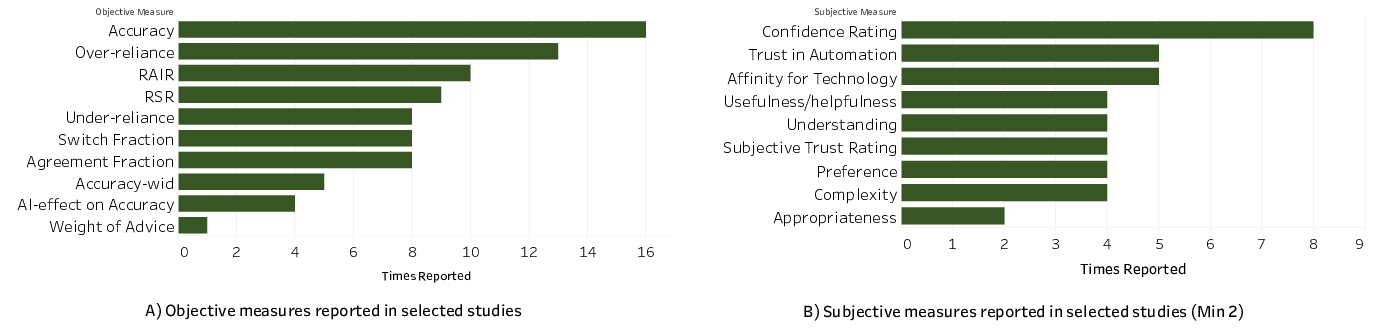
Figure 2: Prevalence of objective and subjective measurement metrics reported in the reviewed studies. Accuracy and over-/under-reliance measures are most common for objective metrics. Subjective measures largely target perceptions such as trust, confidence, and usefulness.
- Objective Metrics:
- Accuracy (final decision correctness) is ubiquitously reported, though it lacks granularity regarding reliance context.
- Over-reliance and Under-reliance: Quantify the tendency to accept incorrect or reject correct AI advice, respectively.
- Relative AI Reliance (RAIR) and Relative Self-Reliance (RSR): Disaggregate reliance by examining user action in mismatched human/AI correctness scenarios, forming the basis of the appropriateness view [schemmer2023appropriate].
- Switch/Agreement Fractions: Track the frequency of changing decisions or aligning with AI, but are insufficient for appropriateness unless contextualized with correctness.
- Weight of Advice (WOA) and AI-Effect on Accuracy: Partially address nuanced reliance behaviors.
- Subjective Metrics:
- Metrics such as perceived trust, confidence, usefulness, satisfaction, and affinity for technology are frequently measured but do not provide actionable insights into discriminatory or appropriateness-relevant behavioral adjustment.
Crucially, the field currently lacks consensus on a unified set of appropriate reliance metrics, with studies variably employing or conflating different behavioral measures.
Experimental Design: Domains, Participants, and System Fidelity
A significant proportion of empirical studies recruit lay participants from crowdsourcing platforms, employing general or artificial tasks rather than domain-specific, high-consequence scenarios. The prevalence of simulated AI interventions—rather than real, production-grade models—further restricts ecological validity, especially in domains where genuine expertise or trust calibration is vital. Study designs almost universally use binary or multi-class classification settings; generative AI and open-ended tasks are notably underrepresented, signaling a structural limitation in the current measurement methodology.
Influence of Interventions and Modulators
Research on interventions designed to optimize appropriate reliance (cognitive forcing, explicit deliberation protocols, frictional AI, second opinions, uncertainty presentations) reports mixed efficacy. While some interventions (e.g., cognitive forcing) succeed in reducing over-reliance in controlled settings, their effects do not generalize robustly across tasks or participant populations. Task complexity, user expertise, and perceived decision stakes modulate the efficacy of interventions and the relevance of reliance metrics. Notably, studies often fail to quantify the dynamic evolution of reliance or the interaction between user expertise and task complexity, further complicating metric interpretation.
Theoretical and Practical Implications
The move toward finer-grained, context-sensitive metrics for appropriate reliance reflects a maturing research agenda, but also exposes significant theoretical fractures. Without unified and validated measurement frameworks, empirical findings are difficult to meaningfully aggregate or generalize.
From a practical perspective, the lack of standardization in reliance metrics, system fidelity, and participant expertise undermines the translation of empirical findings to real-world AI deployment, particularly in safety- or ethics-critical domains (e.g., healthcare, criminal justice). The current focus on objective, behavior-driven metrics is necessary but not sufficient without accounting for user skill adaptation, agency retention, task-specific risk, and the growing complexity of generative AI systems.
Future Directions
Research should prioritize:
- Development and empirical validation of generalizable, context-robust behavioral metrics for appropriate reliance, spanning both classification and generative AI settings.
- Systematic evaluation of intervention strategies across varying user expertise, task complexity, and real-world stakes.
- Increased focus on longitudinal measurement of reliance adaptation, user deskilling, and agency erosion effects.
- Exploration of frameworks that align metrics with underlying theoretical constructs (appropriateness, dominance) in a domain-sensitive manner.
Conclusion
This paper provides a structured synthesis of constructs and measurement strategies for human-AI appropriate reliance in decision-making, highlighting significant conceptual advances as well as urgent gaps. The transition from generic trust metrics to appropriateness-centric, behavioral measurements is evident, yet remains operationally fragmented. Standardization and theoretical unification of measurement constructs are imperative for advancing empirical rigor and maximizing the safe, effective integration of AI in human decision processes.