- The paper demonstrates a nudging-based deep learning framework that generates solver-aware turbulence closures for LES with enhanced stability and accuracy.
- It leverages discretization scheme conditioning via FiLM layers to correct numerical dissipation and capture subgrid-scale dynamics with reduced computational cost.
- Extensive experiments in 2D and 3D homogeneous isotropic turbulence show that the DNN closures outperform traditional SMAG and D-SMAG models by accurately reproducing TKE and energy spectra.
Deep Learning of Solver-Aware Turbulence Closures from Nudged LES Dynamics
Introduction and Motivation
The paper "Deep Learning of Solver-Aware Turbulence Closures from Nudged LES Dynamics" (2604.23874) addresses central challenges in turbulence closure modeling for LES, specifically the limitations associated with conventional a-priori and a-posteriori deep learning (DL) frameworks. Classic a-priori approaches, though computationally attractive, neglect solver-dependent numerical errors, resulting in poor generalization and unstable solver deployments. Conversely, a-posteriori methods, typical of differentiable physics paradigms, entail significant computational cost due to the requirement of backpropagation through the solver and are tightly coupled to specific numerical discretization, thus lacking transferability across solvers and configurations.
The authors propose a data-driven framework for LES closure that leverages continuous data assimilation (nudging) to create solver-aware corrective targets for deep neural network (DNN) learning. Instead of learning closures dependent solely on DNS sub-grid stress estimations, the framework generates training targets by synchronizing LES solutions to coarse-grained (subsampled) DNS via a nudging term. The framework then trains DNNs to estimate this discrepancy as a function of the coarse LES state and discretization scheme identifier, enabling a-priori (offline) training while capturing both subgrid-scale physics and discretization-specific numerical errors.
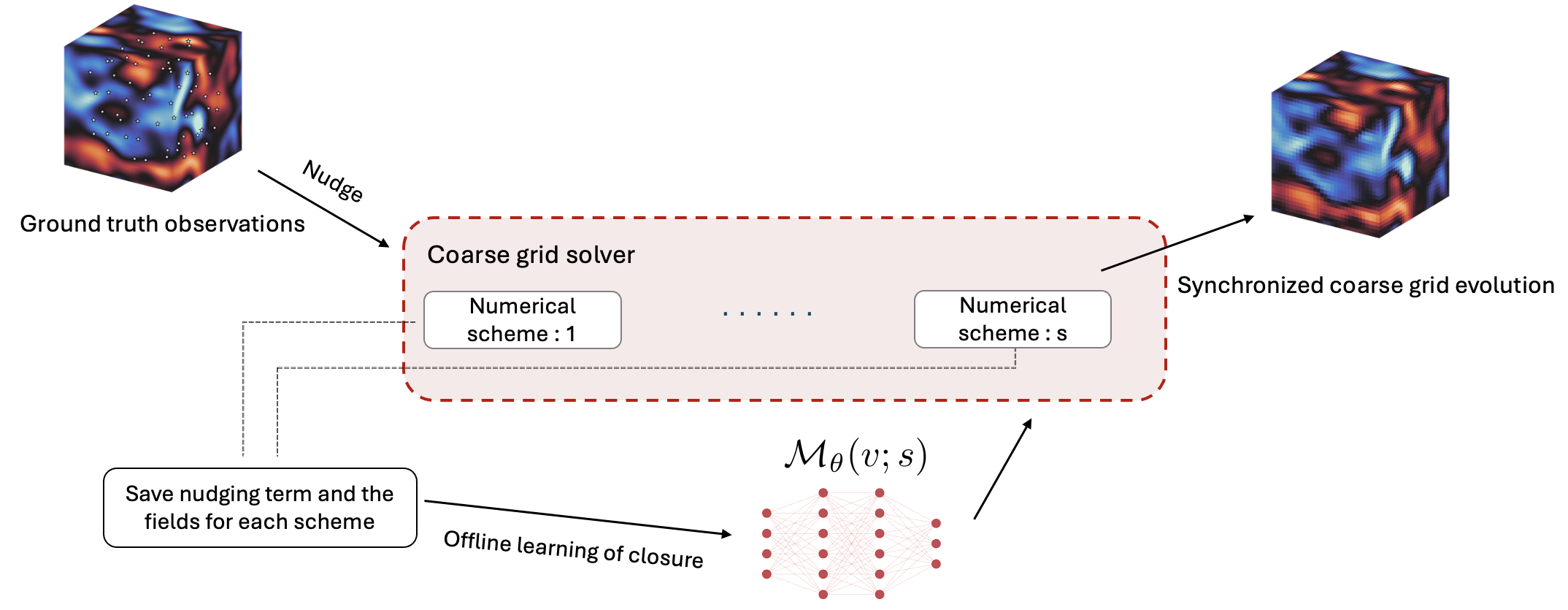
Figure 1: A schematic of the proposed data-driven closure modeling using nudging.
Methodology
This approach reformulates closure modeling as a two-step pipeline:
- Nudged Simulation and Target Generation: LES are run with a baseline (e.g., Smagorinsky) closure while an additional nudging term proportional to the coarse-grid discrepancy with DNS is injected. This term acts as a supervised target indicating the solver-specific correction required to maintain statistical fidelity with reference data.
- Neural Network Training: The DNN learns to predict, a-priori, the nudging term from the coarse LES field, explicitly conditioned on the discretization scheme (using, e.g., FiLM layers for scheme encoding), thereby enabling scheme-aware closure prediction during inference.
The proposed methodology is evaluated on forced homogeneous isotropic turbulence in both two and three spatial dimensions under a variety of discretization schemes.
Results: Two-Dimensional Homogeneous Isotropic Turbulence (2D-HIT)
The 2D-HIT experiments provide a stringent testbed for interrogating solver dependence and statistical fidelity. When both training and deployment are performed on the same discretization, the DNN closure reproduces coarse-DNS turbulent kinetic energy (TKE) and energy spectra with high accuracy and stability. Baseline Smagorinsky (SMAG) closures are excessively dissipative; while dynamic Smagorinsky (D-SMAG) improves upon this, only the nudged or DNN closures achieve reference-level accuracy and preserve physical structures.
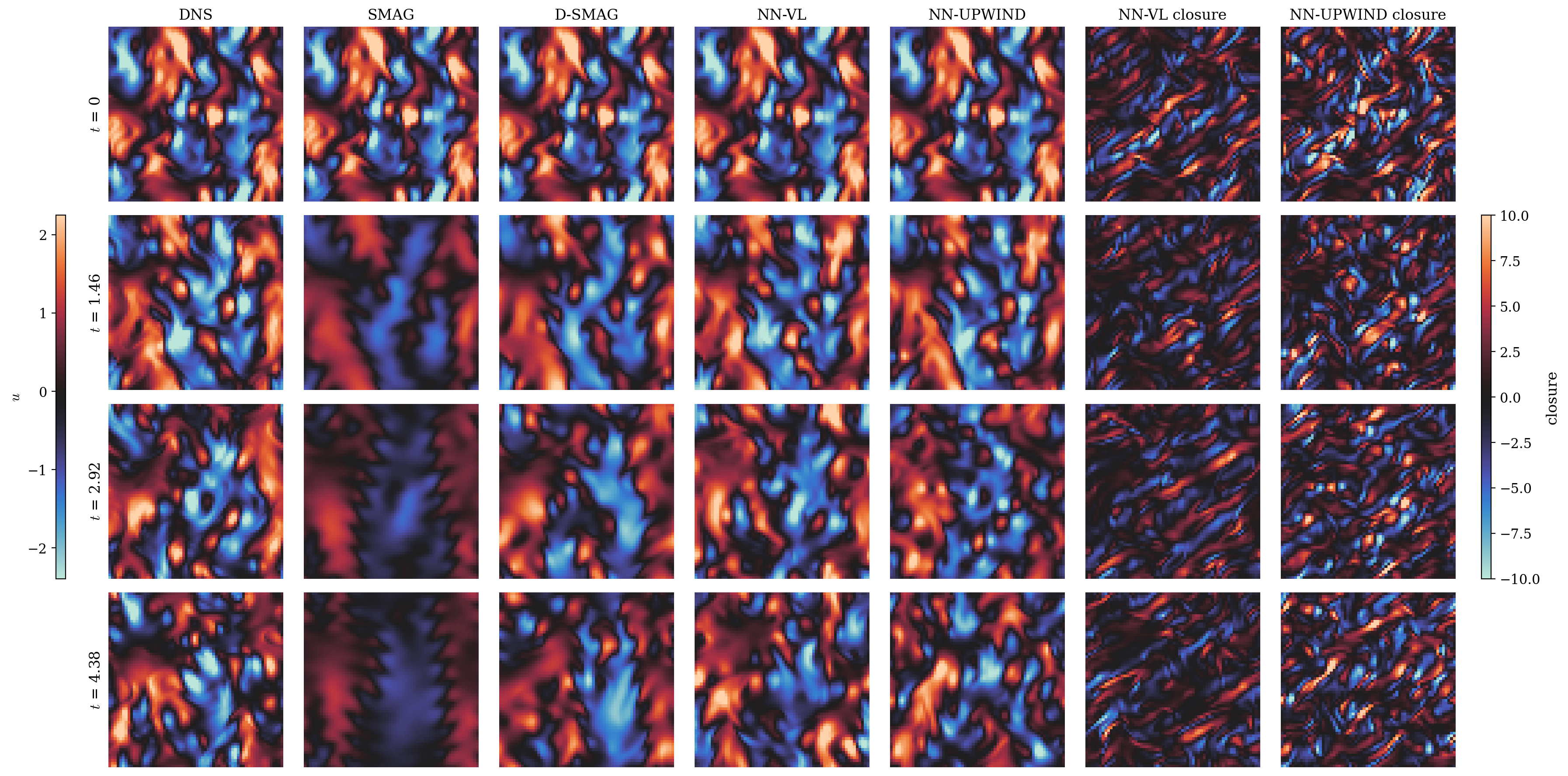
Figure 2: Representative coarse-grid x-component velocity fields at different times. SMAG and D-SMAG are visibly more dissipative than the NN rollouts. The predicted closure fields for the two schemes are also different, reflecting the different levels of numerical dissipation associated with the underlying discretizations.
Transferability tests reveal a strong dependence of the closure correction on the numerical discretization. A model trained using Van Leer (VL) discretization fails to compensate for the higher dissipation of Upwind (UPWIND) or the lower dissipation of Central Differencing (CD2), leading to either undercompensation or unphysical energy growth.
Conditioning the DNN on discretization scheme labels (via FiLM) yields flexible, scheme-aware models that remain robust across discretizations and consistently reproduce reference statistics, as observed in TKE, energy spectra, and PDFs of flow variables.
Results: Three-Dimensional Homogeneous Isotropic Turbulence (3D-HIT)
The framework extends naturally to 3D forced, nearly incompressible HIT, now including compressibility effects in a low-Mach regime. Multiple central difference schemes of varying order were considered for the convective flux. The DNN closure consistently outperforms baseline SMAG and D-SMAG closures in capturing TKE and energy spectra across all schemes. Unlike in the a-posteriori setting, statistical convergence is achieved without solver backpropagation, and the scheme-conditioned network provides accurate closure for all considered discretizations.
The pointwise synchronization with DNS is lost due to chaotic divergence, but low-order statistics are well-preserved, and the learned corrections adapt across C2, C4, and C6 schemes with minimal drop in accuracy.
Analysis of Scheme Dependence and Forcing Characteristics
A direct comparison between differences in discretized convective operators and differences in predicted DNN closures for identical states under varying discretizations confirms that the DNN-based closure correction internalizes and compensates for solver-specific numerical errors. Spectral analyses of the closure corrections parallel the dissipative effect of the solvers, with more dissipative schemes inducing larger DNN corrective terms.
Additional analyses show that the net closure corrections provided by NN and nudging outstrip those from classical SGS closures, especially at the scales where numerical dissipation is significant. The spatial localization of learned corrections is found to coincide with regions of high strain rate and numerical damping.
Generalization Properties and Practical Considerations
The framework demonstrates mild dependence on the time-integration scheme (RK2, RK4, Forward-Euler), with the DNN closure robust to moderate changes in the integration method. Explicit conditioning on the temporal scheme is generally unnecessary, though lower-order integrators can lead to slightly increased deviations in statistics.
For scenarios with partial or sparse observations (e.g., nudging only select velocity components, or scattered observation points reconstructed via interpolation), the methodology continues to lower RMS errors and improve statistical alignment relative to baseline closures. However, performance degrades gracefully as observation sparsity increases, with the optimal choice of nudging gain μ becoming critical.
Implications and Outlook
This study establishes that full a-priori training of turbulence closures for LES is feasible when the supervised targets are derived using nudged LES-DNS synchronizations rather than by classical SGS stress estimation. The fact that scheme-aware closures can be constructed offline, accurately compensating for both physical SGS effects and solver numerical errors, addresses the major hurdles with differentiable physics deployments—high computational cost and poor solver transferability. Additionally, by conditioning closure models on physically meaningful metadata (i.e., discretization identifiers), the pipeline is positioned for practical integration with diverse CFD solvers, particularly in engineering and geophysical applications where solver heterogeneity is unavoidable.
From a theoretical standpoint, this further blurs the distinction between "model" and "numerical discretization error" in LES: optimal closures integrate both effects, and their separation is largely immaterial as long as coarse-grid statistics are appropriately maintained. The successful demonstration over multiple spatial and temporal schemes, as well as for different physical variables and degrees of observation sparsity, signals broad potential for real-world turbulence modeling where observational data (including from experiments) may be sparse or noisy, and solver configurations are not strictly controlled.
Future research directions include extension to more complex flow geometries, real-world observation modalities, and formalization of uncertainty quantification for both the DL and nudging steps.
Conclusion
This work demonstrates a nudging-based, solver-aware framework for deep-learning turbulence closures in LES, enabling stable, accurate, and transferable models across a range of spatial discretizations with significant practical implications for multiphysics and multiscale CFD. The method's capacity to decouple closure learning from solver-differentiability requirements, while preserving accuracy and stability, marks a substantial advance in data-driven turbulence modeling and paves the way for future developments in solver- and observation-aware closure frameworks.

