- The paper introduces a unified (2,p)-positivity framework that generalizes N-representability conditions to systems without particle-number conservation.
- It employs semidefinite programming to enforce physical constraints on 2-RDMs, achieving near full configuration interaction accuracy in benchmark tests.
- The methodology enables variational ground-state calculations for diverse quantum systems, including superconducting and strongly correlated regimes.
Hierarchies of 2-RDM Representability Beyond Particle-Number Conservation
Overview
This work presents a constructive solution to the representability problem for two-particle reduced density matrices (2-RDMs) in quantum systems that do not conserve particle number. It develops a general framework for enforcing physical constraints on 2-RDMs via the intersection of the positive semidefinite cone of the full Fock space with the two-body operator space, deriving a systematic hierarchy of so-called (2,p)-positivity conditions. These constraints, which generalize the well-known N-representability conditions to the number-nonconserving regime, permit direct variational 2-RDM ground-state calculations for a broad class of quantum systems, including superconducting and open quantum systems as well as standard particle-number conserving cases. The formalism is unified across conserving and nonconserving sectors by imposing the particle-number variance constraint as necessary.
Theoretical Framework
The foundational insight is that for systems with two-body interactions, the energy and low-order properties are expressible as functionals of the 2-RDM alone, provided it is physically representable. The representability conditions for a 2-RDM are recast as membership in the polar cone: the set of two-body operators that remain positive semidefinite on Fock space. The explicit construction draws on the decomposition of general operators into irreducible p-body Majorana-like components, identifying systematic families of linear constraints on the 2-RDM that guarantee its physicality even in the presence of particle-number nonconservation.
This leads to the formulation of (2,p)-positivity, which for each p restricts the set of admissible 2-RDMs by enforcing the vanishing of all irreducible higher-than-two-body terms in the expansion of positive operators in terms of p-body Majorana products. At p=2, the constraints are those previously known for standard number-conserving systems; as p increases, the constraints systematically tighten and converge to the true representable set. Imposing the particle-number variance constraint recovers the fixed-N case as a subset of the general formalism.
The numerical implementation employs a dual semidefinite programming (SDP) approach, maximizing the ground-state energy subject to linear and SDP constraints corresponding to the selected positivity level and variance conditions. The approach eschews reliance on higher RDMs or explicit wave function representations.
Numerical Results and Analysis
Application of the V2RDM approach with these number-nonconserving representability constraints is benchmarked on two systems: a six-orbital pairing ring Hamiltonian displaying explicit particle-number nonconservation, and the symmetric dissociation of linear H4, a paradigmatic strong correlation problem which remains strictly number conserving.
Pairing Ring Hamiltonian
The energy error and ground-state energy of the pairing ring Hamiltonian are computed at multiple levels of positivity. At N0-positivity, the results follow full configuration interaction (FCI) closely up to a critical N1 value where ground state parity transitions, after which the errors increase sharply. Full N2-positivity retains high fidelity (errors below N3 a.u.) across all tested interaction strengths, while partial N4-positivity, equivalent to T1 and T2-type constraints, demonstrates intermediate accuracy.
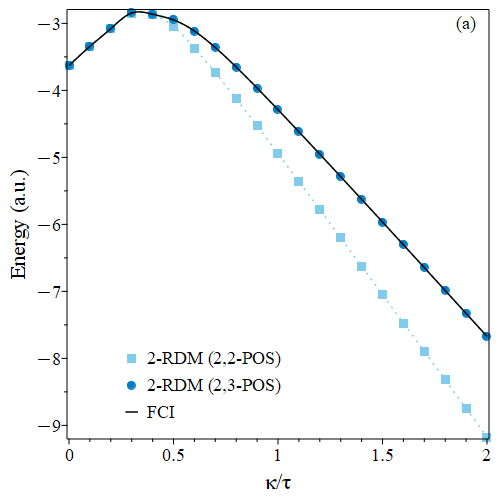
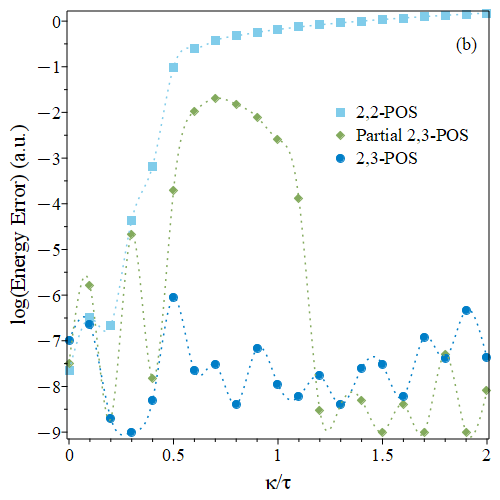
Figure 1: (a) Ground-state energy and (b) base-10 energy error relative to FCI of the six-orbital pairing ring Hamiltonian from V2RDM with N5-, partial N6-, and full N7-positivity.
The particle-number variance computed with these constraints highlights the breakdown of N8-positivity at strong interaction, with full N9-positivity again exhibiting values indistinguishable from FCI, substantiating the representational accuracy of the higher-order constraints.
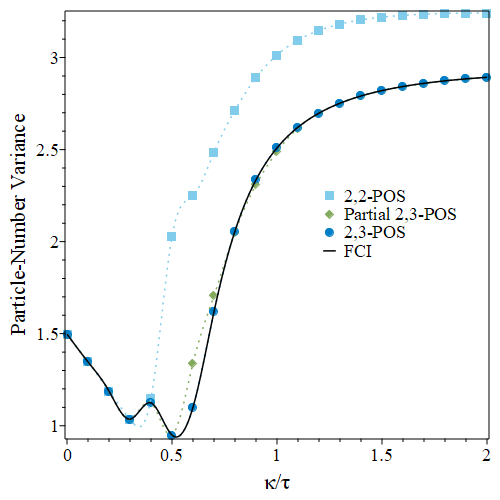
Figure 2: Particle-number variance of the ground state of the pairing ring Hamiltonian from V2RDM at multiple levels of positivity, compared with FCI.
Symmetric Dissociation of Hp0
Testing the framework in the fixed-number sector, the dissociation of Hp1 is examined using the number variance constraint alongside the positivity conditions. The variational 2-RDM results with p2- and p3-positivity track FCI with high accuracy across the entire PES, outperforming standard quantum chemical methods such as CCSD(T) in the strongly correlated regime.
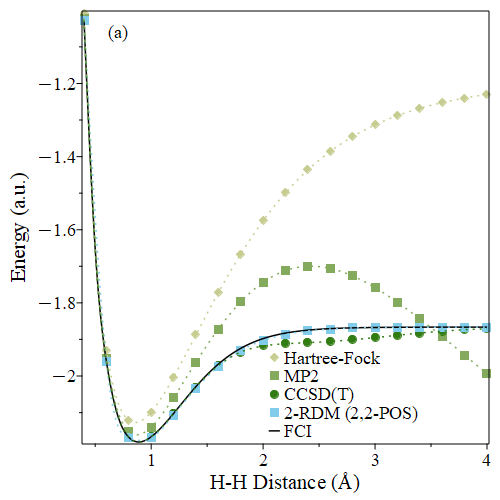
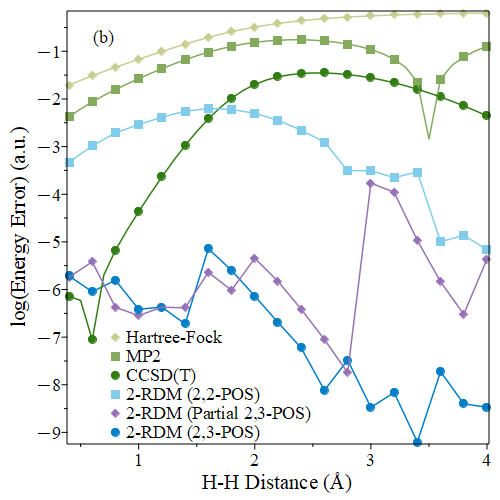
Figure 3: (a) Potential energy curve and (b) base-10 energy error relative to FCI for symmetric dissociation of linear Hp4 from various methods and V2RDM with p5-, partial p6-, and full p7-positivity.
The accuracy gains of full p8-positivity over traditional T1 and T2 analogs become particularly pronounced in dissociation where strong static correlation is present, indicating the power of the full positivity-intersection construction.
Implications and Future Directions
The generalized p9-positivity formalism introduced here unifies representability constraints for both number-conserving and nonconserving quantum systems at the level of the 2-RDM. The explicit, constructive hierarchy enables the treatment of Fock space problems—such as superconductivity, quantum optics, cold atom systems, and open-system dynamics—where particle-number nonconservation plays a central role.
This approach circumvents the need for higher RDMs or explicit wave function parameterizations, leveraging established SDP techniques. While the underlying representability problem is QMA-complete in general, practical computation is feasible via exploitation of symmetry, sparsity, and problem-specific entanglement structure, especially at moderate positivity order.
The framework paves the way for the application of variational 2-RDM methods to a wider array of problems in strongly correlated materials and model Hamiltonians, and motivates further study of practical algorithms and approximations to accelerate convergence for large-scale systems. In particular, the development of scalable constraint handling and exploitation of nonchordal structure in the positivity cones remain impactful areas for future investigation.
Conclusion
This work delivers a unified and constructive hierarchy of representability constraints for the 2-RDM that accommodates both particle-number-conserving and nonconserving quantum systems. The explicit (2,p)0-positivity framework is demonstrated to attain high accuracy on benchmark problems and generalizes classical (2,p)1-representability results, offering a robust new tool for tackling ground-state and correlated phenomena in quantum many-body theory (2604.23869).