- The paper introduces a unified analytic framework combining Hamiltonian dynamics with mutual friction to model dissipative vortex binary motion.
- It employs closed-form solutions and systematic geometric corrections via the Schottky–Klein prime function to account for compact domain effects.
- Numerical validation shows significant improvements, revealing key phenomena such as monotonic energy decay, angular drift, and altered vortex collapse dynamics.
Analytic and Geometric Structure of Dissipative Vortex Binaries in Compact Fluid Domains
Introduction
This paper provides a rigorous analytic treatment of dissipative two-vortex dynamics in compact two-dimensional fluid domains, specifically on a flat torus. The approach integrates the exactly solvable conservative (Hamiltonian) point-vortex system—expressed via the Schottky–Klein prime function and associated special functions—with a minimal model for mutual-friction-induced dissipation, resulting in a symplectic–gradient flow admitting monotonic energy dissipation. The authors address both the universal (planar) regime and systematic corrections induced by the compact domain geometry, yielding a unified framework for dissipative vortex binary motion that has implications for quantum fluids, superfluid turbulence, and hydrodynamic rotor systems.
The conservative planar N-vortex problem on a doubly periodic torus is governed by a Hamiltonian constructed from the hydrodynamic Green’s function. For two vortices, the system is exactly integrable: the antisymmetry of the interaction kernel enables a reduction to a single complex relative coordinate, η=ei(w1−w2), yielding a closed scalar evolution. The resulting conservative dynamics for same-sign pairs encompasses rigid orbital rotations, while equal-strength dipoles propagate at fixed separation and orientation.
Dissipation is introduced through a rotated-velocity (mutual friction) correction reflective of mechanisms in finite-temperature superfluids and Bose–Einstein condensates:
w˙jdiss=(1−iγκj)w˙j,
where γ is a dissipation parameter and κj denotes the sign of circulation. This transforms the dynamics into a coupled Hamiltonian–gradient flow. For quantized vortices (∣Γj∣=1), the model guarantees monotonic energy decay, dH/dt≤0, without loss of analyticity or integrability for the binary system.
Analytic Solutions: Planar and Toroidal Regimes
Planar Limit (Local Regime):
The authors obtain closed-form solutions for three canonical binary classes:
- Same-sign binaries: Outward spiral motion with
r2(t)=r02+π2Γγt,θ(t)=θ0+2γ1log(1+πr022Γγt).
- Equal-strength dipoles: Finite-time collapse at fixed orientation,
r2(t)=r02−π2Γγt.
- Unequal-strength dipoles: Coupled contraction and rotation with a nonlinear chirp,
ω˙∝ω2,
contrasting with electromagnetic (∝ω3) and gravitational (w˙jdiss=(1−iγκj)w˙j,0) inspirals.
Geometric Corrections:
Systematic expansion of the Schottky–Klein-derived kernel yields isotropic (w˙jdiss=(1−iγκj)w˙j,1) and anisotropic (w˙jdiss=(1−iγκj)w˙j,2) corrections, modifying both the radial and angular dynamics. Crucially, on the torus, dipole orientation—conserved in the plane—acquires a slow drift, even when planar theory predicts invariance.
Numerical validation demonstrates excellent agreement of these analytic laws, including toroidal corrections, with full simulations.
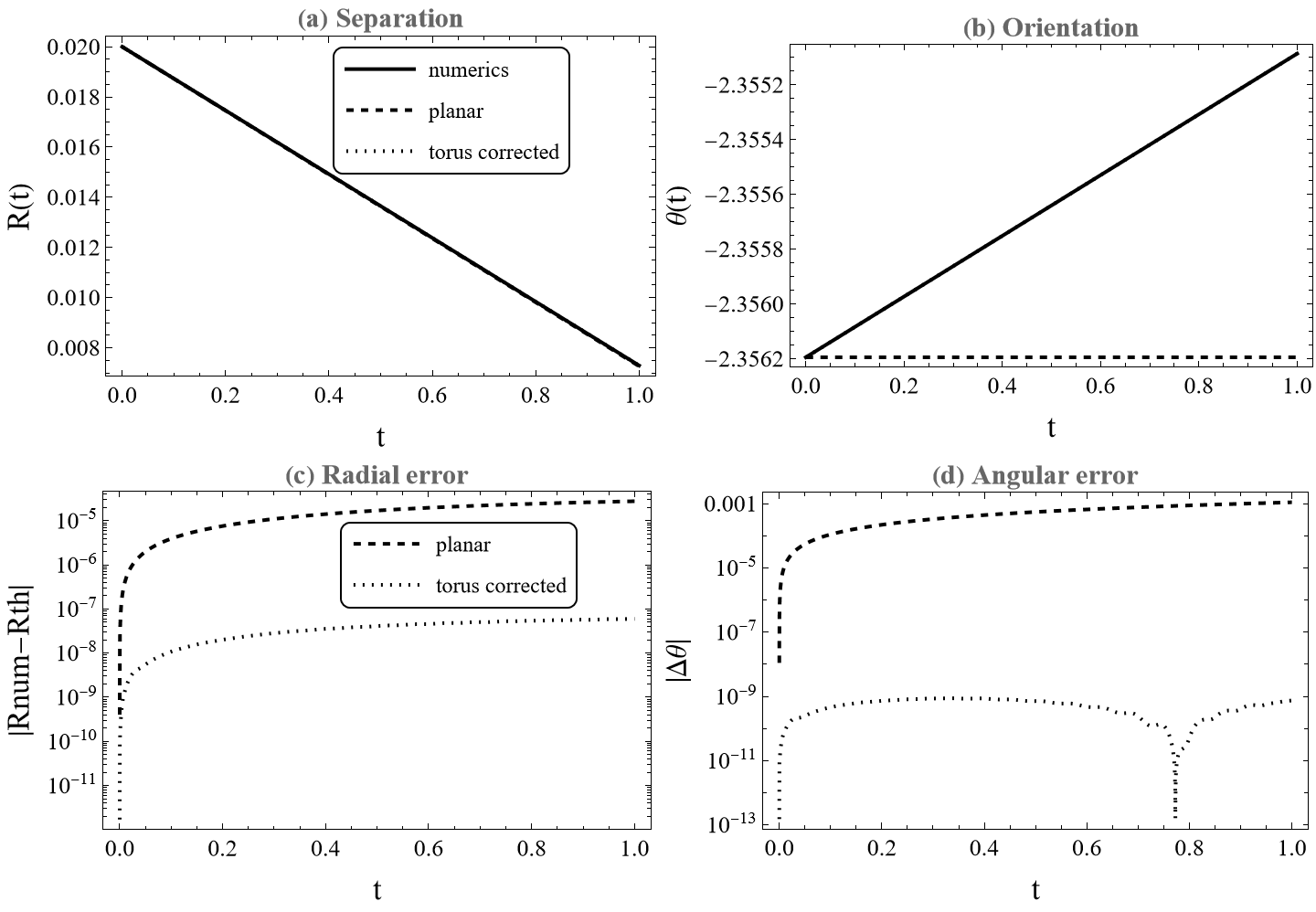
Figure 1: Numerical verification confirms that planar theory underestimates both orientation drift and radial error for dipole collapse; torus corrections dramatically improve accuracy and capture the slow angular drift.
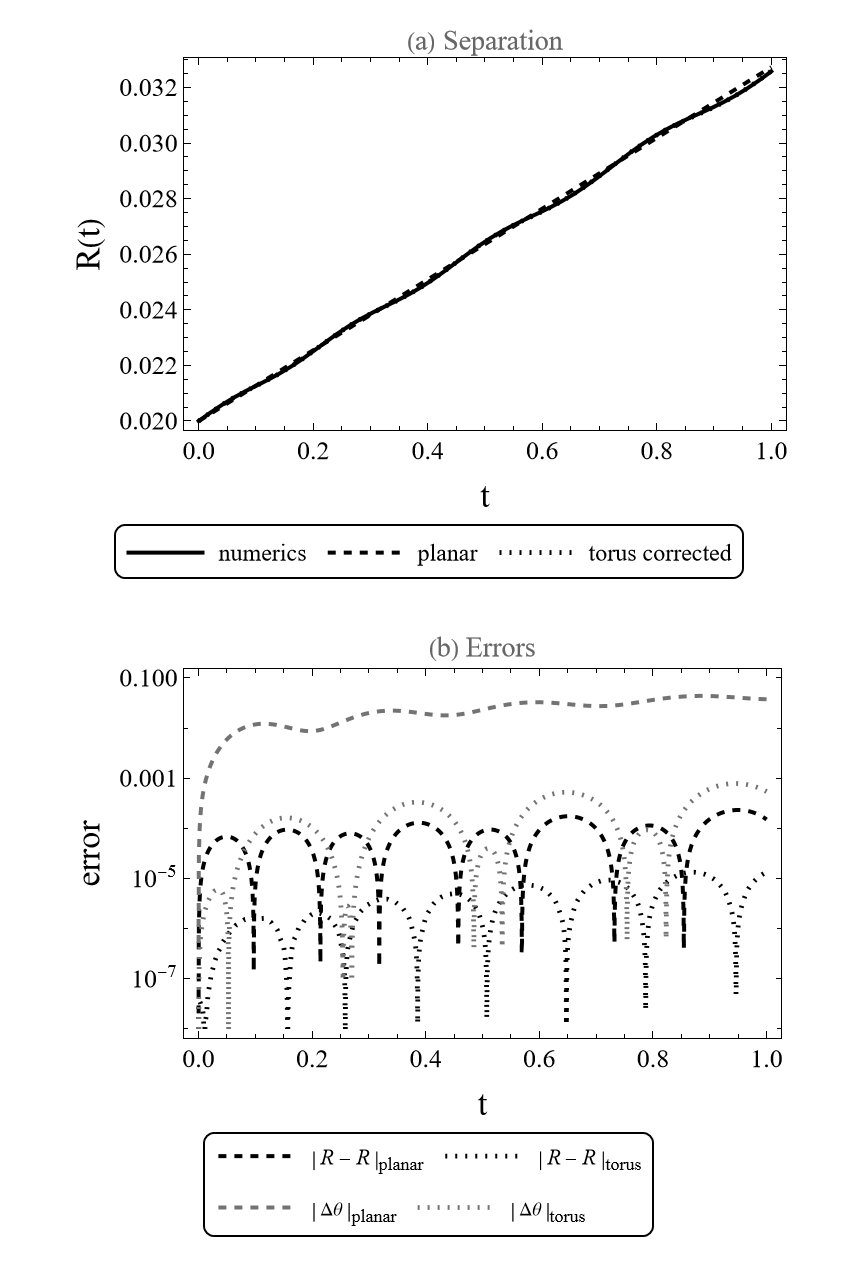
Figure 2: For same-sign binaries, toroidal corrections systematically reduce both radial and angular error over time, emphasizing the geometric control over dissipative dynamics.
Numerical Experiments and Strong Claims
The authors present strong, quantitative validation:
- Torus-corrected theory reduces radial and angular errors by several orders of magnitude compared to planar models during both inward dipole collapse and outward same-sign spiraling.
- The observed angular drift in dipole collapse and secular/oscillatory modifications to same-sign separations via w˙jdiss=(1−iγκj)w˙j,3 and w˙jdiss=(1−iγκj)w˙j,4 coefficients are inaccessible to planar theory, emphasizing the essential role of compact geometry.
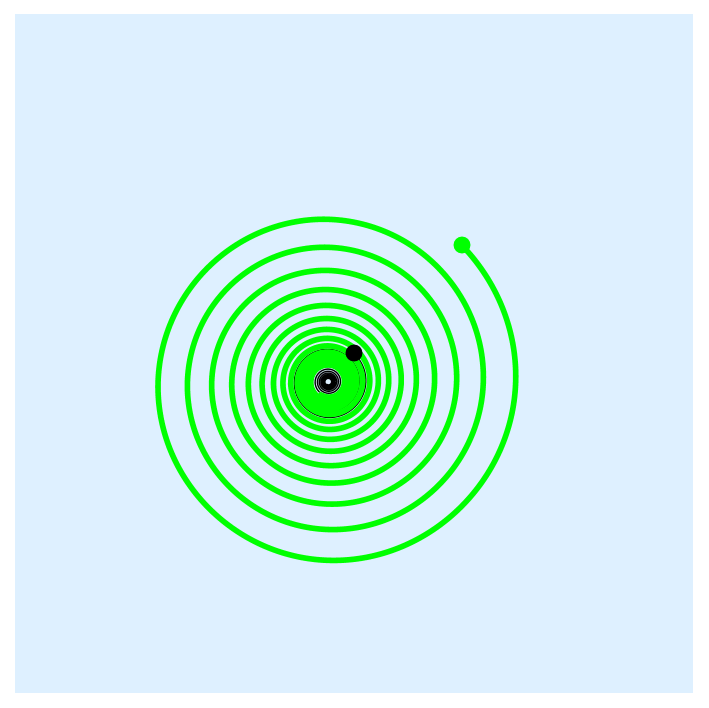
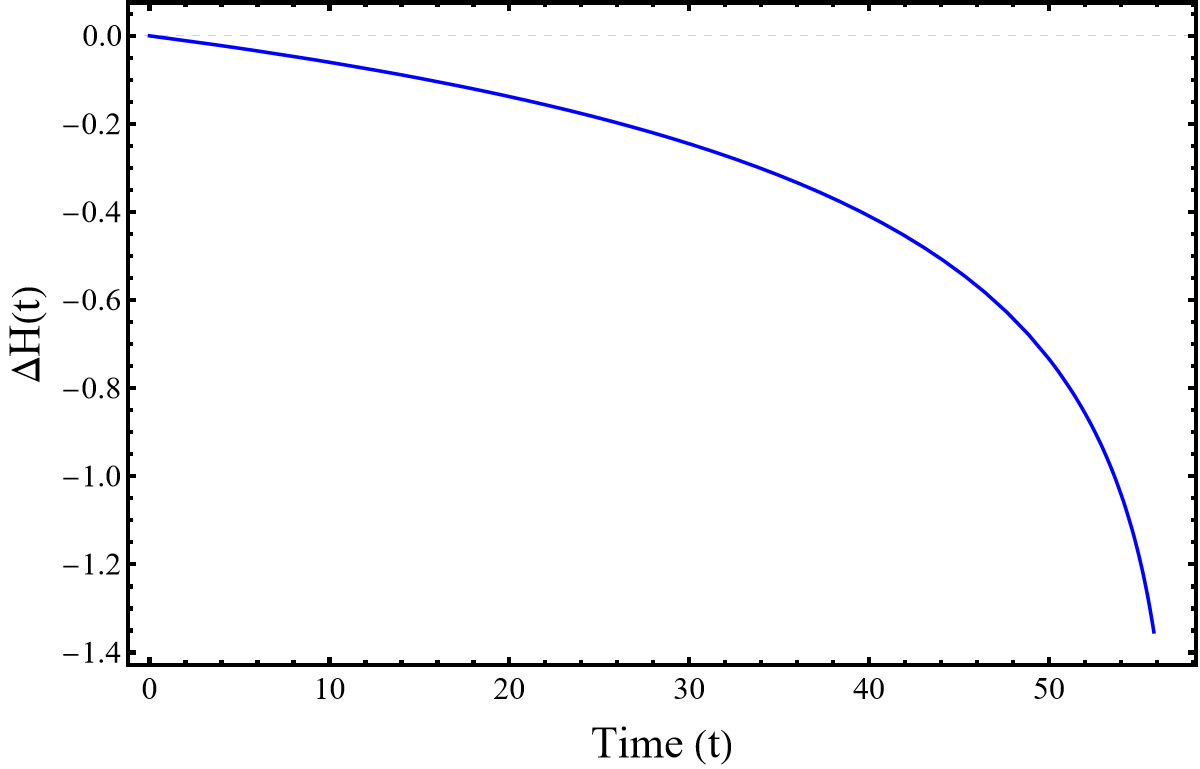
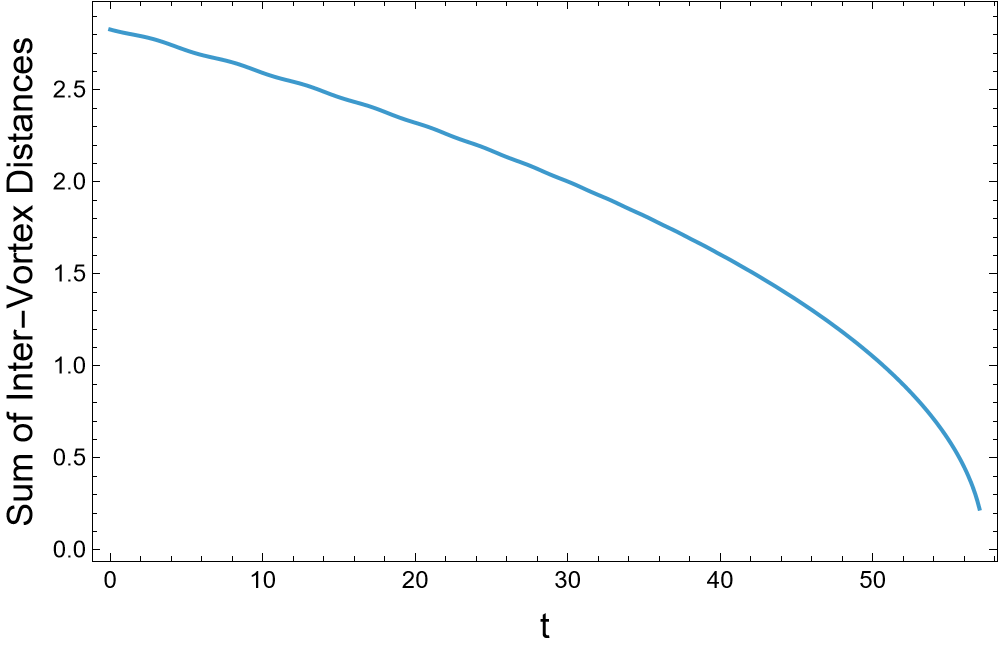
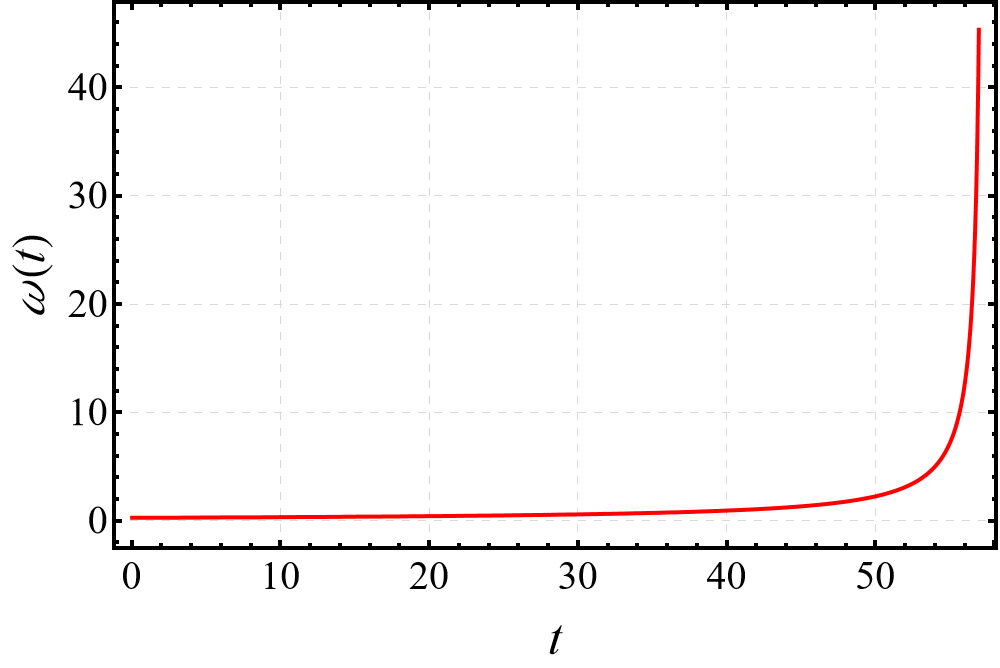
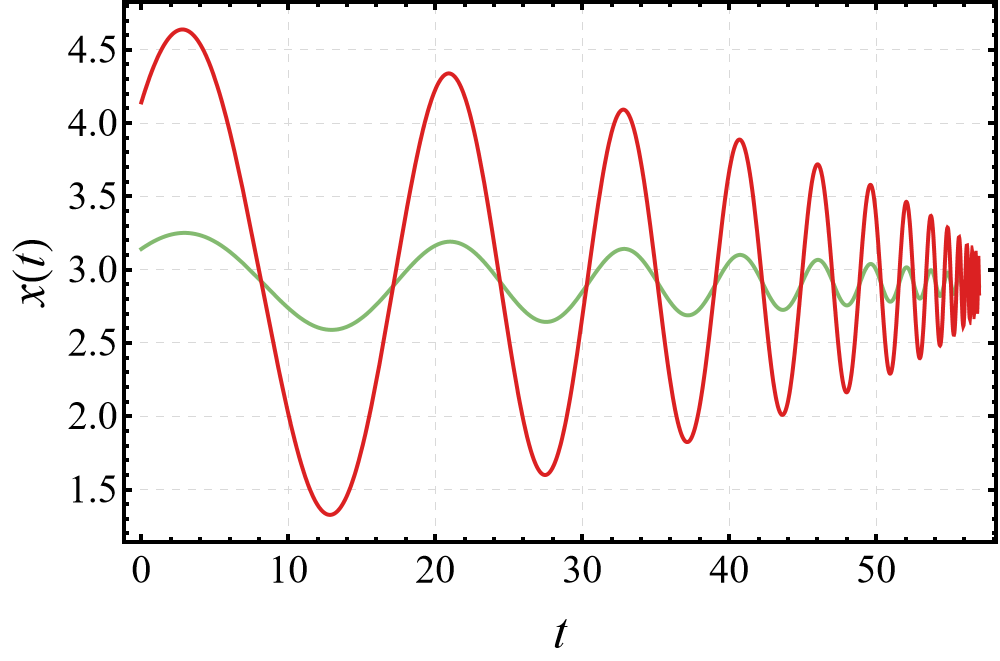
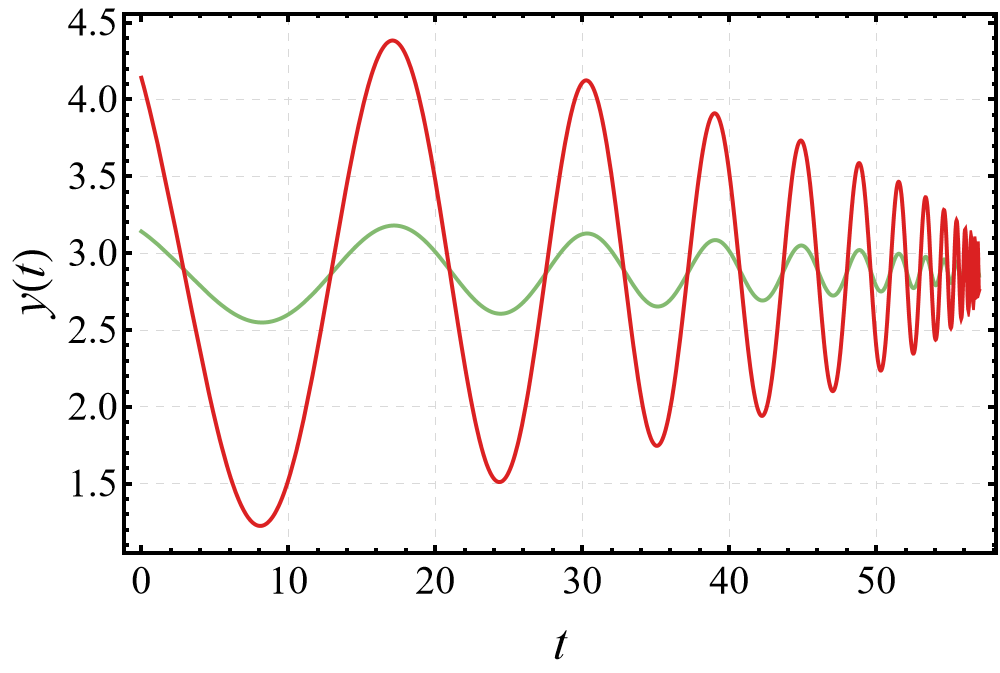
Figure 3: Trajectories for dissipative vortex binaries highlight pronounced geometric and dissipative effects, including spiraling, collapse, and orientation drift, depending on vortex sign and strength.
Implications and Outlook
Theoretical Implications
The study demonstrates that compact domain geometry and mutual friction introduce qualitatively new effects absent in the unbounded plane. The analytic tractability of the binary problem allows explicit identification of geometric invariants broken by the torus, such as dipole orientation, and discloses the mechanisms behind nonlinear chirping distinct from radiative (electromagnetic or gravitational) inspirals.
Practical Relevance
- Quantum fluids: Descriptions of vortex decay and relaxation in Bose–Einstein condensates now account for domain-induced reorientation and altered collapse dynamics.
- Superfluid turbulence: The framework is directly applicable to periodic box simulations, with real finite-size corrections and energy dissipation encoded in closed analytic forms.
Prospects for Extension
- Many-body relaxation: The explicit reductions for w˙jdiss=(1−iγκj)w˙j,5 set the stage for analytic and numerical exploration of dissipative cluster relaxation and metastable configurations in larger vortex assemblies.
- Geometry-dependent transport: The approach supports generalization to other compact geometries or curved surfaces, offering a canonical testing ground for geometry-driven transport and clustering in active matter and soft-matter systems.
- Dissipative chirp laws: The demonstration of the w˙jdiss=(1−iγκj)w˙j,6 scaling in vortex binaries suggests a broader universality class of frequency blow-up phenomena controllable by dissipation and domain structure.

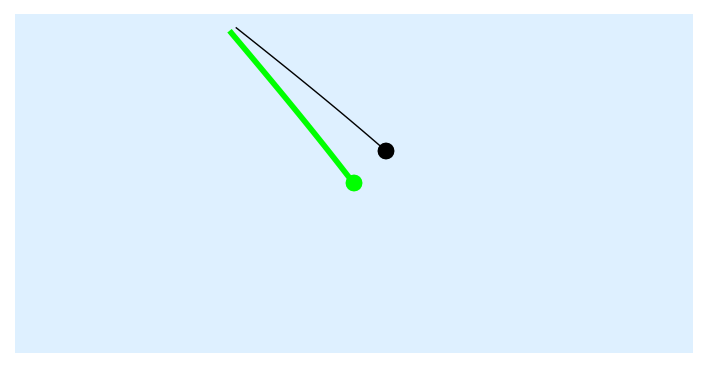
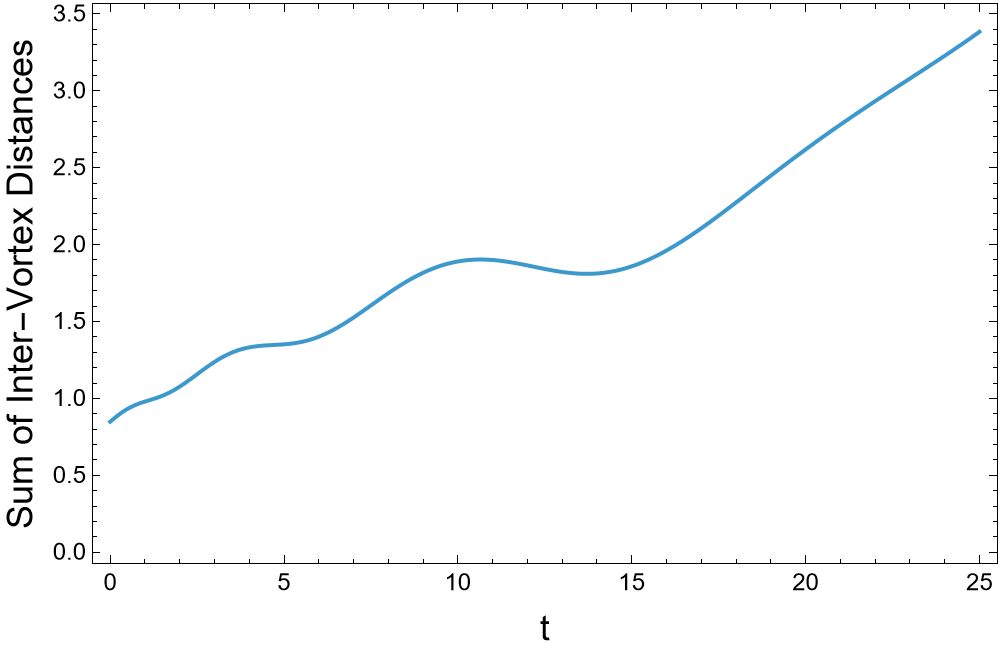
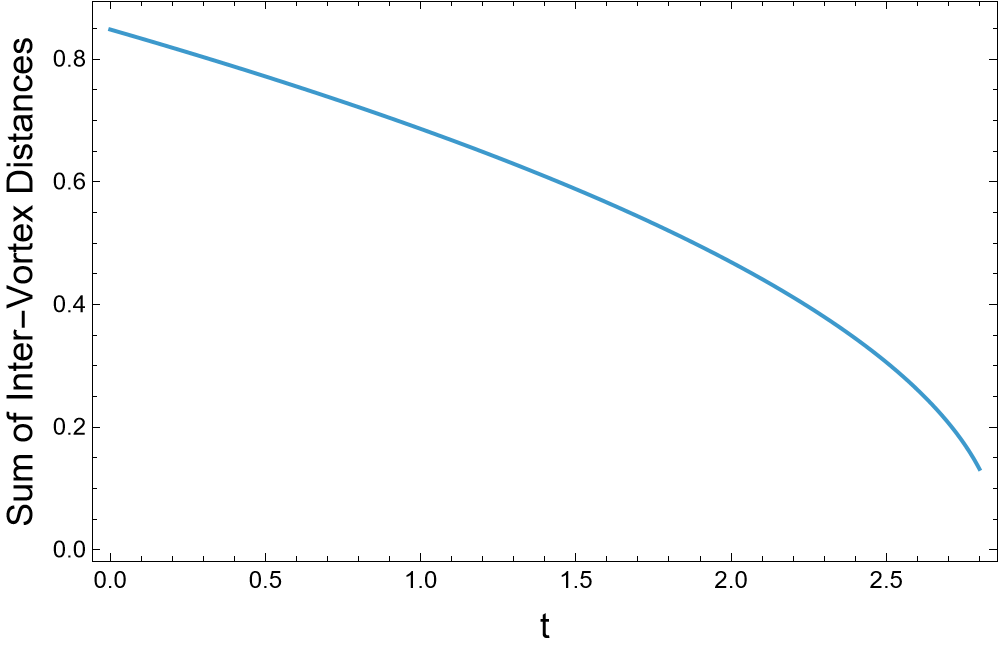
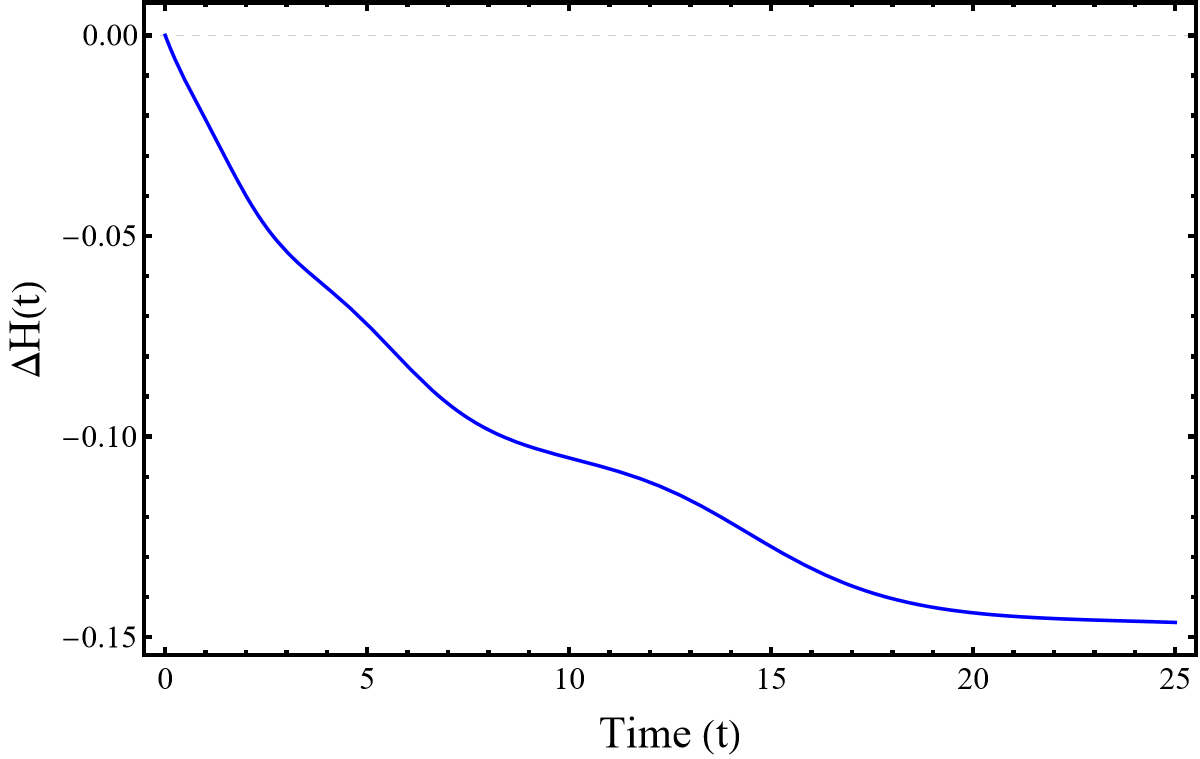
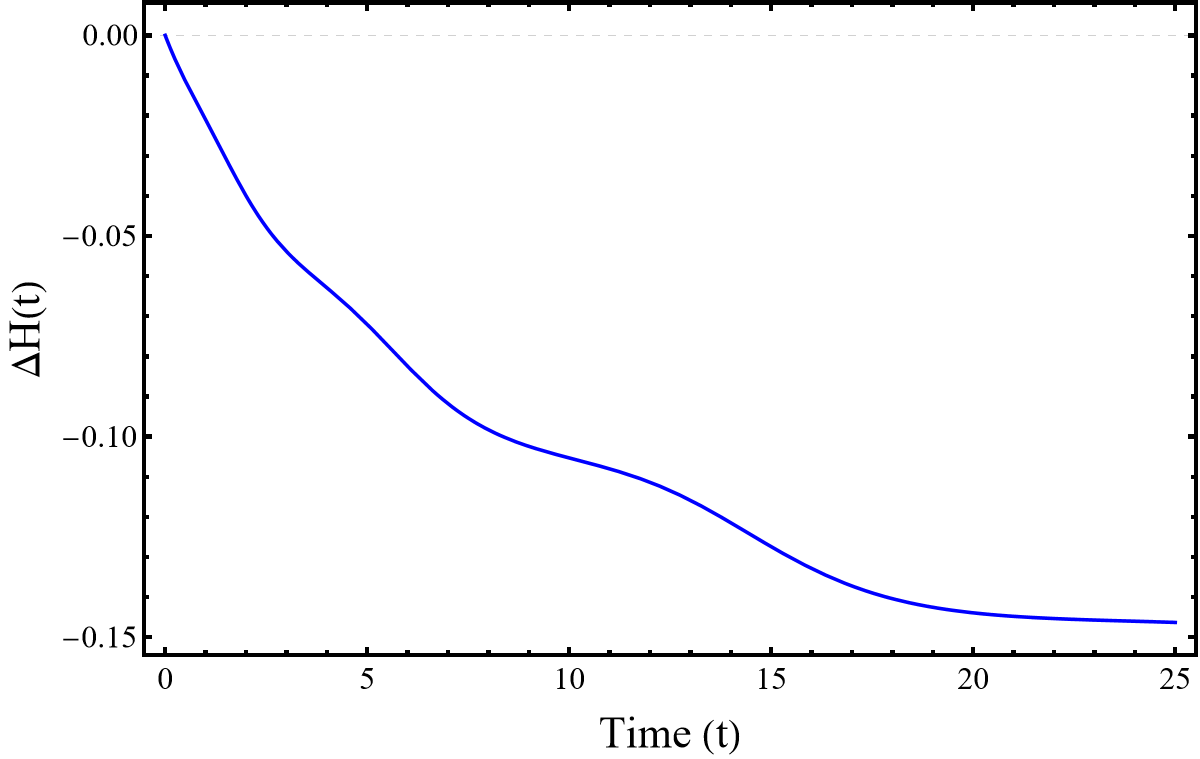
Figure 4: Same-sign vortex trajectories and separations in dissipative periodic domains. Outward spiral and associated Hamiltonian decay manifest geometric and dissipative corrections absent in planar settings.
Conclusion
This work rigorously establishes that in compact periodic domains, dissipation and geometry produce intertwined, quantitatively significant corrections to the canonical vortex binary dynamics. The results highlight the necessity of incorporating finite-size and topological effects for the accurate modeling of vortex decay and relaxation in quantum and classical two-dimensional fluids. The analytic simplicity of the model makes it a foundational reference for further studies in many-body vortex systems, periodic quantum turbulence, and geometry-driven dissipative transport.

