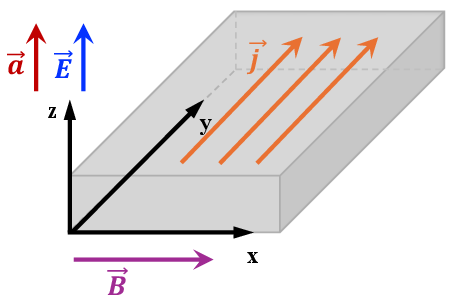
- The paper establishes that the Weyl anomaly fixes a unique, universal second-order transport coefficient in relativistic hydrodynamics, resulting in a new nondissipative current tied to fluid acceleration and electromagnetic fields.
- It employs a comprehensive hydrodynamic framework coupled with boundary QFT methods to confirm that anomaly-induced corrections precisely reproduce the expected current structure.
- The findings have practical implications in heavy-ion collisions, Weyl semimetals, and astrophysical contexts, providing a model-independent framework for exploring quantum anomaly effects in transport phenomena.
Weyl Anomaly Induced Transport in Hydrodynamics
Introduction and Motivation
Quantum anomalies bridge the microphysics of quantum field theories (QFTs) with macroscopic transport in relativistic many-body systems. Historically, the chiral and gravitational anomalies have underpinned key phenomena such as the Chiral Magnetic Effect (CME) and Chiral Vortical Effect (CVE). These encode UV quantum corrections into IR transport, yielding nondissipative currents under magnetic fields or vorticity. The role of the Weyl anomaly, reflecting quantum breaking of classical conformal invariance and manifesting as a nonzero trace of the energy-momentum tensor, has been less clear with respect to universal transport properties. The present work establishes that the Weyl anomaly fixes a distinctive, universal second-order transport coefficient in relativistic hydrodynamics, generating a new non-dissipative current in accelerated, electromagnetically coupled relativistic fluids (2604.23849).
Hydrodynamic Framework: Trace Anomaly and Constitutive Relations
The analysis begins by considering a relativistic fluid in the presence of an external electromagnetic field, focusing on equilibrium hydrodynamics under the Killing condition and using the Landau frame. The core hydrodynamic equations consist of energy-momentum and charge conservation: ∂μTμν=Fνμjμ,∂μjμ=0,
where Tμν and jμ are the energy-momentum tensor and current, and Fμν the field strength. The Weyl (trace) anomaly in this background is,
T μμ=CFμνFμν,
with C fixed by the microscopic theory content. Although this anomaly does not, a priori, entail a nonconserved current as for the chiral case, its hydrodynamic implications are accessed by constructing the most general second-order, nondissipative current corrections built from the acceleration aμ=uν∂νuμ and Eμ=Fμνuν.
Through systematic analysis, including all symmetry-allowed terms and imposing the requirement that the constitutive relations are compatible with both conservation and the trace anomaly, the following non-dissipative current emerges at second order: jμ=−4CFμνaν,
as uniquely fixed by the anomaly. This current couples fluid acceleration with the electromagnetic field and vanishes in trivial (unaccelerated) equilibrium.
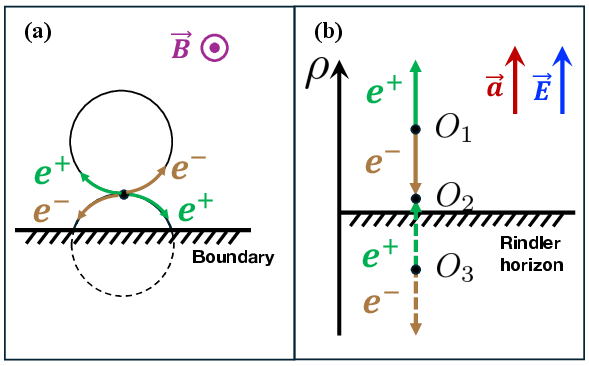
Figure 1: Schematic of Weyl-anomaly-induced current: (a) boundary-induced vacuum magnetization current; (b) screening effect due to the Rindler horizon and electric field.
Boundary Quantum Field Theory and Rindler Horizons
An independent, quantum field-theoretic derivation employs the framework of boundary QFT (BQFT). In BQFT, the Weyl anomaly induces boundary-localized currents—specifically, the vacuum magnetization current in external fields, interpreted as an incomplete cancellation between particles and antiparticles near the boundary. This current takes the universal form,
jμ=4CxFμνnν,
where Tμν0 is the normal to the boundary and Tμν1 the distance from it.
The crucial insight is that an accelerated frame's Rindler horizon provides an effective boundary for the quantum vacuum. By treating the stretched horizon as a boundary and mapping hydrodynamic acceleration onto the normal vector, the BQFT result is shown to precisely reproduce the hydrodynamic result (above), establishing a nontrivial correspondence between boundary-induced response and anomaly-driven hydrodynamic transport.
Physical Manifestation: Rest Frame Structure and Thermomagnetic Effects
Specializing to the local rest frame, the anomalous current admits a tangible tensor structure: Tμν2
At global equilibrium, under stationary, inhomogeneous temperature and chemical potential profiles, both the acceleration and electric field contributions can be expressed as gradients: Tμν3
where Tμν4 is the rescaled chemical potential.
Notably, the spatial current is transverse and exhibits the same tensor structure as the Nernst (thermomagnetic Hall) current:
Broader Implications and Outlook
The results identify a universal, anomaly-induced transport mechanism directly governed by the trace (Weyl) anomaly. The concurrently hydrodynamic and QFT-based derivations guarantee its robust, model-independent nature: the transport coefficients are fully fixed by the anomaly coefficients of the underlying QFT. This bridges the macroscopic transport responses and microscopic quantum information encoded in the anomaly, extending the class of known nondissipative quantum transport effects beyond the chiral sector.
Practical implications occur in various physical systems:
- Heavy-ion collisions: Regions of strong acceleration, magnetic fields, and vorticity coexist in the evolving QGP, suggesting potential relevance for charge separation dynamics and modification of observed collective phenomena.
- Condensed matter: Weyl and Dirac semimetals, where conformal-anomaly-driven transport has already been experimentally probed, provide a promising testbed for the predicted Nernst-like response—critical distinction being the anomaly-fixed transport coefficient [Chernodub et al., (Chernodub et al., 2021)].
- Cosmology and astrophysics: Early universe scenarios and compact astrophysical objects offer regimes of strong electromagnetic fields and nontrivial acceleration, wherein the anomaly-induced transport may impact charge or baryon number separation.
Further developments may involve:
- Extension to out-of-equilibrium regimes and the role in entropy production.
- Exploration of curved backgrounds and gravitational coupling, especially in the context of AdS/CFT or black hole hydrodynamics.
- Detailed kinetic and holographic studies to clarify the interplay with other anomaly-induced effects.
Conclusion
This work rigorously identifies a class of anomaly-induced transport in relativistic fluids, governed by the trace (Weyl) anomaly and manifesting as a universal hydrodynamic current coupling acceleration and electromagnetic fields (2604.23849). The non-dissipative current persists across both bulk equilibrium and boundary-induced QFT frameworks, with distinct tensor structures paralleling, but fundamentally differing in origin from, thermomagnetic effects in conventional matter. These findings advance the theoretical foundation of anomaly-induced phenomena in high-energy, condensed matter, and astrophysical contexts, motivating new avenues for both theoretical investigation and experimental search.