- The paper introduces a two-stage pipeline that jointly infers legal charges and elements to bridge the semantic gap between colloquial queries and formal legal texts.
- It leverages LLM-driven knowledge distillation to generate a silver-standard dataset, ensuring precise legal indicator extraction without human annotation.
- Multi-view evidence fusion combines latent, structural, and lexical signals to achieve superior retrieval performance and robust interpretability even with limited training data.
GLIER: Generative Legal Inference and Evidence Ranking for Legal Case Retrieval
Introduction and Motivation
Legal Case Retrieval (LCR) requires the identification of relevant precedents based not solely on semantic similarity but on underlying juridical logic—specifically, on the consistent alignment of charges and constitutive elements between queries and candidate cases. Existing approaches, particularly dense retrieval models and recent generative retrieval (GR) methods, typically obscure legal reasoning due to their reliance on black-box semantic mappings or identifier generation, resulting in interpretability and hallucination issues. GLIER directly addresses the intrinsic semantic gap arising from colloquial narratives in queries and the formal, structured language of legal documents by redefining LCR as inference over latent legal variables.

Figure 1: A colloquial query must be mapped to structured legal concepts (e.g., charge and constitutive elements) to retrieve legally relevant precedents.
Framework Overview
GLIER introduces a two-stage, interpretable retrieval pipeline: (1) a Joint Generative Inference module that infers latent legal indicators—charges and constitutive elements—from raw queries, and (2) a Multi-Faceted Discriminative Re-ranker (MFDR) that integrates generative scores with structural and lexical evidence for ranking.
The first module utilizes a unified sequence-to-sequence paradigm that generates charge and element predictions jointly, enforcing logical consistency via the autoregressive decoder. The second module fuses generative confidences, explicit structural alignment, and normalized lexical scores using a lightweight MLP, enhanced with hard negative mining for discriminative training.
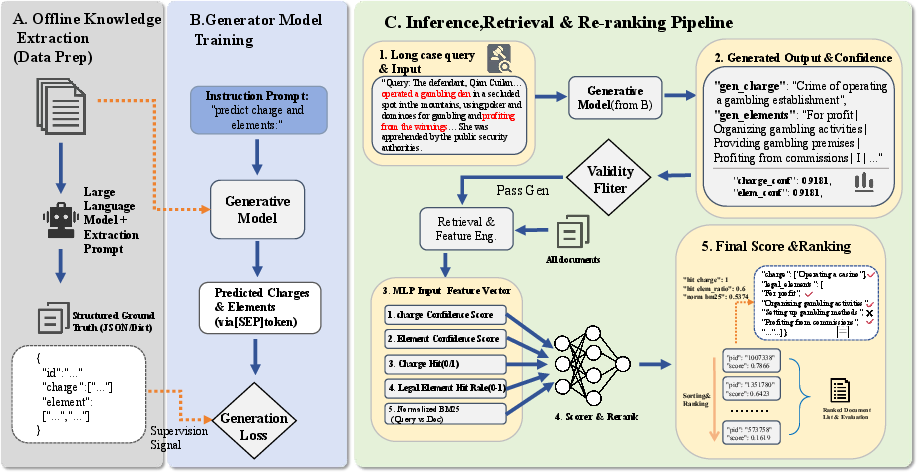
Figure 2: The overall architecture of the proposed framework, consisting of the Generative Legal Indicator Extractor (GLIE) and the Multi-Faceted Discriminative Re-ranker (MFDR).
Technical Contributions
Latent Structured Inference
GLIER formalizes LCR as Pθ(z∣q), where z=(c,e) represents the structured latent juridical interpretation (charge c and elements e). The generative module produces both charge and elements in a single sequence, leveraging chain-rule factorization to model Pθ(c∣q)Pθ(e∣q,c). This joint modeling enforces logical dependency, where legal elements are conditioned explicitly on charge predictions.
Validity constraints are imposed in post-decoding to filter hallucinated structures, referencing a predefined legal taxonomy.
LLM-Driven Knowledge Distillation
To alleviate the cost and noise associated with annotating long legal texts, GLIER distills structured knowledge using ChatGLM, extracting domain-specific legal indicators. Strict prompts enforce terminological precision and prevent target leakage (e.g., exclusion of sentencing information), producing a "Silver Standard" dataset without human labeling. The student retrieval model (mT5-based) is trained to mimic this extraction process, ensuring standardization across the corpus.
Multi-View Evidence Fusion
Candidate relevance scoring aggregates three orthogonal perspectives:
- Latent Confidence: Length-normalized log-probabilities for inferred charge/element sequences.
- Explicit Structural Match: Boolean charge overlap and fine-grained element support ratio between query inference and document ground truth.
- Lexical Match: BM25 scores normalized per query.
These features are fused in an MLP, trained with binary cross-entropy loss and hard negatives (BM25 top lexical matches lacking relevant legal structure), enabling discrimination of semantically similar but legally distinct cases.
Experimental Analysis
Baseline Comparison and Retrieval Effectiveness
GLIER demonstrates consistently superior performance over strong baselines (e.g., SAILER, KELLER) on LeCaRD and LeCaRDv2—two established LCR benchmarks. On LeCaRDv2, GLIER achieves incremental gains for MAP (76.58% vs. 76.22% for KELLER) and Hits@5 (99.37% vs. 98.71%), illustrating robust generalizability despite competitive baselines. The improvements on recall-oriented metrics are statistically significant, with Hits@3 increasing by 11.64% over KELLER on LeCaRD. Notably, GLIER demonstrates exceptional data efficiency, attaining near-optimal performance (Hits@5 >99%) with just 30% of the training data and outperforming baselines with as little as 10%.
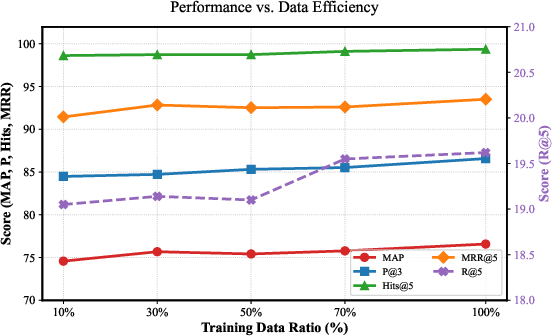
Figure 3: Performance trends on LeCaRDv2 across varying training data ratios (10%∼100%), showing rapid convergence and strong data efficiency.
Feature Importance and Ablation
Model interpretability is evaluated through SHAP analysis. Charge matching is identified as the most decisive signal, acting as a binary gatekeeper for legal relevance. Fine-grained differentiation among candidates within the same charge category is primarily driven by normalized BM25, emphasizing the complementary nature of generative and lexical features. Ablation studies reveal that removing the MLP fusion or legal indicator generation leads to material MAP reductions (e.g., -15.2% for rule-based ranking), and Score drops dramatically when excluding lexical or legal features.
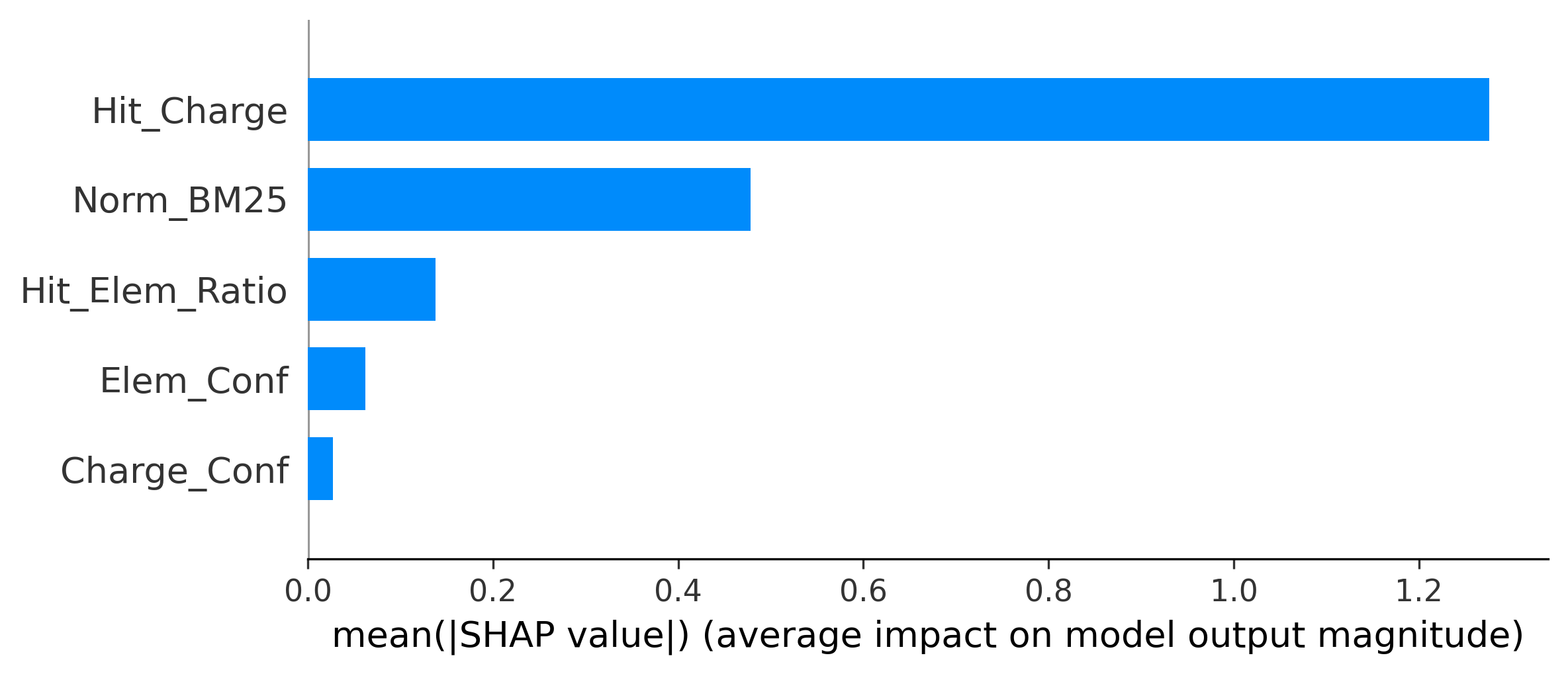
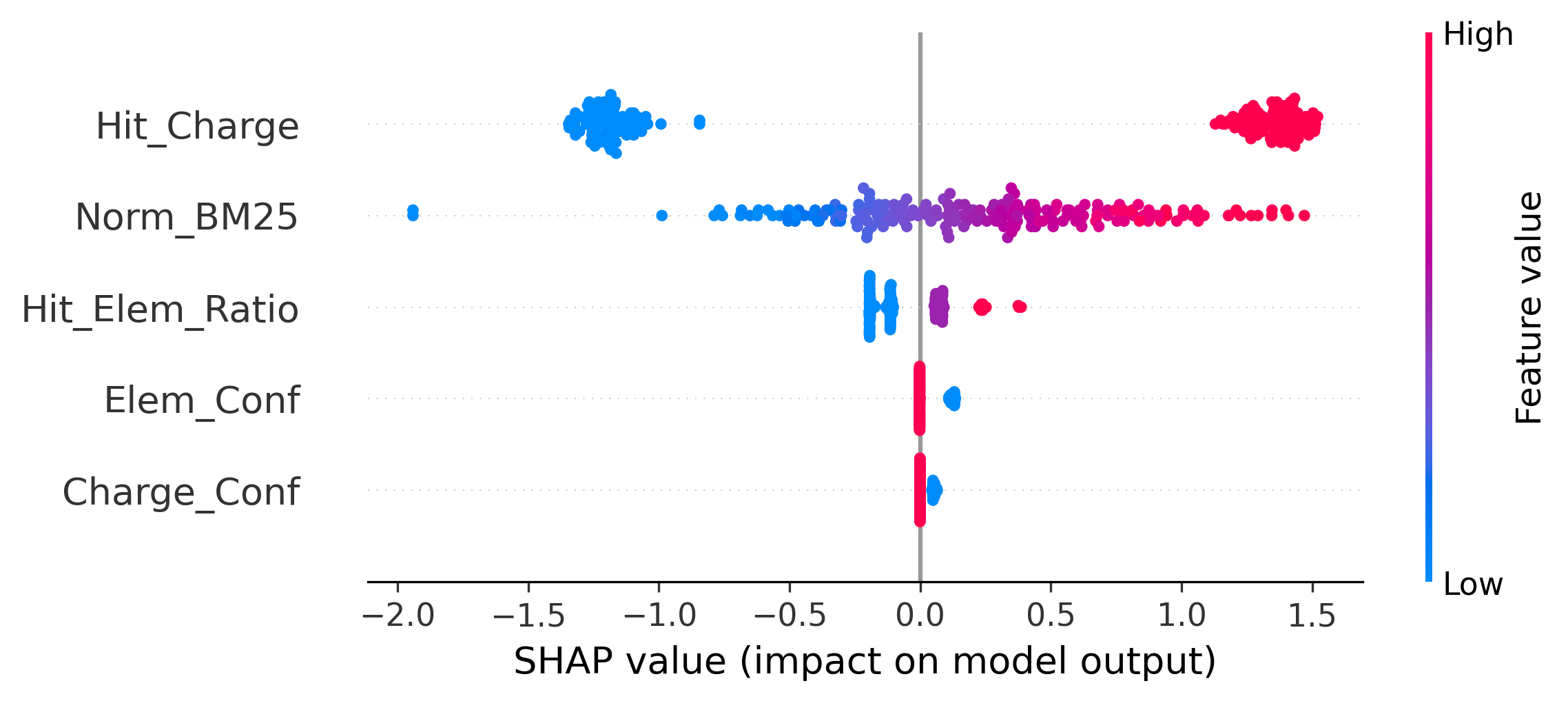
Figure 4: Global Feature Importance (Mean |SHAP|) highlighting the dominance of charge matching over other features in the scoring network.
Hierarchical Modeling and Robustness
Comparing hierarchical joint generation to independent charge/element prediction, hierarchical modeling yields consistent improvements (+1.87% MAP), attributable to enhanced chain-of-logic supervision and minimized hallucinations. The model's robustness under low-resource regimes is explained by high intra-class homogeneity across legal cases—the legal phraseology and logic repeat per charge, facilitating rapid generalization with limited examples.
Neural Backbone Generalization
Tests with mT5 and Qwen2.5-7B backbones confirm that GLIER's design, rather than backbone scale/context, is the primary driver of retrieval gains. Model scaling yields marginal improvements only, supporting the centrality of structured inference.
Practical and Theoretical Implications
Practically, GLIER sets a new standard for LCR systems, ensuring both legal interpretability and retrieval safety, critical for use in real-world legal settings where transparent justification for recommendations is required. The explicability provided by explicit charge/element inference also positions the framework as suitable for deployment in high-stakes, regulated domains.
Theoretically, this work demonstrates the advantages of hybrid generative-discriminative architectures in retrieval, where interpretability and robust filtering via structured latent variables complement the fine discriminative power of PLM representations. The generative modeling of legal structure opens avenues for extending LCR methods to more intricate legal systems (e.g., common law) and suggests applicability to any retrieval scenario where relevance is underpinned by latent reasoning processes.
Conclusion
GLIER exemplifies an interpretable, data-efficient approach to legal case retrieval, synthesizing generative latent inference and multi-view evidence fusion within a single, logically coherent framework. Its empirical results highlight strong performance, robust recall, and practical data efficiency versus leading baselines. Future work can extend the paradigm beyond codified legal systems and further scale cross-lingual or cross-jurisdiction retrieval research.