- The paper derives an explicit formula for the limiting joint density of eigenvector weights, capturing the transition from localized to ergodic regimes.
- It employs a Kac-Rice integral representation to analytically solve eigenvector statistics in a 2N×2N non-Hermitian block matrix with tunable coupling.
- Results reveal a critical coupling threshold where eigenstate ergodicity emerges, offering new insights into quantum chaos and non-Hermitian random matrix theory.
Gradual Eigenvector Ergodization in Coupled Ginibre Matrices
Overview and Motivation
The study presents a comprehensive and rigorous analysis of the ergodization process for eigenvectors in a model comprising two coupled N×N complex Ginibre ensembles, with particular focus on the statistical behavior of right eigenvector weights across a tunable coupling regime. The model is realized via a 2N×2N non-Hermitian block matrix with coupling parameter c∈C, interpolating between two decoupled Ginibre systems and the fully coupled regime. The research addresses, in the large N limit, the statistical transition from localized eigenvectors (inhabiting distinct subsystems) to fully ergodic eigenvectors uniformly spanning both subspaces as the coupling increases.
The work is situated within the context of quantum chaos and non-Hermitian random matrix theory (RMT), directly relevant to dissipative quantum systems where gain/loss mechanisms break Hermiticity. The results are also significant for understanding fundamental questions of the Eigenstate Thermalization Hypothesis (ETH) in non-Hermitian settings, and the universality of ergodic features under random matrix modeling.
Model Description
The core object is the 2N×2N matrix ensemble
X=(G1c1N c1NG2),c∈C
where G1, G2 are independent Ginibre matrices and 1N is the N×N identity. For 2N×2N0, the spectrum and eigenvectors are trivially those of the uncoupled subsystems, whereas finite 2N×2N1 mixes the subsystems via direct coupling.
The key eigenvector statistic is the pair of squared weights (norms) 2N×2N2, 2N×2N3 for a normalized eigenvector 2N×2N4. The central object of interest is the joint probability density (JPD) 2N×2N5 at a spectral point 2N×2N6, capturing the distribution of the eigenvector weights for eigenvalues near 2N×2N7.
Main Results
A major analytic achievement of the paper is the derivation of an explicit formula for the limiting (as 2N×2N8) JPD at 2N×2N9:
c∈C0
where c∈C1 is the modified Bessel function of the first kind. This provides a full description of the ergodization of the eigenvector weights as a function of the coupling strength c∈C2, interpolating smoothly from fully localized to fully ergodic regimes.
Additionally, the marginal distribution for one component c∈C3 is
c∈C4
which captures the progression and crossover of ergodic properties.
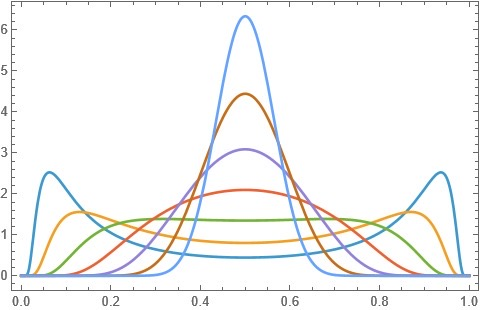
Figure 1: The density c∈C5 for several values of c∈C6, showing the evolution from a double-peak structure (localized) toward a single, symmetric, ergodic peak as the coupling increases.
The asymptotic mean eigenvalue density at the spectral origin is calculated to be c∈C7 in the transition regime (fixed c∈C8), and undergoes a structural transition for extensive coupling c∈C9. In this latter case, the density vanishes at N0, indicating the division of the density support into disjoint domains.
Analysis of the Ergodization Transition
The limiting distributions reveal several salient features of eigenvector statistics under increasing coupling:
- Zero Coupling N1: The JPD reduces to two delta functions at N2, N3 and N4, N5, reflecting complete localization in subsystem 1 or 2 respectively.
- Strong Coupling N6: The distribution concentrates as a sharp Gaussian around N7, denoting full ergodicity and uniform weight across both subsystems.
- Intermediate Regime: The density N8 presents either two maxima away from N9 (weak coupling), signaling persistence of subsystem identity, or a single central maximum (stronger coupling), reflecting the loss of identity and the onset of full ergodicity. A critical coupling 2N×2N0 marks the crossover where the double peak merges into a single peak.
- Spectral Density Transition: For extensive scaling 2N×2N1, there is an abrupt transition at 2N×2N2, linked to the splitting of the complex spectral support into two disconnected domains—a phenomenon with analogs in related non-Hermitian matrix problems.
These analytic findings quantitatively describe the crossover from subsystem-localized to globally ergodic eigenstates, and precisely characterize the loss-of-identity threshold in terms of the coupling 2N×2N3, providing interpretable criteria for ergodicity in non-Hermitian coupled systems.
Methodological Advances
The derivation employs a recent approach by Fyodorov, based on a Kac-Rice-type integral representation for the joint density of eigenvalues and eigenvectors, which offers advantages over standard Girko or Efetov supersymmetry approaches. This framework enables tractable computation of finite-2N×2N4 quantities and facilitates asymptotic analysis, producing explicit and manageable expressions for the relevant densities.
A key technical achievement is the demonstration that the eigenvector ergodization described is universal in the large 2N×2N5 limit and robust under generalizations, such as more generic non-Hermitian ensembles and different forms of the coupling.
Theoretical and Practical Implications
From a theoretical perspective, the results contribute to a deeper understanding of ETH, quantum chaos, and the universality of eigenstate statistics in open quantum systems. The model provides a quantitative and exactly solvable paradigm for tracking the ergodization of eigenvectors, directly relevant for quantum chaotic systems with loss/gain described by non-Hermitian RMT.
Practically, the insights inform expectations for the spread and structure of eigenstates in models of coupled dissipative systems, including potential applications in non-Hermitian extensions of the Sachdev-Ye-Kitaev model, many-body localization, and random band matrices. The identification of a clear ergodic transition controlled by a tunable parameter opens paths for further numerical and analytical studies, including the analysis of eigenvalue correlations and the fate of ergodicity in spatially structured random systems.
Connections and Outlook
The work connects directly with several themes in contemporary mathematical physics:
- Quantum Thermalization and ETH: The results extend the scope of ETH and quantum unique ergodicity notions to the non-Hermitian domain.
- Random Matrix Theory: The analytic tractability exemplifies the power of RMT tools for extracting explicit spectral and eigenfunction statistics, potentially extensible to non-Gaussian matrices.
- Supersymmetric and Kac-Rice Techniques: The adoption of the Kac-Rice-inspired approach signals new directions for non-Hermitian eigenvector theory, with generalizations conceivable for more complex or physically structured models.
Future directions include exploration of eigenvalue-eigenvector correlations in the crossover regime, application of the method to multi-block or banded random matrices (with relevance to Anderson (de)localization), and extension to settings with explicit spatial or network structure.
Conclusion
The paper provides a rigorous and highly explicit quantitative framework for understanding the ergodization of eigenvectors in coupled non-Hermitian random matrix ensembles. It identifies, for the first time, analytic forms for the gradual transition from localization to ergodicity as a function of system coupling, establishes the conditions for subsystem identity loss, and characterizes accompanying changes in the eigenvalue spectral density. These results form a critical addition to the theory of non-Hermitian quantum systems, opening new avenues for analysis and computation in both mathematical physics and quantum statistical mechanics.

