- The paper demonstrates a precise vertical mapping of Mg II gas, revealing exponential scale heights and pronounced north–south asymmetry.
- It employs high SNR far-UV spectroscopy combined with Bayesian inference to mitigate saturation and accurately quantify covering fractions.
- The results clarify ISM phase transitions and depletion patterns, offering crucial benchmarks for models of chemical evolution and feedback.
The Vertical Structure and Asymmetry of Mg II-enriched Gas in the Milky Way Disk
Introduction and Methodology
This study provides a comprehensive assessment of the vertical distribution, abundance, and asymmetry of Mg II-enriched gas in the Milky Way, leveraging high SNR far-UV spectroscopy from 482 extragalactic sightlines observed with HST/COS, along with a curated set of Galactic stellar sightlines. The analysis focuses on the unsaturated λλ1239,1240 Mg II doublet, circumventing the saturation issues associated with the NUV λλ2796,2803 lines prevalent in extragalactic studies. Voigt profile and curve-of-growth methodologies are applied, with a conservative adoption of b=10 km s−1 and systematic uncertainty propagation.
A robust statistical treatment—specifically, a Bayesian approach accounting for both measurement error and intrinsic ISM scatter—enables precise modeling of the vertical column profile and covering fraction, while explicit treatment of upper limits guards against detection bias. Integration with H I Lyα column measurements and molecular hydrogen data allows for the explicit investigation of depletion patterns and environmental dependencies.
Mg II Distribution and Covering Fraction
The survey identifies 43 low-velocity Mg II absorbers (∣vLSR∣<40 km s−1), yielding a covering fraction of 32±5% for logNMgII>15. The observed distribution of Cf as a function of column density and equivalent width is best described by an exponential decay, sharply departing from the canonical power-law behavior that characterizes diffuse circumgalactic gas:
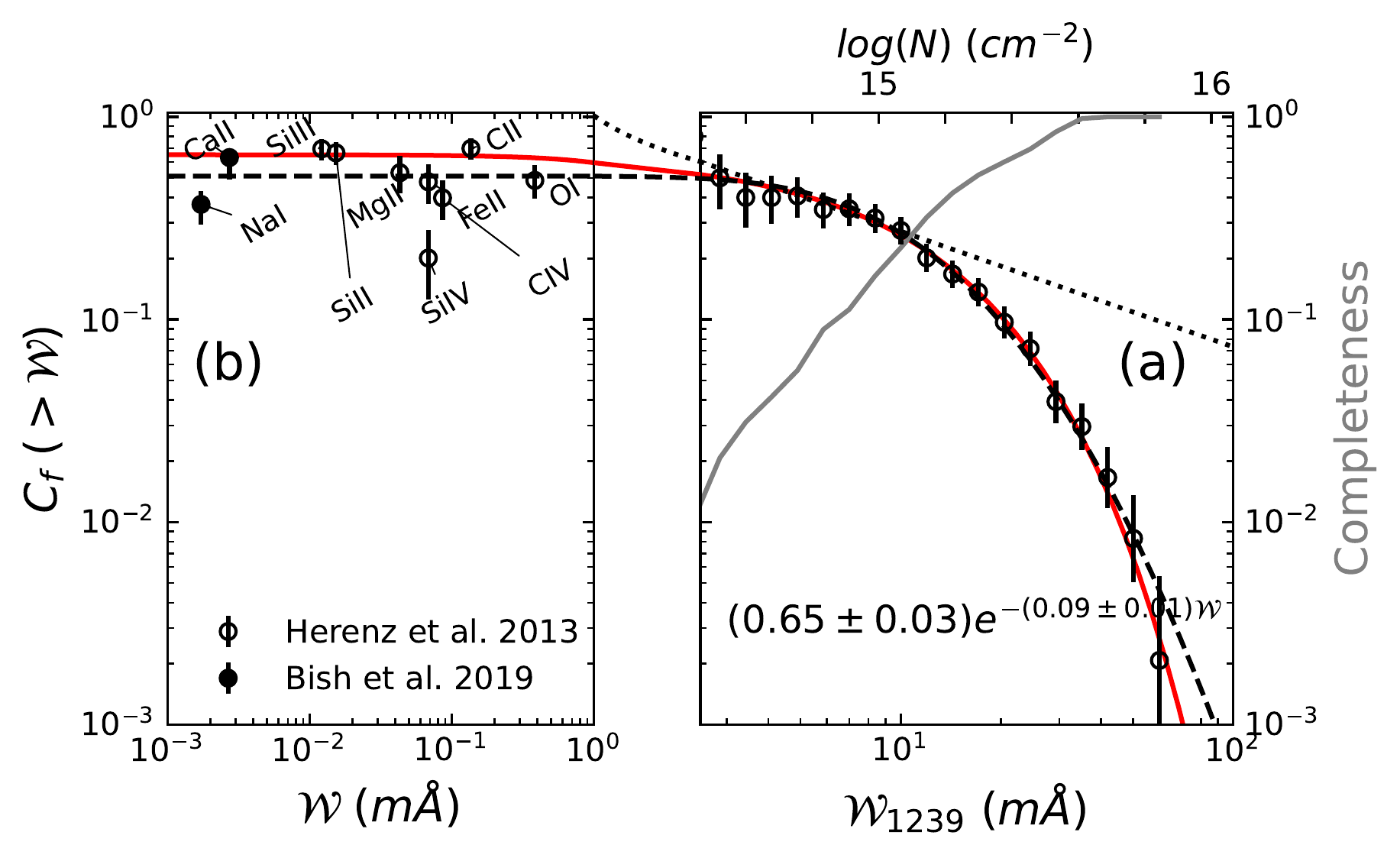
Figure 2: Covering fraction Cf vs. equivalent width threshold, showing best-fit exponential, log-normal, and power-law models; the exponential provides the superior fit and reflects transition to denser ISM phases.
This functional form signals a transition from diffuse, turbulent ISM/halo gas (power-law regime) to structurally confined, dense ISM structures—particularly CNM cores—at high column densities. The high-column-density cutoff and exponential nature is further supported by Bayesian model comparison (minimum AIC), and the physical interpretation is corroborated by environmental correlation analyses.
Vertical Scale Height and Asymmetry
The combination of extragalactic and stellar sightlines under a self-consistent Bayesian model yields:
- Exponential scale height hMgII=0.12±0.02 kpc
- Mid-plane density λλ2796,28030
- Perpendicular column λλ2796,28031
The vertical Mg II distribution is markedly thinner than that of the warm neutral hydrogen, placing it in strong alignment with the dust layer and supporting a scenario where Mg II traces the envelopes of CNM structures subject to strong depletion effects.
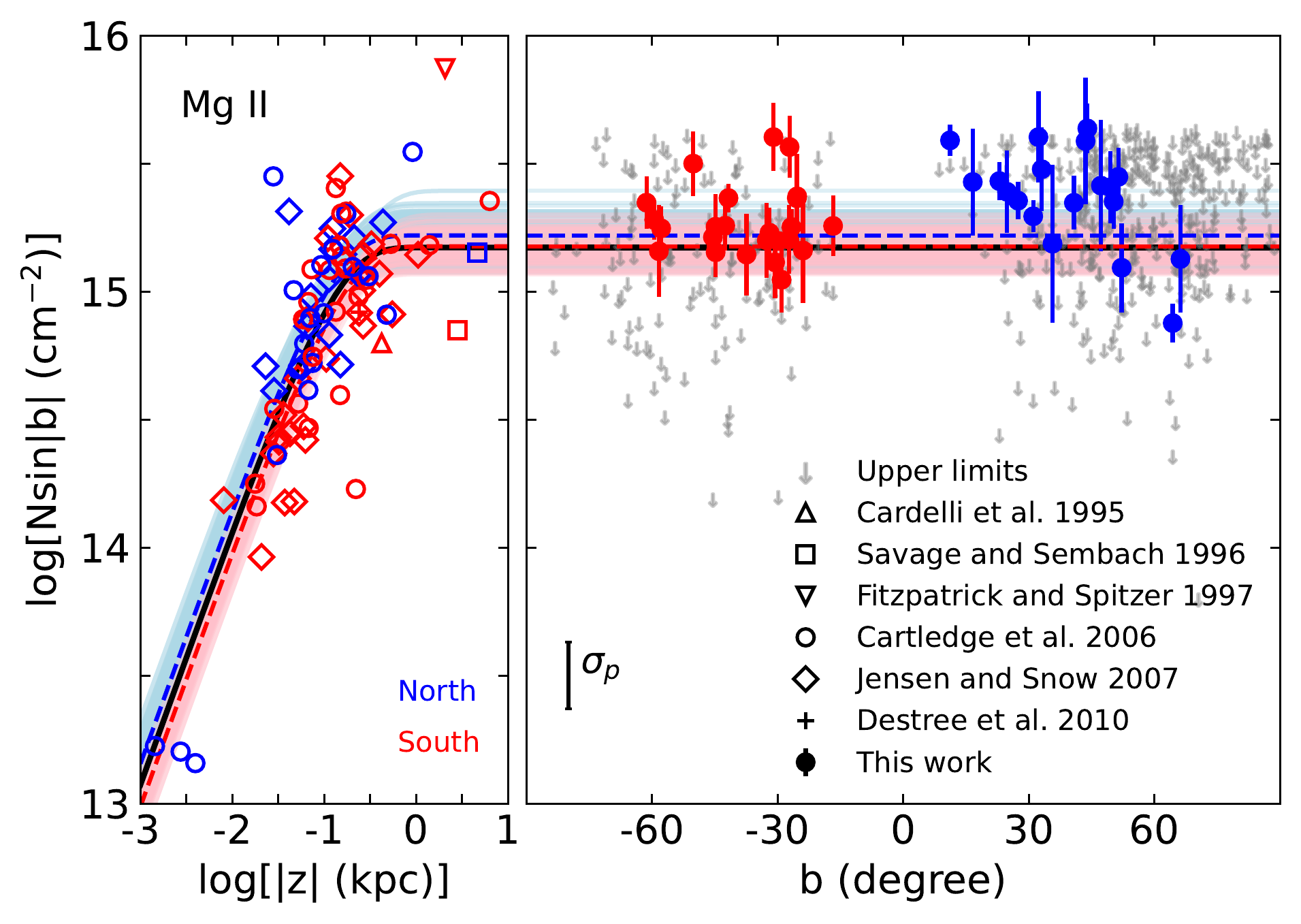
Figure 4: Projected vertical column densities for stellar and extragalactic sightlines, with Bayesian best-fit models for symmetric and asymmetric hemispheres.
Crucially, a pronounced north-south asymmetry is detected: while the southern hemisphere exhibits a higher covering fraction (λλ2796,28032) and broader filling factor, the northern hemisphere hosts a significantly higher mid-plane density (λλ2796,28033 vs. λλ2796,28034). The vertical scale height remains statistically consistent across hemispheres, ruling out geometric artifacts such as the Sun’s displacement from the midplane as a dominant factor. This indicates intrinsic differences in ISM clumpiness and concentration, with the north being denser yet patchier.
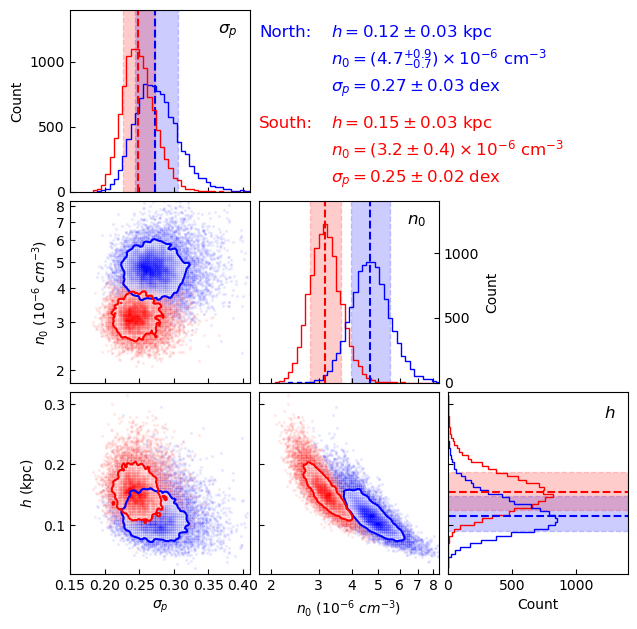
Figure 6: Marginalized Bayesian posterior distributions for disk model parameters in each hemisphere, highlighting separation in mid-plane density λλ2796,28035.
Mg Depletion and ISM Phase Structure
Arrayed against the vertical hydrogen column, extinction, and molecular fraction, Mg depletion shows strong, systematic anti-correlation, reflecting the coupling between local density, dust condensation, and Mg gas-phase abundance:
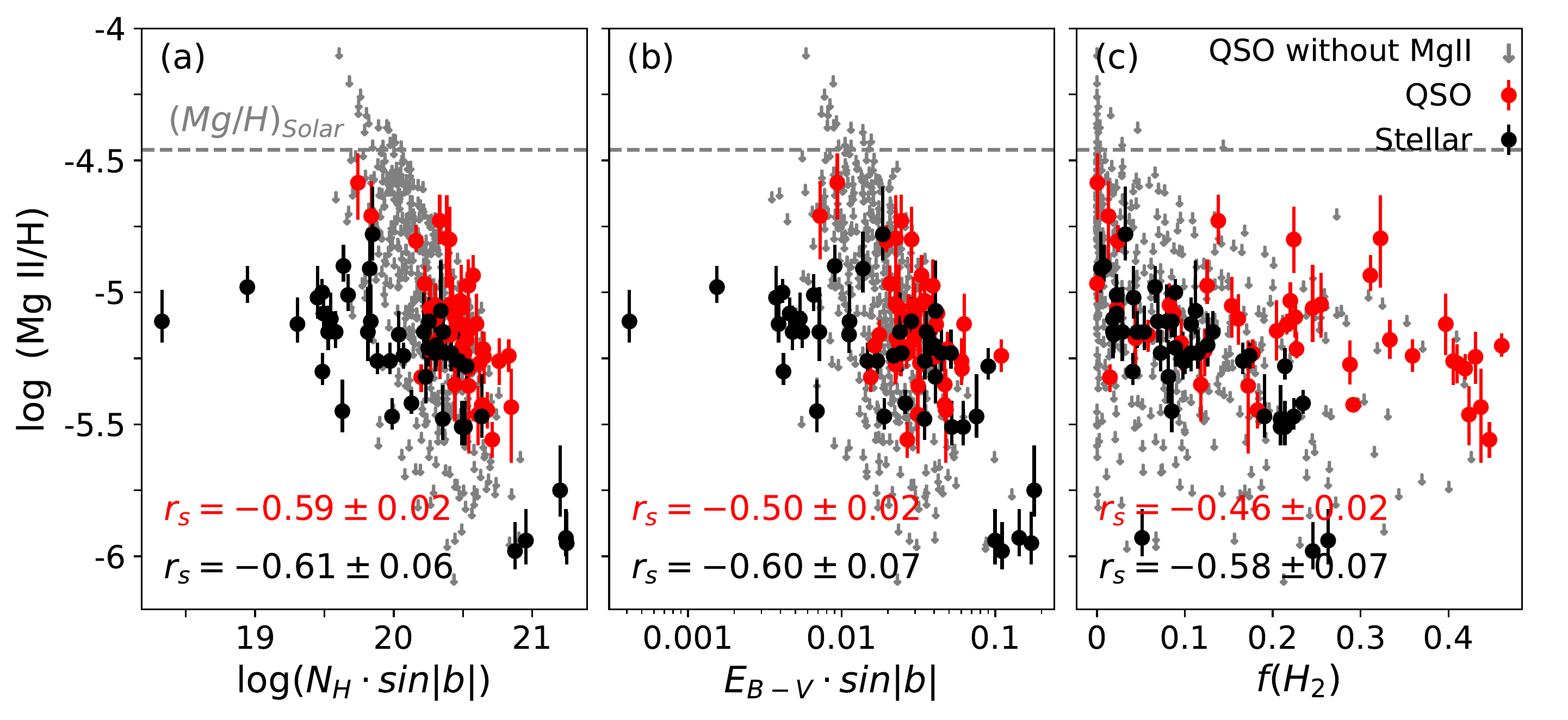
Figure 8: Gas-phase Mg depletion versus vertical H density, extinction, and λλ2796,28036, with extragalactic sightlines (detections and upper limits) and stellar sightlines.
At high λλ2796,28037, QSO and stellar sightlines converge, underscoring phase-insensitive depletion in massive CNM clouds. Below this threshold, divergence emerges: stellar sightlines, truncated within the dense midplane, maintain low depletion, while most QSO sightlines sample diffuse, volume-filling WNM—integrating over much larger path lengths and structures and thus displaying elevated gas-phase Mg. The data establish a robust lower limit for vertical H column (λλ2796,28038) in extragalactic sightlines, arguing for the ubiquity of a low-density WNM baseline across the Galactic disk.
Vertical Structure in Multi-phase Context
The derived Mg II scale height is the thinnest among the surveyed low ions, in close correspondence with the dust disk. This effectively distinguishes Mg II as a tracer of the CNM and its immediate environment, bridging the distributional gap between the most confined CNM cores (λλ2796,28039) and the extended WNM/H I disk (b=10 km s−10):
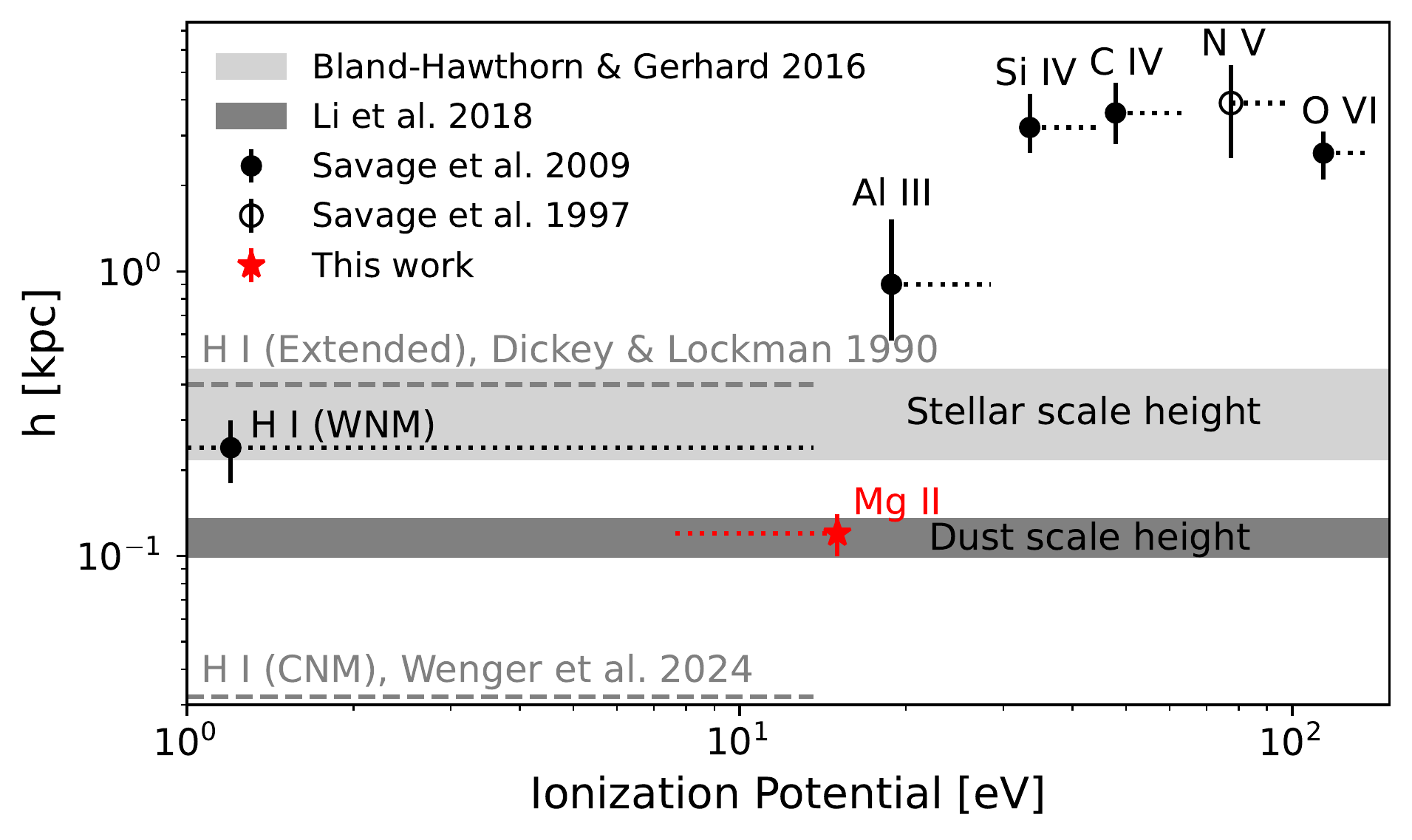
Figure 1: Exponential scale heights of various ions vs. their ionization potentials compared to dust, CNM, WNM, and stellar vertical distributions.
The robust boundary imposed by QSO non-detections at higher latitudes quantifies the true upper limit to the vertical extent of detectable, slightly less depleted Mg II-bearing gas. Observational selection and geometric path constraints ensure that only lines-of-sight passing proximal to the midplane register strong absorption, with the majority of the Galactic sky at high b=10 km s−11 being dominated by undetectable, diffuse gas.
Transverse external-galaxy sightlines probe more diffuse, extended halo gas, whereas Milky Way pencil-beam vistas are highly sensitive to the midplane and thus denser ISM. Correcting for geometric effects, the inside-out covering fraction for b=10 km s−12 extracted here (b=10 km s−13) maps onto a transverse value consistent with extrapolations from external galaxy studies at small impact parameters. This supports the claim that the strong absorber population in galactic inner halos typically achieves b=10 km s−14, in line with DLA and strong Mg II system properties.
Implications and Future Directions
The tight vertical confinement and distinctive north-south asymmetry in Mg II suggest heterogeneous mixing and feedback processes at play within the Milky Way's ISM, affecting dust and metal distribution at parsec to kiloparsec scales. The strong structuring and clumpiness of the dense phase are critical for models of chemical enrichment, gas dynamics, and star formation feedback.
The demonstrated efficacy of weak FUV transitions for quantifying high-column density gas, in conjunction with Bayesian inference fully accounting for non-detections, sets a methodological precedent for similar ISM stratification and depletion studies of other ions. Precise mapping of phase boundaries in the ISM and the interplay with depletion provides crucial constraints for chemical evolution and feedback models.
Potential future directions include denser sky sampling at high latitudes, time-domain studies of ISM patchiness variability, integration with radio and infrared tracers, and analogous analyses in the Magellanic Clouds and other Local Group galaxies. Extending the sensitivity of FUV spectroscopy and exploiting higher resolution facilities will further elucidate the interface between CNM, WNM, and circumgalactic structures, and clarify the processes responsible for Galactic asymmetries and their relation to star formation, feedback, and Galactic dynamics.
Conclusion
This work achieves a precise, systematically robust mapping of Mg II-bearing gas in the Milky Way disk, revealing its vertical confinement, environmental depletion dependencies, and significant north-south structural asymmetry. The results provide quantitative benchmarks for ISM phase structure, metallicity distributions, and inform both Galactic and extragalactic models of metal-enriched gas. The methodologies and insights developed here are broadly applicable for reconstructing chemical and dynamical architectures in the complex baryonic environments of galaxies.