- The paper introduces neuroGravity, a hybrid physics-informed graph neural network that accurately reconstructs urban mobility networks from as little as 1% observed flows.
- It leverages a novel meta-Gravity module with adaptive gravitational parameters and an edge-enhanced Graph Transformer to refine flow predictions.
- The framework also infers socioeconomic indicators from learned embeddings, providing scalable proxies for urban planning and public health.
Transferable Human Mobility Network Reconstruction with neuroGravity
Motivation and Context
Quantitative modeling of urban mobility flows is foundational for urban planning, infrastructure deployment, epidemiology, and environmental analysis. Conventional approaches such as travel surveys and manual census efforts suffer from severe limitations in terms of cost, coverage, and refresh rate, especially in underdeveloped regions. Efforts to reconstruct city-level mobility networks without direct observations are constrained by the inadequacies of physical models (e.g., gravity, radiation) in capturing complex urban dynamics and the poor transfer/generalization properties of deep learning-based data-driven solutions when applied to domains lacking source flow data.
The paper introduces neuroGravity, a hybrid physics-informed graph deep learning framework, that fuses the interpretability and generalization of the classical gravity model with the expressive capacity of graph neural networks (GNNs), incorporating high-dimensional built environment and population features. neuroGravity is designed to robustly reconstruct urban mobility networks from minimal partial observations and, crucially, to generalize these reconstructions (in a zero-shot fashion) to completely unobserved cities and regions by leveraging transfer learning. The model’s architecture, training strategy, and embedding space are explicitly structured to capture both mobility mechanisms and latent socioeconomic factors, allowing not only flow prediction but also inference of regional socioeconomic status.
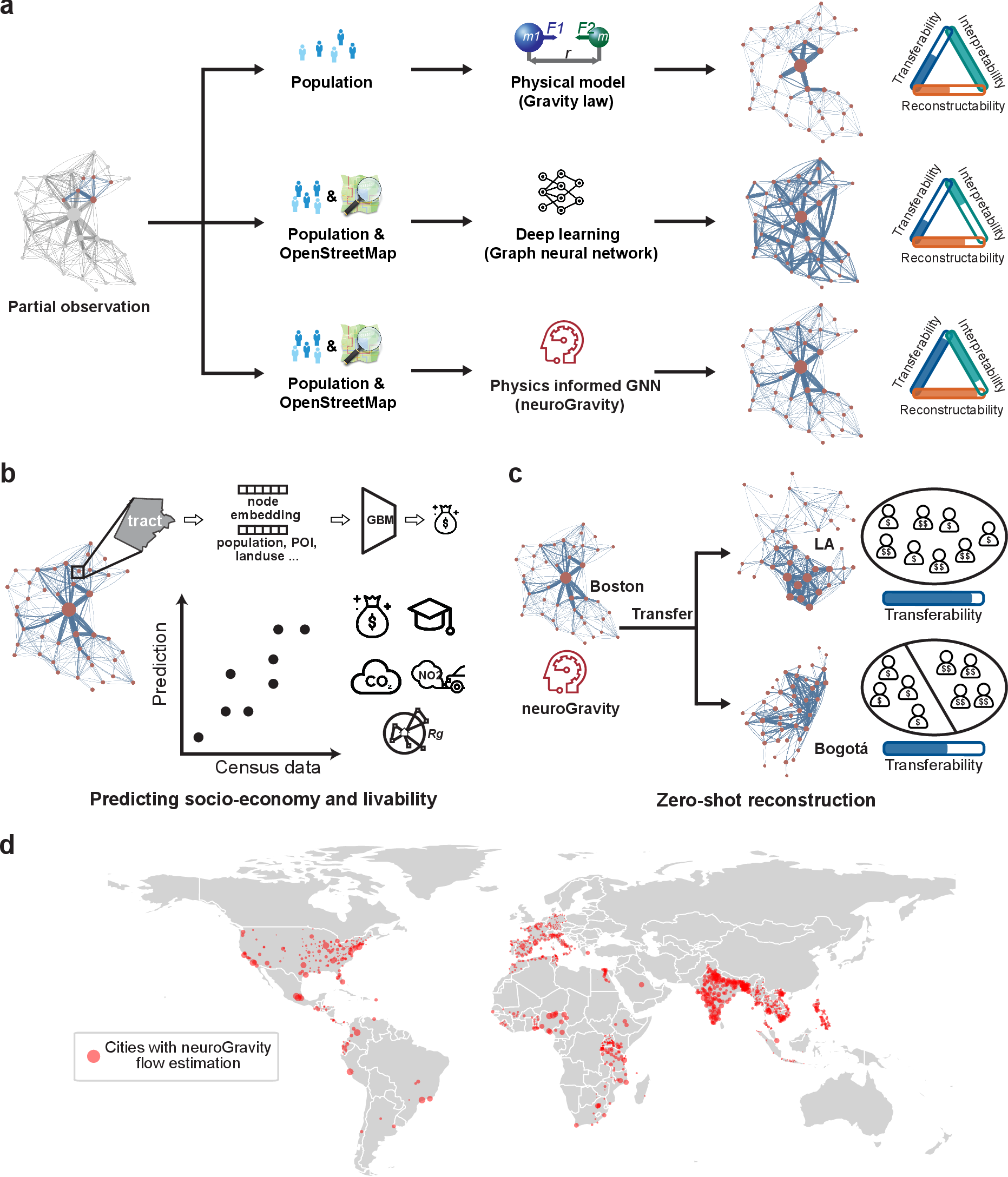
Figure 1: neuroGravity overview: physical model versus GNN versus physics-informed GNN, socioeconomic proxy inference, zero-shot reconstruction, and global application coverage.
neuroGravity operates in several interlinked stages:
- Feature Extraction: The model begins by generating region-level high-dimensional features (h0), including OSM-derived attributes (building, POI, road, land use statistics) and population assignments (from census or WorldPop). These features serve as the input for both structure prediction and flow inference.
- Connection Predictor: Drawing on the inherent sparsity of mobility networks, a LightGBM binary classifier leverages these features and inter-regional distances to infer likely origin-destination (OD) links, pruning the full pairwise network to a plausible set of connections for further processing.
- Meta-Gravity Module: Each OD pair is processed through a deep-parameterized gravity law. Instead of static parameters, multi-layer perceptrons estimate a variable gravitational constant and distance decay exponent based on concatenated region features, generating an adaptive, physically-constrained base flow estimate for each edge.
- Edge-Enhanced Graph Transformer: Combining meta-Gravity outputs, spatial distances, and other initial edge features, an edge-enhanced multi-layer Graph Transformer (Graph-BERT variant) propagates and refines embeddings. Message passing is regulated with attention mechanisms sensitive to both node and edge attributes, further encoding local and nonlocal spatial dependencies.
- Log-Flow Predictor: Flow inference is cast in logarithmic space — linearizing multiplicative interactions and addressing the heavy-tailed distribution typical of urban flows. A final MLP, incorporating populations, learned node and edge embeddings, and distance decay terms, predicts log-flows. All model components are trained jointly via a Huber loss.
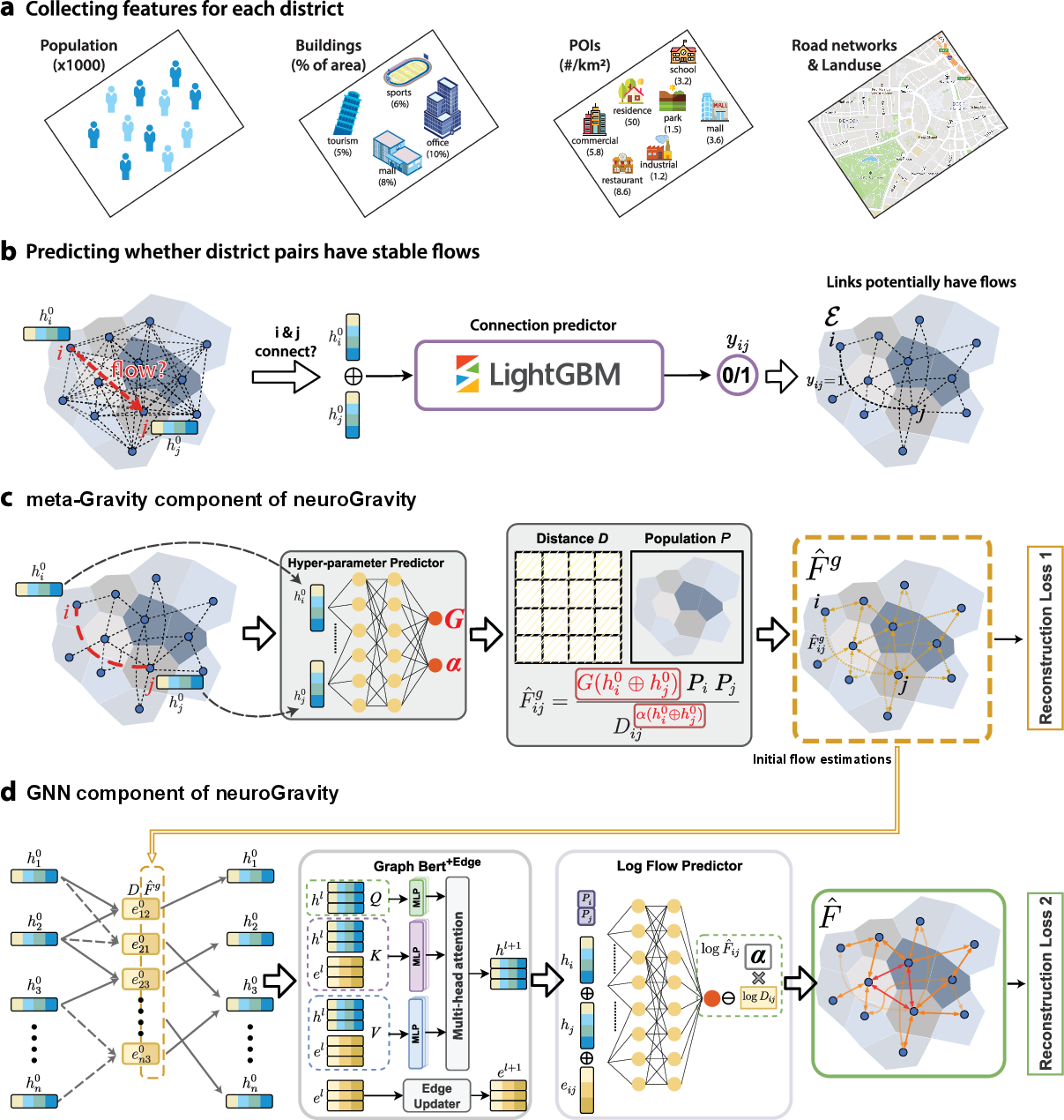
Figure 2: neuroGravity pipeline from feature preparation to connection prediction, meta-Gravity estimation, GNN refinement, and final log-space flow prediction.
The system thus enables end-to-end differentiable learning with robust inductive bias towards physical law, enabling generalization under data-scarce conditions while adaptively capturing context-specific interactions.
Flow Reconstruction: Partial and Zero-Shot Scenarios
Few-Observation Regime
In scenarios where only sparse partial observations are available (as little as 1% of internal flows in Boston; 10% region sample covering <1.2% of possible OD links in test cities), neuroGravity stably reconstructs full mobility matrices. Across six cities (Boston, LA, SF Bay, Porto, Bogotà, Riyadh), neuroGravity consistently outperformed classic gravity, standalone GNNs, and improved deep baselines (DG++), with gains most pronounced under challenging observation conditions and in cities with highly heterogeneous urban structures.
Strong numerical improvements are evidenced: for Boston, with a 10% observation ratio, neuroGravity achieves R2=0.77 and CPC = 0.73, significantly outperforming the gravity model (R2=0.59, CPC = 0.63). It also demonstrates superior stability and less performance decline as the observation ratio varies, compared to the gravity baseline, which shows diminishing R2 as observation ratio increases (a symptom of poor link-level specificity).
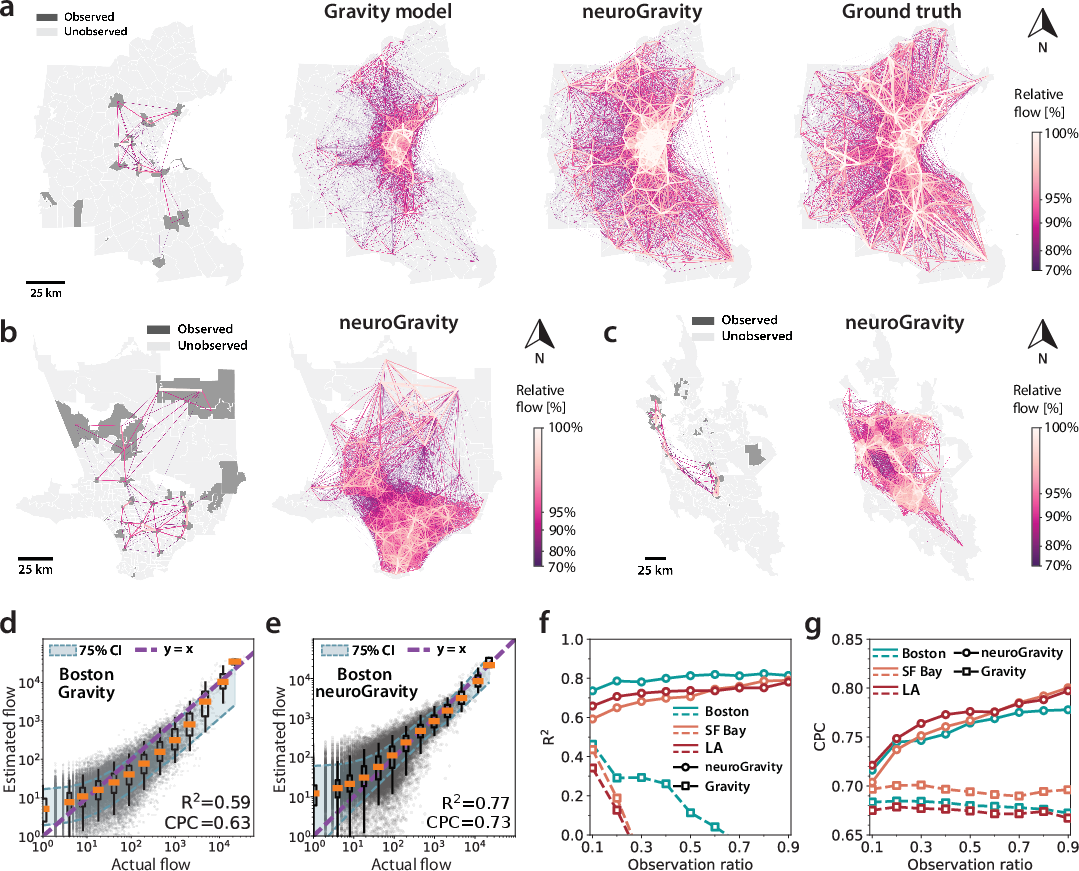
Figure 3: Visual and quantitative flow reconstruction assessment in Boston, LA, and SF Bay; accurate recovery of main arteries and improved correlation with ground truth, especially at high-volume links.
Cross-City Transfer and Zero-Shot Reconstruction
A critical advancement is neuroGravity's strong transferability: a model trained only in Boston can reconstruct flows in unseen, unobserved cities (e.g., LA, SF Bay, Bogotà, Rio de Janeiro) with high accuracy. For LA and SF Bay, transfer R2 values (0.69, 0.61) approach those obtained when modest fractions of local observations are available. Crucially, neuroGravity nearly doubles the R2 of the best baseline in transfer, and its structure is robust across modalities (CDR, LBS, census).
However, the transfer efficacy depends on the similarity of spatial income segregation between source and target cities.
Socioeconomic and Livability Inference via Model Embeddings
The learned regional embeddings in neuroGravity not only structure flows but also encode rich socioeconomic signals absent from input data. These can be exploited with downstream regressors (GBM) to infer household income, educational attainment (college degree rate), carbon footprint, NO2 exposure, and the radius of gyration.
In Boston, GBM models combining neuroGravity embeddings and OSM features reach high explained variance for traffic/environmental metrics (carbon R2=0.73, NO2 R2=0.78, R2=0.770 R2=0.771), and moderate success for income (R2=0.772) and college degree rate (R2=0.773). These embeddings meaningfully cluster regions by economic status irrespective of geographical distance, and SHAP analysis confirms their primacy as predictive signals, particularly in monocentric cities.
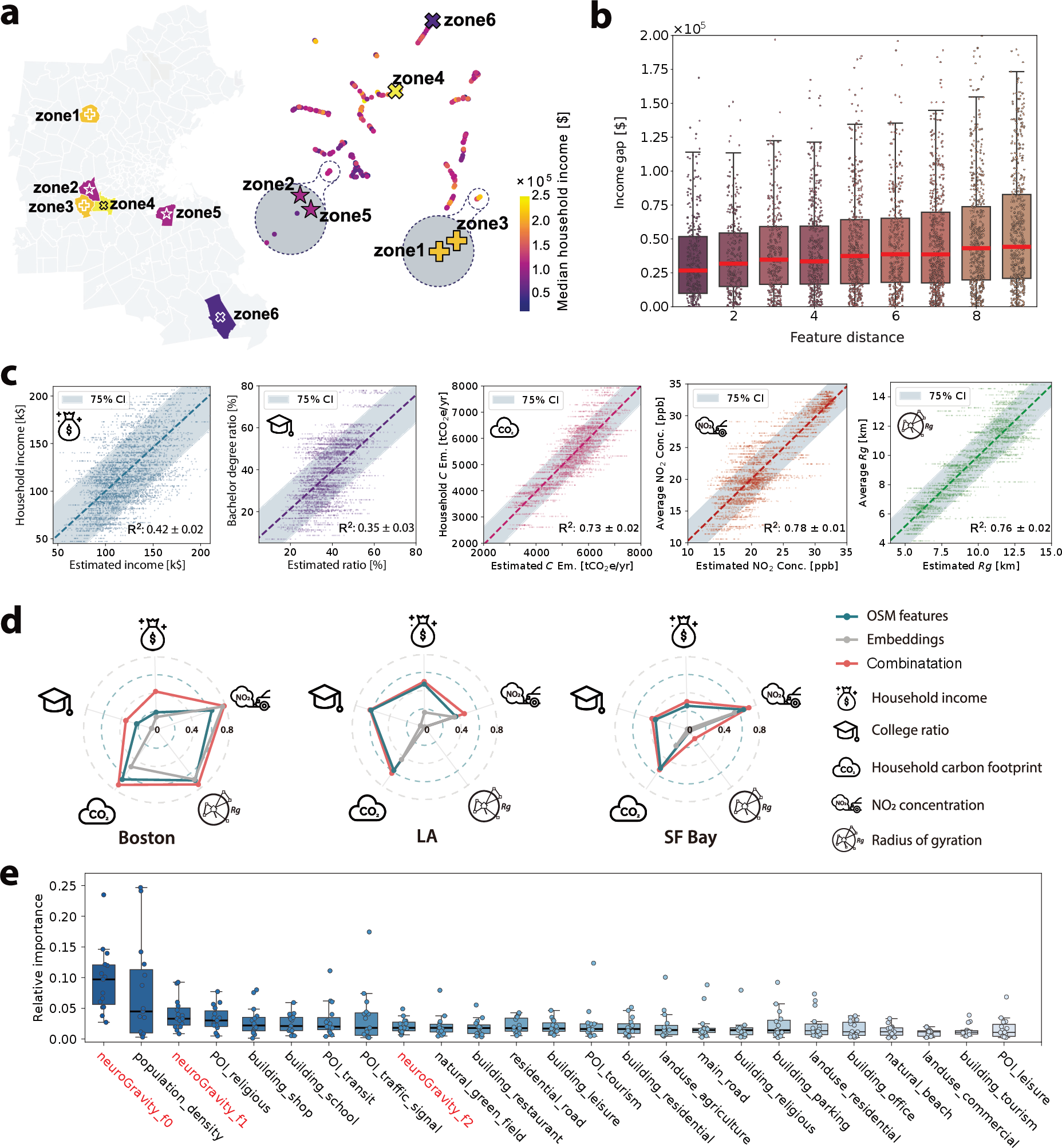
Figure 4: Embedding UMAP projections, income/inference scatterplots, cross-city comparison, and SHAP-based feature importance demonstrating the socioeconomic content of neuroGravity’s learned representations.
Spatial Income Segregation and Transferability
The authors introduce a novel spatial income segregation index (R2=0.774), built on Bregman information decomposition, capturing the extent of clustering and disparity in regional income. They empirically demonstrate that neuroGravity’s transfer performance is strongly inversely related to SI difference between source and target cities, and that cities with lower SI are better transfer sources.
A simple linear model using SI, administrative division metrics, and OSM coverage (where SI difference is the primary factor) accurately predicts transfer R2=0.775 (R2=0.776 of fit = 0.97). This quantitative link highlights that, among urban morphological variables, spatial segregation dominates model transferability.
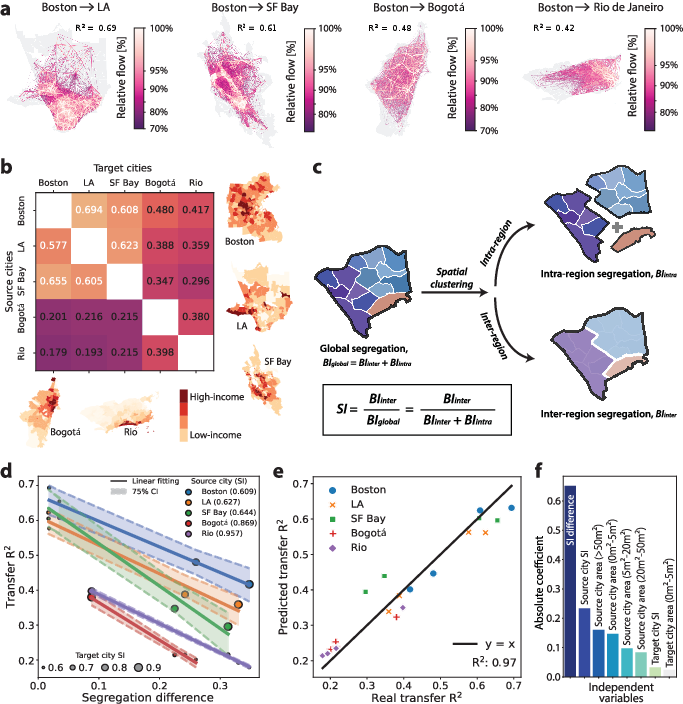
Figure 5: City-wise transfer performance map, SI definition schematic, and regression analyses elucidating the dependence of transfer accuracy on SI disparity.
Implications, Limitations, and Future Directions
neuroGravity closes key methodological gaps in urban mobility analysis, offering a practical route for flow network estimation and socioeconomic mapping in resource-limited domains. Its approach provides:
- Scalable mobility and livability proxies for >1,200 cities with open data alone, mitigating critical data poverty in urban science and public health (e.g., pandemic modeling).
- Theoretically justified transfer diagnostics, informing where physical-data hybrids are expected to generalize and where additional interventions or modalities are required.
- Embeddings as compressed socioeconomic descriptors enabling fine-grained analysis without access to censored or privacy-sensitive data.
However, the model inherits limitations:
- Dependence on the completeness and quality of open-source built environment datasets (notably OSM), with resilience tested up to 30% missing rates but not for extreme deficit cases (particularly in segments of the Global South).
- Variability in embedding informativeness with respect to city type: in polycentric urban layouts (e.g., LA, SF Bay), socioeconomic inference from embeddings is less robust than in monocentric cities.
- Simple feature/tested fusion approaches for augmenting with satellite (e.g., AlphaEarth) imagery yield marginal improvement, indicating a need for advanced multimodal learning strategies.
Potential directions include improved OSM data collection, advances in visual-semantic fusion for built environment representation, and utilizing the SI framework for policy analysis of spatial segregation.
Conclusion
neuroGravity represents a substantive contribution to human mobility modeling, introducing a physics-informed, interpretable, and transferable GNN architecture for mobility network reconstruction and regional socioeconomic estimation using only minimal or zero mobility flow data. The explicit quantification of transferability via spatial income segregation adds both diagnostic rigor and practical utility. The framework is poised for direct application in urban science, infrastructure planning, and public health in both data-rich and data-scarce locales.