The Deep Newtonian Regime in Late-Time Blast Waves: Inevitable Transition and Distinct Flux Signatures
Published 26 Apr 2026 in astro-ph.HE | (2604.23567v1)
Abstract: In many astrophysical transients, outflows drive shocks into the ambient medium, accelerating electrons to non-thermal energy distributions that produce broadband synchrotron emission. At late times, even initially collimated relativistic jets evolve into quasi-spherical Newtonian blastwaves. As the shock decelerates, the post-shock internal energy per particle decreases; below a critical velocity β<em>DN≈0.2, only a fraction $ξ_e < 1$ of electrons are accelerated to relativistic energies, defining the deep Newtonian (DN) regime. We develop a unified analytic framework for synchrotron emission in this phase, applicable to both single-velocity and stratified ejecta. For gamma-ray burst afterglows in a uniform medium, the DN transition occurs at t</em>DN≈3.7E51<sup>1/3</sup>n0<sup>−1/3~yr, yielding a shallower decay by δα=6(p−2)/5 relative to standard Newtonian predictions. For kilonova remnants (E0=10<sup>50.5~erg, Mej=0.1M⊙), the DN phase begins prior to deceleration; neglecting it underestimates radio flux by factors of ∼3--$5$ during coasting and even more thereafter. Magnetar-boosted remnants (E∼10<sup>52~erg) should reach ∼\,10\,--\,100\,μJy at 3~GHz at ∼\,40\;Mpc, though limits on GW170817 already disfavor a long-lived millisecond magnetar. In core-collapse supernovae in a wind medium (ρ!∝!r<sup>−k), the peak luminosity remains constant during coasting, while ν<em>pk∝t<sup>−1; for SN~2023ixf, we find k=1.29±0.14. The DN SED typically satisfies $ν_m!<!ν</em>{\rm sa}!<!ν_c$, peaking at sub-GHz frequencies where LOFAR and SKA-low are most sensitive. Even non-detections place robust constraints on ambient density and outflow energetics.
The paper introduces a new analytic framework for the deep Newtonian regime, revealing that only a fraction of electrons are accelerated as shocks decelerate.
It couples advanced shock microphysics with hydrodynamic evolution, predicting slower flux decay and flatter light curves in late-time blast wave emission.
The study highlights practical implications for low-frequency radio observations, offering refined diagnostics for GRBs, SNe, kilonovae, and SNRs.
The paper introduces a new analytic framework for the deep Newtonian regime, revealing that only a fraction of electrons are accelerated as shocks decelerate.
The Deep Newtonian Regime in Late-Time Blast Waves: Transition Physics and Observational Signatures
Motivation and Physical Regime
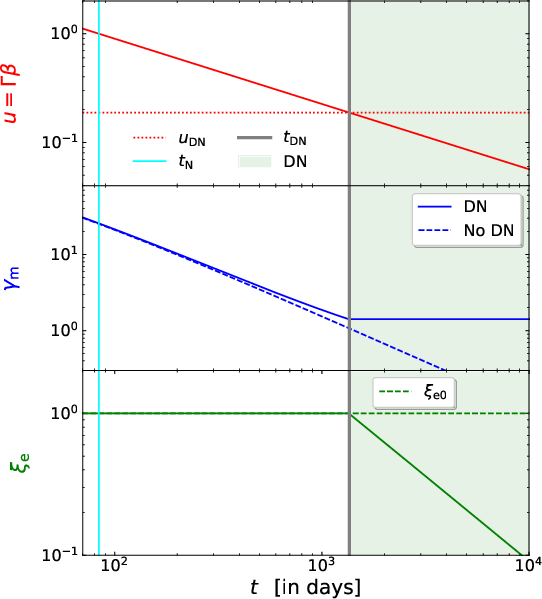
Shocks driven by energetic astrophysical outflows—spanning GRBs, kilonovae, and SNe—ubiquitously decelerate in their late-time evolution, transitioning from relativistic to Newtonian expansion characterized by (quasi-)spherical symmetry. A critical, under-addressed dynamical phase ensues, defined by the outflow velocity dropping below βDN∼0.2, where shock microphysics mandates that only a fraction ξe<1 of electrons are accelerated to relativistic energies. This "deep Newtonian" (DN) regime fundamentally changes the non-thermal electron distribution and, consequently, the broadband synchrotron emission properties.
Previous treatments typically assume "all" electrons are shock-accelerated (ξe=1) and adopt the standard Newtonian scaling, thus mischaracterizing both temporal and spectral evolution at late times. The presented work rectifies this, constructing a general analytic framework for the DN regime applicable to arbitrary ejecta stratification and external medium profiles.
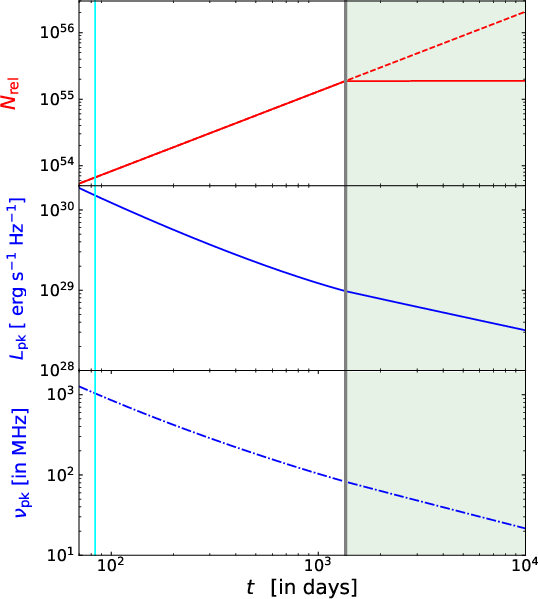
Figure 1: Temporal evolution of hydrodynamics, particle acceleration efficiency (ξe), and key synchrotron spectral properties as a blast wave transitions into the DN regime for a spherical outflow.
Unified Microphysical Treatment
The electron distribution is modeled as a power-law in Lorentz factor, parametrized by p, bounded by minimum γm and maximum γM Lorentz factors. In the relativistic phase, γm is simply set by energy partition; however, as the internal energy per particle decreases below threshold, fewer electrons can be put into the relativistic tail without violating energy conservation. The DN regime thus transitions the parameter of interest from γm (now fixed at γdn∼2) to the dynamic fraction ξe<10, which decreases as ξe<11 once ξe<12. The number of relativistic electrons thus rapidly saturates to a value fixed at the DN transition.
This microphysical evolution couples to the shock dynamics. In the adiabatic regime, the temporal evolution of outflow velocity ξe<13, the swept-up mass, and the electron acceleration efficiency are all governed by the explosion energy, ambient density profile (ξe<14), and the initial ejecta structure.
Synchrotron Spectral Evolution in the DN Regime
The broadband spectral evolution in the DN regime is analytically derived for both pre- and post-deceleration (coasting and adiabatic) phases. Distinctive properties arise:
The slow-cooling regime (ξe<15) dominates, with the spectral peak at the self-absorption frequency, ξe<16.
The characteristic spectral ordering arises because the minimal electron Lorentz factor in the DN regime is proximate to the cyclotron frequency, making ξe<17 close to the self-absorption frequency, and preventing ξe<18.
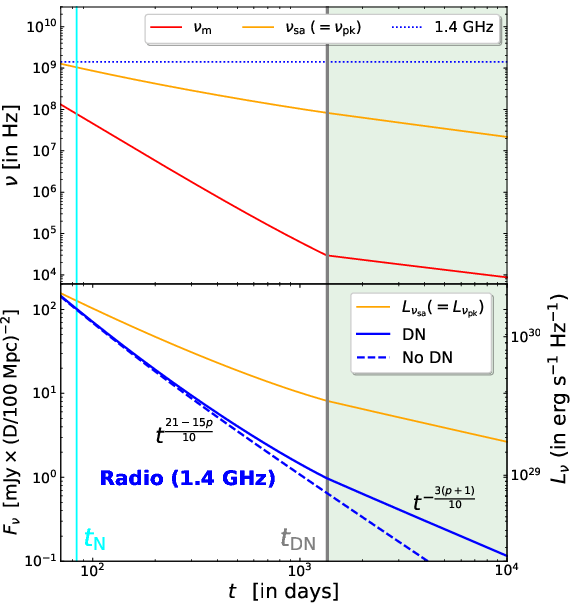
The observable emission at GHz to sub-GHz radio frequencies is dominated by the segment ξe<19 with spectral slope ξe=10.
Temporal slopes of the light curves change characteristically—the flux decay becomes shallower by ξe=11 compared to standard Newtonian estimations.
Figure 2: Example: GRB afterglow evolution, highlighting ξe=12, ξe=13, and flux density at radio frequencies, and the flattening of the light curve in the DN phase.
Application to Astrophysical Transients
Gamma-Ray Bursts and Magnetar Giant Flares
For relativistic outflows such as GRB afterglows, the DN transition is realized at ξe=14 yr (assuming standard parameters), typically a decade post-explosion. At this point, the observed afterglow flux at GHz frequencies is ξe=15 orders of magnitude fainter than during the Newtonian transition, but the temporal decline is distinctly flattened. These features are inherent regardless of ambient density or microphysical details. For magnetar giant flares, the energetics required restrict detectability of the DN signature to Galactic sources.
Kilonova Remnants (KNR, EKNR)
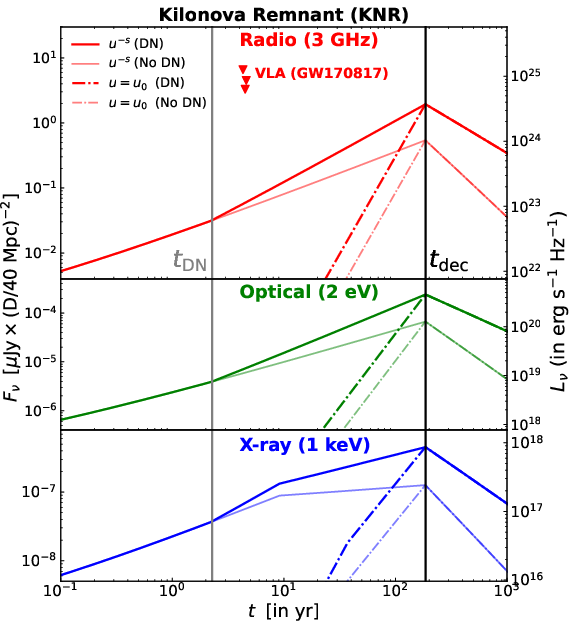
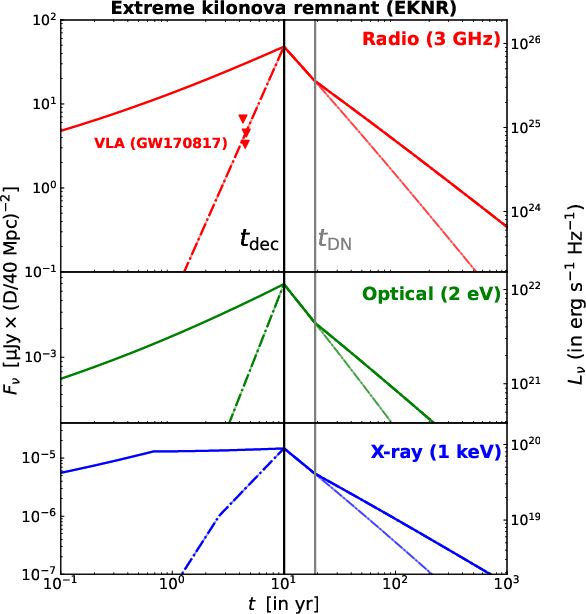
In kilonovae, the high ejecta mass (ξe=16) relative to ξe=17 ensures that the DN regime occurs well before the ejecta decelerates, i.e., during the coasting phase. For standard scenarios, the Newtonian approximation significantly underestimates radio fluxes by factors of ξe=18 at the coasting phase, increasing further at later times. The effect is magnified for magnetar-boosted kilonovae (EKNR), but recent upper limits on GW170817 disfavor such engines.
Figure 3: Multi-band KNR and EKNR afterglow light curves, contrasting Newtonian and DN treatments for both stratified and single-velocity ejecta; the DN regime predicts significantly higher and longer-lived radio flux.
Core-Collapse and Superluminous Supernovae
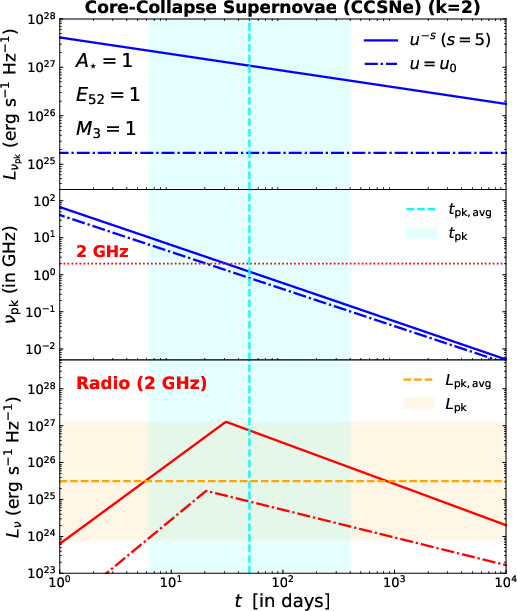
In CCSNe, the DN regime is established throughout the observable radio-bright phase. Analysis of early radio peak times and luminosities in both wind (ξe=19) and uniform (ξe0) media reveals that the peak spectral luminosity typically remains constant during the coasting phase (in a wind), while the peak frequency declines approximately as ξe1. Light curve fitting of SN2023ixf independently recovers the ambient stratification index ξe2, consistent with free-free absorption constraints.
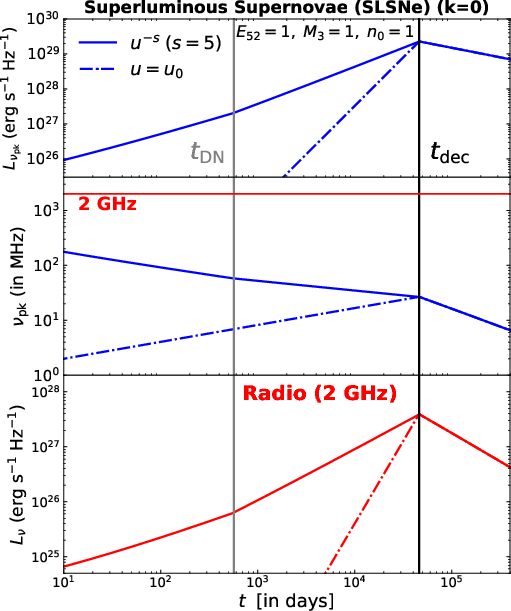
In SLSNe, the spectral peak persists in the low-frequency radio (100 MHz) regime for decades, motivating LOFAR and SKA-low follow-up. Non-detections at late times can place robust upper limits on the circumburst density.
Figure 4: Impact of DN phase on early radio light curves in CCSNe and SLSNe, including radio upper limits, demonstrating the necessity for deep low-frequency follow-up.
Evolved Supernova Remnants and ξe3--ξe4 Relation
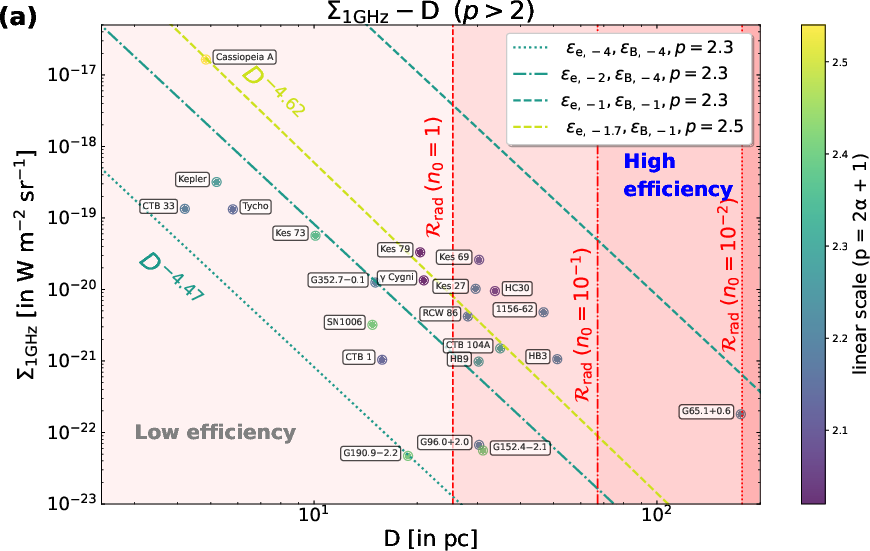
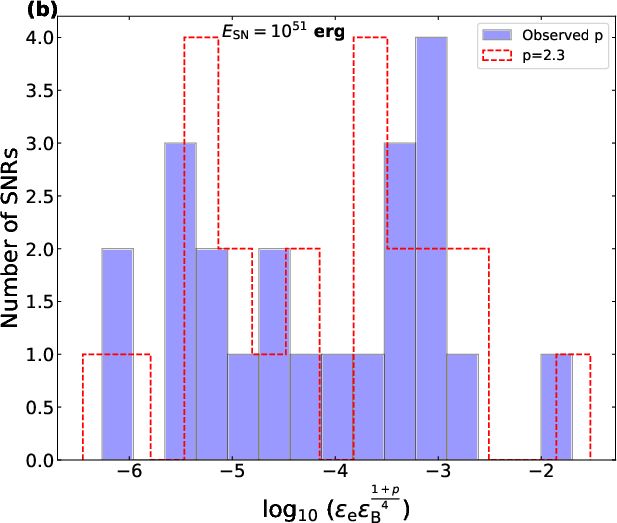
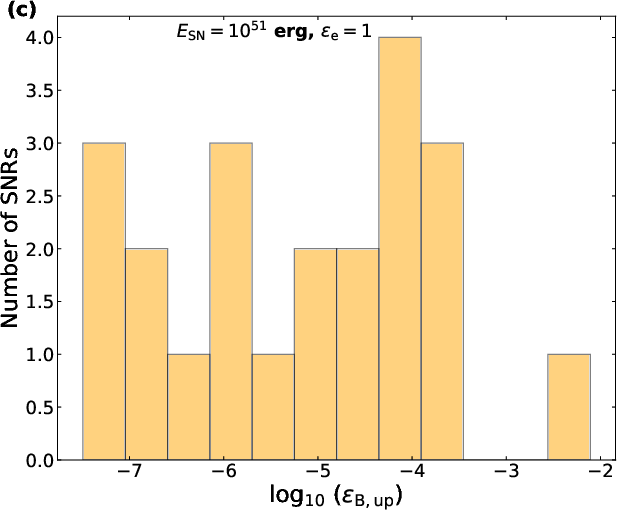
The study addresses the radio surface brightness--diameter (ξe5--ξe6) relation for SNRs, which, in the DN regime, follows a universal scaling ξe7 once microphysical parameter variation is marginalized over. The observed broad scatter in the Galactic SNRξe8--ξe9 diagram is overwhelmingly due to order-of-magnitude spread in p0, rather than explosion energy dispersion.
Figure 5: p1--p2 relation at 1 GHz for SNRs with p3, shown with models spanning microphysical parameter space, illustrating the origin of the observed data scatter.
Implications for Observational Strategy
The framework unambiguously predicts that the DN regime, with its shallow, long-lived synchrotron emission, is an unavoidable evolutionary endpoint for all initially energetic shock-driven outflows decelerating in a uniform or stratified medium. Neglecting the DN regime leads to systematic underestimation of late-time radio flux, and can obscure both the outflow energetics and microphysical diagnostics.
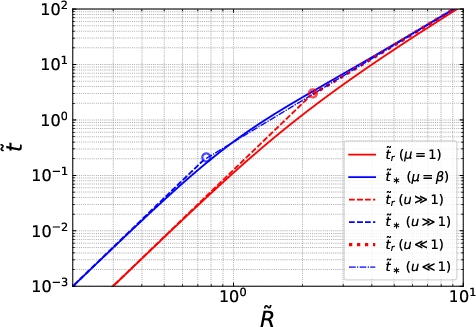
Figure 6: Evolution of observed normalized time as a function of normalized radius, providing a mapping between emission location and arrival time for spherical blast waves—critical for interpreting late-time afterglows.
Low-frequency radio telescopes (LOFAR, SKA-low) are optimally positioned to detect DN signatures, which remain observable for years--decades post-explosion for nearby GRBs, SNe, and kilonovae. Even non-detections in this regime provide strong constraints on ambient density and energetics, and can be used to rule out scenarios such as magnetar-powered kilonovae in events like GW170817.
Theoretical and Practical Impacts
The work provides a general analytic apparatus for DN-phase modeling applicable to a wide range of transients. The coupling of shock microphysics and hydrodynamics in the late-time regime emphasizes the breakdown of the equipartition paradigm as the available internal energy falls below the threshold to accelerate all electrons. The input from first-principles PIC simulations and its linkage to the observed flattening in late afterglows advances the microphysical interpretation of blast wave evolution.
Future developments may refine the microphysics of p4 via kinetic simulations, improve modeling of stratified ejecta and complex circumstellar environments, and aid the statistical interpretation of SNR radio population data. For survey science, the framework provides crucial templates essential for interpreting the legacy of energetic transients in the local universe.
Conclusion
A physically consistent treatment of electron acceleration and emission in the deep Newtonian regime is indispensable for modeling late-time blast wave evolution in energetic transients. The distinctive temporal and spectral signatures derived here define a natural observational target for upcoming low-frequency radio facilities, enabling new probes of outflow energetics, shock acceleration, and the properties of the environments around the most extreme stellar explosions.
For in-depth theory, modeling, and astrophysical applications, see "The Deep Newtonian Regime in Late-Time Blast Waves: Inevitable Transition and Distinct Flux Signatures" (2604.23567).
“Emergent Mind helps me see which AI papers have caught fire online.”
Philip
Creator, AI Explained on YouTube
Sign up for free to explore the frontiers of research
Discover trending papers, chat with arXiv, and track the latest research shaping the future of science and technology.Discover trending papers, chat with arXiv, and more.