- The paper introduces a sparsity-aware impulse radio transceiver design that optimizes event-driven transmission for neuromorphic inference.
- It proposes a two-timescale repetition coding strategy combining inter-frame and intra-frame repetitions to enhance reliability under fading conditions.
- Empirical results on gesture classification show an SNR-dependent performance crossover between digital and analog spike encoding, guiding adaptive system design.
Sparsity-Aware Event-Driven Impulse Radio Transceivers for Reliable Neuromorphic Inference
System Architecture and Model
The work presents a comprehensive architecture for multi-user remote inference leveraging event-driven neuromorphic sensing and ultra-wideband (UWB) impulse radio (IR) communication. The system comprises K spatially-distributed event-camera-equipped users and a remote inference unit implementing spiking neural networks (SNNs) for object recognition tasks.
At the sensing front-end, users deploy dynamic vision sensors (DVS) that produce highly sparse spatio-temporal event frames. Each event is mapped to a bit stream using polarity-aware binary encoding, significantly reducing transmitted data volume compared to frame-driven approaches. Transmission is performed using time-hopping on-off keying (TH-OOK), which inherently matches the sparse event structure, reducing multi-user interference and conserving energy. The receiver—after selective RAKE (SRAKE) and maximal ratio combining (MRC)—prepares received data for neuromorphic inference.
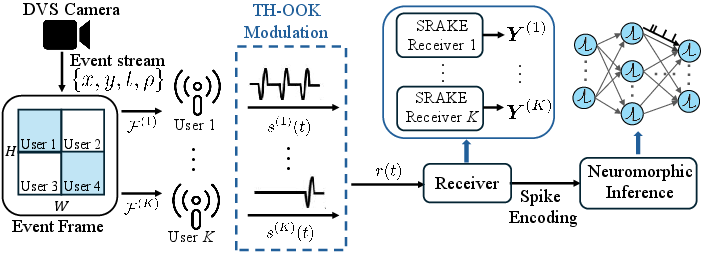
Figure 1: System block diagram encompassing DVS event generation, sparsity-matched TH-OOK transmission, and SNN-based remote inference.
Key advantages of the design arise from leveraging event sparsity via TH-OOK, ensuring low collision rates, scalable multi-user support, and compatibility with the statistical characteristics of neuromorphic outputs.
Two-Timescale Repetition Coding Scheme
The paper introduces a two-timescale repetition coding strategy exploiting event stream sparsity to enhance resilience against fading and interference without excessive latency or bandwidth cost. The approach combines:
- Inter-frame repetition: Each bit is transmitted across multiple frames to improve reliability.
- Intra-frame repetition: Within a frame, sparsity leaves numerous chips idle, which are utilized for additional pulse repetitions of '1'-bits.
This achieves Ns=NfNp total repetitions using just Nf frames, increasing coding gain and robustness while keeping transmission overhead minimal due to sparse event activation.
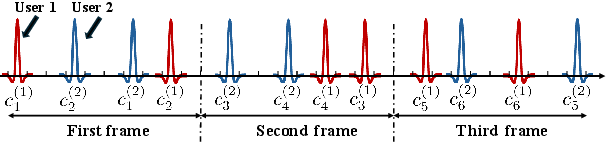
Figure 2: Conceptual example of the two-timescale repetition coding for two users, showing inter- and intra-frame repetition allocation.
Numerical analysis shows that increasing intra-frame repetition (Np) significantly narrows the performance gap between practical deployment and ideal channel conditions, especially at moderate-to-high SNR, before collision effects emerge.
Neuromorphic Inference: Digital vs. Analog Spike Encoding
Two inference paradigms are developed and comparatively studied:
- Digital Spike Encoding (Separated Inference): Event frames are reconstructed from received statistics through adaptive thresholding using sparsity estimates provided by an SNN-based estimator, followed by conventional SNN classification.
- Analog Spike Encoding (End-to-End Inference): Channel output statistics are normalized (e.g., via a sigmoid nonlinearity) and input directly into the SNN classifier, allowing the network to learn channel-adaptive representations in an E2E fashion—bypassing hard detection.
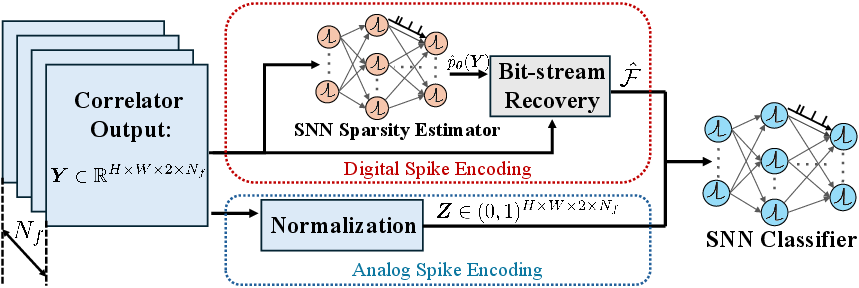
Figure 3: Comparison of digital spike encoding (detection followed by SNN inference) and analog spike encoding (direct E2E channel-aware SNN).
A key technical contribution is the derivation of a MAP-based decision threshold for digital decoding that incorporates event sparsity and an explicit bias parameter λ, which is numerically optimized in conjunction with SNN-based prior estimation.
Empirical Evaluation and Results
The approach is evaluated on gesture classification tasks using the DVS128 Gesture dataset and ultra-wideband channel models. The experimental protocol includes:
- Pre-trained and fine-tuned SNN classifiers (DVSGestureNet) for both encoding modes.
- SNN-based sparsity estimators for adaptive thresholding in digital inference.
- Monte Carlo averaging for robust statistical performance estimation.
Numerical Results:
- The proposed intra-frame repetition coding yields clear performance gains over inter-frame-only repetition, with larger Np values further improving accuracy at mid-to-high SNR before saturating due to pulse collisions.
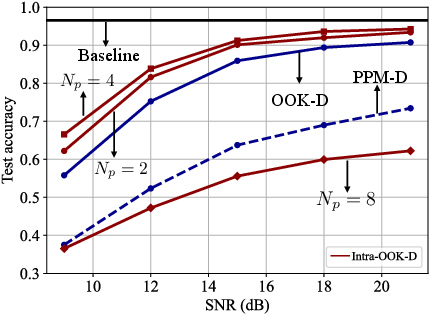
Figure 4: Test accuracy versus SNR demonstrating superiority of intra-frame repetition, especially at Np=4 in high SNR regimes.
- TH-OOK-based schemes deliver substantial accuracy improvements over traditional PPM, validating the efficacy of collision minimization via sparsity-aware design.
- A significant SNR-dependent crossover is observed between the digital and analog inference pipelines: Digital spike encoding is robust under low SNR, while analog encoding outperforms at higher SNR due to superior end-to-end channel adaptation.
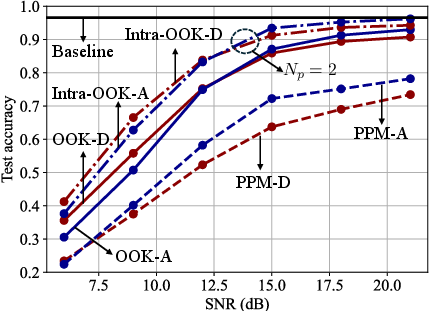
Figure 5: Comparative test accuracy across SNRs, highlighting the SNR-dependent crossover between digital and analog spike encoding approaches.
Theoretical and Practical Implications
The integration of sparsity-aware coding, ultra-wideband TH-OOK modulation, and SNN-based inference sets forth a scalable template for IoT-edge neuromorphic systems. Practically, this enables highly energy- and bandwidth-efficient multi-user deployments for real-time AI tasks in wireless and resource-constrained environments. The dual-inference architecture provides flexibility for system adaptation according to link quality and channel statistics.
Theoretically, the results underscore the importance of matching physical-layer design (modulation and coding) to statistical properties of neuromorphic outputs. The findings also chart experimental guidelines for SNR-adaptive selection between digital and analog inference modalities, advancing the regime of joint communication-inference system co-design.
Conclusion
This work systematically addresses the challenge of reliable multi-user neuromorphic inference over fading-prone wireless links by harnessing event sparsity through physical-layer and learning-layer co-optimization. The proposed sparsity-aware two-timescale repetition coding and dual inference pipelines substantially outperform conventional baselines under realistic channel stress, opening avenues for practical, scalable neuromorphic systems in wireless edge environments. The demonstrated SNR-dependent performance crossover further motivates future research on adaptive, context-aware communication-inference integration in intelligent distributed systems.