- The paper demonstrates significant OAM non-conservation in Type-I SPDC with a quantified non-conservation parameter of ~43%.
- The paper establishes a detailed theoretical framework without p=0 approximations, identifying spatial walk-off as the key mechanism breaking OAM symmetry.
- The paper introduces a novel high-sensitivity two-photon OAM detection scheme that achieves an 87% fidelity between theory and experiment.
Observation of OAM Non-Conservation in Entangled Photon Generation
Introduction
The utilization of orbital angular momentum (OAM) states of photons provides a high-dimensional resource advantageous for a broad scope of quantum technologies, including secure quantum communication, high-density quantum key distribution, and quantum information processing. Spontaneous parametric down-conversion (SPDC) in nonlinear crystals, particularly of Type-I and Type-II phase-matching, serves as the primary method for generating OAM-entangled photon pairs. The longstanding assumption in the field, derived primarily from experiments with low-sensitivity detection and approximate theory, asserts strict OAM conservation in Type-I SPDC. The paper "Observation of OAM non-conservation in entangled photon generation" (2604.23550) presents a rigorous experimental and theoretical refutation of this assumption, evidencing substantial OAM non-conservation even in collinear Type-I SPDC and attributing this phenomenon to spatial walk-off effects of the extraordinary-polarized pump.
Theoretical Framework and Non-Conservation Mechanism
OAM conservation in SPDC requires that the sum of the photon pair's OAMs equals the pump's OAM. Conventional analyses, leveraging severe phase-matching approximations and detection schemes selecting only the lowest radial mode (p=0), suggested conservation holds in Type-I SPDC due to the absence of differential spatial walk-off in the down-converted photons. Here, the authors employ a theoretical model free from such approximations and establish that the extraordinary-polarized pump undergoes significant spatial walk-off in an anisotropic crystal, leading to symmetry breaking and OAM non-conservation across a substantial parameter regime.
The two-photon state generated in SPDC is generally expressed as a superposition over Laguerre-Gaussian (LG) modes with OAM index l and radial index p. The framework accounts for the vectorial and spatial structure of the pump and the phase-matching function without reducing the multidimensional spectrum to a postselected p=0 subspace. Importantly, the model reveals that for nonzero spatial walk-off, parameterized by αpL (where αp encodes the walk-off angle and L is the crystal thickness), joint OAM spectra become populated with off-diagonal elements, i.e., Plsli=0 even when ls=−li.
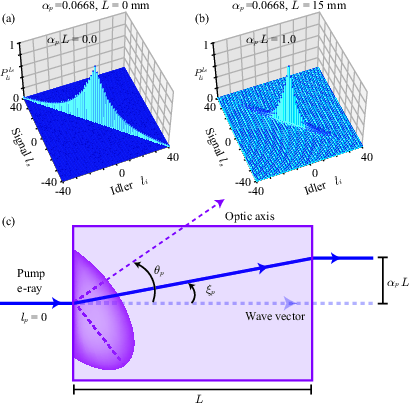
Figure 1: Non-conservation of OAM in SPDC as numerically revealed by off-diagonal elements in the joint OAM spectrum for increasing crystal thickness.
The magnitude of OAM non-conservation is quantified via a parameter N, defined such that l0 corresponds to perfect conservation and l1 to maximal non-conservation (i.e., vanishing antidiagonal elements of the joint spectrum). The theoretical analysis shows l2 increases monotonically with crystal thickness, and is only weakly dependent on the phase-matching angle in practical regimes.
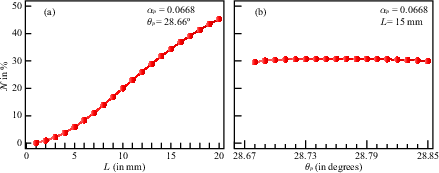
Figure 2: Dependence of non-conservation parameter l3 on crystal thickness and phase-matching angle, demonstrating strong scaling with l4 but negligible influence of l5 in the collinear regime.
Advanced OAM Detection and Experimental Setup
The experimental demonstration hinges on overcoming mode-selective inefficiencies characterizing previous two-photon OAM detection schemes. The authors design and implement a high-sensitivity, broadband, uniform-efficiency two-photon OAM detector based on angular correlation measurements. This device collects the full joint OAM spectrum l6 of entangled photon pairs by measuring angular two-photon interference in a variant of the Franson interferometer, incorporating well-calibrated image rotators for high-fidelity modal analysis.
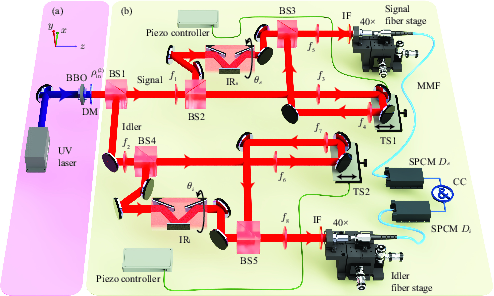
Figure 3: Schematic of the experimental setup for SPDC-based photon pair generation and broadband, uniform-efficiency two-photon OAM spectrum detection.
The setup utilizes a l7 mm thick BBO crystal for SPDC under collinear Type-I phase-matching (l8) and a Gaussian pump. Coincidence counts are measured as a function of analyzer rotation angles for the signal and idler arms, and Fourier inversion yields the full two-photon OAM joint spectrum. Control over path length, phase, and polarization allows for discrimination of temporal and spatial interference contributions, ensuring accurate extraction of OAM information.
Experimental Results
The reconstructed joint OAM spectrum for Type-I SPDC reveals pronounced non-conservation: substantial off-diagonal population is observed, directly contradicting traditional expectations of strict OAM conservation. The measured non-conservation parameter, l9, constitutes strong evidence for OAM non-conservation in Type-I SPDC with thick crystals and collinear geometry.
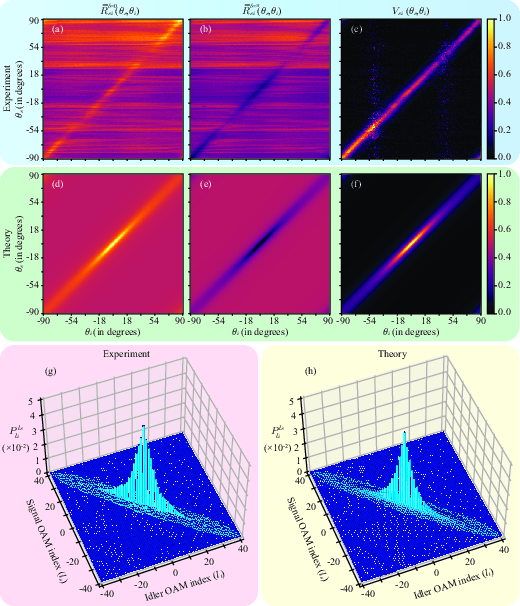
Figure 4: Experimentally measured two-photon OAM spectrum for Type-I SPDC showing off-diagonal population indicative of significant OAM non-conservation.
The experimental data are quantitatively reproduced by the theoretical model up to p0 fidelity, confirming the role of spatial walk-off of the extraordinary-polarized pump as the principal mechanism. Comparative numerical analysis shows that non-conservation is observable even when postselecting for p1 modes, though magnitude is enhanced when all p2 modes are collected. The results are robust to variations in phase-matching angle within the collinear regime and are not an artifact of experimental detection inefficiency.
Calibration and Systematic Effects
Accurate measurement of the OAM spectrum requires meticulous polarization and path-stabilization calibration. The authors present polarization calibration data (Figure 5), temporal coincidence calibration (Figure 6), and Hong-Ou-Mandel-type temporal interference to validate indistinguishability (Figure 7).
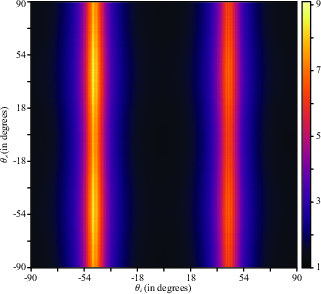
Figure 5: Plot of polarization calibration factor as a function of image rotator angles, used to correct for mode-dependent detection bias.
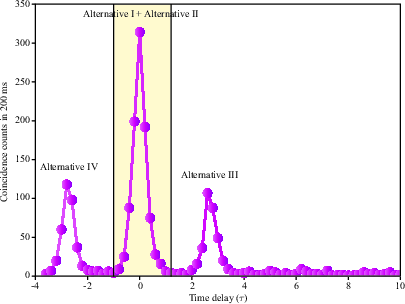
Figure 6: Coincidence count histogram versus time delay between signal and idler detectors, identifying valid window for two-photon interference.
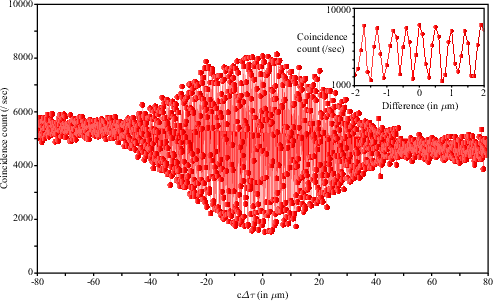
Figure 7: Coincidence count rates as a function of two-photon path length difference, showing the oscillatory signature of high-visibility quantum interference.
Limitations to the measured OAM bandwidth owing to finite collection aperture are evaluated (Figure 8), ensuring that the interpretation of non-conservation is not confounded by modal clipping.
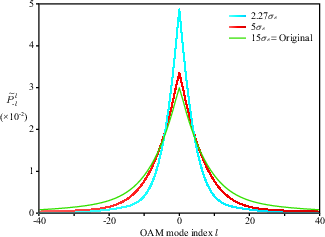
Figure 8: Effect of collection aperture size on detection of higher-order OAM modes, underlining experimental control over modal truncation.
Physical Origin: Spatial Walk-off
A fundamental and previously overlooked factor, the spatial walk-off of the extraordinary-polarized pump, is formally quantified here. As the pump propagates through the anisotropic crystal at an angle, the Poynting vector deviates from the wavevector, leading to a lateral shift that breaks the azimuthal symmetry necessary for strict OAM conservation.
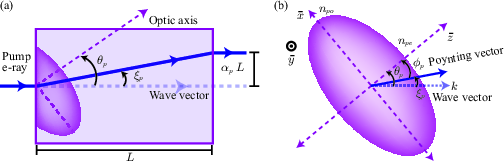
Figure 9: Schematic illustration of the spatial walk-off experienced by the extraordinary-polarized pump in an anisotropic crystal.
Such walk-off effects are inherently absent in models considering idealized thin crystals or neglecting vectorial pump structure, explaining why they escaped detection in prior experiments and theoretical treatments.
Implications and Future Perspectives
The experimental observation that OAM is not strictly conserved in Type-I SPDC, even in a collinear geometry with a Gaussian pump, challenges a foundational premise employed throughout OAM-based quantum technologies. This work indicates that all existing protocols relying on the presumption of strict conservation—such as high-dimensional entanglement generation, certified quantum key distribution, and entanglement-based quantum computation—must carefully account for spatial walk-off and possible non-conservation effects, particularly in thick-crystal or high-flux regimes.
The results also necessitate a revision of theoretical models for joint OAM spectra in SPDC toward frameworks that properly account for spatial and polarization-dependent vectorial properties. Future developments may focus on engineering spatial walk-off through crystal design or pump configuration to tailor OAM conservation or explore regimes of intentional OAM non-conservation for new quantum information protocols.
The detector architecture introduced sets a new standard for high-fidelity measurement of two-photon OAM spectra, eliminating postselection and enabling rigorous joint measurements over high-dimensional mode spaces. This advancement broadens the accessible parameter space for both experimental and applied investigations of high-dimensional photonic entanglement.
Conclusion
This work constitutes a technically detailed, quantitative, and conceptually significant demonstration that OAM non-conservation occurs in SPDC-generated photon pairs even in Type-I, collinear, Gaussian-pump configurations. The experimental non-conservation parameter approached p3 in thick-crystal operation, with strong agreement between theory and experiment validating the spatial walk-off hypothesis. These findings mandate reevaluation of standard assumptions underlying OAM-based quantum protocols and highlight the necessity for uniform-efficiency, postselection-free two-photon modal detection in advanced quantum optics experiments.

