- The paper presents a unified input-output model that integrates electromagnetic reconfigurable antenna characteristics directly into tri-hybrid MIMO signal processing.
- It benchmarks diverse antenna architectures using the Reconfigurability Efficiency Factor (REF) to quantify tradeoffs between spectral efficiency and power consumption.
- Results demonstrate enhanced aperture flexibility and system performance, paving the way for next-generation XL-MIMO and hardware-efficient wireless networks.
Signal Processing Foundations of Reconfigurable Antennas in the Tri-Hybrid MIMO Architecture
Introduction
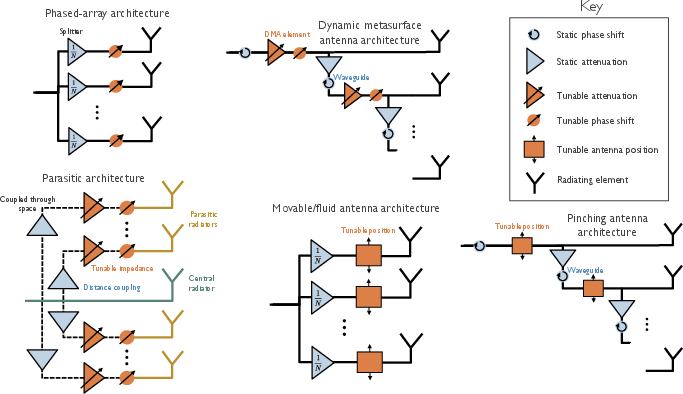
The tri-hybrid MIMO architecture represents a fundamental shift in wireless transceiver design by introducing a third precoding layer—implemented directly in the antenna domain—on top of conventional digital and analog processing. This integration of reconfigurable antennas at the electromagnetic (EM) layer enables dramatic extensions in aperture size, power efficiency, and spatial flexibility compared to traditional hybrid MIMO. The reviewed work formulates a unified signal processing and system design framework for tri-hybrid MIMO, models a range of reconfigurable antenna architectures, and introduces a reconfigurability efficiency factor (REF) for comparative performance evaluation.
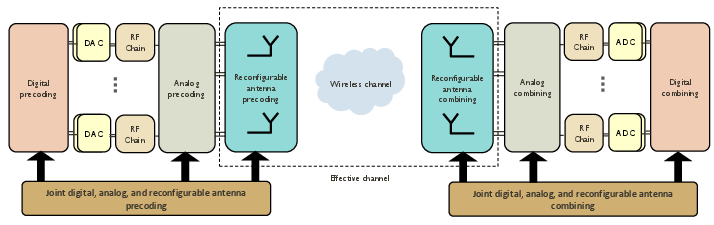
Figure 1: The tri-hybrid MIMO architecture incorporates a reconfigurable antenna layer as a third stage, enhancing the expressiveness and efficiency of the overall MIMO system.
Unified System Model for Tri-Hybrid MIMO
The core technical advance is the development of a generalized input-output model that integrates reconfigurable antenna characteristics directly into an effective channel representation. This model acknowledges the tight, architecture-specific coupling of the channel matrix, precoder structure, and radiated power in tri-hybrid systems. Traditional MIMO abstractions separate antenna hardware from digital signal processing; in contrast, the tri-hybrid model forces the channel to be an explicit function of the electromagnetic precoder, which is often nonlinearly parameterized according to antenna physics.
Key modeling aspects include:
Architectural Specializations
The paper specializes the unified tri-hybrid framework to seven classes of reconfigurable antenna technology, each of which introduces distinct physical degrees of freedom and hardware constraints:
Parasitic Antenna Arrays
Parasitic arrays leverage strong mutual coupling to augment beamforming with passive reconfigurable loads, enabling large apertures with relatively few active RF chains. The effective channel is derived from a rigorous circuit-theoretic multiport analysis, with the radiated power and induced currents jointly determined by the loading state of parasitic elements.
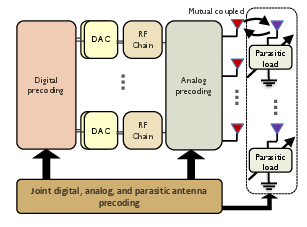
Figure 3: System model for the parasitic antenna based tri-hybrid architecture, illustrating mutual coupling between active and passive elements.
Pixel Arrays and Fluid Antenna Systems
Pixel arrays and FAS employ state-selection or position-reconfiguration to activate sub-aperture geometries or radiator locations, typically using discrete switching networks. The system is modeled with state-selection matrices and dictionaries of excitation patterns, and performance is dominated by the combinatorial diversity of aperture states and their realized efficiency.
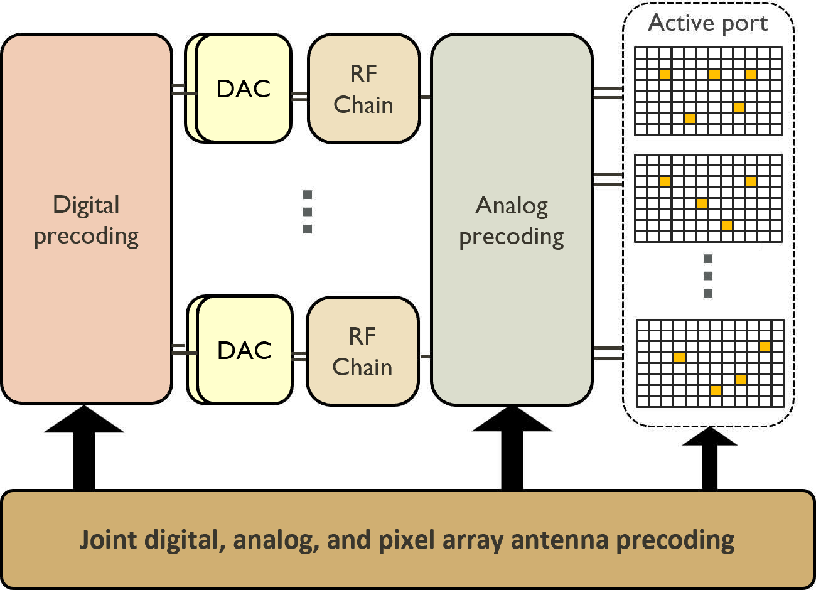
Figure 4: A pixel-array/FAS tri-hybrid system, where analog feeds enable state selection from a finite set, activating specific radiating elements.
DMAs perform beamforming via independently tunable slot elements embedded in a waveguide. The Lorentzian constraint, resulting from the magnetic polarizability of each slot, couples the amplitude and phase as well as the forward scattering along the waveguide, fundamentally limiting independent per-element weight control.
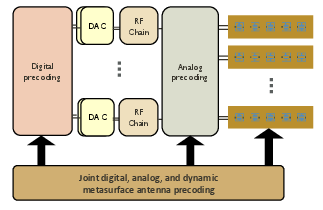
Figure 5: The DMA-based tri-hybrid architecture showing interdependency among slot elements due to forward scattering and the tuning of varactor diodes.
Polarization-Reconfigurable Antennas
Polarization reconfigurable architectures adapt each antenna's polarization state to match the physical propagation channel, reducing loss from polarization mismatch and enabling single-port implementation in place of dual-polarized feeds. The effective channel must be explicitly parameterized by the transmit and receive EM polarization basis.
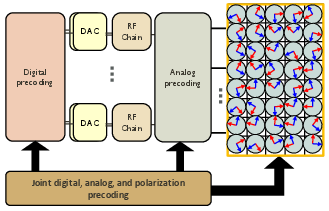
Figure 6: The polarization-reconfigurable architecture, where polarization angles and phase offsets are dynamically controlled per antenna.
SIM employs cascaded metasurface layers to perform multi-stage wave-domain spatial conditioning, enabling passive, frequency-flat beamforming through programmable per-layer phase shifts. Optimization is complicated by the deep non-convex product structure over layers, particularly for multiuser or wideband scenarios.
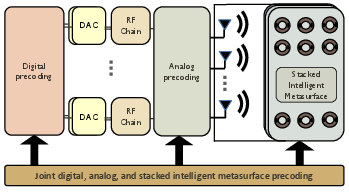
Figure 7: The SIM-based tri-hybrid system uses stacked layers of tunable meta-atoms for cascaded spatial processing in the wave domain.
Pinching-Antenna Systems (PASS) and Non-Radiating Wires
Both PASS and non-radiating wire designs use distributed guided-wave structures to extract or confine EM energy at discrete points. PASS achieves aperture reconfiguration via the physical repositioning of pinching elements along the waveguide, whereas non-radiating wires modulate the load impedances at fixed ports to tailor the near-field profile.
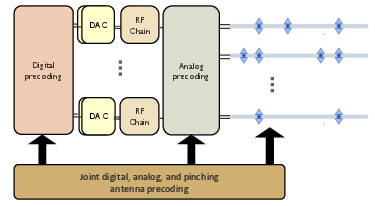
Figure 8: PASS-based tri-hybrid model, highlighting the sequential coupling and spatial dependency inherent to pinching element placement.
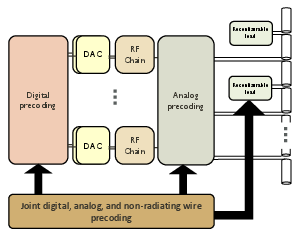
Figure 9: Connected dipole model for a non-radiating wire showing distributed feeding and global mutual coupling via adaptive port loading.
A central contribution is the formalization of the REF as a system-level, multi-objective metric for quantifying the net benefit of reconfigurability. Unlike conventional antenna figures of merit (such as directivity or realized gain, which fail to capture system tradeoffs), the REF normalizes improvements in spectral efficiency or power reduction by the associated physical cost—such as array aperture or added hardware complexity. The REF formulation is flexible, supporting various design intents (performance-limited, power-limited, area-limited), and is robustified by enforcing linear unit comparisons and penalizing comparisons with negligible denominators.
Strong numerical results reported in the paper include:
- For parasitic arrays, the REF is used to analyze the incremental benefit of adding passive elements for reduced transmit power at fixed spectral efficiency; diminishing returns are rigorously quantified.
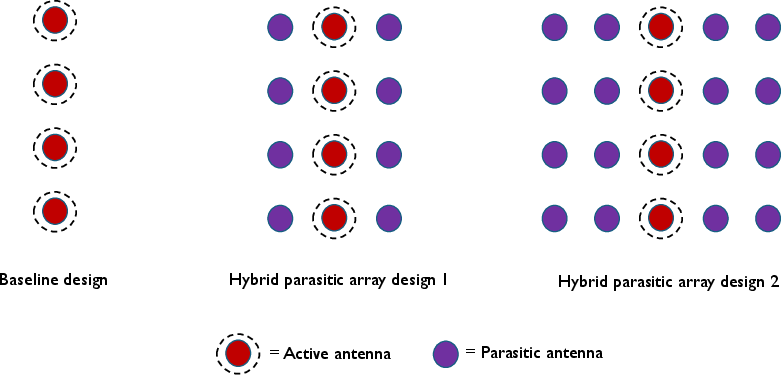
Figure 10: REF illustrates tradeoffs in adding parasitic elements: a modest increase in aperture yields substantial power savings, but further scaling provides reduced efficiency gain.
- In DMA-based systems, the REF is analyzed as a function of waveguide and slot count; a clear optimum for the number of waveguides is identified, balancing beamforming gain and power consumption.
- For SIM-based systems, the REF quantifies the tradeoff between the number of metasurface layers and DAC resolution, revealing that modest SIM depth can substitute for high-resolution back-end converters.
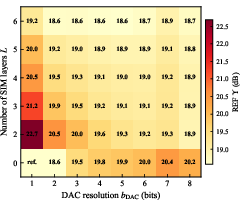
Figure 11: REF for SIM-aided quantized zero-forcing precoding, highlighting optimal tradeoff points for SIM depth and DAC resolution.
- For polarization-reconfigurable arrays, the REF clearly demonstrates significantly higher efficiency values compared to static or dual-polarized architectures, particularly at low SNR, and for a wide range of component-level reconfiguration power overheads.
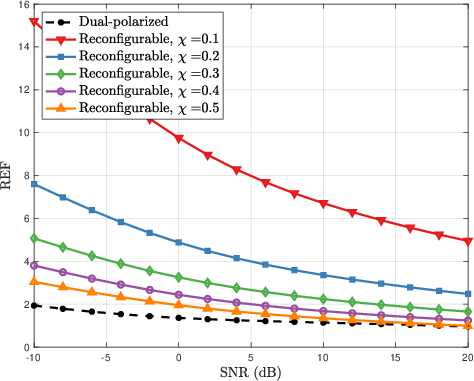
Figure 12: The REF sharply favors polarization-reconfigurable arrays over dual-polarized counterparts under realistic power consumption models, especially at low SNR.
Implications and Future Directions
The tri-hybrid framework mandates a holistic, circuit-consistent approach to large-aperture and EM-reconfigurable system design. The strong coupling between digital, analog, and EM layers fundamentally changes how signal processing and optimization must be performed—classical linear algebraic abstractions are replaced with nonlinear, architecture-driven system modeling and resource allocation. The generalized input-output and REF framework offer a foundation for rigorous cross-architecture benchmarking and resource-aware algorithm development. Notably, the architecture-specific constraints—such as nonconvexity, discrete selection, and interdependent physical variables—underscore the need for new classes of optimization and learning-based algorithms, as well as hardware-aware, physically consistent EM–signal processing co-design.
Practical implications include:
- Significantly increased spectral efficiency and/or reduced power consumption without unsustainable hardware scaling, through fine-grained hardware-aware optimization.
- The potential for very-large-scale (XL-MIMO) and even continuous-aperture architectures with manageable complexity, given the system-level understanding of EM programmability.
- The possibility to tailor reconfigurability to application-specific traffic, environment, and energy consumption requirements using the unified REF benchmark.
Theoretically, these developments drive further progress on the integration of electromagnetic theory, circuit modeling, and information-theoretic capacity analysis, closing the gap between physical-layer hardware and algorithmic design.
Conclusion
This work delivers a comprehensive framework for modeling, analyzing, and comparing tri-hybrid MIMO systems with diverse reconfigurable antennas. By developing a unified signal processing abstraction that directly incorporates EM hardware constraints and by introducing the REF metric for system-level evaluation, the study exposes both opportunities and fundamental challenges in the design of future large-aperture, hardware-efficient wireless networks. The confluence of EM-domain constraints, analog/digital signal processing, and physically informed metrics establishes a rigorous platform for both scientific analysis and the practical design of advanced MIMO systems.
(2604.23529)