- The paper establishes a definitive stabilization threshold (β > (α+1)/2) to ensure the Polyak–Ruppert CLT holds in adaptive stochastic approximation.
- It introduces an exact pathwise decomposition to isolate preconditioner effects and provides convergence guarantees for SA-AdaGrad, SA-RMSProp, and SA-ONS.
- Empirical simulations validate that properly stabilized preconditioners maintain asymptotic inference accuracy, while fixed-EMA schemes fail to eliminate dynamic remainders.
Dynamic Preconditioning and Central Limit Theorems in Stochastic Approximation: The Stabilization Threshold
Introduction: Polyak–Ruppert Averaging Under Dynamic Preconditioning
Stochastic approximation has become indispensable in modern statistics and machine learning, particularly through recursive gradient-based schemes. Polyak–Ruppert (PR) averaging remains crucial for attaining optimal asymptotic efficiency and calibration, as its averaged iterates satisfy a central limit theorem (CLT) with sandwich covariance H−1SH−1, grounding online statistical inference. However, PR averaging's finite-sample performance deteriorates in ill-conditioned problems, a shortcoming ameliorated by dynamic preconditioning methods such as AdaGrad, RMSProp, and online Newton step (ONS), where the step-wise preconditioner Pt is estimated adaptively.
This paper rigorously addresses a fundamental theoretical question: How rapidly must a data-driven preconditioner Pt stabilize to preserve the Polyak–Ruppert CLT, and what is the unavoidable threshold for stabilization within polynomial-rate bounds? The authors provide a definitive stabilization-rate threshold, identify its tightness, and deliver constructive convergence and finite-sample analysis for several classes of stochastic-approximation (SA) preconditioners.
Preconditioner-Isolating Decomposition and Threshold Characterization
A core technical innovation is an exact pathwise decomposition of the averaged estimation error that fully isolates all explicit dependence on the preconditioner sequence Pt into a dynamic remainder Rn. Specifically,
xn−x∗=−n1H−1t=1∑nξt−n1H−1t=1∑nut+Rn({Pt}),
where ξt are martingale increments and ut are Taylor remainders. Neither ξt nor ut features explicit preconditioner dependence. All dynamic effects arising from Pt0 are relegated to Pt1. This separation permits a reduction of the CLT question to a concrete stabilization-rate condition on Pt2.
The stabilization rate is quantified via Pt3:
Pt4
where Pt5 and the learning rate decays as Pt6, Pt7. The main result asserts that
Pt8
is both necessary and sufficient (within the polynomial-rate upper-bound class) for the asymptotic negligibility of the dynamic remainder: Pt9 in Pt0, preserving the traditional CLT and sandwich covariance for the PR average.
A constructive lower bound is given, showing that no argument based solely on these polynomial upper bounds can weaken the threshold: sequences achieving rate Pt1 produce non-vanishing normalized remainders.
Verification and Characterization of SA Preconditioners
The paper provides a unified stabilization proof for three major classes of SA preconditioners with Pt2 one-step stabilization of rate Pt3; pathwise stabilization with Pt4 is obtained under bounded-input assumptions:
- SA-AdaGrad (full-matrix): Pt5,
- SA-RMSProp (diagonal): Pt6,
- SA-ONS (full-matrix, Newton-type): Pt7 based on inverse running averages of stochastic Hessian inputs.
These preconditioners, under appropriate regularity conditions (bounded gradients or Hessians), all deliver Pt8 for Pt9. Crucially, the constant-EMA (exponential moving average) preconditioners with fixed Pt0 (as typically used in original RMSProp/Adam) do not satisfy the threshold: their dynamic fluctuations do not decay, making their asymptotic inferential properties unreliable in principle.
Numerical Experiments and Empirical Validation
Extensive simulations validate the theoretical claims. For both synthetic linear regression (varying Pt1 and Pt2 vs. Pt3) and real-data logistic regression, all SA-preconditioned methods converge to the same nominal coverage and normalized MSE as identity-preconditioned PR-SGD (i.e., Pt4), as predicted by the generalized CLT. At finite samples, full-matrix preconditioners incur transiently higher dynamic remainder than diagonal or identity, matching the theoretical coupling constants.
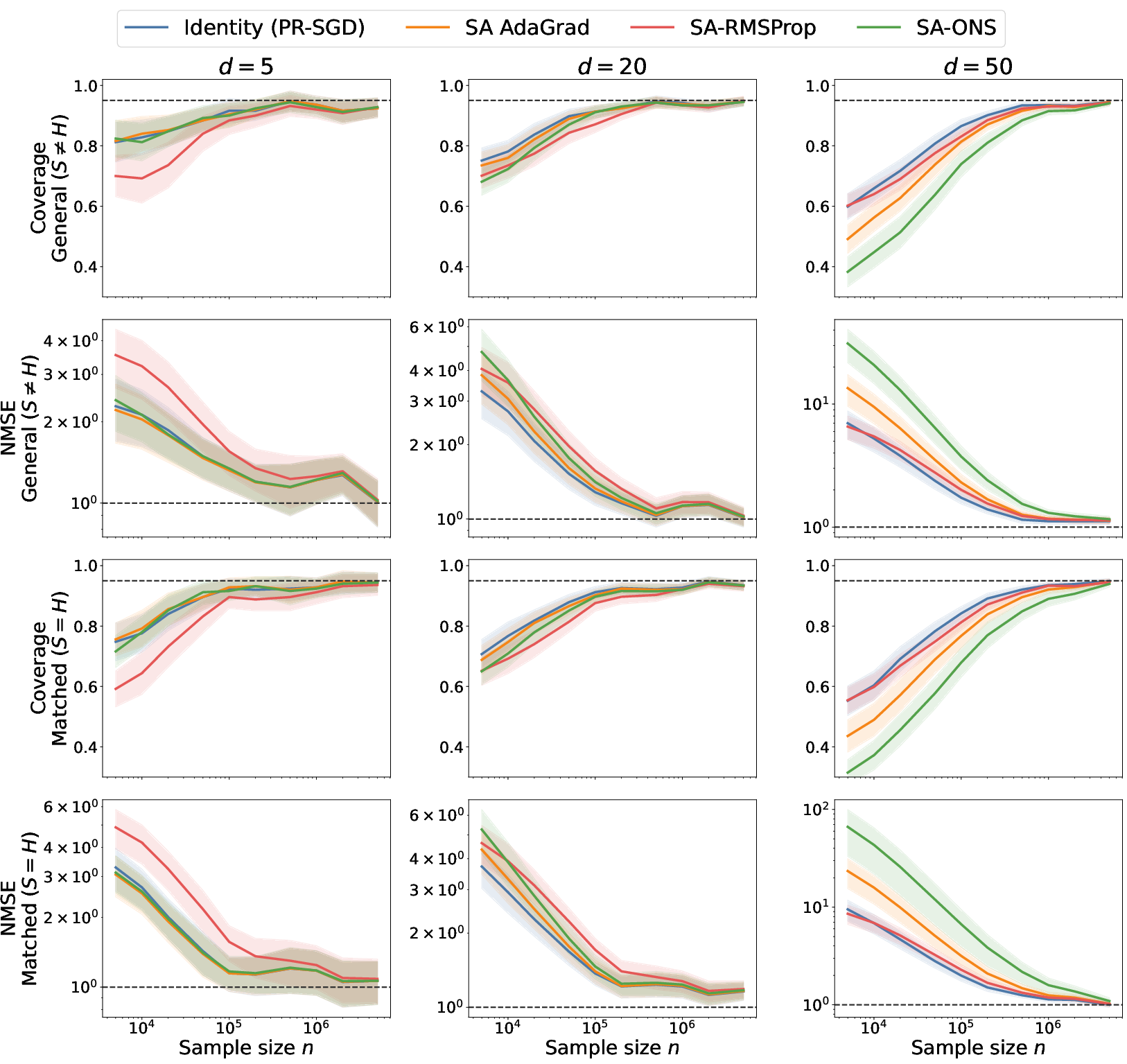
Figure 1: Coordinatewise marginal coverage and normalized MSE for synthetic linear regression, demonstrating convergence of all preconditioned and unpreconditioned methods to the nominal values as sample size increases across various dimensions and covariance regimes.
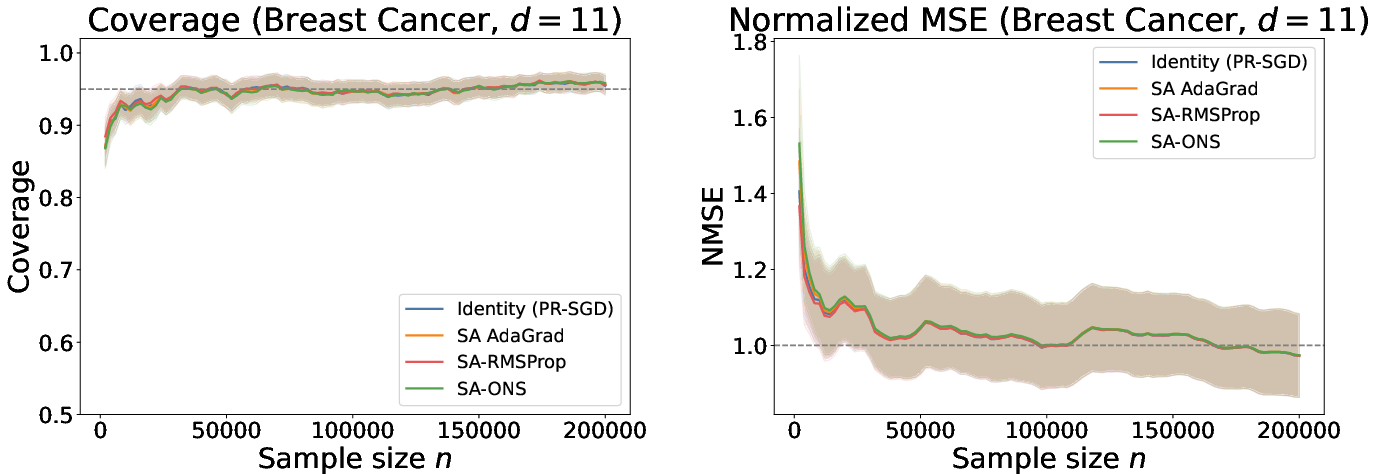
Figure 2: Coordinatewise marginal coverage and normalized MSE for Pt5-regularized logistic regression, showing near-identical asymptotic performance for all methods.
The stabilization threshold violation experiment (constant-EMA RMSProp/Adam) confirms the necessity of the threshold: the preconditioner dynamic remainder fails to vanish, in contrast to properly stabilized SA-RMSProp.
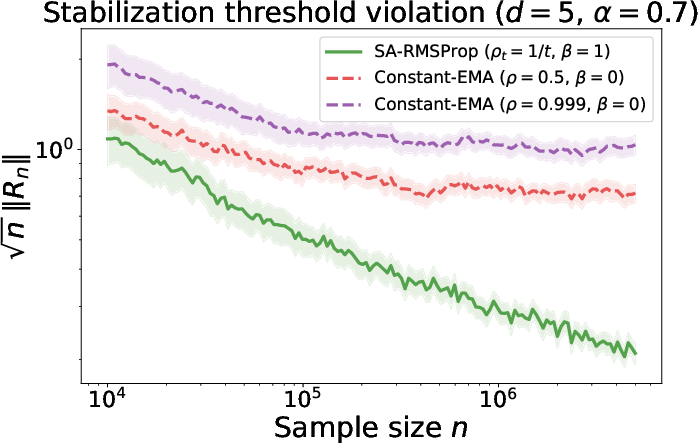
Figure 3: Log–log plot of scaled remainder, illustrating failure of constant-EMA preconditioners to achieve proper stabilization and CLT accordance.
Additional diagnostics detail the dynamic remainder convergence and method ranking in high dimensions. The operator-factor comparison quantifies that SA-ONS eliminates the Pt6 penalty in ill-conditioned settings relative to identity, justifying its higher per-iteration cost in some regimes.
Theoretical Implications for Inference and Rate Preservation
From a statistical perspective, all SA-constructions above threshold preserve the Polyak–Ruppert CLT and guarantee that Wald-type inference based on the plug-in sandwich remains asymptotically valid. In information-equality models (Pt7), asymptotic efficiency (Fisher lower bound) is attained regardless of preconditioner choice, provided stabilization exceeds threshold.
Further, the Wasserstein-Gaussian approximation rate for preconditioned PR averaging matches the unpreconditioned case (Pt8 at optimal step size Pt9), confirming that no rate penalty is paid for dynamic preconditioning above threshold:
Rn0
given appropriate bounds on the underlying stochastic noise.
Broader Impact and Open Problems
The threshold result rigorously delineates which classes of adaptive preconditioning can be safely utilized for online inference with PR averaging. Notably, originally published Adam and RMSProp, which use constant-EMA accumulators, do not satisfy these constraints and may produce non-negligible, unquantifiable biases in uncertainty quantification. In contrast, SA-ONS, SA-AdaGrad, and other Rn1-gain schemes are both practical and theoretically guaranteed.
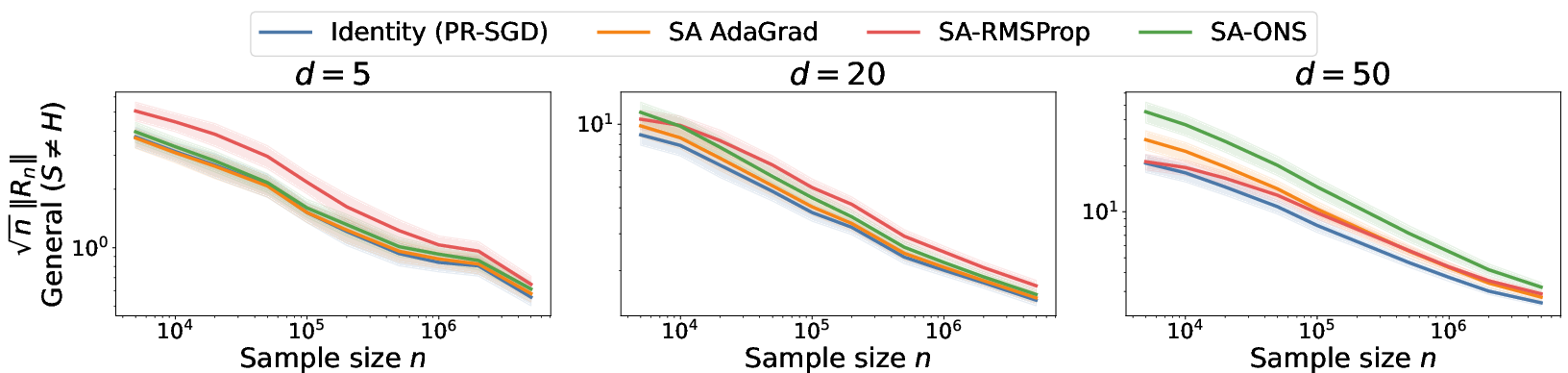
Figure 4: CLT convergence diagnostics; scaled remainder trajectories highlight effective stabilization for threshold-satisfying methods versus constant-EMA.
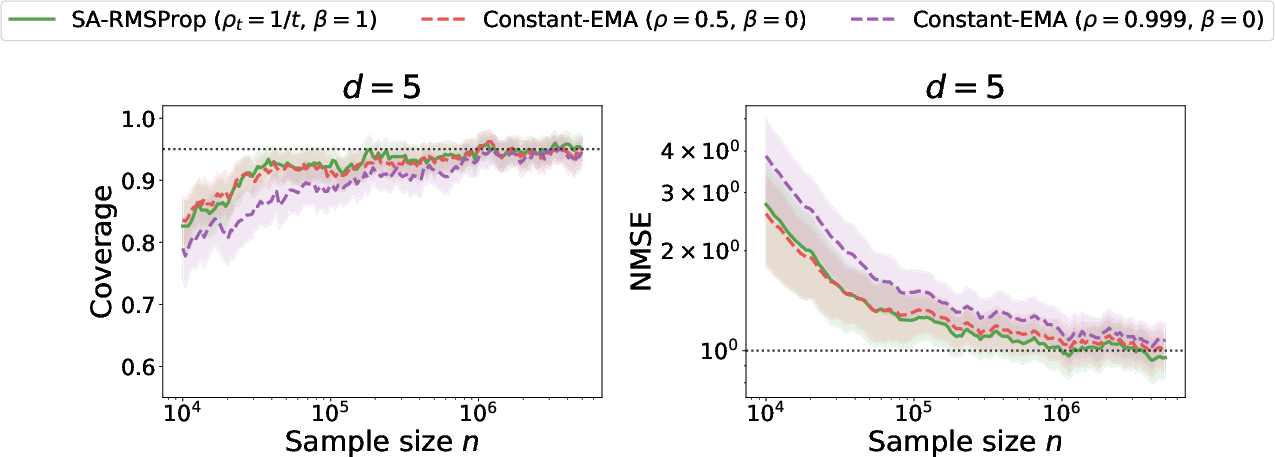
Figure 5: Coverage and NMSE for the threshold violation experiment, confirming loss of statistical validity for constant-EMA schemes compared to properly stabilized preconditioners.
Open theoretical directions include:
- Tightening lower bounds by exploiting the coupling structure inherent in adaptive preconditioners/iterates,
- Improving Wasserstein or Berry–Esseen rates for nonlinear SA,
- Extending results beyond strong convexity to general convex or even non-convex settings,
- Analyzing sub-Gaussian and high-dimensional regimes with explicit dimension dependence.
Conclusion
The study provides a precise, non-loosenable threshold on preconditioner stabilization for the preservation of inferential fidelity in Polyak–Ruppert averaged SA with dynamic preconditioning. SA-ONS, SA-AdaGrad, and SA-RMSProp (with Rn2 gain) are validated as theoretically safe preconditioners, whereas fixed-EMA schemes are excluded. The results yield actionable guidance for the principled design of online inference procedures in adaptive stochastic optimization and illuminate optimality tradeoffs between finite-sample and asymptotic properties in a unified framework (2604.23498).