- The paper introduces a joint estimation framework that simultaneously optimizes phase and memory correlation factor using squeezed reservoir engineering.
- It shows that optimal squeezing-phase alignment significantly restores quantum Fisher information, mitigating decoherence effects.
- The study highlights that adaptive control strategies in quantum sensing yield superior resource efficiency compared to independent estimation.
Enhancing Quantum Parameter Estimation through Squeezed Reservoir Engineering
Introduction
This work formulates a rigorous investigation of quantum parameter estimation in the physically realistic scenario of open quantum systems subject to engineered nonclassical environments. The study specifically addresses two critical metrological parameters: the phase of a two-qubit entangled state (ϕ) and a memory correlation factor (μ) that quantifies the non-Markovian correlations introduced via sequential passage through a squeezed thermal reservoir. Unlike the majority of prior approaches that restrict attention to either Markovian environments or treat phase and memory estimation in isolation, this work delivers a comprehensive joint estimation framework, explicitly incorporating control over both the squeezing strength and phase of the engineered reservoir.
Theoretical Model and Reservoir Engineering
The system under study consists of two-level systems (qubits) sequentially interacting with a bosonic squeezed thermal reservoir. Both the system–environment coupling and reservoir state are parameterized, enabling a continuous interpolation between fully uncorrelated (μ=0) and perfectly correlated (μ=1) dissipation dynamics. The reservoir is realized by injecting a broadband squeezed field into an optical cavity, as depicted below:
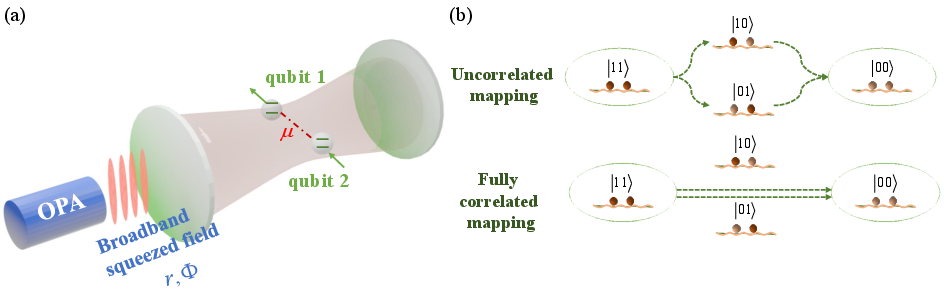
Figure 1: Theoretical model of qubits passing sequentially through a squeezed thermal reservoir with adjustable correlation strength μ (memory effect).
Correlations in the noise process are established by adjusting the temporal overlap between qubits relative to the cavity relaxation time. The system's density matrix is derived via a convex combination of independent and correlated Lindbladian evolutions. This analytic structure enables computation of the quantum Fisher information (QFI) for both independent and joint estimations of ϕ and μ.
Precision Enhancement of Phase Estimation
The QFI for the phase parameter, Fϕ, is found to be highly sensitive to both reservoir squeezing and the squeezing phase Φ. In the absence of squeezing/correlation, environmental interaction rapidly degrades phase sensitivity. Introducing squeezing with phase-matching can substantially suppress this degradation and, in specific parameter regimes, restore or even exceed the lossless QFI values.
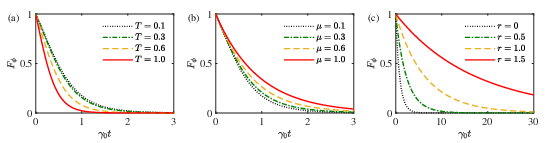
Figure 2: Behavior of Fϕ vs. time, temperature, squeezing strength, and correlation factor, illustrating the preservation and enhancement effects induced by squeezing and environmental correlation.
Detailed analysis demonstrates that the phase-matching condition between the squeezing phase μ0 and the system's intrinsic phase μ1 is nontrivial and depends explicitly on the correlation regime (μ2). In the independent (μ3) regime, the optimal condition is μ4; in the fully correlated regime (μ5), μ6. Off-optimal choice of μ7 can not only nullify the advantages of squeezing but degrade precision below even the unsqueezed thermal case, a behavior substantiated by the non-monotonic landscape evident in the following:
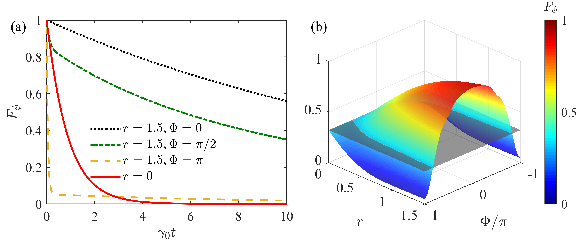
Figure 3: QFI surface for μ8 as a function of both squeezing strength μ9 and squeezing phase μ=00, exhibiting both enhancements and detrimental regions relative to thermal-reference.
The authors confirm these optimal conditions via numerical scans over μ=01 for various μ=02, highlighting the requisite for adaptive squeezing-phase control when optimizing estimation performance across varying correlation strengths.
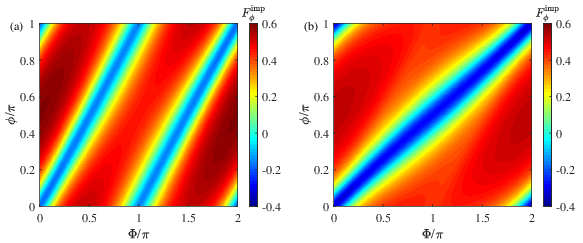
Figure 4: QFI improvement for μ=03 with μ=04 as a function of μ=05 at representative μ=06. The optimal phase-matching shifts as μ=07 is tuned.
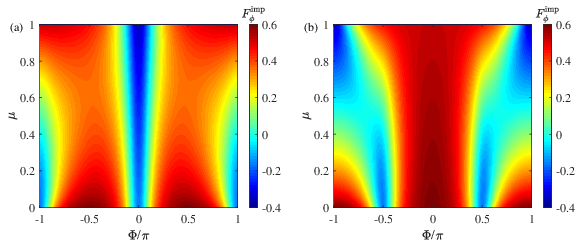
Figure 5: Complex evolution of μ=08 as both μ=09 and μ=10 are varied, illustrating breakdown of definite phase-matching for intermediate correlations.
Precision Enhancement of Correlation Estimation
The estimation of the channel correlation factor μ=11 is likewise strongly enhanced by squeezing, although with qualitative distinctions from phase estimation. Specifically, μ=12 is generally increased for all squeezing phases, though its maximum remains phase-sensitive. Strong squeezing universally improves sensitivity to μ=13, and higher temperature further facilitates information transfer of μ=14 to the system, in contrast to its detrimental effect on phase estimation.
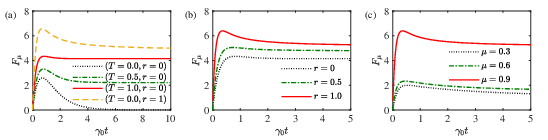
Figure 6: Dynamic enhancement of μ=15, showing dependencies on temperature, squeezing strength, and correlation factor.
Analysis of the optimal squeezing phase again reveals μ=16-dependent phase-matching conditions: μ=17 for weak correlations, transitioning to μ=18 in the strong correlation limit, a conclusion directly visualized for varying μ=19.
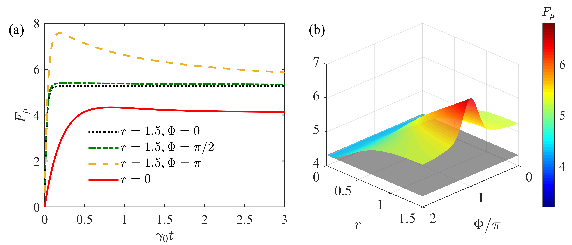
Figure 7: μ0 enhancement surfaces in μ1, analogous to the μ2 analysis.
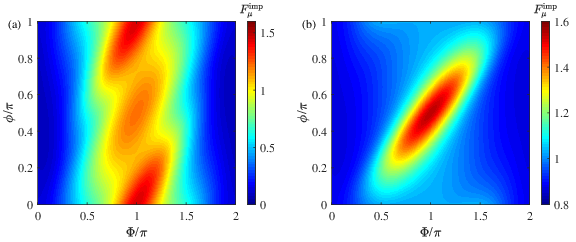
Figure 8: Phase-matching optimization for μ3 with results for low and high μ4.
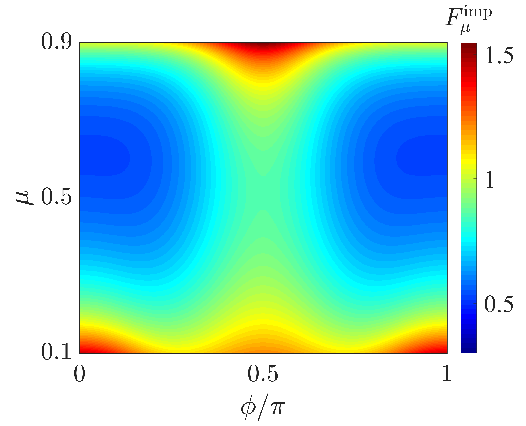
Figure 9: Behavior of μ5 across μ6, confirming persistence of enhancement, with absolute maximum determined by phase-matching.
Joint Estimation and Resource Efficiency
Simultaneous estimation of both parameters is addressed by the QFI matrix formalism. The interplay between the off-diagonal QFI elements and the SLD incompatibility governs the achievable trade-off—parameter incompatibility precludes saturating the quantum Cramér-Rao bound for both parameters independently. The total variance in the joint scheme, μ7, is shown to be dominated by μ8 due to its higher susceptibility to decoherence and inadequate squeezing-phase matching.
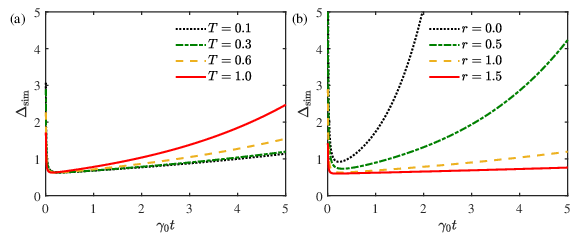
Figure 10: Joint estimation total variance μ9 as a function of time, temperature, and squeezing, with evident phase sensitivity in the enhancement.
Crucially, the optimal squeezing phase for minimizing joint estimation variance is always aligned with that maximizing ϕ0—not ϕ1—regardless of their individual optima. This is numerically demonstrated below:
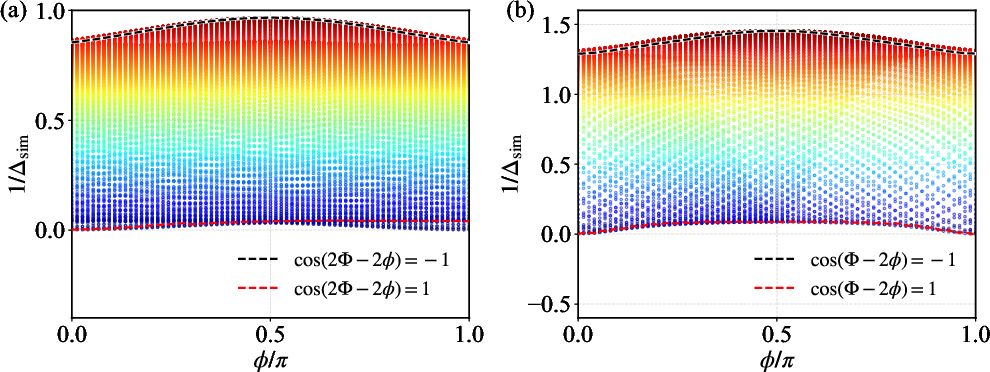
Figure 11: Trade-off analysis: joint estimation precision ϕ2 as a function of phase and squeezing-phase, with optima marked for both individual and joint protocols.
Despite parameter incompatibility, the resource gain metric ϕ3 demonstrates that joint estimation is always superior (ϕ4) for any phase choice, with optimal benefit achieved when the squeezing phase is tailored for ϕ5.
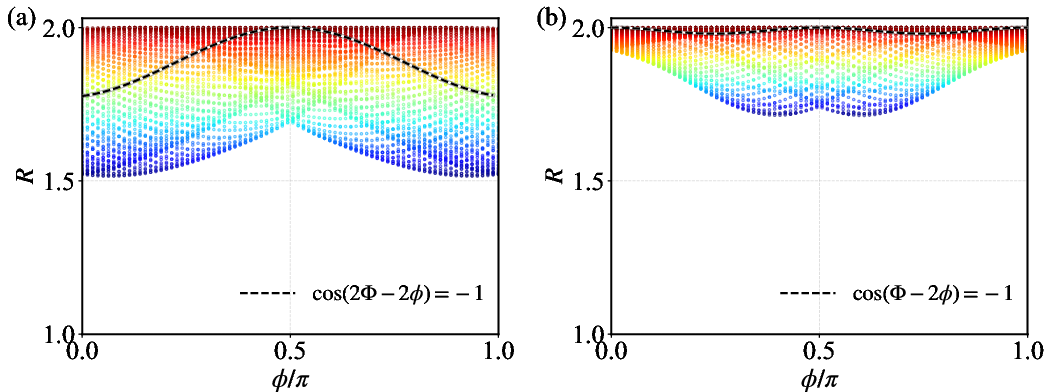
Figure 12: Joint estimation advantage ϕ6 as function of squeezing phase; resource conservation is robust to phase-matching, with maximal efficiency at the ϕ7 optimal phase.
Implications and Outlook
The analytical and numerical results establish that optimal quantum parameter estimation in realistic correlated environments necessitates dynamic control of the reservoir's squeezing phase, contingent upon both the parameter of interest and the system-reservoir correlation regime. These findings have impactful consequences for quantum sensing, metrology, and robust quantum information transfer, particularly in architectures (such as cavity/circuit QED and trapped-ion systems) where squeezed reservoir engineering is experimentally available.
Practically, adaptation of the squeezing phase should be integrated within real-time feedback systems to maintain quantum-enhanced sensitivity as the environmental memory profile evolves. The behavior of parameter incompatibility in the multiparameter estimation scenario underscores the importance of prioritizing phase estimation in joint estimation protocols, as it structurally limits the collective precision.
Future research directions include extending the framework to higher-dimensional systems, considering estimation under more general forms of reservoir non-Gaussianity, and integrating adaptive Bayesian or machine learning strategies for squeezing-phase tracking. The presented methodology can be extended toward quantum error correction/parameter estimation synergies and optimal resource allocation protocols in quantum networks.
Conclusion
Through explicit analytical construction and extensive numerical validation, this work elucidates fundamental limits and optimal control strategies for enhancing both independent and joint quantum parameter estimation in the presence of engineered squeezed reservoir correlations. The results provide a detailed roadmap for exploiting squeezing phase control and environmental correlations as metrological resources, while rigorously quantifying the joint estimation trade-offs intrinsic to quantum Fisher information incompatibility. These findings substantively advance the operational blueprint for precision quantum metrology and correlated noise engineering (2604.23476).

