- The paper introduces a fiber-integrated quantum frequency conversion system that uses a PPLN waveguide to convert NV center signals from 637 nm to 1588 nm with up to 9% conversion efficiency.
- It employs dense wavelength division multiplexing, ultra-narrowband filtering, and synchronized single-photon detection to achieve low noise and alignment-free operation.
- The system delivers improved entanglement fidelities (up to 89.0% at high NV count rates) over 100 km, underscoring its scalability for long-distance quantum communications.
Fiber-Integrated Quantum Frequency Conversion for Long-Distance Quantum Networking
Introduction and Motivation
The paper "Fiber-integrated Quantum Frequency Conversion for Long-distance Quantum Networking" (2604.23444) addresses a fundamental bottleneck in quantum communication—the spectral mismatch between emission wavelengths of quantum nodes and the low-loss telecom window required for efficient fiber transmission. The work focuses on quantum frequency conversion (QFC) as an interface bridging quantum hardware, such as NV centers, operating at visible wavelengths (637 nm), to telecom-band channels (1588 nm), critical for scalable quantum networking.
Experimental Architecture
The authors present a fiber-coupled QFC system based on a periodically poled lithium niobate (PPLN) waveguide. The system employs a continuous-wave laser at 637.2 nm, pulsed by an acousto-optic modulator and attenuated to single-photon-levels by cascaded variable optical attenuators. The signal is merged with a 1064.1 nm pump via dense wavelength division multiplexing, then enters the PPLN waveguide for frequency conversion. Post-conversion, a multi-stage filtering module, including DWDM, fiber Bragg gratings, and an ultra-narrowband tunable filter, suppresses noise sources. Single-photon detection is conducted via a high-efficiency SNSPD, with temporal gating synchronized across the system.
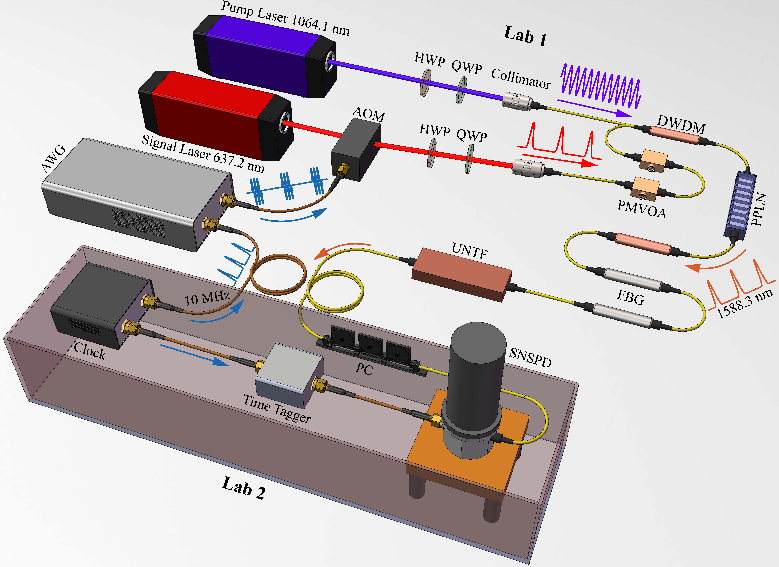
Figure 1: Diagram of the fully fiber-integrated QFC system, showing pulsed signal preparation, frequency mixing, hybrid filtering, and routed detection.
The entire frequency conversion module is fiber-coupled, providing alignment-free operation and compatibility with field deployment, unlike most free-space QFC architectures.
Conversion Efficiency and Noise Characteristics
Conversion efficiency is measured with both CW and pulsed input, yielding a maximum efficiency of 9% at 1.2 W pump power. This corresponds to an internal waveguide efficiency near 80%, with the primary losses attributed to fiber-waveguide coupling and filtering insertion loss. The system maintains low pump-induced noise (154 Hz at 1.2 W), credited to the hybrid filtering module, with noise further suppressed by temporal gating in photon detection.
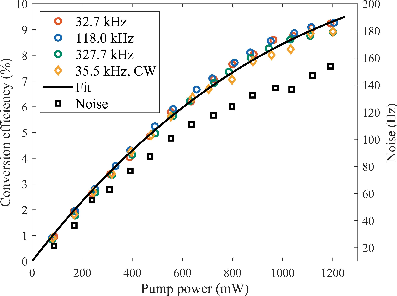
Figure 2: Conversion efficiency and noise as functions of pump power, exhibiting optimal fidelity-performance trade-offs at moderate pump levels.
The SNR is reported across typical photon count rates for NV center emission (32.7, 118.0, and 327.7~kHz), achieving values of $12.3$, 1588 nm0, and 1588 nm1, respectively, at 1588 nm2. At this emission rate, the SNR is improved by 1588 nm3 over prior pioneering NV center QFC systems.
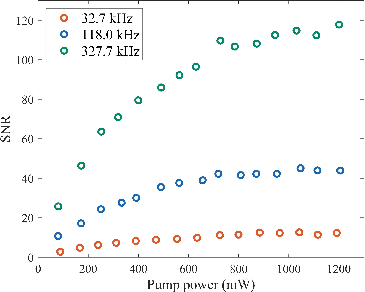
Figure 3: SNR as a function of pump power for several photon count rates, highlighting the critical dependence of performance on source brightness.
The SNR initially increases with pump power due to enhanced conversion, but noise growth at higher powers eventually dominates, reducing SNR beyond optimal points.
Entanglement Fidelity over Long-Distance Fibers
Theoretical modeling is employed to relate SNR to spin-photon entanglement fidelity for NV centers transmitting over optical fibers. The fidelity model incorporates conversion efficiency, detection efficiency, fiber losses, and detector dark counts, yielding:
1588 nm4
Simulations indicate that, at the NV emission rate (1588 nm5), the expected entanglement fidelity remains above 1588 nm6 after 1588 nm7 transmission. This represents a substantial fidelity enhancement relative to previous systems, which achieve only 1588 nm8 under the same conditions due to lower SNR.
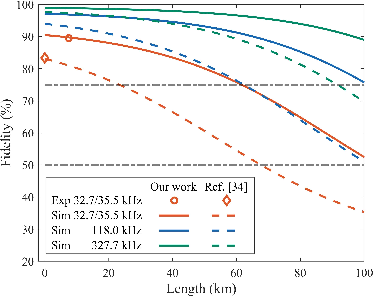
Figure 4: Simulated entanglement fidelity versus fiber length, comparing the present system (solid lines) with historical results (dashed lines) and demonstrating superior long-distance performance.
Higher input count rates from NV centers further elevate achievable fidelities: 1588 nm9 at 637.2 nm0 for 637.2 nm1 and 637.2 nm2 for 637.2 nm3, reinforcing the importance of source optimization for network scalability.
Practical Implications and Future Prospects
This fiber-integrated QFC platform enables robust, alignment-free quantum networking compatible with existing telecom fiber infrastructure. Compared to free-space systems, the architecture dramatically reduces footprint and operational complexity, facilitating deployment for entanglement distribution, quantum key distribution, and quantum repeater protocols over metropolitan and intercity links.
Theoretical simulations underscore the critical interplay between SNR, conversion efficiency, and source brightness for sustaining high-fidelity entanglement at scale. Enhancing the ZPL photon flux from NV centers—via Purcell enhancement or improved photon collection—offers a direct path to higher long-distance fidelities.
Areas for further refinement include:
- Increasing fiber-to-waveguide coupling efficiency (currently 637.2 nm4, with integrated spot-size converters or mode-matching optics likely to yield considerable gains).
- Improving photon collection efficiency by cavity integration or optimized micro-optical interfacing.
- Reducing the insertion loss in filtering modules by leveraging advanced fiber Bragg grating technologies and light-guiding designs.
Such advancements would further boost system performance, enabling networked quantum processors and sensors with high-fidelity photonic links over hundreds of kilometers.
Conclusion
The work presents a compact, fully fiber-integrated QFC system with strong conversion efficiency, low noise, and substantially improved SNR, yielding enhanced entanglement fidelity for NV center-based quantum networking over long-distance optical fibers. The practical, robust design and accompanying theoretical analysis demonstrate the platform’s clear suitability for scalable quantum internet deployment, with future improvements expected from photonic source and interface optimization.