- The paper establishes that the integrated left-right transmission asymmetry saturates to a plateau at Cħω, directly linking it to the bulk winding number independent of boundary details.
- It employs numerical simulations, analytic derivations, and experimental proposals—including cold atom spectroscopy and SAW-driven nanowire devices—to validate the theoretical prediction.
- The work introduces a deep-bulk branch-population principle that underpins the robustness of transmission asymmetry, offering a practical diagnostic for topological properties in driven systems.
Boundary-Robust Transmission Asymmetry in Open Floquet Lattices
Introduction
The paper "Boundary-Robust Transmission Asymmetry as a Topological Signature in Open Floquet Lattices" (2604.23420) addresses the critical question of whether Floquet band topology, specifically winding invariants, manifests in open-system transport observables robustly against boundary details. Periodically driven systems enable topological phenomena beyond static analogs, notably quantized pumping and bulk winding invariants. In practice, experimental probes invariably involve open geometries—finite driven regions interfacing with asymptotic leads. The work rigorously demonstrates that although boundaries can strongly reshape pointwise transmission profiles (e.g., via sideband mixing or Fabry-Perot oscillations), the integrated left-right transmission asymmetry exhibits boundary robustness, saturating to a plateau dictated solely by the bulk winding number. The physical origin and implications of this robustness are analyzed via a newly formalized deep-bulk branch-population principle and supported by numerical, analytic, and experimental proposals.
Smoothed Transmission and Boundary Sensitivity
In finite Floquet lattices, incident energy-resolved transmission spectra TL/R(E;L) exhibit dense Fabry-Perot oscillations, highly sensitive to both sample length and boundary profile, and are thus unsuitable for extracting stable bulk features.
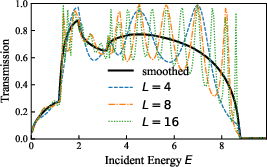
Figure 1: Construction of the smoothed transmission spectrum; raw transmission curves show strong Fabry-Perot interference, while local energy smoothing yields stable spectral curves in the L→∞ limit.
To extract robust information, transmission is smoothed over energy windows shrinking asymptotically with increasing sample length, yielding observables TˉL/R(E0). In the adiabatic limit (smooth boundary interpolation), these smoothed windows align directly with the bulk Floquet band structure, and the width difference of left- versus right-incident transmission windows is strictly Cℏω, with C the band winding number.
Boundary Robustness of Integrated Asymmetry
Crucially, when boundaries deviate from adiabaticity, the fine structure of TˉL/R(E) can be arbitrarily distorted, yet the integrated spectral asymmetry
A(E0)=∫0E0dE[TˉL(E)−TˉR(E)]
remains invariant, saturating to a plateau at Cℏω. This plateau persists for a broad window even under strong nonadiabatic boundary scattering.
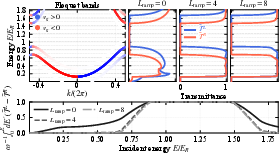
Figure 2: Boundary robustness of the integrated spectral asymmetry; varying boundary ramp length distorts smoothed transmission spectra, but the integrated asymmetry plateau remains fixed.
This result demonstrates that the topological invariant is encoded in the cumulative transmission imbalance—not in any boundary-sensitive features of TˉL/R(E).
Deep-Bulk Branch-Population Principle
The origin of this robustness is formalized via the deep-bulk branch-population principle. In the long-sample limit, a propagating Floquet-Bloch branch deep inside the lattice is generically populated with unit weight under incoming excitation, as true Floquet bound states require overdetermined and nongeneric matching conditions, occupying measure zero in parameter space.
For incident window isolating a target band, the integrated asymmetry
AInc≈∫0ℏωdϵμ∈Btar∑sgn(vμ)
counts the net chirality, i.e., the winding number L→∞0, thereby locking the plateau height to the topological invariant, regardless of microscopic boundary configuration.
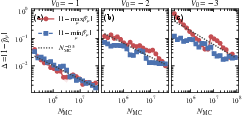
Figure 3: Monte Carlo convergence of branch populations; extremal deviations from unity decay as L→∞1, confirming generic openness and L→∞2 for all branches in representative open geometries.
Experimental Proposals: Cold Atom and SAW Devices
Direct cold-atom transmission spectroscopy is proposed, wherein a quasi-1D atomic waveguide coupled to a moving optical lattice realizes an open Floquet band structure, with the natural laser waist providing an adiabatic boundary. Measuring transmission in both propagation directions enables extraction of the integrated asymmetry plateau.
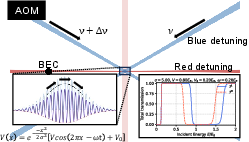
Figure 4: Schematic of the cold-atom Bragg-scattering setup; propagation through a BEC waveguide and tunable lattice enables direct measurement of the boundary-robust transmission asymmetry.
For electronic transport, boundary-robust asymmetry translates into a zero-bias dc current dependent on the chosen contact model for electron injection and extraction. Within a coherent Floquet-Landauer-Büttiker framework, the response is a near-L→∞3 plateau in weak-field surface acoustic wave (SAW) devices—distinct from strong-field single-electron pumping regimes.
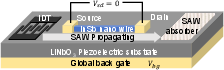
Figure 5: Schematic of a SAW-driven nanowire device; measuring zero-bias transport current realizes an electrical readout of the integrated spectral asymmetry.
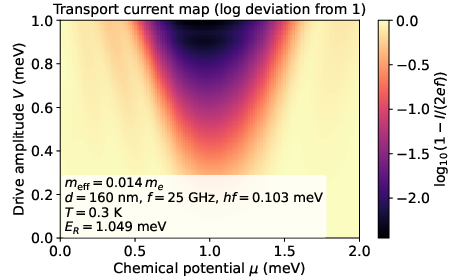
Figure 6: Zero-bias current profile versus SAW strength and chemical potential; hard-wall boundaries yield conservative estimates, with a near-L→∞4 plateau over wide regimes.
Alternatively, post-processing within a blocking-factor prescription yields qualitatively different temperature dependence and signal suppression, offering experimentally distinguishable predictions.
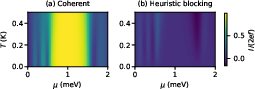
Figure 7: Comparison of transport predictions using coherent vs. blocking-factor prescriptions; near-L→∞5 plateau in the coherent model, but suppressed and strongly temperature-dependent response in the blocking-factor model for identical sideband-resolved transmission data.
Theoretical and Practical Implications
The central theoretical implication is the identification of the integrated transmission asymmetry as the boundary-robust topological observable in open Floquet systems. Unlike edge-state physics, the topological protection arises from deep-bulk branch population and generic openness, a feature grounded in scattering theory for time-periodic Hamiltonians and not sensitive to boundary conditions for propagating bands. Practically, this reframes the experimental focus from detailed transmission lineshapes to cumulative imbalances as diagnostics of bulk topology; boundary engineering is no longer restrictive for topological detection.
Future developments may extend this paradigm to higher-dimensional periodically driven systems, interacting mechanisms, and engineered probe schemes. The distinction between contact-model-dependent electrical readouts (coherent vs. blocking-factor) highlights the subtleties in mesoscopic transport, motivating further study of microscopic contact modeling in nonequilibrium Floquet settings.
Conclusion
The paper establishes that open Floquet lattices possess a boundary-robust transmission asymmetry whose plateau height is fixed solely by the bulk winding number, providing a universal topological signature accessible via integrated transport observables. Cold atom spectroscopy and SAW-driven nanowire transport experiments offer practical routes for detection. The robust observable is the cumulative left-right transmission imbalance, not the boundary-sensitive lineshape. This work clarifies and quantifies the transmission manifestation of Floquet band topology in open systems and motivates future exploration of its implications in both fundamental and applied contexts.

